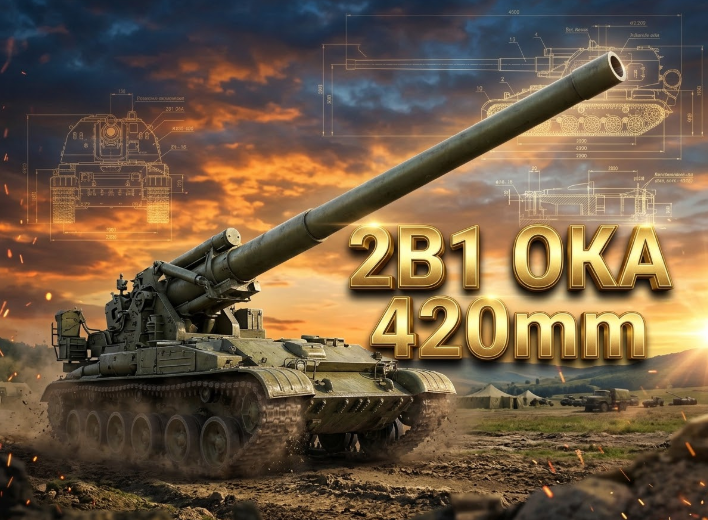
2B1 Oka (420mm): The Soviet Union’s 20-Meter Atomic Super-Mortar
In November 1957, a tracked giant rolled across Moscow’s Red Square and stunned Western intelligence officers. Its smoothbore barrel stretched more than twenty meters into the winter sky. Soviet engineers named this experimental atomic mortar the 2B1 Oka, and they designed it to hurl 420-millimeter nuclear shells deep behind NATO lines.
However, raw firepower alone could not defeat the laws of physics. Violent firing shock, slow reload cycles, and severe transport limits doomed the system within three years. Today, this complete dossier from WW2 Visual Archive unpacks its Cold War origins, mechanical anatomy, nuclear munitions, 1957 parade deception, and our 4K/60fps archival film restoration.
 Featured 4K Restoration
0:09
Oka Heavy Artillery Super-Gun Barrel Tank — AI Enhanced
Watch two 420mm 2B1 Oka nuclear mortars rumble past Soviet parade crowds in stabilized, color-graded 4K motion. Notice the full-width front cab and towering 20-meter tube.
01. Cold War Origins: Why the Soviet Union Built Nuclear Artillery
The Shock of America’s M65 Atomic Annie in 1953
The story of the 2B1 Oka begins in the Nevada desert on May 25, 1953. On that morning, the United States Army conducted Operation Upshot–Knothole Grable at Area 5 of the Nevada Test Site. A massive 280mm M65 atomic cannon, nicknamed Atomic Annie, fired a live W9 nuclear shell seven miles downrange. Nineteen seconds later, the 15-kiloton warhead detonated 160 meters above Frenchman Flat.
Consequently, that single blast transformed European land warfare overnight. Earlier nuclear weapons required strategic bombers flying through dense air defenses. By contrast, artillery shells could strike in any weather, day or night, without risking expensive aircraft. Furthermore, the United States soon deployed twenty M65 cannons to West Germany, South Korea, and Okinawa.
Moscow viewed this American breakthrough with immediate alarm. Soviet military planners relied on massive armored divisions to overwhelm NATO defenses in Central Europe. Suddenly, a single American artillery battery could vaporize an entire staging area or river crossing. Therefore, Soviet leadership demanded an urgent counterweight capable of delivering tactical nuclear warheads from the ground.
The 1954 Soviet Nuclear Artillery Directive
In 1954, the Soviet Union launched an ambitious crash program to build indigenous nuclear artillery, as documented in historical records of the 2B1 Oka development program. However, Soviet nuclear physicists faced a serious miniaturization hurdle during the mid-1950s. Early Soviet fission warheads remained bulky, heavy, and sensitive to extreme firing acceleration.
As a result, Soviet engineers could not fit an atomic warhead inside a standard 152mm or 203mm artillery shell. Instead, they had to build colossal gun barrels exceeding 400 millimeters in diameter. While the American M65 relied on two separate wheeled tractor trucks for transport, Soviet doctrine demanded self-propelled tracked mobility.
Therefore, designers turned to the heaviest proven armored platform in the Red Army inventory: the T-10 heavy tank chassis. By mounting super-heavy barrels onto tracked hulls, the Soviet Army hoped to cross muddy terrain, fire a devastating atomic round, and relocate before enemy counter-battery fire arrived.
Three Competing Cold War Titans on T-10 Hulls
To hedge against technical failure, the Soviet defense ministry funded three parallel self-propelled nuclear gun projects on modified T-10 chassis. Each bureau pursued a distinct ballistic philosophy to solve the brutal physics of nuclear shell delivery.
- 2A3 Kondensator 2P (406mm Gun): Built around Vasily Grabin’s SM-54 rifled cannon on the Object 271 chassis, this 406mm self-propelled howitzer drew inspiration from pre-war Soviet battleship ordnance.
- 2B1 Oka (420mm Mortar): Engineered as the SM-58 smoothbore mortar on the Object 273 hull, the Oka used lower chamber pressures and high-angle trajectories to protect its delicate atomic payload.
- S-103 (420mm Recoilless Rifle): A radical recoilless concept designed to vent propellant gases rearward. However, engineers abandoned the S-103 in November 1956 after its barrel catastrophically burst during the 93rd test firing.
Ultimately, only the 2A3 Kondensator and the 2B1 Oka reached the prototype stage in 1957. Both machines represented the absolute physical extreme of tracked gun artillery, echoing the colossal siege weapons examined across our complete archive of superweapons and heavy ordnance.

02. Engineering Anatomy: The SM-58 Mortar & Object 273 Chassis
Barrikady Plant Meets Leningrad’s Kirov Works
Building a mobile 420mm nuclear mortar required two of the Soviet Union’s most famous industrial powerhouses. First, the Barrikady Plant in Stalingrad designed and manufactured the monstrous SM-58 ordnance system. Barrikady had decades of experience forging super-heavy naval and siege guns for the Red Army.
Meanwhile, the legendary Kirov Plant (LKZ) in Leningrad engineered the tracked carriage, designated Object 273. Because Soviet industry favored standardization, Kirov engineers adapted proven suspension, transmission, and drivetrain parts from the T-10M heavy tank. Four complete prototypes rolled off the Kirov assembly floor in 1957.
Together, the barrel and hull created a surreal silhouette. The complete combat vehicle weighed 55.3 metric tons (61.0 short tons), measured 3.08 meters wide, and stood 5.73 meters tall with its gun elevated. Even today, its proportions dwarf modern main battle tanks.
The 20.02-Meter Smoothbore Barrel
No feature of the 2B1 Oka captures the eye faster than its staggering 20.02-meter (65.7-foot) smoothbore barrel. Unlike traditional mortars that drop shells down the muzzle, the Oka loaded its projectiles through a heavy side-opening breech at the rear. Furthermore, the untapered steel tube carried no muzzle brake.
Why did engineers make the barrel over sixty-five feet long? The answer lies in nuclear survival physics. A low-pressure smoothbore mortar needed an exceptionally long acceleration path to push a 650-kilogram atomic mine to safe standoff distances. Without that massive barrel length, the Oka crew risked sitting inside the blast and fallout radius of their own detonation.
Moreover, smoothbore geometry reduced friction and rotational stress on early nuclear warhead electronics. Because the barrel lacked rifling grooves, the projectile relied on tail fins or aerodynamic stabilization rather than high-speed spin to hold its flight path.

Cab Layout, Suspension Locks, and Diesel Power
At first glance, the Object 273 hull looks almost identical to the 2A3 Kondensator’s Object 271 chassis. However, a closer look at the front superstructure reveals an unmistakable difference. While the Kondensator used a narrow tandem cab perched over the right front track guard, the 2B1 Oka featured a wide, full-width armored cab across the entire front deck.
Beneath the hull, Kirov engineers installed eight pairs of double-tired road wheels with reinforced torsion bars and heavy-duty suspension locks. Before firing, the crew locked the suspension solid so the tracks would not bounce uncontrollably under the downward blast. A front drive sprocket and rear idler guided the wide steel tracks.
Power came from a modified V12-6B diesel engine paired with an eight-speed planetary transmission. Sources vary slightly on rated output, with technical archives citing 750 kW (1,010 hp) for the upgraded powerplant and Military Factory listing 700 horsepower on baseline units. Either way, the 55.3-ton giant topped out at 30 km/h (19 mph) on paved roads with an operational range of 200 to 220 kilometers.
03. 420mm Transformator Atomic Munitions & Firing Cadence
Adapting the RDS-9 Nuclear Torpedo Warhead
An artillery piece is only as effective as its ammunition. For the 2B1 Oka, Soviet weapons scientists adapted the compact nuclear core originally built for the Navy’s RDS-9 atomic torpedo. According to historian Steven J. Zaloga, engineers developed two distinct tactical nuclear rounds under the codename Transformator: the Transformator-AR and the Transformator-D.
These colossal artillery mines measured 420 millimeters (16.5 inches) across—wider than the main battery shells of American Iowa-class battleships. Standard nuclear rounds weighed roughly 650 kilograms (1,430 pounds) and achieved a maximum firing range of 25 kilometers (16 miles). In addition, military historians James Kinnear and Stephen Sewell note later reports claiming rocket-assisted or heavy 750-kilogram (1,650-pound) projectiles could stretch the Oka’s reach to 45 kilometers (28 miles).
Because the Oka carried zero onboard ammunition storage, every deployment required a dedicated heavy transport truck equipped with cranes and climate-controlled warhead cradles. Consequently, the mortar could never operate as an independent lone wolf on the battlefield.
The Five-Minute Reload Cycle
Loading a 650-to-750-kilogram nuclear shell into a 420mm side-opening breech demanded painstaking teamwork. The seven-man crew (one driver plus six artillery specialists) relied on mechanized hoists, trays, and power rammers to seat the massive round safely. Any slip or misalignment risked damaging the delicate nuclear fuzing assembly.
As a result, the Oka’s practical rate of fire crawled at just one round every five minutes—or roughly twelve shots per hour under ideal proving-ground conditions. Some field reports even documented intervals stretching past ten minutes when crews inspected the breech seals and elevation gears between shots.
However, Soviet tactical planners initially shrugged off this glacial firing tempo. In a tactical nuclear exchange, a single 420mm atomic detonation would obliterate a fortified headquarters, rail junction, or bridgehead instantly. Therefore, commanders reasoned that the Oka would rarely need to fire a second round from the same firing position.
Support Convoys, Nuclear Security, and Battlefield Exposure
Operating a 420mm atomic mortar demanded far more than seven gunners. In real wartime service, every Oka battery required a sprawling support column. Specialized crane vehicles hoisted each 650-kilogram Transformator shell from insulated transport vans, while nuclear security detachments guarded the warhead arming keys around the clock.
Furthermore, the Oka lacked any overhead armor, night-vision optics, or chemical-biological-radiological-nuclear (CBRN) cabin filtration. During loading and aiming, the six artillerymen stood completely exposed atop the rear deck. If NATO reconnaissance aircraft spotted the 20-meter barrel and called in a strike, even light fragmentation bombs could disable the crew and turn a priceless nuclear launcher into scrap metal.


04. Recoil Physics & Field Trial Breakdowns
When the Entire Tank Becomes the Shock Absorber
Traditional heavy artillery uses massive hydro-pneumatic cylinders to absorb recoil energy smoothly over a long travel stroke. On the 2B1 Oka, however, designers omitted conventional recoil-absorbing cylinders altogether. Instead, the hull, suspension locks, and earth beneath the tracks acted directly as the kickback dampener, as detailed in historical analyses of the Oka’s firing trials.
Because the Oka fired at high mortar elevations, most of the firing force drove straight downward into the ground rather than horizontally backward. By comparison, the sibling 2A3 Kondensator fired at flatter howitzer angles, which violently hurled the 64-ton Kondensator several meters backward on every shot and tore gearboxes apart.
Even so, the Oka did not escape the brutal mathematics of Newton’s Third Law. Launching a 650-kilogram projectile out of a 20-meter barrel sent a bone-crushing shockwave straight through the trunnions and into the Object 273 hull. Despite reinforced torsion bars and heavy shock absorbers, repeated test firings cracked structural welds, battered road-wheel bearings, and jarred drivetrain alignments out of tolerance.
The Nightmare of Bridges, Railroads, and Mud
Mechanical shock during firing was only half the problem. Moving the 2B1 Oka across the Soviet Union proved nearly impossible under real wartime conditions. First, the vehicle’s 3.08-meter width and extreme 55.3-ton weight exceeded the load ratings of countless rural wooden and steel bridges across Eastern Europe.
Second, the 20-meter barrel created an absurd logistical bottleneck. Navigating tight urban corners, forest trails, or mountain switchbacks risked slamming the overhanging barrel into buildings, utility poles, or embankments. Moreover, loading the Oka onto standard Soviet railway flatcars required partial disassembly or specialized out-of-gauge clearances, defeating the entire promise of rapid self-propelled deployment.
Third, off-road mobility suffered badly. Although the V12 diesel engine pushed the chassis along flat asphalt at 30 km/h, soft mud or snow quickly bogged down the nose-heavy giant. Engineers struggled for three years to reinforce the running gear, yet every extra ton of bracing only worsened ground pressure and mechanical wear.
Aiming Limits and Structural Fatigue Under Repeated Tests
Another persistent headache involved horizontal aiming. Because the 420mm barrel mounted on a fixed central cradle with minimal traverse, the driver had to pivot the entire 55.3-ton hull on its tracks just to shift fire toward a new bearing. Grinding wide steel tracks across gravel or frozen soil chewed through final-drive gears and track pins at an alarming rate.
Meanwhile, firing on soft ground caused the rear hull to sink unevenly into the mud after a single shot. Consequently, crews had to re-level the entire vehicle and re-verify ballistic sights before attempting a follow-up round. Each test campaign confirmed the same harsh verdict: the chassis simply could not endure prolonged field operations.
05. The 1957 Red Square Parade: Psychological Deterrence on Display
November 7, 1957: Cold War Theater in Moscow
Although proving-ground tests exposed deep structural defects, the Kremlin saw immediate strategic value in the four completed prototypes. On November 7, 1957, the Soviet Union celebrated the 40th anniversary of the October Revolution with a monumental military parade across Moscow’s Red Square. Alongside the 2A3 Kondensator, the 2B1 Oka rumbled past Lenin’s Mausoleum in full view of international journalists and NATO military attachés.
The visual impact was electric. Spectators stared in disbelief as the 20-meter olive-drab tubes glided across the cobblestones like steel tree trunks mounted on tank hulls. Soviet commanders carefully concealed the vehicle’s firing fractures and gearbox failures behind strict state secrecy.
Furthermore, the parade coincided with the Sputnik space launch just one month earlier. Together, Sputnik and the atomic superguns projected an aura of unstoppable Soviet technological power. In the high-stakes psychology of 1957, perception mattered almost as much as battlefield reliability.
Why Western Analysts Thought It Was a Sham
Foreign correspondents and Western defense experts scrambled to analyze the blurry newsreel frames from Moscow. Ironically, several Western journalists initially dismissed the 2B1 Oka and 2A3 Kondensator as elaborate propaganda mockups. They argued that no tracked chassis could possibly survive the recoil of a 420mm cannon with a 65-foot barrel.
In a strange twist of Cold War history, those skeptical analysts were both wrong and right. The vehicles rolling through Red Square were 100 percent real steel prototypes that had genuinely fired test shells. However, the Western intuition about physics proved completely accurate—the superguns truly were too massive and fragile for practical frontline service.
Intelligence Fallout Across NATO Capitals
Even while debating whether the barrels were real or hollow sheet metal, Western intelligence agencies could not afford to gamble. NATO planners immediately reassessed Warsaw Pact tactical nuclear capabilities across Central Europe. If the Red Army truly possessed self-propelled 420mm atomic mortars, fixed defensive fortifications along the Fulda Gap looked suddenly vulnerable.
Therefore, the 1957 Red Square appearance accomplished its psychological mission brilliantly. Four flawed experimental vehicles forced Western analysts to spend years tracking Phantom nuclear artillery divisions—buying Soviet rocket bureaus precious time to perfect the far deadlier tactical missiles waiting in the wings.

06. Supergun Showdown: 2B1 Oka vs. Cold War & WWII Giants
To understand just how extreme the 2B1 Oka truly was, historians compare it against three iconic peers: its Soviet twin, the 2A3 Kondensator 2P; its American catalyst, the M65 Atomic Annie; and World War II’s ultimate railway monster, Schwerer Gustav (explored in depth inside our Complete Record superweapons dossiers). Use the interactive comparator below to pit the Oka directly against each rival.
Full Technical Comparison Matrix
| Specification | 2B1 Oka (USSR) | 2A3 Kondensator 2P (USSR) | M65 Atomic Annie (USA) | Schwerer Gustav (Germany) |
|---|---|---|---|---|
| Year Unveiled | 1957 (4 built) | 1956–1957 (4 built) | 1953 (20 built) | 1941–1942 (2 built) |
| Caliber & Bore | 420 mm smoothbore mortar | 406 mm rifled howitzer | 280 mm rifled cannon | 800 mm rifled railway gun |
| Barrel Length | 20.02 m (65.7 ft) | ~20.0 m (65.6 ft) | 12.2 m (40.2 ft) | 32.48 m (106.6 ft) |
| Combat Weight | 55.3 metric tons | 64.0 metric tons | 75.6 metric tons (83.3 short tons) | 1,350 metric tons |
| Shell Weight | 650–750 kg | 570 kg | 272 kg (600 lb) | 4,800–7,100 kg |
| Maximum Range | 25–45 km | 25.6 km | 11–32 km (7–20 mi) | 38–47 km |
| Nuclear Capability | Yes (Transformator / RDS-9) | Yes (RDS-series atomic shell) | Yes (W9 15-kt live fired) | No (Conventional HE & AP) |
| Mobility Platform | Self-propelled T-10M hull | Self-propelled T-10M hull | Dual wheeled prime movers | Twin parallel railway tracks |
Key Engineering Trade-Offs Revealed by the Data
Comparing these four titans highlights why the 2B1 Oka occupied a fascinating middle ground. On one hand, the Oka weighed nearly twenty tons less than America’s towed M65 Atomic Annie while firing a projectile more than twice as heavy. On the other hand, the American M65 actually fired a live nuclear detonation in 1953 and served operationally in Europe and Korea for a decade.
Meanwhile, comparing the Oka to World War II’s Schwerer Gustav shows how far metallurgy and propulsion had evolved in just fifteen years. Gustav required 250 men three days to assemble and needed twin railroad tracks to move. By contrast, a single driver could roll the 55.3-ton Oka down Moscow’s streets under its own diesel power—yet even that leap could not save tube artillery from the missile revolution.

07. Cancellation in 1960: How Missiles Ended the Supergun Era
Nikita Khrushchev’s Missile Revolution
By 1960, political winds inside the Kremlin shifted decisively against Stalin-era super-heavy armor and monstrous artillery. Soviet Premier Nikita Khrushchev championed rockets and ballistic missiles as the future of modern warfare. He openly criticized heavy tanks, battleships, and giant cannons as expensive relics of the past.
At the exact same time, Soviet missile design bureaus delivered compact, mobile tactical rockets that outperformed the 2B1 Oka in almost every category. Systems like the 2K1 Mars and 2K6 Luna (known in the West as FROG unguided nuclear rockets) mounted cleanly onto lighter amphibious or tank chassis without any crushing recoil forces.
Furthermore, liquid-fueled tactical ballistic missiles such as the R-11 Zemlya and R-17 Elbrus (NATO codename Scud) offered dramatically longer ranges—reaching hundreds of kilometers rather than a mere twenty-five. A missile launcher did not need a 20-meter steel barrel, reinforced suspension locks, or five-minute mechanical breech hoists.
Why Missiles Won the Cost and Survivability Equation
When Soviet defense economists compared the 2B1 Oka against emerging rocket launchers, the numbers sealed the mortar’s fate immediately. Forging a single 20-meter 420mm smoothbore barrel required rare industrial lathes, precision heat-treating ovens, and massive allotments of high-grade alloy steel. Moreover, barrel wear and chassis repairs drove maintenance costs sky-high after only a few dozen test shots.
By contrast, a tactical rocket carried its own propulsion motor away from the launch rail. Because launch gases vented harmlessly into open air, a lightweight tracked vehicle could fire a nuclear warhead, lower its rail, and vanish into forest cover within minutes. Consequently, missiles delivered superior range, lower weight, cheaper production, and vastly higher crew survivability.
The Council of Ministers Order & Final Retirement
Faced with mounting repair bills, unresolved chassis fatigue, and vastly superior missile alternatives, the Soviet Council of Ministers pulled the plug in 1960. Both the 2B1 Oka and the 2A3 Kondensator were officially cancelled before entering regular frontline combat service.
Similarly, the United States reached the exact same conclusion across the Atlantic. By 1963, the U.S. Army retired the M65 Atomic Annie in favor of Honest John tactical rockets and miniaturized nuclear shells (the W48 and W33) that fired from standard 155mm and 203mm howitzers. Thus, the brief, flamboyant era of dedicated atomic superguns came to a permanent close on both sides of the Iron Curtain.
In later decades, Soviet deterrence migrated from giant tracked guns to mobile missile launchers and massive ballistic missile submarines—a strategic evolution you can trace further in our Typhoon-class nuclear submarine dossier.
08. The Last Survivor in Saint Petersburg
Preserved at Aleksandrovsky Park
Although the Soviet Union built only four 2B1 Oka prototypes in 1957, military history enthusiasts can still stand directly beneath its towering barrel today. One complete vehicle survives on permanent outdoor display at the Military-Historical Museum of Artillery, Engineer and Signal Corps in Saint Petersburg, Russia, located at Aleksandrovsky Park right across from the Peter and Paul Fortress.
Visitors walking through the museum courtyard immediately spot the Oka’s unmistakable profile rising above nearby Cold War missile launchers and World War II howitzers. Curators thoughtfully positioned a deactivated 420mm artillery mine directly beside the hull so guests can appreciate the sheer physical bulk of its ammunition.
Meanwhile, one surviving 2A3 Kondensator 2P rests on display at the Central Armed Forces Museum in Moscow. Together, these two museum relics preserve a fleeting moment when Cold War engineers pushed conventional gunsmithing to the absolute edge of mechanical endurance.
What Museum Inspection Reveals About Cold War Craftsmanship
Standing beside the Saint Petersburg survivor exposes engineering details that grainy 1957 newsreels completely hid. Thick weld seams along the Object 273 glacis plate show the rush to reinforce a tank hull never designed for 420mm mortar shock. Likewise, the massive elevation gears and side-hinged breech assembly resemble naval battleship turret machinery bolted straight onto land armor.
Even today, historians and scale modelers study this single survivor to verify authentic dimensions, bolt patterns, and paint tones. Without Saint Petersburg’s preservation effort, the 2B1 Oka might have vanished entirely into classified Soviet blueprints and faded black-and-white parade reels.

09. Inside Our 4K/60fps Archival Restoration of the 2B1 Oka
Why Historic 1957 Newsreels Needed Frame-by-Frame Rebuilding
Surviving 1950s Soviet parade newsreels of the 2B1 Oka suffer from heavy archival decay. Original 35mm monochrome prints show severe film grain, jerky low frame rates, vertical scratches, and blown-out highlights against Moscow’s overcast November skies. Because the footage lacked color and crisp edge detail, modern viewers often struggled to grasp the true scale of the 20-meter barrel and wet asphalt reflections.
At the WW2 Visual Archive Restoration Lab, our mission is to transform degraded monochrome clips into lifelike, museum-grade historical windows. Every single frame of our Oka Heavy Artillery Super-Gun restoration passes through a disciplined four-stage enhancement workflow guided strictly by archival paint and uniform references.
Optical Stabilization & De-Flicker
We lock shaky hand-cranked camera pans, remove film gate weave, and eliminate luminance flicker across the parade sequence before touching resolution.
4K Neural Detail Recovery
AI-assisted upscaling sharpens rivets, T-10M road wheels, track links, Soviet greatcoats, and ornate neoclassical facades without inventing fake geometry.
4BO Olive-Drab Color Grading
Colorists calibrate authentic Soviet 4BO armor green, crimson parade banners, damp cobblestone reflections, and crisp autumn sky tones.
60fps Motion & Acoustic Foley
Optical-flow interpolation smooths movement to 60fps, paired with layered V12 diesel rumble, heavy steel track clatter, and ambient crowd acoustics.
Historical Color Calibration and Environmental Realism
Colorizing Soviet Cold War hardware requires strict discipline rather than guesswork. During the late 1950s, parade vehicles from the Leningrad Kirov Plant carried fresh coats of matte-to-satin 4BO olive-drab protective green, accented by crisp white parade trim along road-wheel rims. Meanwhile, surrounding spectators wore heavy wool greatcoats in charcoal, muted brown, and dark slate under overcast autumn light.
By anchoring our color palette to surviving museum paint chips and natural wet-pavement specular reflections, the restored sequence restores genuine depth and weight. Suddenly, viewers feel the damp chill of November 1957 and appreciate just how surreal two 65-foot smoothbore barrels looked gliding past neoclassical facades.
High-Definition Stills from Our YouTube Restoration Archive
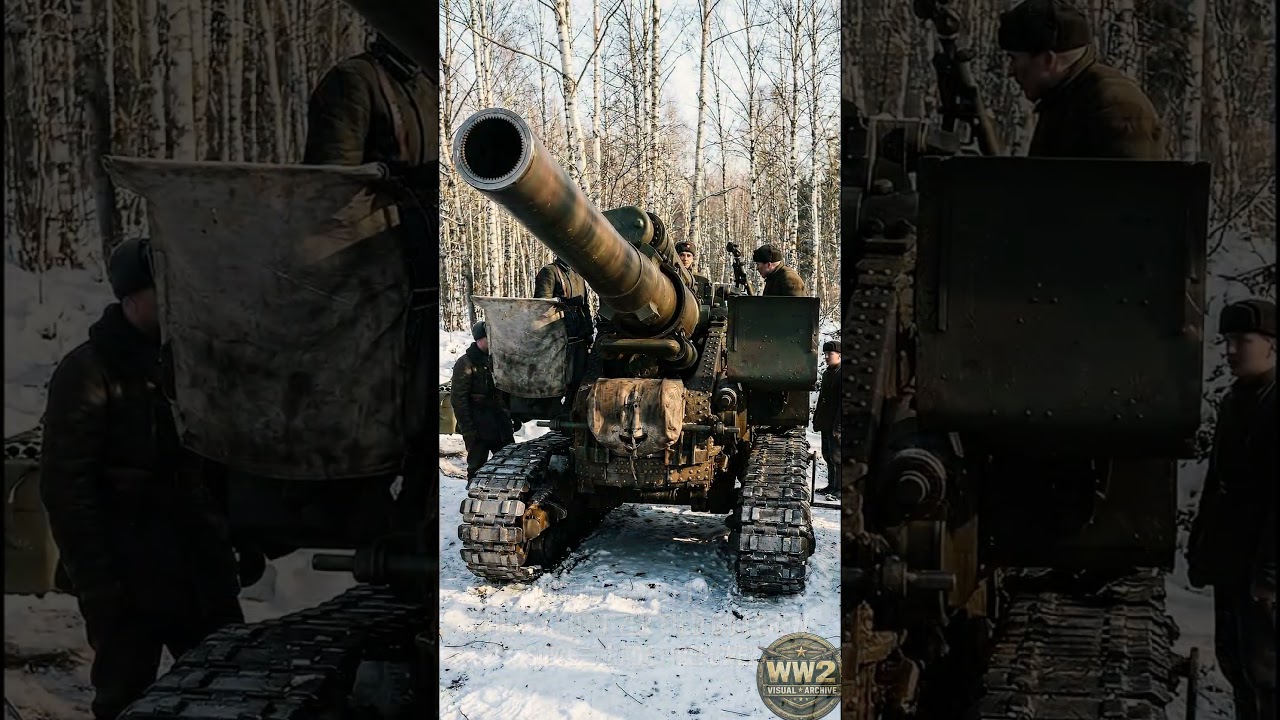
Below are high-definition thumbnails captured directly from our @WW2VisualArchive YouTube channel. Each frame highlights how accurate color grading and neural upscaling reveal mechanical details—from the Oka’s massive elevation trunnions to the tracked carriages of its Soviet and German artillery predecessors.


10. Related Heavy Artillery Restorations from Our Channel
The 2B1 Oka did not emerge in a vacuum. Instead, it stood at the climax of a twenty-year arms race in super-heavy siege guns, assault howitzers, and railway cannons. Tap any card below to play six directly related restorations from our YouTube archive right inside this dossier—engineered with fast click-to-play facades so your page stays lightning quick.
Soviet Heavy Artillery
0:09
Soviet 203mm B-4 — The Biggest Gun in the Frame Near Moscow
Nicknamed “Stalin’s Sledgehammer,” this tracked 203mm siege howitzer proved Soviet engineers could pair giant barrels with crawler treads.
WWII Supergun
0:09
Schwerer Gustav Dora — The Biggest Gun Ever Built
Compare the 55-ton self-propelled Oka against Germany’s 1,350-ton 800mm railway colossus that required twin tracks to deploy.
 Tracked Tank Chassis
0:09
Soviet ISU-152 — 152mm Assault Gun That Smashed Fortified Lines
Built on the IS heavy tank hull—the direct predecessor to the T-10 chassis used by the 2B1 Oka—the ISU-152 mastered heavy self-propelled firepower.
Strategic Ordnance
0:09
Railway Gun — When Artillery Came on Tracks (WW2 in Color)
See how wartime armies moved massive strategic barrels by rail before Cold War engineers attempted tracked self-propelled nuclear mortars.
 Soviet Ordnance Heritage
0:09
The Soviet 85mm 52-K — The Gun That Saved Moscow
Explore the rugged Soviet artillery design school that defended Moscow in 1941 and later evolved into Cold War nuclear ordnance bureaus.
 Western Counterpart
0:09
The American Long Tom — 155mm Field Gun That Changed Artillery
Trace the U.S. Army heavy artillery lineage that led straight from World War II’s Long Tom to the 1953 M65 Atomic Annie.
11. Interactive Cold War Artillery Verification Quiz
Test your technical recall of the Soviet 2B1 Oka and the 1950s atomic artillery race. Select one answer per question to check your score immediately.
1. Which American 1953 nuclear artillery test directly prompted the Soviet Union to launch the 2B1 Oka and 2A3 Kondensator programs?
2. How long was the 420mm smoothbore barrel mounted on the 2B1 Oka?
3. What visual feature instantly distinguishes the 2B1 Oka hull from its sibling, the 2A3 Kondensator 2P?
4. Why did the Soviet Council of Ministers cancel the 2B1 Oka program in 1960?
5. Where is the surviving 2B1 Oka prototype preserved on public display today?
12. Historical References & Archival Sources
Every specification, prototype count, munition designation, and historical milestone in this dossier draws on verified museum records, defense archives, and published Cold War ordnance scholarship. Explore the primary external reference materials below, or continue browsing the full WW2 Visual Archive dossier index.
-
Primary Technical Reference
2B1 Oka — Technical Specifications & Development History
Cites James Kinnear & Stephen Sewell (Soviet T-10 Heavy Tank and Variants, Bloomsbury, 2017) and Steven J. Zaloga (Superguns 1854–1991, Bloomsbury, 2018) on SM-58, Object 273, Transformator-AR/D rounds, and 1960 cancellation. -
Defense Archive
Military Factory — 2B1 Oka Self-Propelled Artillery (SPA)
Detailed structural breakdown covering the Kirov Plant LKZ chassis, eight double-tired road wheels, open gunnery stage, and off-road mobility limits. -
Historical Analysis
War History Online — Soviet “Atomic Annie”: The 2B1 “Oka” Nuclear Mortar
Covers the 1957 October Revolution Red Square parade, foreign press skepticism, side-breech loading, and recoil-dampening trials. -
Sibling Program Reference
Tank Encyclopedia Archives — 2A3 Kondensator 2P & 2B1 Oka
Comparative Cold War Soviet super-heavy artillery archive contrasting Object 271 (Kondensator) with Object 273 (Oka). -
Sibling Technical Record
2A3 Kondensator 2P — 406mm Self-Propelled Howitzer
Documents Grabin Design Bureau’s 406mm counterpart, Artillery High Command reserve service, and Moscow museum preservation. -
U.S. Counterpart Record
M65 Atomic Cannon (“Atomic Annie”) — Specifications & Deployment
Complete technical record of the 280mm U.S. nuclear cannon deployed to West Germany, Korea, and Okinawa from 1955 to 1962. -
Nuclear Test Record
Operation Upshot–Knothole Grable (May 25, 1953)
Historical record of the 15-kiloton W9 nuclear artillery test at the Nevada Test Site that catalyzed Soviet nuclear artillery development. -
Public Domain Photo Archive
Wikimedia Commons — Category: 2B1 Oka (Saint Petersburg Museum)
Verified high-resolution public domain and free-license museum photographs of the surviving 2B1 Oka at the Military-Historical Museum of Artillery.