01 Watch Our Restored 4K Shorts: Skyward Field Rigs
Tap either restored card below to play the 4K clip right inside this page. First, watch Soviet gunners point captured German MG 34 guns toward the sky. Next, inspect a wild ten-pistol Mauser C96 mount built for high-angle air defense.

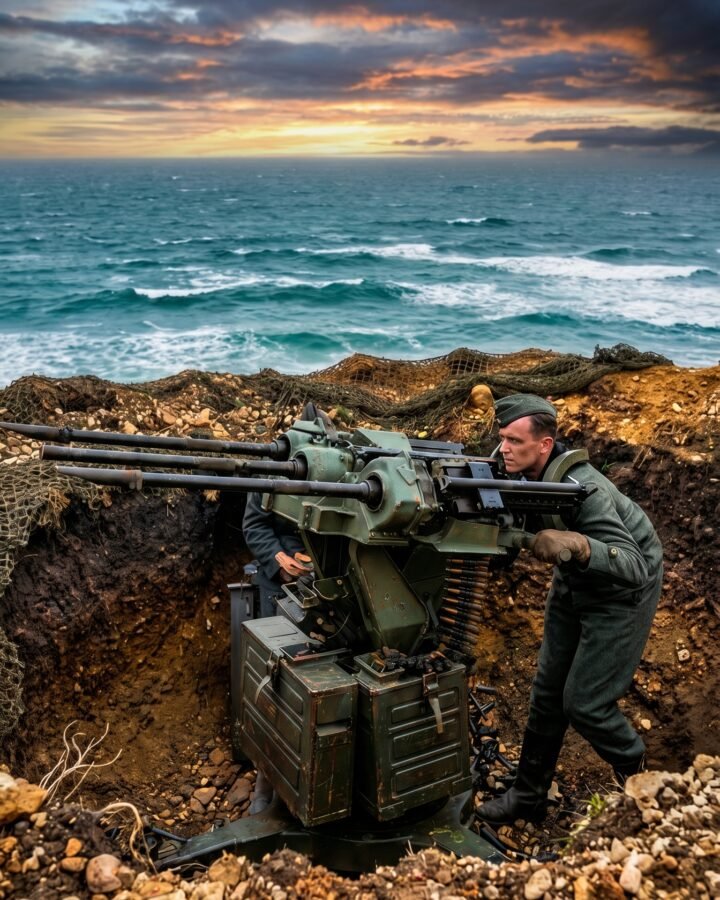
Red Army crews bolted captured German MG 34 guns onto wheeled frames to fire over 3,000 rounds per minute at enemy planes.
- Base Weapon: Captured 7.92mm German MG 34s
- Combined Rate: 3,000+ rounds per minute
- Featured Partner: World of Warships

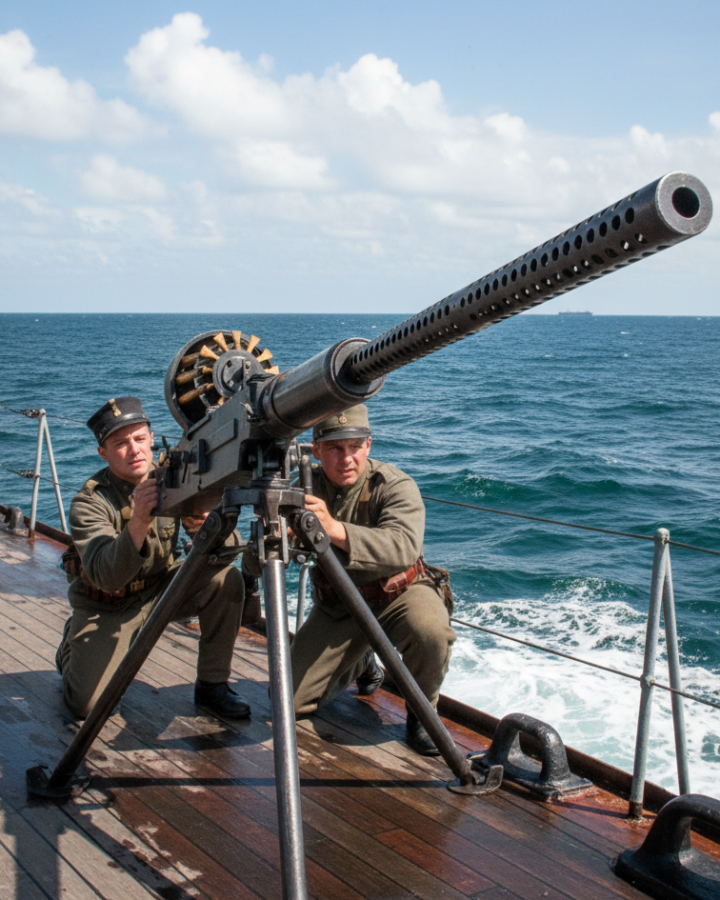
Before true flak guns arrived, gunners linked ten pistols or light infantry guns onto one frame to throw a wall of lead upward.
- Base Weapon: 10 × Mauser C96 Semi-Auto Pistols
- Tactical Role: Early high-angle volley fire
- Featured Partner: World of Warships
02 Why Hard Times Sparked WW2’s Rarest Field Weapons
Most war books focus on sleek planes, big ships, and factory tanks. However, World War II did not run on factory gear alone. Whenever supply trains stalled or armies lost gear, troops built their own weapons to stay alive.
At first glance, many field builds look crude or even odd. Yet frontline survival follows one clear rule: any gun that works beats no gun at all. Therefore, mechanics, rebels, and foot soldiers turned scrap steel, water pipes, and captured arms into real weapons.
As shown in the Australian Army Research Centre study on stopgap weapons, field mods fill sudden gaps long before big plants catch up. Across Europe and the Pacific, these rare tools met fast threats from dive bombers, tanks, and thick bunkers.
Still, not every homemade gun stayed safe in action. Some kicked hard, jammed in mud, or risked blowing up in the crew’s hands. Even so, the smartest ideas saved lives and won lasting fame in war museums.
03 Soviet Captured MG 34 Skyward Anti-Aircraft Rigs
On the Eastern Front, low German dive bombers and attack planes hunted Soviet road columns every day. Single rifle shots rarely downed fast planes skimming over the trees. Meanwhile, true flak cannons stayed scarce near front-line trenches.
As a result, Red Army field shops got clever with captured German guns. Whenever Soviet troops took German lines, they gathered stacks of MG 34 machine guns and crates of 7.92×57mm ammo belts.
Why did Soviet crews prize the MG 34 for sky defense? Unlike slower Allied squad guns that fired 450 to 600 rounds per minute, one MG 34 fired 800 to 900 rounds per minute. Furthermore, its quick-swap barrel let crews keep firing through long air raids.
Unleashing Over 3,000 Rounds Per Minute
To build a thick wall of lead, Soviet crews bolted four captured MG 34s onto wheeled frames or truck beds. When all four guns fired through one linked trigger bar, they sent 3,200 to 3,600 rounds per minute into the sky. Consequently, any dive bomber swooping through that cone risked torn wings, cut fuel lines, or a dead engine.
This smart field build echoed official Soviet quad Maxim 4M rigs, yet it ran faster and weighed much less. In addition, the MG 34’s 765 m/s bullet speed gave tracers a flat path against diving planes. Because German units hauled huge stocks of 7.92mm belts, Soviet teams could feed these mounts with enemy ammo.
How Field Crews Handled Aiming, Mud, and Heat
Running four high-speed German guns in Russian snow and mud took constant care. The MG 34 had tight steel parts that hated fine dirt and frozen grease. Therefore, gunners kept clean rags, oil cans, and spare barrels right beside the wheels.
For aiming, field welders often copied simple spider-web ring sights made from bent wire. By watching bright tracer streaks arch toward a plane, the gunner walked his stream of bullets straight onto the nose. Even with its flaws, this captured rig gave exposed troops vital sky cover beside heavier Bofors 40mm guns and German Flak batteries.
04 Ten Mauser C96 Pistols on One Rig: Early Air Defense
Long before quad machine guns filled World War II skies, early air crews faced the same tough riddle. Fast planes flew too quickly for one slow bolt-action rifle shot. Therefore, early mechanics tried bolting whole rows of handguns onto one aiming rack.
One of the wildest builds ever photographed was the ten-gun Mauser C96 volley rig. First built by Austro-Hungarian troops in World War I, this rare rack lined up ten broomhandle Mauser pistols on a biplane observer ring. By pulling one linked lever, the gunner fired all ten pistols almost at once.
At first, the idea looked smart on paper. Ten pistols threw a sudden shotgun-like cloud of 7.63mm rounds across an enemy pilot’s path. Moreover, frontline units had plenty of pistols when true aircraft machine guns stayed hard to find.
Why Multi-Pistol Racks Led to WW2 Multi-Barrel Flak
In real flight, loading ten loose pistols in freezing wind turned into pure chaos. Each Mauser C96 held just ten rounds fed from top stripper clips. Thus, once a gunner fired his burst, he spent long minutes fumbling with clips while the enemy looped back.
Still, that odd ten-pistol rack taught gun designers a key lesson. Raw volume of fire beat slow single shots against fast aircraft. By World War II, that same rule shaped belt-fed triple and quad mounts like the Luftwaffe’s MG 151/20 Drilling triple gun and Japan’s mounts in our WW2 Japanese Anti-Aircraft Guns registry.
05 The USMC “Stinger”: Iwo Jima’s Homemade Machine Gun
In the Pacific islands, U.S. Marines fought deadly close battles in thick brush and black ash. Heavy Browning M1919 tripod guns slowed down fast beach pushes. Meanwhile, the Browning Automatic Rifle held only twenty rounds per mag.
To close that gap, two smart Marines—Sergeant Milan “Mel” Grevich and Private First Class John Lyttle—built a beast in their tent. According to historical records of the M2 Stinger, they stripped .30-caliber AN/M2 machine guns out of wrecked Navy dive bombers.
An aircraft AN/M2 fired roughly 1,200 to 1,350 rounds per minute—more than twice as fast as a ground Browning. Next, the Marines fitted a wooden M1 Garand buttstock, a BAR bipod, a rear sight, and a field-made trigger. Finally, they hung a 100-round ammo box right under the gun.
Corporal Tony Stein’s Medal of Honor Stand
Only six Stinger guns ever saw real combat. On February 19, 1945, Corporal Tony Stein of A Company, 28th Marines carried the sixth Stinger ashore on Iwo Jima. Because the gun tore through targets so fast, Marines said it packed a fierce sting.
During the bloody landing, Stein rushed enemy bunkers alone and poured blinding bursts into firing slits. Whenever his 100-round belt ran empty, he ran barefoot back to the beach for fresh ammo and carried hurt Marines to cover. For his brave stand with that handmade gun, Stein won the Medal of Honor.
Why Only Six Stingers Ever Reached the Front
If the Stinger hit so hard, why did the Marine Corps not mass-produce it? First, the thin aircraft barrel lacked cool air from a flying plane, so long bursts made it glow red hot fast. Second, carrying enough .30-caliber ammo for a 1,300-rpm gun quickly wore out a small foot squad.
Even so, the Stinger proved how creative frontline armorers can be under pressure. By blending parts from three different U.S. weapons, two Marines gave their platoon unmatched shock power on one of the toughest beaches of the war.
06 Polish Underground Arsenal: The Błyskawica SMG
Inside Nazi-occupied Warsaw, Polish Home Army fighters had no open factories or rail lines. Allied air drops brought some crates, yet thousands of fighters still stood empty-handed. Consequently, underground teams built a secret arms industry right under German patrols.
In 1943, two Polish engineers named Wacław Zawrotny and Seweryn Wielanier drew up the Błyskawica (“Lightning”) submachine gun. As told in War History Online’s Warsaw Uprising archive, the Błyskawica became the only submachine gun mass-built in secret across occupied Europe.
To let tiny cellar shops build it, the designers skipped heavy factory welding. Instead, workers joined parts with simple water-pipe threads and bent sheet steel. Better yet, the gun fired standard 9×19mm rounds from German MP 40 magazines so rebels could reuse captured ammo.
Hiding a Gun Factory Inside Occupied Warsaw
Running an illegal gun shop in Warsaw meant risking instant execution if German raids found a single barrel. Therefore, the Home Army split part making across dozens of tiny basements and metal shops. One shop cut tubes, another shaped springs, and a small fence-net workshop did final assembly.
By August 1944, those hidden crews had built around 600 Błyskawica guns, plus 40 more while street battles raged. Alongside them, local chemists made ET wz. 42 “Sidolówka” hand grenades hidden inside real metal-polish cans so couriers could walk past checkpoints in plain sight.
Furthermore, underground welders built K-Pattern flamethrowers out of hoses, pipes, and two pressure tanks. They even welded steel plates onto a civilian Chevrolet truck to craft an armored car called “Kubuś.” Together, these secret street weapons kept the Warsaw Uprising fighting for sixty-three days.
07 Britain’s Post-Dunkirk Stopgap Shield (1940)
After the retreat from Dunkirk in June 1940, Britain faced a sudden fear of invasion. Returning troops had left most of their big cannons and anti-tank guns on French beaches. Meanwhile, 1.5 million volunteers joined the Home Guard holding old shotguns and wooden pikes.

The Northover Projector in Home Guard Hands
British Home Guard troops aim a Northover Projector during 1941 coastal drills. Built from a 2.5-inch iron pipe on a heavy tripod, it used black powder to lob burning phosphorus bottles up to 150 yards.
Source: Imperial War Museums / Wikimedia Commons (Public Domain).
Drainpipe Artillery: Northover Projector and Blacker Bombard
To arm civilian guards fast, officer Robert Harry Northover invented a cheap anti-tank tube. As shown in Northover Projector records, the 27.2-kilogram launcher was a 914 mm smoothbore iron pipe bolted to a tripod. After Winston Churchill watched a test, shops built nearly 19,000 units by early 1943.
Crews loaded a glass No. 76 Special Incendiary Grenade packed with white phosphorus and fired it with black powder and a musket cap. Alongside it stood Lieutenant-Colonel Stewart Blacker’s 29mm Spigot Mortar, called the Blacker Bombard. Instead of a hollow tube, it launched heavy 20-pound bombs off a solid steel rod.
Why Home Guard Crews Feared Their Own Launchers
While cheap to build, Britain’s 1940 stopgap guns carried real danger for their own crews. On the Northover Projector, the sudden jolt of black powder sometimes cracked the glass phosphorus bottle right inside the breech. When that happened, blazing white fire splashed straight back onto the gunners.
In addition, dragging a heavy iron tripod across muddy fields took real muscle. Still, these stopgap pipes bought Britain priceless months until real factories turned out 2-pounder anti-tank guns and PIAT launchers. Once modern arms arrived, the Home Guard gladly retired the drainpipe cannons.
08 Finland’s Factory-Made Molotov Cocktail
No improvised weapon in history grew more famous than the simple glass fire bottle. Fighters first threw crude gas bottles during the Spanish Civil War. However, Finnish troops gave the bomb its lasting name during the cold 1939 Winter War against the Soviet Union.
When Soviet Foreign Minister Vyacheslav Molotov claimed on radio that Russian planes were dropping “food packs” to starving Finns, Finnish troops mocked those cluster bombs as “Molotov bread baskets.” Soon after, as noted in Molotov cocktail history records, they named their fire bottles “Molotov cocktails”—a drink to go with his food.
What made Finland’s version truly rare was turning a backyard bomb into a neat factory item. The state liquor firm Alko turned its Rajamäki plant into an ordnance line. According to Finland at War’s Rajamäki archive, workers filled 500 ml bottles with petrol, paraffin, and sticky tar, taping two storm matches on the sides.
How Finnish Tank-Hunter Teams Used Fire Bottles
By spring 1940, Rajamäki had turned out 542,104 Molotov cocktails, and Soviet bombers raided the plant nine times without a direct hit. Meanwhile, Finnish crews mounted 40mm Bofors guns on twin concrete towers to shield the bottling floor.
In snowy forests, Finnish tank-hunter squads let enemy armor roll past infantry cover. Next, hidden soldiers darted close and smashed burning bottles over rear engine vents so flames choked the air intake. Soon, Norwegian defenders built “Hitler cocktails” in 1940, and U.S. Marines even carried factory M1 frangible fire grenades onto Iwo Jima.
U.S. Frangible Fire Grenades in the Pacific
American forces did not ignore the lessons of Finland either. During World War II, the U.S. military tested its own factory-made version called the Frangible Grenade M1. Instead of cloth wicks, engineers fitted glass bottles with chemical igniters that sparked the moment the glass broke.
In total, U.S. ordnance plants turned out roughly five thousand M1 frangible grenades using napalm and other thick fuels. Over 1,100 napalm-filled M1 bottles reached Navy and Marine units for close combat at Iwo Jima. Meanwhile, Marines also tested a field mix using nitric acid and metallic sodium to light petrol and diesel on impact.
Even with clever chemistry, glass fire grenades soon fell behind dedicated flamethrowers and bazookas. Carrying breakable glass bottles under heavy mortar fire put infantrymen at steep personal risk. Still, the M1 showed how quickly even the world’s richest industrial power copied a simple street weapon.
How Captured Enemy Gear Powered Frontline Workshops
Capturing enemy stores gave strapped armies a fast shortcut to better firepower. On the Eastern Front, Red Army armorers did not stop at German MG 34 machine guns. They also salvaged enemy optics, ammo belts, gun shields, and truck axles to keep field mounts rolling.
However, fighting with captured gear always came with a hidden trap. If your unit moved away from enemy supply dumps, finding fresh 7.92mm belts grew hard fast. Therefore, field mechanics prized simple bolt-on brackets that let them swap guns quickly when ammo ran dry.
In addition, captured weapons sometimes confused friendly troops in low light. Because the MG 34 had a sharp, rapid bark unlike Soviet Maxim guns, crews had to coordinate tightly with nearby rifle squads. Clear radio calls and bright tracer fire kept friendly units from mistaking their own AA rigs for German posts.
Training Civilians to Fight With Stopgap Arms
Handing a strange makeshift launcher to part-time guards brought a whole new challenge. Regular armies spend months drilling soldiers on standard rifles and recoil habits. In contrast, Britain’s Home Guard and Warsaw’s underground fighters often had only days to learn how their odd weapons worked.
For example, firing a Northover Projector took calm teamwork under heavy stress. One volunteer aimed the iron pipe while another loaded the black-powder charge and fragile glass bottle. If the loader rushed or jammed the breech, a cracked phosphorus jar could turn the trench into an instant hazard.
Similarly, underground fighters in Warsaw practiced stripping and clearing their Błyskawica submachine guns inside dark cellars. Because each gun came from small workshops, minor fit quirks were common. Knowing how to clear a stuck bolt in two seconds often meant the difference between escape and capture.
How WW2 Field Hacks Shaped Post-War Weapon Design
Many wartime stopgaps vanished the moment peace returned in 1945. Yet the core tactical ideas behind them lived on for decades. Multi-barrel machine-gun rigs proved that dense walls of fast fire could protect ground columns from low-flying attack planes.
Likewise, the U.S. Marine Stinger highlighted the exact hunger for a light, belt-fed squad automatic gun. Years later, post-war armies built lighter general-purpose machine guns inspired directly by German MG 34 and MG 42 concepts, such as the American M60. Even modern counter-drone and militia conflicts still echo the same urgent math of World War II field workshops.
The Lasting Legacy of WW2 Battlefield Ingenuity
Looking across all six weapons, one clear pattern stands out. Armies rarely plan to fight with scrap pipes, captured mounts, or liquor bottles. Yet when survival hangs by a thread, front-line grit turns ordinary parts into fierce tools.
Today, only a tiny handful of Stingers, Błyskawica SMGs, and multi-gun field mounts survive in museum vaults. Preserving their stories reminds us that war engineering does not happen only in grand labs—it also happens in muddy trenches and hidden basements.
09 Master Technical Table: Six Rare Improvised Weapons
Comparing these six rare weapons side by side shows how different nations beat severe shortages using whatever steel, glass, or captured guns lay close at hand.
| Improvised Weapon | Origin & Era | Core Parts / Ammo | Primary Combat Role | Verified Scale / Output |
|---|---|---|---|---|
| Soviet Quad MG 34 AA Rig | USSR (1941–1945) | Captured German 7.92mm MG 34s + wheeled mount | Low-level anti-aircraft defense (3,000+ rpm) | Field-built front-line unit mods |
| 10× Mauser C96 Volley Rig | Austria-Hungary (WWI precursor) | 10 × 7.63mm Mauser C96 pistols on ring rack | Early high-angle aerial & skyward volley fire | Experimental / rare observer mounts |
| USMC M2 “Stinger” | USA / Iwo Jima (1945) | .30-cal AN/M2 aircraft gun + Garand stock + BAR bipod | Ultra-fast assault support (1,200–1,350 rpm) | 6 custom field guns built |
| Błyskawica SMG | Polish Home Army (1943–1944) | Water pipes, scrap steel, 9×19mm MP 40 mags | Urban underground resistance combat | ~640 built in secret Warsaw shops |
| Northover Projector | United Kingdom (1940–1943) | 2.5-in iron pipe + tripod + black powder + No. 76 SIP | Home Guard stopgap anti-tank defense (150 yd) | ~19,000 units issued by 1943 |
| Alko Molotov Cocktail | Finland (1939–1940) | 500 ml bottle, petrol/tar mix, twin storm matches | Close-range ambush against armored engines | 542,104 bottles at Rajamäki plant |
10 How We Restore Rare Ordnance Footage in 4K
Field-built guns rarely showed up in clean studio newsreels. Instead, real clips come from shaky front-line cameras and faded prints. Therefore, our team at WW2 Visual Archive runs four clean passes before posting each short with our World of Warships history series.
Locks shaky hand-cranked frames steady and clears film scratches while keeping tiny bolts and trigger links sharp.
Brings out crisp cooling jackets on captured MG 34 barrels, wood pistol grips, and welded carriage joints.
Restores real gunmetal bluing, olive field paint, worn timber, and bright daylight muzzle-flash tones.
Matches authentic 3,000+ rpm overlapping gunfire sound and smooths fast bolt action for modern screens.
11 Inspect and Compare Six Rare Field Weapons
Pick any makeshift weapon from the left rack to compare its firepower volume, field ingenuity, operator risk, and rarity.
Soviet Quad MG 34 Anti-Aircraft Rig
USSR · 1941–194512 Test Your Knowledge: WW2 Improvised Weapons Quiz
13 Explore Related Ordnance and Anti-Aircraft Dossiers
Compare these field-built guns against the official weapons and superweapons preserved across WW2 Visual Archive.
See how Germany turned three aircraft cannons into one fast mobile air-defense mount.
Compare makeshift skyward machine-gun rigs against Germany’s purpose-built flak guns.
Explore the famed rapid-fire cannon that guarded Finland’s Rajamäki Molotov factory.
Review 18 verified Japanese air-defense mounts from light 25mm cannons to heavy ship guns.
Contrast tiny partisan grenades with Britain’s massive deep-penetrating seismic bomb.
Jump from lightweight improvised pipes to the heaviest 1,350-ton gun ever forged.
14 Primary Sources, External Links and Cite This Dossier
Every firearm spec, output count, and combat date in this dossier comes from trusted military archives and museum references:
- Australian Army Research Centre: Stopgap Weapons as a Feature of Warfare — Doctrine study on why armies build field gear.
- MG 34 Technical Record: Maschinengewehr 34 Specifications — Verified 800–900 rpm cyclic rate, 7.92×57mm cartridge, and AA mount role.
- USMC M2 Stinger Record: M2 Stinger Field Modification — Story of Sgt. Grevich, PFC Lyttle, and Cpl. Tony Stein on Iwo Jima.
- Warsaw Uprising Arsenal: 4 Improvised Weapons Used in the 1944 Warsaw Uprising — Błyskawica SMG, Sidolówka grenades, and K-Pattern flamethrowers.
- British Home Guard Ordnance: Northover Projector Archive & Wikimedia Commons 1941 Photo.
- Winter War Incendiary Logs: Finland at War — Molotov Cocktail & Molotov Cocktail Reference.
Cite and Link This Dossier (For Blogs, Videos and History Forums)
Sharing a thread on rare World War II firearms, YouTube Shorts, or field engineering? Copy this clean HTML backlink snippet to cite our spec table and 4K restorations: