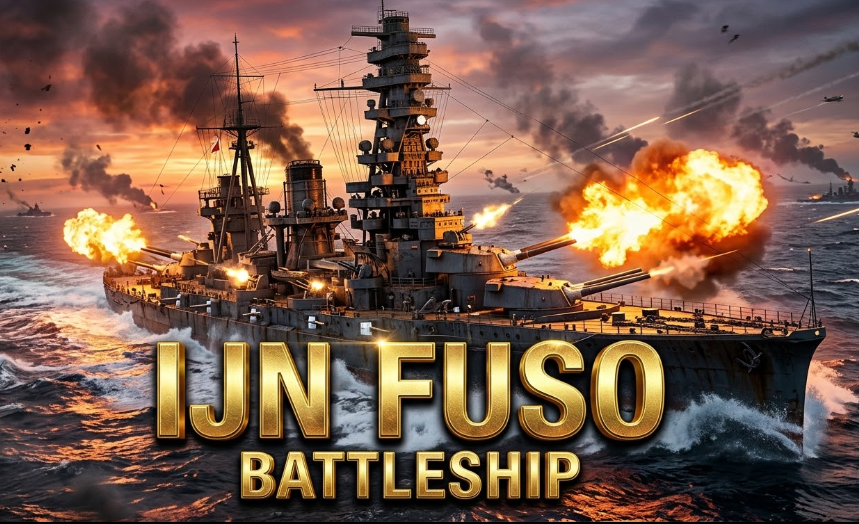
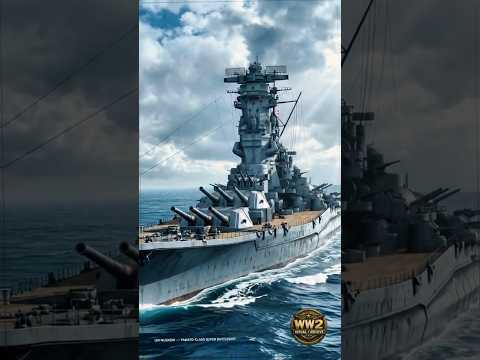
Built at Kure Naval Yard in 1915, IJN Fusō packed twelve 14-inch guns into six twin turrets. Later, her giant pagoda mast rose higher than any rival ship in the Pacific.

01 Watch Our Restored 4K Shorts: Fusō and IJN Power
Tap any card below to watch our restored 4K shorts right inside this page. First, see why Fusō earned her floating skyscraper name before radar. Next, view her six-turret broadside, and then compare her build with Japan’s later giant, Musashi.


02 Why Battleship Fusō Stood Out in the Pacific
Few ships in sea history look as wild as the Japanese battleship Fusō. Her tall bridge tower rose more than 40 meters above the waves. As a result, sailors and writers still call her the floating skyscraper of World War II.
However, Fusō did not start life with that famous tall tower. Naval leaders named her after Fusang, an old poetic name for Japan. They wanted a strong home-built ship that could beat any rival warship in the Pacific.
At the same time, world powers were racing to build bigger steel fleets. Older Japanese ships had come from British yards with British plans. Therefore, building Fusō at home gave Japan a huge boost in naval pride.
Even so, bold plans often bring hard trade-offs at sea. Fusō carried huge firepower on a tight hull. Consequently, her crew fought limits in speed, armor weight, and deck space for thirty years.
Building Japan’s Own Super-Dreadnought at Kure
Workers at Kure Naval Arsenal laid Fusō’s keel on March 11, 1912. Before this ship, Japan bought the battlecruiser Kongō from Britain. Now, local shipbuilders set out to prove they could build a top warship on their own.
Work moved fast despite tough steel and engine needs. Yard crews launched Fusō into Kure Bay on March 28, 1914. Then, on November 8, 1915, the navy put her into active fleet duty.
When she hit the water, Fusō drew wide eyes across the globe. Her first hull stretched 202.7 meters long and 28.7 meters wide. Meanwhile, she weighed 29,326 long tons light and 35,900 long tons at full load.
Furthermore, her steam plant ran well for 1915. Two Brown-Curtis steam turbines drew power from 24 Miyahara boilers burning coal and oil. On speed trials, she hit 23 knots with 46,500 shaft horsepower, beating her 22.5-knot goal.
The Six-Turret Bet: Twelve 14-Inch Guns
Big guns sat at the core of Japanese sea plans. Because Japan had fewer yards than the United States, Tokyo wanted each ship to pack more punch. Thus, builders gave Fusō twelve 14-inch (356 mm) guns in six twin turrets.
No other warship on Earth held more heavy guns in 1915. Every turret sat on the center line so all twelve guns could fire to one side. In theory, one full broadside could smash a rival ship from miles away.
In practice, six big turrets on one deck caused real trouble. Builders placed two turrets in front, two in the middle, and two in the rear. Because Turrets 3 and 4 sat near the boilers, their blast shook the bridge and deck gear.
In addition, six ammo rooms forced Japan to stretch the thick armor belt down the hull. Stretching that belt meant thinner steel over vital spots. Later giants like Battleship Yamato and USS Iowa-class battleships fixed this by using three triple turrets instead.
03 Inside the 40-Meter Pagoda Mast
Show any history fan a side view of Fusō, and they spot her right away. Her tall front tower looked like a stack of old temple roofs piled to the sky. Allied officers soon gave this wild steel stack a clear name: the pagoda mast.
Yet Japan did not build that tower for looks. Instead, the pagoda mast solved a hard problem during the 1920s and 1930s. Long-range gun crews needed spotters high enough to see over the curve of the Earth.
Because sea radar did not exist yet, height meant sight. Higher decks let gun crews spot enemy masts and shell splashes first. Therefore, Japan poured time and steel into tall optical towers.
How a Naval Treaty Built a Skyscraper
World politics also drove Fusō’s strange new shape. In 1922, the Washington Naval Treaty banned new battleships for ten years. Since Japan could not build new hulls, the navy rebuilt its older ships from World War I.
Fusō first sailed with a clean tripod mast made of three stout legs. Rather than tear it out, Kure crews welded new floors right around those legs. Across two major refits, those stacked rooms climbed past 40 meters above the sea.
Each deck held key gear for steering and fighting the ship. Lower floors held the main compass, map tables, and armored bridge posts. Above them sat bright searchlights for night fights, lookout decks, and air-defense sights.
At the very top stood the ship’s sharpest eyes. During her first rebuild, crews placed an 8-meter optical rangefinder on the roof. Later, in 1938, yard teams swapped it for a huge 10-meter rangefinder.
Why High Sight Decks Turned Into a Risk
Early in the war, tall towers gave Japanese crews a real edge at night. Trained lookouts scanned dark waves with big glass lenses from high perches. Meanwhile, bright arc lights lit up enemy ships in pitch-black seas.
However, piling tons of steel high in the air came with a steep cost. First, the pagoda raised the ship’s weight high above the keel and hurt balance. Second, the huge tower stood out like a tall billboard against the sky.
Worse still, Allied radar soon beat pure sight in every way. By 1944, American ships like USS Tennessee (BB-43) used Mark 8 radar to aim straight through total darkness. Thus, Fusō’s proud tower became a top-heavy flaw in her last fight.
04 Technical Specs: 1915 vs. 1944 Refit
Looking at Fusō in 1915 beside her 1944 wartime build shows how much Japan changed her. Crews stretched her stern, widened her hull for torpedo safety, and packed her decks with air-defense guns. The chart below lists her verified data from Fusō-class naval records.
| Ship Feature | As Built (1915) | Final Wartime Fit (October 1944) |
|---|---|---|
| Weight (Displacement) | 29,326 long tons (light) / 35,900 long tons (full) | 39,154 long tons (39,782 metric tons) deep load |
| Total Length | 202.7 m (665 ft) | 212.75 m (698 ft) — stern extended by 7.62 m |
| Width & Draft | 28.7 m (94 ft 2 in) wide · 8.7 m (28 ft 7 in) draft | 33.1 m (108 ft 7 in) wide · 9.69 m (31 ft 9 in) draft |
| Main Guns | 12 × 356 mm (14 in) /45 Type 41 (6 twin turrets) | 12 × 356 mm (14 in) /45 Type 41 (higher gun lift) |
| Side & Torpedo Arms | 16 × 152 mm (6 in) side guns · 6 × 533 mm tubes | 14 × 152 mm (6 in) side guns · torpedo tubes gone |
| Air-Defense Guns | 5 × 76 mm (3 in) AA guns (added 1918) | 8 × 127 mm (5 in) DP guns · 96 × 25 mm Type 96 AA |
| Steel Armor | Belt: 229–305 mm · Deck: 32–51 mm · Turrets: 279.4 mm | Thicker deck steel (up to 114–152 mm) + torpedo bulges |
| Planes & Crew | No catapult · 1,198 officers & sailors | 1 × catapult, 3 × floatplanes · ~1,620–1,800 crew |
05 Peacetime Duty and Two Giant Rebuilds
Fusō saw zero battle in World War I. Although Japan sided with Britain and France, no German battle fleet sailed near Japan. Instead, Fusō ran patrols off China and drilled her gun crews in calm seas.
Her best peacetime work came in September 1923. When the Great Kantō Quake hit Tokyo and Yokohama, Fusō rushed in to help. Her sailors carried food, water, and aid to thousands of people trapped by fire.
Soon after, fast planes and stronger shells made old dreadnoughts easy prey. Heavy bombs could punch straight through thin 1915 decks. Therefore, Japan launched two costly rebuilds between 1930 and 1941.
First Rebuild (1930–1935): Stretching the Steel Hull
From 1930 to 1935, Kure crews rebuilt Fusō from keel to mast. First, they pulled out her old torpedo tubes and swapped her coal boilers for oil-fired units. Second, they bolted wide steel bulges onto her sides to stop torpedoes.
Those side bulges added buoyancy to hold thicker deck armor. However, a fatter hull also dragged harder through the waves. To keep her speed up, workers added 7.62 meters (25 feet) to her stern, making her 212.75 meters long.
Meanwhile, gun crews gained higher lift on the 14-inch barrels for longer shots. Builders also swapped her small 3-inch guns for eight 127 mm (5-inch) Type 89 air-defense guns. You can study those exact mounts in our WW2 Japanese Anti-Aircraft Guns guide.
Second Rebuild (1937–1941): Still Too Slow for Carriers
In February 1937, Fusō went back into drydock for round two. Yard crews tuned her pagoda bridge, added the 10-meter rangefinder, and set up gear for three floatplanes. After a short trip off China in 1939, she finished her last pre-war refit on April 10, 1941.
Even after all that work, one flaw refused to go away. Fusō stayed far too slow to run with Japan’s fast fleet carriers. Fast ships like the Kongō class hit 30 knots, whereas Fusō topped out near 24.7 knots.
Furthermore, her 14-inch guns trailed Japan’s 16-inch Nagato class and the secret 18.1-inch Yamato class. Because fuel oil ran low after 1941, admirals saved oil for faster ships. As a result, Fusō missed the early carrier fights of the war.
Life Inside the Floating Skyscraper
Serving aboard Fusō meant climbing steep steel ladders all day long. Sailors stationed near the top rangefinder worked more than twelve stories above the sea. When rough Pacific swells rolled the hull, that high perch swung wide from side to side.
Inside the narrow tower rooms, heat and noise never stopped. Dozens of men packed into tight spotting booths with heavy lenses, voice tubes, and range clocks. Meanwhile, smoke from the front funnel often blew straight across the upper bridge in strong winds.
Still, her crew took fierce pride in their veteran ship. Every week, gunners drilled to load and fire all twelve 14-inch rifles in crisp unison. Even as newer ships grabbed headlines, Fusō’s men stayed ready for one decisive fleet battle.
06 World War II Shadow Duty (1941–1944)
When Japan struck Pearl Harbor on December 7, 1941, Fusō stayed near home waters. She sailed with Battleship Division 2 as distant backup for the carrier strike force. Consequently, her big guns stayed silent during the war’s opening month.
The same story played out at Midway in June 1942. Fusō steamed north with the Aleutian Support Group while Japan lost four fleet carriers. Soon after, naval chiefs thought about turning Fusō and Yamashiro into part-carrier hybrids.
However, planners picked the newer Ise-class ships for flight decks instead. Fusō kept all six turrets and trained new cadets in the Inland Sea. During 1943, she also carried troops and gear across the western Pacific.
Lingga, Biak, and the 1944 Flak Upgrade
By early 1944, U.S. subs and carriers had broken Japan’s outer island wall. In February 1944, Fusō dodged an air raid and moved to Lingga Island near Singapore for fuel and drills. Three months later, she sailed to Tawi-Tawi to back a failed supply run to Biak Island.
In July 1944, Fusō escaped torpedoes from the U.S. submarine Pomfret and sailed home to Kure. During early August, crews bolted extra radar sets and piles of 25 mm Type 96 guns onto every open deck. By departure time, she carried 96 rapid-fire 25 mm barrels.
Even that ring of light flak fell short of Allied radar-guided shields like the Bofors 40mm L/60. Yet Japan had no ships left to spare. On September 10, 1944, the navy placed Fusō and Yamashiro under Vice Admiral Shōji Nishimura.
On September 23, both old ships left Kure for Lingga and dodged the sub USS Plaice the next day. At Lingga, Nishimura moved his flag to Yamashiro while Rear Admiral Masami Ban led Fusō. Soon, they fueled at Brunei for Operation Shō-Gō, Japan’s last big roll of the dice in the Philippines.
07 Operation Shō-Gō and the Sulu Sea Air Strike
In October 1944, General Douglas MacArthur’s troops landed on Leyte in the Philippines. According to The National WWII Museum’s Leyte Gulf record, Japan fired back with Operation Shō-1, a bold three-way naval trap.
Admiral Takeo Kurita’s main fleet—with Yamato and Musashi—would strike Leyte Gulf from the north. At the same time, Nishimura’s Southern Force would push up narrow Surigao Strait from the south. Meanwhile, Admiral Ozawa’s northern carriers would pull Admiral Halsey’s Third Fleet away.
Nishimura’s force was far too small for such a deadly run. He had just two old battleships (Yamashiro and Fusō), the heavy cruiser Mogami, and four destroyers: Michishio, Asagumo, Yamagumo, and Shigure. Worse still, they had zero friendly planes overhead.
USS Enterprise Planes Draw First Blood (October 24, 1944)
On the morning of October 24, 1944, planes from USS Enterprise found Nishimura crossing the Sulu Sea. Dive bombers dropped through thick flak to strike the slow ships below. Real U.S. Navy photos on Wikimedia Commons show Fusō weaving under bombs beside Mogami.
During that raid, a heavy bomb tore into Fusō near Turret No. 2. The blast killed the crew of her No. 1 side battery and sparked fierce fires below. Another hit smashed her plane catapult and burned her scout floatplanes.
As a result, Fusō leaned two degrees to starboard. Still, her damage crews put out the fires and kept the old giant moving toward Surigao Strait. Nishimura knew U.S. forces had seen him, yet he pushed straight ahead into the dark.
08 Nightmare in Surigao Strait (October 25, 1944)
At the north end of Surigao Strait, Rear Admiral Jesse B. Oldendorf set a steel wall. As noted by the Naval History and Heritage Command, Oldendorf lined up 39 PT boats, 28 destroyers, 8 cruisers, and 6 battleships across the narrow pass.
Five of those six U.S. battleships—West Virginia, Maryland, Tennessee, California, and Pennsylvania—had survived Pearl Harbor. Now armed with sharp Mark 8 radar, they waited in the dark to cross Japan’s T and unleash full broadsides.
Nerves aboard Fusō snapped soon after midnight on October 25. First, fast American PT boats darted out from the dark islands to harass the line. Around 01:00, tense gunners on Fusō mistook a dark shape to port for a foe and fired on their own cruiser, Mogami.
Destroyer Torpedoes in the Pitch-Black Strait
Between 03:00 and 03:15, Captain Jesse Coward’s Destroyer Squadron 54 rushed in from both sides. Lookouts on Shigure spotted the U.S. ships, and Yamashiro flashed her searchlight. Moments later, Fusō fired star shells and big 14-inch rounds using her radar to straddle USS Remey.
However, American destroyers had already fired fans of Mark 15 torpedoes into the dark. Around 03:09 to 03:10, torpedoes—most closely linked to USS Melvin and USS McGowan—slammed into Fusō’s right side. Based on forensic work in CombinedFleet’s Surigao Strait wreck study by Anthony Tully and Robert Lundgren, Fusō took three starboard hits.
One torpedo blew out her bottom near Frame 50 under Turret No. 1, flooding the front ammo room. A second hit near the base of the pagoda mast, cracking her hull frame. Meanwhile, a third hit aft near Frame 210–230, knocking out her outer starboard shaft.
Debunking the “Split in Half” Blast Myth
For sixty years, older books—echoed by Warfare History Network and CombinedFleet’s early log—said Fusō blew clean in half at 03:38. Those tales claimed both burning halves drifted apart for an hour before sinking.
Yet Japanese survivors told a very different story. Petty Officer Hideo Ogawa and fellow crewmen said Fusō kept moving for a while after the hits. Instead of blowing apart, steady flooding pulled her right side deeper into the dark sea.
Within about forty minutes, between 03:38 and 03:50, Fusō rolled over and went down. As she sank, broken tanks spilled huge pools of fuel oil that caught fire on the waves. In the pitch-black smoke, distant Allied crews mistook two bright oil fires for two floating halves of the ship.
09 The 2017 Wreck Find and Final Human Cost
More than seventy years later, deep-sea cameras proved the truth beyond doubt. On November 25, 2017, Paul Allen’s research ship RV Petrel found Fusō 185 meters (607 feet) down on the seabed. Clear underwater video settled the old myth once and for all.
Fusō lies completely upside down in one joined piece—not split into two far-apart halves. Although her hull bent and cracked midship when she hit the ocean floor, her bow and stern stayed linked. Meanwhile, her tall 40-meter pagoda mast broke loose on the way down and rests nearby.
The loss of life that night remains heartbreaking. Out of roughly 1,620 men aboard Fusō, only a few dozen escaped the rolling hull and burning oil. Some climbed onto the destroyer Asagumo, which U.S. ships sank later that morning.
In the end, only ten crewmen from Fusō lived to return to Japan. Minutes later, her sister Yamashiro sank under Oldendorf’s radar-aimed broadsides, leaving only ten survivors as well. On August 31, 1945, Japan struck Fusō from the Navy List, ending the age of battleship duels forever.
What Fusō Taught Modern Naval History
Looking back, Battleship Fusō tells a clear story about how fast war tech can change. In 1915, twelve big guns and a tall sight tower stood at the peak of sea power. By 1944, aircraft carriers, radar, and night destroyer strikes ruled every ocean.
Still, Fusō remains an icon of bold engineering and human courage. Her 40-meter pagoda mast stands unmatched as the tallest stacked bridge ever sent into battle. Today, her wreck rests quietly beneath Surigao Strait as a lasting grave for over 1,600 sailors.
10 How We Restore IJN Fusō in 4K and 60FPS
Real clips and stills of old Japanese battleships are rare, grainy, and worn by time. Therefore, our studio rebuilds each frame with strict archive checks before posting to WW2 Visual Archive and our naval history series with World of Warships.
Clears dust, film grain, and scratches while keeping thin rigging and pagoda tower ladders crisp.
Sharpens fine edges on 14-inch gun barrels, 10-meter rangefinders, and riveted steel plates.
Applies true Kure Naval Yard hull gray, warm teak decks, and crisp Pacific daylight tones.
Smooths ocean wave motion and adds rich steam hum, sea wind, and heavy gun audio.
11 Compare IJN Fusō Against World War II Rivals
How did Japan’s 1915 dreadnought stack up against her Surigao Strait foe and the top battleships of World War II? Pick any rival below to compare weight, main guns, belt steel, top speed, and fire control side by side.
IJN Fusō (1944 Refit)
USS Tennessee (BB-43) (1944 Refit)
12 Test Your Knowledge: IJN Fusō Quiz
13 Explore Related WW2 Visual Archive Dossiers
Keep exploring naval history across WW2 Visual Archive. Each dossier below pairs 4K restored video with clear battle logs and full ship specs.
See how Japan moved from Fusō’s six twin turrets to Yamato’s nine giant 18.1-inch naval rifles.
Check out the Type 89 127 mm guns and Type 96 25 mm cannons bolted onto Fusō in 1944.
Explore another bold Japanese naval design built during the final stretch of the Pacific War.
Compare Fusō’s 24-knot steel hull against America’s 33-knot radar-aimed fast battleships.
Follow the Pacific battleship story from Surigao Strait all the way to peace in Tokyo Bay.
See how Germany’s famed Atlantic warship stacked up in speed, armor belt, and battle endurance.
14 Primary Sources, External Links and Cite This Dossier
Every spec, refit date, and Surigao Strait wreck fact in this page comes from trusted naval archives and maritime history logs:
- CombinedFleet.com (TROM): IJN Fusō Tabular Record of Movement — Full date-by-date service log and 1944 Surigao Strait timeline.
- Tully & Lundgren Wreck Study: Battleships at Surigao Strait: Revelations of the Wrecks and Records — Forensic torpedo hit analysis at Frames 50, 80–100, and 210–230.
- Naval History and Heritage Command: 1944 October 24–25: Battle of Surigao Strait — Official U.S. Navy fleet lineup and wartime photos.
- The National WWII Museum: The Battle of Leyte Gulf — Full overview of Operation Shō-1 and Nishimura’s Southern Force.
- Warfare History Network: How the Battle of Surigao Strait Brought Revenge for Pearl Harbor — Side-by-side look at U.S. radar and Japanese night gunnery.
- Reference & Public Domain Media: Japanese Battleship Fusō, Fusō-Class Battleship, and Wikimedia Commons Public Domain Plates.
Cite and Link This Dossier (For Blogs, Videos and Naval Forums)
Writing a history blog, YouTube video note, Reddit post, or forum thread on Surigao Strait? Copy this ready HTML link below to cite our spec table and 4K restoration showcase: