Eight guns. Thirty knots. Three minutes.
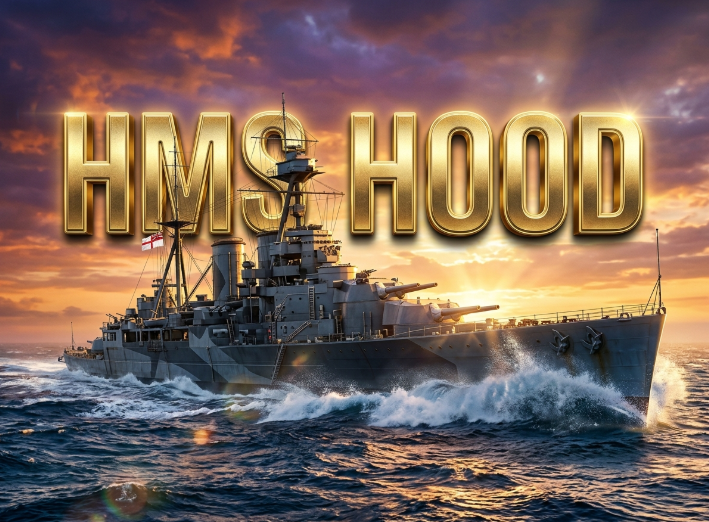
She was the largest warship in the world for two decades: a floating embassy with teak decks, a band, and eight 15-inch guns. On a grey morning in the Denmark Strait, HMS Hood met the Bismarck and ceased to exist before most of her crew could reach the upper deck.
 HMS HOOD (51) · 1924

The Pride, and the Warning
A long-form pass through Hood’s career: the showpiece years, the imperial cruise, the refits that never came, and the four minutes that ended the battlecruiser argument.
HMS Hood is usually remembered for how she died. That is understandable—the photographs are stark, the casualty list is almost total, and the ship that had been the Royal Navy’s public face simply vanished in front of two German warships. But the loss only makes sense if you understand the ship that was built: a 32-knot compromise between the battlecruiser idea and the battleship reality, launched in 1918, commissioned in 1920, and never fully modernized in the twenty-one years that followed.
This archive file reconstructs that ship from the keel up. It covers the design that put speed ahead of deck armor, the ten-month empire cruise that made Hood a household name, the Denmark Strait battle minute by minute, the long argument over what actually ignited her aft magazines, the hunt that ended with Bismarck at the bottom of the Atlantic, and the 2001 discovery of Hood’s wreck in 2,800 meters of water. It also follows the three men who survived, and the bell that came home to Portsmouth in 2015.
A Super-Ship Built on a Hidden Compromise
Hood was designed to hunt fast raiders, not to stand in a battle line. The difference between those two jobs was measured in inches of deck steel.
On 31 May 1916, three British battlecruisers exploded at Jutland in less than an hour. Indefatigable, Queen Mary and Invincible had been built for speed and gun power, and their thin deck armor could not survive the plunging shells that found them at long range. The Admiralty’s response was not to abandon the battlecruiser. It was to build a bigger, faster, more heavily armed one—and to add just enough armor to quiet the critics.
The result was the Admiral class: four ships ordered in 1916, of which only HMS Hood was completed. Anson, Howe and Rodney were cancelled as the war ended. Hood was laid down at John Brown & Company in Clydebank on 1 September 1916, launched on 22 August 1918, and commissioned on 15 May 1920. She cost £6,025,000—an enormous sum for a ship that would spend most of her career showing the flag rather than fighting.
At 860 feet 7 inches overall and 104 feet 2 inches on the beam, Hood was the longest capital ship in the world. Deep load displacement reached 47,430 long tons. Twenty-four Yarrow boilers fed four Brown-Curtis geared turbines; the design called for 144,000 shaft horsepower and 31 knots, but on trials in 1920 she produced 151,280 shp and ran at 32.07 knots. For two decades, no other warship combined that speed with eight 15-inch guns.
The main battery was the proven BL 15-inch Mark I: four twin turrets, A and B forward, X and Y aft, firing a 1,920-pound armor-piercing shell at roughly 2,458 feet per second. The turret faces were 15 inches thick; the barbettes up to 12 inches; the waterline belt 12 inches, inclined 12 degrees outward. By the standards of 1920, that was a respectable belt. The problem was everything above it.
The belt was built to stop a shell arriving flat. Hood’s deck was built for a world where shells arrived flat, too.
Hood’s main deck was 3 inches over the magazines and as little as 1 inch elsewhere. At the ranges at which World War I ships expected to fight, that was considered adequate: gunnery was inaccurate, and plunging hits were rare. By 1941, radar ranging and mechanical fire-control computers had made long-range hits routine. A shell arriving at 20 degrees could drop through the deck and into the magazines without ever touching the belt. The armor scheme had not changed; the world had.
The Admiralty knew. A major reconstruction planned for 1939 would have doubled the deck armor to 6 inches, replaced the machinery, and rebuilt the bridge and anti-aircraft battery. The war began first. Hood went into the 1940s with her original deck, a set of added pom-poms and 4-inch mounts, and—after a refit in early 1941—Type 279 air-warning and Type 284 gunnery radar. She was faster than almost anything afloat, better protected than a cruiser, and still not a battleship.


Steel Before Legend
A 15-inch turret takes shape on the slipway. The ship that would become a national symbol began as riveted plate and yard crane.

The Most Beautiful Ship Afloat
Hood’s proportions were designed to impress. For twenty years, she was the ship foreign navies photographed and British crowds came to see.
Armor Profile · HMS Hood, 1941
Schematic · not to scale12-inch main belt
- Coverage
- A to Y barbettes
- Incline
- 12° outward
- Ends
- 5–6 in
A respectable belt for 1920. It was designed to defeat flat-trajectory fire at close range—the kind of shooting expected in a North Sea battle.
Ten Months, Three Oceans, and a Myth
The cruise turned HMS Hood into a household name. It also kept her out of the dockyard at the moment she most needed modernizing.
In November 1923, Hood left Devonport as the flagship of the Special Service Squadron. With her sailed the battlecruiser Repulse and a squadron of Danae-class light cruisers. The route ran west through the Panama Canal, across the Pacific to Australia and New Zealand, then through the Indian Ocean to South Africa, up the African coast, and home to Britain in September 1924. It was part goodwill tour, part imperial audit, and part demonstration of what British industry could put to sea.
The receptions were enormous. In Vancouver, crowds filled the waterfront and children were taken aboard; the ship’s crew kept a kangaroo mascot. In Sydney, an aerial photograph from 1924 shows Hood lying in the harbor like a steel baseline against the city. To the dominions, she was proof that the Royal Navy could still reach them. To the Admiralty, she was a mobile embassy that happened to carry 15-inch guns.
The cruise worked. Hood became “the Mighty Hood”—the most recognized warship in the world, the ship that appeared on postcards, cigarette cards, and newsreels. Schoolchildren could draw her three funnels from memory. When people said “the Navy,” many of them pictured one ship.
Celebrity had a cost. Hood spent the interwar years on ceremonial duty, showing the flag in the Mediterranean and the Baltic, patrolling the Spanish coast during the Civil War, and carrying dignitaries. The 1929–31 refit added torpedo bulges and improved anti-aircraft mounts; a planned 1939 reconstruction that would have replaced her machinery and doubled her deck armor was cancelled when the war began. By 1941 she had radar, more pom-poms, and a degraded powerplant that could no longer guarantee 32 knots. She was still the most famous ship in the fleet. She was no longer the most modern.


860 Feet Through the Locks
Hood was built to the widest beam the Panama Canal could take. This reel shows just how little water was left on either side.
Denmark Strait: Three Minutes That Changed Everything
Two squadrons, seventeen miles apart, closing at a combined fifty-five knots. The battle lasted less time than a coffee break.
On 20 May 1941, the Bismarck and the heavy cruiser Prinz Eugen sailed from Gotenhafen for Operation Rheinübung, a raid into the Atlantic shipping lanes. The Swedish cruiser Gotland spotted them in the Baltic and the report reached the British naval attaché in Stockholm. By the evening of 23 May, the cruisers Norfolk and Suffolk had them on radar in the Denmark Strait. The Home Fleet had a chance to intercept.
Vice-Admiral Lancelot Holland had HMS Hood, flying his flag, and the brand-new battleship HMS Prince of Wales. Six destroyers had been detached the night before; the two capital ships were on their own. Holland’s plan was sound in principle: close fast, get inside the range band where German shells would arrive on a flat trajectory, and let Hood’s 12-inch belt do its job. The geometry did not cooperate.
At 05:35, lookouts in Prince of Wales sighted the German masts at about 17 miles. Holland ordered action at 05:37. At 05:52, Hood opened fire at roughly 26,500 yards—but she fired at the leading German ship, Prinz Eugen, which the British had misidentified as Bismarck. The German ships returned fire three minutes later. Both concentrated on Hood.
The first German hit may have come from Prinz Eugen: an 8-inch shell struck Hood’s boat deck between the funnels and started a fire among the ready-use ammunition and the Unrotated Projectile rocket mounts. That hit did not sink her. It did, however, put a fire in the middle of the ship at the worst possible moment.
At about 06:00, Holland ordered a 20-degree turn to port so that the aft turrets could bear. During that turn, Bismarck’s fifth salvo straddled Hood abreast the mainmast at a range of roughly 18,200 yards. A 15-inch shell plunged through the deck. A jet of flame shot up near the mainmast; the aft magazine detonated; the stern fell away and the bow rose and sank. From the fatal hit to the ship’s disappearance took about three minutes.
Of the 1,418 men aboard, three survived. Ordinary Signalman Ted Briggs, Able Seaman Bob Tilburn and Midshipman William Dundas were picked up by the destroyer Electra about two hours later. Vice-Admiral Holland and Captain Ralph Kerr were lost with the ship. Prince of Wales, hit seven times and with thirteen dead, turned away under smoke and withdrew.
A 47,000-ton ship did not vanish because of one lucky shell. She vanished because the shell arrived at the one angle her armor could not answer.
The shock was national. Hood was the ship the public knew, the one that had carried the flag around the world. The Admiralty announced her loss on 25 May; the press struggled to explain how a ship of her size could be destroyed in minutes. The answer lay in a design decision made in 1916, a refit cancelled in 1939, and a firing solution that put a 15-inch shell through three inches of deck at exactly the right moment.

The Three Minutes · 05:30 to 06:10
Ship’s time · drag to scrubHood opens fire
At about 26,500 yards, Hood fires on the leading German ship. It is Prinz Eugen, not Bismarck—a misidentification that sends the first British salvos at the wrong target.
What Actually Killed HMS Hood
Two boards of inquiry, one wreck, and eighty years of argument. The mechanism is less mysterious than the myth.
The first Board of Inquiry, convened in June 1941, concluded that a 15-inch shell from Bismarck had penetrated Hood’s aft magazine. The second board, in September, refined the finding: the 4-inch magazine probably exploded first, and the blast or the fire then reached the adjacent 15-inch magazine. Both boards agreed on the essential point. Hood was not sunk by a single explosion in isolation; she was sunk by a chain reaction that began with a shell arriving through the deck.
The wreck supports that chain. When David Mearns and Blue Water Recoveries found Hood in 2001, the aft magazines were gone. The rudder was still locked 20 degrees to port, consistent with the turn Holland had ordered. A section of bow just forward of A turret was missing, suggesting a second explosion or the collapse of the hull as the ship broke up. The wreck did not answer every question, but it confirmed the broad shape of the event.
The most detailed modern analysis, published in 2019 by Bill Jurens, William Garzke and Robert Dulin, concluded that a 380 mm shell from Bismarck penetrated the deck, exploded in the aft 4-inch magazine, ignited cordite, and flashed into the 15-inch magazine. The exact fuse functioning and the shell’s path remain debated. The vulnerability does not.
Hood’s main deck was 3 inches over the magazines. At 18,200 yards, a 38 cm shell from Bismarck arrived at an angle of fall of roughly 19 to 20 degrees. That is steep enough to reach the deck, and the deck was not thick enough to stop it. The 12-inch belt was irrelevant because the shell never touched it. This is the central lesson of the Denmark Strait: against plunging fire, the thickness of the belt is not a proxy for protection.
The belt was 12 inches. The deck was three. The shell came from above.
The Prinz Eugen hit matters too, even if it was not the fatal blow. An 8-inch shell on the boat deck started a fire among the UP rocket mounts and ready-use ammunition, and that fire was burning near the base of the mainmast when Bismarck’s salvo arrived. Some accounts argue the fire weakened or distracted damage-control parties; others argue it was incidental. What is clear is that the German shooting was accurate, the British fire control was hampered by spray and the angle of approach, and Hood was hit in the worst possible place at the worst possible time.
The myth of the “lucky hit” is comforting because it implies that nothing could have been done. The design record says otherwise. The Admiralty had identified the deck weakness, planned a reconstruction, and cancelled it when the war began. Hood went to war with the armor she had in 1920, against a shell designed in the 1930s, at a range where the angle of fall exposed exactly the part of the ship that had never been upgraded.
Plunging Fire · The 38 cm Problem
Approximate · published penetration tablesThe Hunt for Bismarck and the Ship That Finished the Job
Hood’s killer lived another three days. The ship that helped end her was a 28-knot treaty battleship with ten 14-inch guns.
Bismarck did not escape the Denmark Strait unmarked. Prince of Wales had hit her three times, including an underwater hit that cut a fuel tank and left a visible oil slick. The German squadron made for France, with Bismarck’s speed reduced and her fuel margin shrinking. Norfolk and Suffolk shadowed; the Home Fleet closed from the south and west.
On 24 May, the carrier Victorious launched a strike by Fairey Swordfish. One torpedo hit did no serious damage, but it forced Bismarck to maneuver and confirmed that the British had found her. On 26 May, Ark Royal’s Swordfish attacked again in heavy weather. A torpedo struck the stern and jammed the rudder. The ship that had outrun everything could no longer steer.
On the morning of 27 May, King George V and Rodney engaged at about 08:43, opening fire at roughly 20,500 yards. King George V fired 339 rounds of 14-inch; Rodney fired 380. By 10:00 Bismarck was silenced. Dorsetshire torpedoed her at 10:21. Of a crew of about 2,200, 114 survived.
King George V was the treaty battleship the Royal Navy had built instead of another Hood: 42,237 tons full load, 28 knots, a 15-inch belt, a 5.6-inch deck, and ten 14-inch guns in two quadruple turrets and one twin. Her quad turrets were mechanically temperamental; during the final action they began to jam after about thirty minutes, and from 09:27 every gun missed at least one salvo. She stayed in the fight anyway, which is what mattered.
The irony is hard to miss. Hood was built to hunt raiders and was killed by a battleship. King George V was built to fight battleships and helped kill a raider. The battlecruiser era ended in the Denmark Strait; the battleship era ended three days later, in the same ocean, for many of the same reasons.
Four Ships, One Strait
The celebrity. Fast, heavily gunned, and thin-decked. Her 1941 speed was degraded by machinery wear, and her deck had never been upgraded.

Ten Guns, One Chance
The treaty battleship that helped run Bismarck down: 14-inch guns, a 15-inch belt, and a machinery plant that kept her in the line when her turrets began to fail.
The Wreck, the Bell, and the Men Who Came Home
HMS Hood is still on patrol in 2,800 meters of water. In Portsmouth, her bell is rung eight times every year.
For sixty years, Hood’s exact resting place was unknown. In 2001, the broadcaster Channel 4 commissioned David Mearns and Blue Water Recoveries to find her. Using side-scan sonar and a carefully plotted search box, the team located the wreck in the Denmark Strait on the 39th hour of the search, at a depth of about 2,800 meters (9,200 feet), near 63°24′ N, 32°03′ W. The ship lies in two main debris fields. The amidships section is inverted in a large impact crater; the rudder is still locked 20 degrees to port.
In 2002, the site was designated an official war grave under the Protection of Military Remains Act. There has been no salvage and no commercial intrusion. The wreck is treated as a cemetery, which is what it is.
The bell came home by a different route. A first attempt to recover it in 2012, sponsored by Paul Allen, was abandoned after ten days of bad weather. In August 2015, Mearns’s team raised it from the wreck. On 24 May 2016—the 75th anniversary—it was unveiled by the Princess Royal at the National Museum of the Royal Navy in Portsmouth and rung eight times at midday. The bell had originally belonged to the 1891 pre-dreadnought Hood; it carries two inscriptions, one commemorating Rear-Admiral Horace Hood and one recording its presentation by Lady Hood at the launch in 1918.
Three men came home from the Denmark Strait. Ordinary Signalman Ted Briggs, Able Seaman Bob Tilburn and Midshipman William Dundas were picked up by Electra after about two hours in the water. Briggs lived until 2008 and spent much of his life keeping the ship’s memory alive; Tilburn died in 1995, Dundas in 1965. Their accounts are the human counterweight to the armor diagrams: the noise, the list, the water, the sudden absence of a ship that had seemed permanent.
Hood’s legacy is not a single lesson. She demonstrated the cost of a compromise design carried into a war it was not built for. She proved that deck armor and magazine safety matter as much as belt thickness. She ended the battlecruiser concept in the Royal Navy, accelerated the shift to fast battleships, and gave the postwar generation a blunt argument for better horizontal protection. And she left a name that still fills a museum gallery.

The Ship That Stayed Famous
Why one battlecruiser outlived her class in the public imagination—and why the three survivors spent the rest of their lives answering questions about three minutes.

HMS Hood · Frequently Asked Questions
Short answers to the common searchesWhere is HMS Hood now?
Hood lies in the Denmark Strait at a depth of about 2,800 meters (9,200 feet), near 63°24′ N, 32°03′ W. The site was designated an official war grave in 2002.
How many men survived HMS Hood?
Three of the 1,418 aboard: Ordinary Signalman Ted Briggs, Able Seaman Bob Tilburn and Midshipman William Dundas. They were rescued by the destroyer HMS Electra about two hours after the sinking.
What actually sank HMS Hood?
A 15-inch (38 cm) shell from Bismarck penetrated her deck near the mainmast and triggered the explosion of the aft magazines. An earlier 8-inch hit from Prinz Eugen started a fire on the boat deck. The exact fuse and path are still debated; the vulnerability of the 3-inch deck is not.
Was HMS Hood a battleship or a battlecruiser?
A battlecruiser—the only completed ship of the Admiral class. She carried battleship-caliber 15-inch guns and a 12-inch belt, but only 3 inches of main deck armor, and she was designed for 32 knots.
Why was HMS Hood so famous?
She was the largest warship in the world for two decades and the centerpiece of the 1923–24 Empire Cruise. The press called her “the Mighty Hood,” and she became the Royal Navy’s most recognizable ship.
How long did HMS Hood take to sink?
About three minutes from the fatal hit. The ship broke in two; the stern fell away and the bow rose before sinking.
Related Dossiers
The ships and actions that frame Hood’s story, from the Japanese super-battleship she was never meant to fight to the treaty battleship that finished hers.


Add to the Record
If your family served in Hood, or you hold a primary-source account, a gunnery note or a photograph, add it to the archive.
Hood’s story is still being assembled from small pieces: a letter, a photograph, a rating’s notebook, a damage report filed in 1941 and never published. The archive is open to corrections and additions, especially from families of the 1,415 men who did not come home.
Submissions are reviewed before they are added to the public record. Please include the source of any document or image so it can be verified.
Principal sources: Royal Navy and Admiralty records; Imperial War Museums; Naval History and Heritage Command; National Museum of the Royal Navy; Wikimedia Commons; Jurens, Garzke & Dulin, The Loss of HMS Hood (2019). Figures are rounded where sources differ.