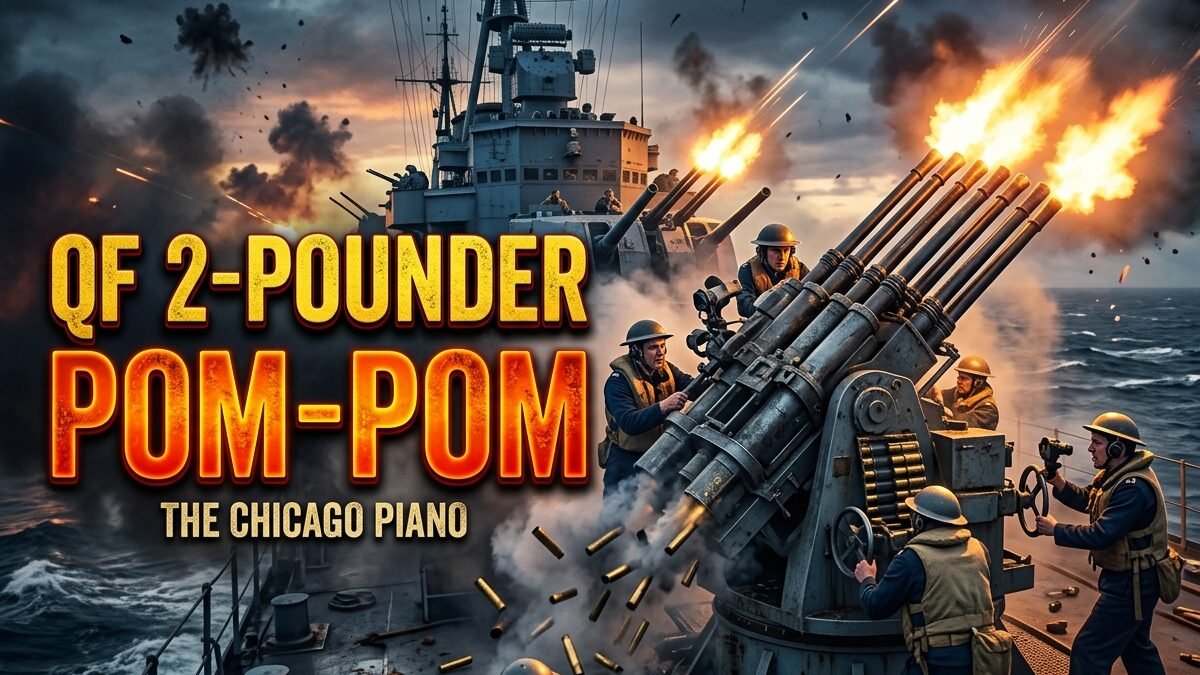
Long before radar-guided missiles defended fleet carriers, survival aboard a British warship under dive-bomber attack hung on a rhythmic, chest-rattling mechanical roar: the Ordnance QF 2-pounder Mark VIII “Pom-Pom”.
Crowned with eight flared conical flash hiders and fed by 140-round disintegrating link belts, the octuple and quadruple 40 mm mounts — nicknamed the “Chicago Piano” by Allied sailors — spat up to 920 high-explosive shells per minute into the sky. Across every theater from the Arctic convoys and Malta to Okinawa, this water-cooled mechanical colossus stood as the final curtain between a warship and catastrophic impact.
Every sailor who served aboard a Royal Navy or Commonwealth warship between 1939 and 1945 knew the hierarchy of anti-aircraft gunfire solely by ear. First came the deep, slamming crack of the long-range 4.5-inch or 5.25-inch dual-purpose batteries engaging high-altitude contacts miles off the beam. Moments later, as an attacker tipped into its terminal dive, the ship’s superstructure erupted with a rhythmic, syncopated “pom-pom-pom-pom” that vibrated through steel bulkheads down to the boiler rooms.
That unmistakable acoustic signature gave the Ordnance Quick-Firing (QF) 2-pounder its universal nickname. Originally coined by British troops and Boer commandos during the Second Boer War (1899–1902) to describe Hiram Maxim’s 37 mm 1-pounder belt-fed field gun, the moniker followed the weapon to sea when Vickers scaled the design up to a 40 mm (1.575-inch) bore firing a two-pound projectile.
A Masterclass in Interwar Budget Engineering
In the early 1920s, the British Admiralty’s Anti-Aircraft Gunnery Committee recognized a lethal shift in naval warfare: torpedo bombers and dive bombers moved too rapidly inside 3,000 yards to be tracked by slow-firing single-shot guns, yet were too heavily framed to be stopped reliably by rifle-caliber machine guns. What the Fleet needed was a multi-barrelled cannon capable of saturating a predictable volume of sky with high-explosive shells.
Severely constrained by post-World War I treasury cuts, Vickers-Armstrongs engineers at Crayford and Erith faced an unusual mandate: design a revolutionary multi-barrelled weapon around the existing 40×158mmR ammunition stockpile, of which more than two million rounds remained in naval magazines from the Great War. Beginning trials in 1927 and entering service in 1930, the resulting QF 2-pounder Mark VIII was an enlarged, water-cooled, recoil-operated Vickers-Maxim mechanism built largely of non-corrosive gunmetal, phosphor bronze, and high-grade ordnance steel.
Why Every Barrel Wore a Conical Trumpet
In archival photographs and our 4K restorations, the most recognizable visual trait of the Pom-Pom is the cluster of long, flared conical flash hiders (officially termed flash eliminators) bolted to the muzzle of each water jacket. These trumpets served two critical combat functions:
- Night-Vision Preservation for Gun Layers: Cordite propellant burned with a blinding yellow-orange flash. During dawn, dusk, or night convoy battles in the North Atlantic and Mediterranean, eight unshielded muzzles firing 15 rounds per second would instantaneously blind the mount’s gun layers and lookouts.
- Recoil Booster Assistance: Because the Mark VIII operated on a long-recoil toggle-lock principle, the internal geometry of the muzzle cone trapped a fraction of expanding propellant gas against the barrel face, imparting an extra rearward impulse that ensured positive cycling even when the gun was elevated to 80 degrees in freezing Arctic spray.
To adapt the QF 2-pounder across warships ranging from 900-ton Flower-class corvettes to 42,000-ton battleships, the Royal Navy fielded the weapon in three primary naval mountings. The largest and most famous was the Mark VI Octuple Mounting — an eight-barrelled turretless fortress weighing between 11.8 and 16 long tons that sailors immediately christened the “Chicago Piano” after the Prohibition-era Thompson submachine guns of 1920s gangland cinema.
Engineering eight water-cooled 40 mm autocannons to fire simultaneously from a single rotating turntable without shaking their own sighting gear apart required extraordinary mechanical choreography. Rather than aligning all eight barrels in a flat row, Vickers arranged them in two superimposed tiers of four barrels. Within each bank, the inner and outer gun breeches were staggered slightly fore-and-aft so the feed chutes, ejection ports, and cooling pipes could sit tightly together, shrinking the mount’s horizontal footprint and increasing angular traverse speed to 25 degrees per second.
Mark VI & Mark VIA* Octuple (“The Chicago Piano”)
The heavyweight close-in shield fitted to King George V-class battleships (up to six octuple mounts — 48 barrels per ship), Illustrious-class armored carriers, and Nelson, Rodney, and Hood. Powered by a 15-horsepower hydraulic motor, it could fire continuously for 73 seconds from its internal 1,120-round ready lockers without pausing to reload.
Mark VII & Mark VII* Quadruple Mounting
Developed when the 16-ton octuple mount proved too top-heavy for fleet destroyers and light cruisers. Essentially a single-tier “half-piano” mounting four side-by-side Mark VIII guns, the Mark VII became standard equipment aboard Tribal-, J/K/N-, and War Emergency-class destroyers, as well as supplementary sponsons on fleet carriers.
Mark VIII Pedestal & Mark XVI Power Single Mount
Where deck space and metacentric height precluded multi-barrel mounts, single pedestal-mounted QF 2-pounders (both the older Mark II and the belt-fed Mark VIII) armed Atlantic convoy escorts, River-class destroyers like HMCS Assiniboine, Flower-class corvettes, and Fairmile C/D motor gunboats fighting E-boats in the English Channel.
Eight-Barrelled 2-Pounder Pom-Pom in Action — Gunnery Practice on HMS Howe
Captured aboard the King George V-class fast battleship HMS Howe (32), this restored live-fire sequence reveals the raw physical violence of an octuple Mark VIA mount at full cyclic rate. Watch how the upper and lower four-barrel tiers alternate recoil strokes while a torrent of smoking brass 40×158mmR shell casings cascades onto the splinter-shielded deck.
Even an eight-barrelled cannon firing 900 rounds per minute is useless if those shells detonate three hundred yards behind an enemy aircraft’s tail. During the 1930s, hitting a dive-bomber hurtling downward at 280 knots required calculating continuous lead angles in three dimensions while the warship itself rolled and pitched in heavy seas.
Here, the Royal Navy achieved a milestone often overlooked in popular histories: in 1931, it introduced the Pom-Pom Director Mark I — the world’s first dedicated gyro-tachymetric close-range anti-aircraft fire-control system. Stationed in an elevated tub clear of the gun’s cordite smoke, the director crew tracked the incoming target through optical sights while a mechanical predictor computed future target position from angular rate of movement and rangefinder inputs.
From Early-War Shortcomings to the Type 282 Radar Breakthrough
When combat erupted off Norway and Dunkirk in 1940, two severe vulnerabilities surfaced in the early Pom-Pom system:
- The Low-Velocity (LV) Trajectory Lag: Pre-war stocks of Low-Velocity 2-pounder ammunition left the muzzle at just 1,920 to 2,040 ft/s (585–622 m/s). Over a 2,000-yard slant range, the shell took nearly four seconds to arrive, giving German Ju 87 Stuka pilots just enough time to release their bombs at the edge of the Pom-Pom envelope and pull out.
- Follow-the-Pointer Human Delay: Early directors transmitted firing solutions to the gun mount via electrical dials; the gun layer and trainer still had to crank or steer hand-controls to keep their needles aligned under deafening concussions and blinding smoke.
Between 1940 and 1942, British ordnance engineers overhauled every link in this chain. First came High-Velocity (HV) ammunition in strengthened Mark VI* and Mark VII* mounts, boosting muzzle velocity to 2,400 ft/s (732 m/s), flattening the trajectory, and pushing effective lethal slant range out to 2,500–3,000 yards. Second came the Mark III and Mark IV Gyro-Rate Directors paired with Type 282 50-centimeter decimetric radar (recognizable by its twin Yagi aerial arrays mounted atop the director hood) and Remote Power Control (RPC). With RPC engaged, the radar-assisted director drove the 16-ton gun mount’s hydraulic motors directly, slewing all eight barrels onto unseen targets through thick fog, gun smoke, or pitch-black night.
The operational history of the QF 2-pounder Pom-Pom spans both the darkest afternoons and most ferocious defensive triumphs of the Royal and Commonwealth Navies.
In December 1941, off Malaya, the loss of HMS Prince of Wales and HMS Repulse (Force Z) to Japanese naval land-attack bombers exposed the tragic consequences of tropical ammunition degradation. Stored in hot, humid magazines, the early cloth cartridge belts shrunk and rotted, causing repeated feed jams at the exact moment Japanese torpedo planes bored in, while several time-fuzed shell batches failed to detonate. That painful lesson triggered an immediate Fleet-wide replacement of cloth belts with disintegrating steel-link belts and sealed tropicalized cordite charges.
Where the upgraded steel-belted HV mounts fought — from the Malta convoys of Operation Pedestal (August 1942) to the Arctic runs to Murmansk — the octuple and quad Pom-Poms proved devastating. Yet the gun’s single most dramatic close-quarters duel did not happen against aircraft at all, but at point-blank range against a surfaced German submarine in the choking fog of the North Atlantic.
Point-Blank in the Fog: HMCS Assiniboine vs. U-210 (6 August 1942)
On the afternoon of August 6, 1942, while defending Transatlantic Convoy SC 94 south of Cape Farewell, Greenland, the Royal Canadian Navy River-class destroyer HMCS Assiniboine (I-18), commanded by Lieutenant-Commander John H. Stubbs, suddenly sighted Kapitänleutnant Rudolf Lemcke’s Type VIIC submarine U-210 through a rift in dense Grand Banks fog at less than 800 yards.
As both vessels twisted at full speed through the mist, the range collapsed to less than 50 to 100 yards. At that knife-fight proximity, Assiniboine‘s main 4.7-inch naval guns could not depress low enough to hit the U-boat’s hull. Meanwhile, German gunners scrambled up from U-210‘s conning tower hatch to man their 88 mm deck gun, which at fifty yards could punch straight through the destroyer’s unarmored boiler rooms.
Everything now depended on Assiniboine‘s bridge-wing .50-caliber machine guns and her single-mounted QF 2-pounder Pom-Pom. For thirty-five desperate minutes, as U-210 and Assiniboine circled one another like boxers in a closet—with German 20 mm flak rounds setting fire to the Canadian destroyer’s petrol tanks on deck—the 2-pounder Pom-Pom crew kept firing through the flames. Hammering 40 mm high-explosive shells directly into U-210‘s conning tower at 100 rounds per minute, the Pom-Pom swept the submarine’s deck clear, killing Kptlt. Lemcke and every German gun crew that attempted to reach the 88 mm cannon, allowing Stubbs to ram U-210 twice, drop shallow-set depth charges, and send the submarine to the bottom.
QF 2-Pounder Fire Shield of HMCS Assiniboine
Visual reconstruction of the pedestal-mounted QF 2-pounder aboard the RCN River-class destroyer HMCS Assiniboine, illustrating how the close-range anti-aircraft weapon doubled as a lethal anti-boat and anti-submarine suppression cannon when combat ranges dropped below main-battery depression limits.
1945: Stopping Power Against the Kamikaze Storm
When the British Pacific Fleet (Task Force 57) joined the U.S. Fifth Fleet off Okinawa and the Sakishima Islands in the spring of 1945, the nature of the air threat changed fundamentally. Previously, tearing off an enemy bomber’s aileron or puncturing its radiator was enough to make the pilot abort his run. Against a Japanese Kamikaze pilot locked into a terminal dive, however, merely damaging the airframe was fatal to the ship—the aircraft had to be structurally disintegrated in mid-air or knocked violently off its flight vector.
Here, the 20 mm Oerlikon cannon proved too light, while the octuple 2-pounder Pom-Pom worked in tandem with the 40 mm Bofors. Aboard battleships like HMS Howe and armored carriers like Indefatigable and Victorious, the sheer volume of eight simultaneous streams of 40 mm shells inside 1,500 yards acted as a physical wall of exploding steel.
Naval historians frequently debate whether the QF 2-pounder Pom-Pom was eclipsed by the Swedish-designed Bofors 40 mm L/60. The answer lies in comparing single-barrel ballistics against multi-barrel saturation density:
Barrel-for-barrel, the air-cooled Bofors 40 mm L/60 was undeniably superior: its longer 60-caliber barrel and larger 40×311mmR cartridge propelled a 2-pound shell at 2,890 ft/s (880 m/s)—nearly 500 ft/s faster than the HV Pom-Pom—giving the Bofors a flatter trajectory and almost double the effective reach. However, because the Royal Navy had already mastered eight-barrelled Pom-Pom mountings in 1930 (whereas most mid-war Allied ships carried single, twin, or quad Bofors mounts), an octuple Mark VIA Pom-Pom still threw a higher weight of exploding shells per second into the inner 1,500-yard “death zone” than any twin or quad Bofors mount afloat until the late-war British 6-barrel “Boffin” and USN quad Bofors proliferated.
| Specification | QF 2-Pdr Mk VIII “Pom-Pom” (UK) | Bofors 40 mm L/60 (Allied) | Oerlikon 20 mm (Allied) | Type 96 25 mm (Japan) |
|---|---|---|---|---|
| Caliber & Barrel Length | 40 mm (L/39 · 40×158mmR) | 40 mm (L/56–L/60 · 40×311mmR) | 20 mm (L/70 · 20×110mmRB) | 25 mm (L/60 · 25×163mm) |
| Standard Multi-Mount | 8-Barrel (Mk VI) & 4-Barrel (Mk VII) | Twin, Quad (USN) & Single | Single & Twin Pedestal | Single, Twin & Triple |
| Muzzle Velocity | 2,400 ft/s (732 m/s HV) / 2,040 ft/s (LV) | 2,890 ft/s (881 m/s) | 2,750 ft/s (840 m/s) | 2,950 ft/s (900 m/s) |
| Cyclic Rate (Per Barrel) | 98–115 rpm | 120–140 rpm | 450–480 rpm | 220–260 rpm (110 rpm practical) |
| Max Mount Burst Output | 800–920 rpm (Octuple Mount) | 480–560 rpm (Quad Mount) | 900 rpm (Twin Mount) | 330 rpm practical (Triple Mount) |
| Ammunition Feed | 140-round continuous link belt | 4-round top-fed stripper clips | 60-round drum magazine | 15-round box magazine |
| Effective Slant Range | 1,500–2,800 yd (HV) | 2,500–4,000 yd | 1,000–1,200 yd | 1,500–2,000 yd |
| Primary Tactical Strength | Unmatched sustained 73-sec 8-barrel lead wall | High velocity, flat trajectory & long reach | Compact footprint for every deck corner | High muzzle velocity, crippled by 15-rd reloads |
Restoring World War II combat and gunnery footage of the QF 2-pounder Pom-Pom presents unique optical challenges. Because each barrel cycles nearly twice per second while ejecting brass casings and dense clouds of cordite smoke, standard automated colorization tools suffer from severe chroma flicker—turning brass links grey on one frame and smearing muzzle flashes across the water jackets on the next.
To preserve authentic mechanical detail across all five restorations in this dossier, our engineering pipeline isolated ordnance components onto dedicated neural tracking layers before applying historically verified Royal Navy and Royal Canadian Navy pigment standards.
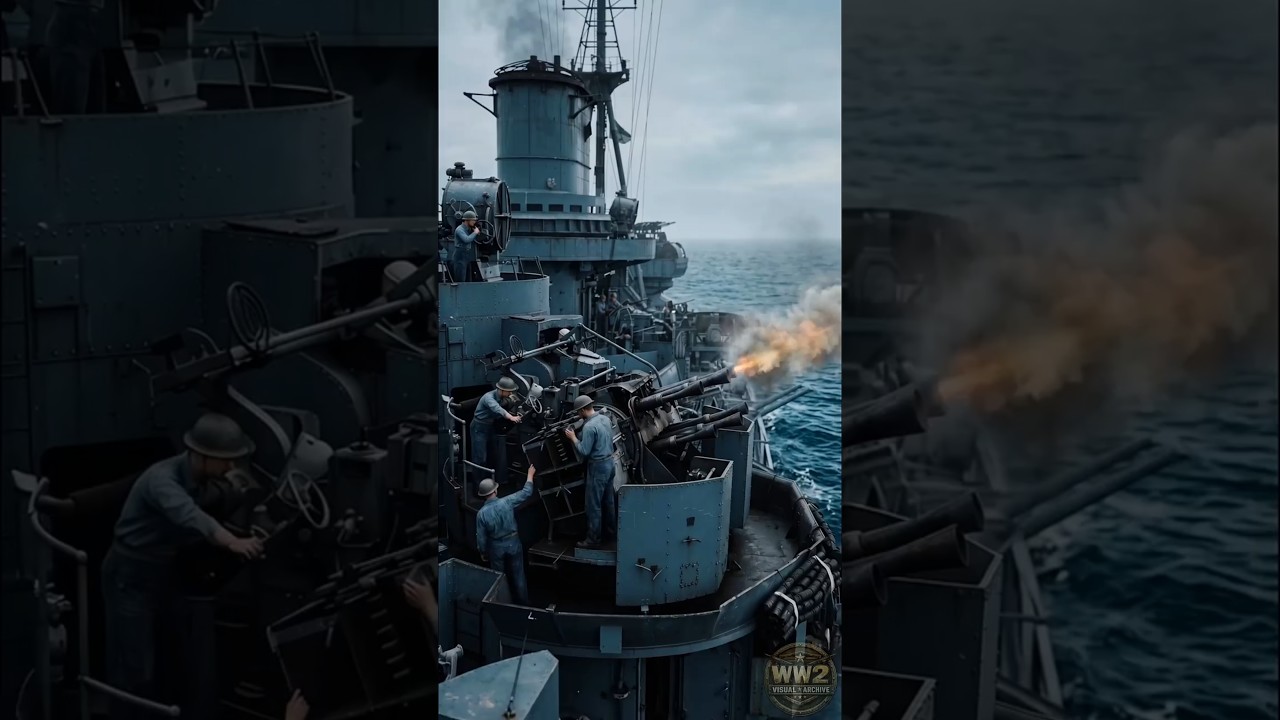
High-Cadence Recoil & Link Stabilization
Original 1940s 35mm and 16mm combat cameras shot at 18 to 24 frames per second, causing fast-moving Pom-Pom barrels and ejecting brass shells to blur into indistinct streaks. We apply motion-compensated optical flow to recover crisp edges on every conical flash hider and belt link.
Gunmetal, Blued Steel & 70/30 Cartridge Brass
The Mark VIII mechanism combined dark blued steel water jackets, unpainted phosphor-bronze/gunmetal breech fittings, and bright C26000 cartridge brass. Each metallic surface was masked separately so brass belts never bleed warm hues onto the cold steel barrels.
Cordite Muzzle Flash & Smoke Plume Grading
British solventless cordite (SC) produced a characteristic deep amber-orange flash followed by dense, warm-grey smoke. We reconstruct clipped white highlights inside the muzzle blast to restore realistic dynamic range without blowing out adjacent crew helmets.
Admiralty Disruptive Schemes & Foul-Weather Gear
Crew uniforms are calibrated against Imperial War Museum textile specimens—distinguishing heavy camel-fawn wool Admiralty duffle coats and olive-drab Mk II Brodie helmets from dark blue No. 3 working dress and light blue tropical action working shirts.
 Dossier · File 007
The Steel Titan Reborn: Inside the Secret History and 4K Restoration of Battleship Yamato
Examine the 71,111-ton flagship of the Imperial Japanese Navy, her 46 cm Type 94 main battery, Operation Ten-Go, and our Kure Arsenal Gray 4K colorization pipeline.
 Ordnance · File 008
Type 94 46 cm Main Battery: Engineering the Largest Naval Guns Ever Mounted
Inside the 2,774-ton triple turrets capable of hurling 3,219-pound armor-piercing shells over 26 miles—and why their muzzle blast threatened exposed AA crews.
 Archive · 1,100+ Clips
Warships & Sky Killers: Complete 4K Naval & Anti-Aircraft Restoration Vault
From the Bofors 40 mm and German Flakvierling 38 to Bismarck, USS Iowa, and Atlantic wolfpack encounters—browse our complete restored film index.
Every restoration in the WW2 Visual Archive strips away decades of film degradation and monochrome distance—bringing the engineering, acoustic terror, and human reality of 1939–1945 into true-to-life 4K color.