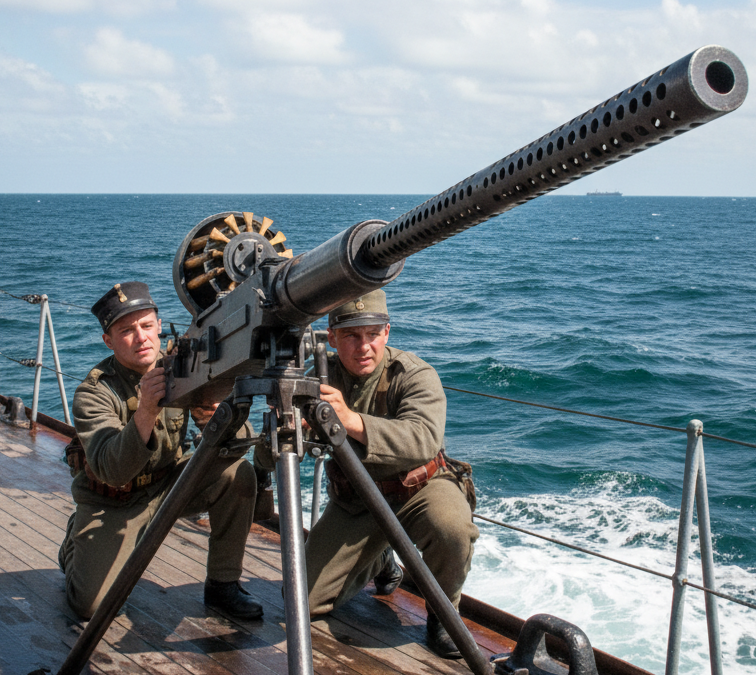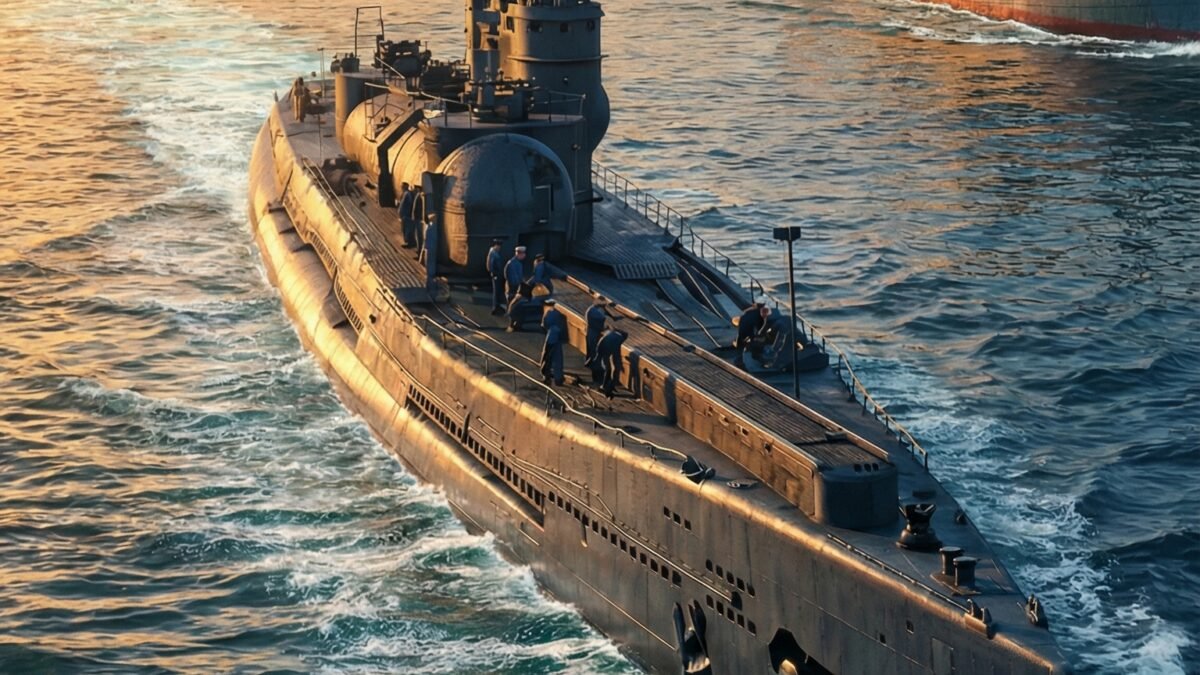
First Metric · Full Dive Weight. 6,560 TONS Displacing 3,530 tons dry, these boats led the world in size until 1960s nuclear subs.
Second Metric · Total Hull Length. 122.0 METERS With a 12.0 m beam and 7.02 m draft, each steel frame dived 100 meters deep.
Third Metric · Nonstop Sea Range. 37,500 NMI Cruising at 14 knots, the crew had enough fuel to circle the Earth 1.5 times.
Fourth Metric · Hidden Air Wing. 3 × M6A1 SEIRAN Stored inside a 31 m waterproof tube, each plane carried an 800 kg bomb or torpedo.
JAPAN’S GIANT UNDERSEA AIRCRAFT CARRIER: THE IJN I-400 SENTOKU FLEET
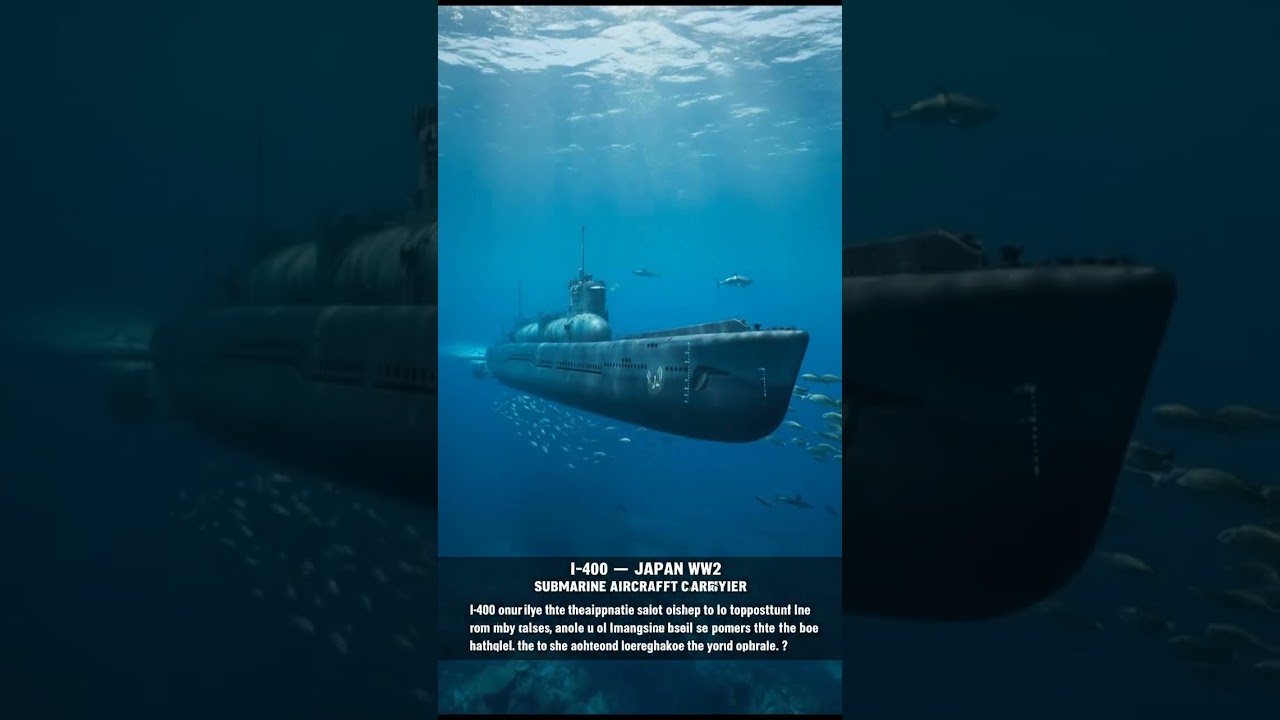
During the final winters of World War II, Japanese yards at Kure and Sasebo built a bold new warship. Specifically, they created an ocean-going submarine carrier. Known as the Sentoku-type (Special Sub), the lead boat IJN I-400 stretched 122 meters long. Moreover, it displaced 6,560 metric tons beneath the waves. As a result, each giant vessel worked as a self-contained underwater aircraft carrier. Crews could surface off a distant coast at night and launch three Aichi M6A1 Seiran strike bombers in minutes. Soon after, the massive boat slipped back under the sea before coastal guards could strike back.
At first, Admiral Isoroku Yamamoto planned this fleet in January 1942. Above all, he wanted to bomb American East Coast cities and the Panama Canal. Therefore, the I-400 project pushed diesel sub building to its outer limits. For example, naval designers built a twin-tube figure-eight pressure hull. Then, they topped it with a 31-meter waterproof hangar and a 26-meter air catapult. In addition, yard crews armed the upper deck with ten Type 96 25mm anti-aircraft guns. They also mounted a 14cm deck gun and German radar detectors. In the end, only three sister boats—I-400, I-401, and I-402—entered service before August 1945. Even so, their bold layout shaped Cold War missile subs.
SIAMESE “FIGURE-8” TWIN PRESSURE HULL GEOMETRY
Japanese builders joined two steel tubes side by side beneath an offset bridge and hangar pipe. As a result, they stopped top-heavy rolling at sea. Moreover, this twin frame resisted crushing water pressure 100 meters below the ocean surface.
STRATEGIC CONCEPTION: YAMAMOTO’S TRANSPACIFIC DOCTRINE
From the Pearl Harbor Aftermath to Project Number 623 (January 1942 – June 1942)Why the Imperial Japanese Navy Built Submarine Carriers
Long before December 1941, Japanese planners studied the vast spans of the Pacific Ocean. Soon, they saw that long-range subs needed their own scout planes. For this reason, the Imperial Japanese Navy led the world in testing sub-launched floatplanes during the late 1920s and 1930s. Over the course of World War II, Japan built forty-two aircraft-carrying subs for service across the Pacific and Indian Oceans. By contrast, German Kriegsmarine U-boats hunted cargo convoys in Atlantic wolfpacks. Meanwhile, Japanese fleet boats served as eyes for the main battle fleet.
In addition, early sub-carrier trials gave Japanese crews vital deck experience before war broke out. Mechanics learned how to seal small deck hangars against salt water and pull floatplanes onto folding tracks in rolling seas. Furthermore, builders tested compressed-air catapults on the Junsen cruiser subs I-5, I-6, and I-7 during the mid-1930s. Because these early tests succeeded, senior admirals trusted sub aviation when global war arrived in 1941.
Early Scout Subs and the 1942 Oregon Forest Bombing
Soon after Pearl Harbor, Type B1 fleet subs proved that small floatplanes could fly over enemy harbors and return unseen. For example, scouting flights photographed Pearl Harbor, Sydney, Diego Suarez, and the Aleutian Islands ahead of major fleet moves. Then, in September 1942, the sub I-25 surfaced off the misty coast of Oregon. Warrant Officer Nobuo Fujita launched into the morning sky aboard a tiny Yokosuka E14Y “Glen” floatplane.
Next, Fujita dropped two incendiary bombs over the Siskiyou National Forest near Brookings, Oregon. Thus, a sub-launched plane carried out the only aerial bombing of the United States mainland during World War II. Even so, the fragile E14Y carried only two 76-kilogram bombs and flew at just 150 knots. Therefore, Japanese commanders realized they needed a much larger sub and a true high-speed attack bomber to inflict serious damage.
Admiral Yamamoto’s Secret January 1942 Strike Plan
Following the Pearl Harbor attack, Admiral Isoroku Yamamoto assessed the strategic balance. Clearly, Japan could not win a long shipyard race against America. Instead, he wanted to shock Washington with surprise air raids. Specifically, he aimed at New York, Washington, D.C., and the Panama Canal. On 13 January 1942, Yamamoto sent a top-secret outline to the Navy General Staff from his flagship cabin. He asked builders for eighteen giant ocean-crossing subs that could operate without surface warship support.
Moreover, Yamamoto insisted that each boat carry enough diesel fuel to sail to the American coast and return home nonstop. He also demanded that each vessel store heavy bombers capable of dropping 800-kilogram armor-piercing bombs or aerial torpedoes. In short, Yamamoto envisioned a hidden undersea strike force. These boats would cross the ocean, surface at night, and hit distant targets without warning.
Project Number 623 and Wartime Shipyard Cuts
To turn Yamamoto’s idea into steel, Captain Kameto Kuroshima led the initial study. Next, Rear Admiral Keiji Fukuda drafted the blueprints under Project Number 623. At first, the 1942 plan called for eighteen Sentoku (“Special Type”) subs, each carrying two attack planes. On 18 January 1943, workers at Kure Naval Arsenal began assembly. There, they laid down the heavy keel plates for the lead boat, I-400. Soon after, Sasebo Naval Arsenal began work on sister hulls I-401 and I-402.
However, in April 1943, American P-38 Lightning fighters ambushed and shot down Admiral Yamamoto over Bougainville. After his death, severe steel shortages and Allied sub attacks slowed Japanese shipyard output. As a result, the Navy Ministry slashed the Sentoku building plan. Production dropped from eighteen boats to nine, then five, and finally three hulls. Meanwhile, Captain Tatsunosuke Ariizumi pushed for greater strike power in late 1943. Consequently, builders lengthened the hangar on I-400 and I-401 to hold three bombers.
NAVAL ARCHITECTURE: THE FIGURE-8 PRESSURE HULL
Twin-Cylinder Stability, 7,700 HP Diesel Engines & 37,500-Mile EnduranceSolving Roll Problems with a Twin Figure-Eight Hull
Mounting a 31-meter steel hangar tube on deck created a major balance problem. Moreover, the heavy bridge tower added even more top-side weight. If designers simply built one wider round hull, draft would increase sharply. Then, the boat would sit too deep for Japanese drydocks. Worse still, the heavy deck hangar raised the center of gravity. Without a wide base, the sub would roll wildly in rough seas. Therefore, Kure’s naval builders came up with a clever twin-cylinder frame.
Along the middle of the boat, workers welded two parallel steel tubes side by side along a thick center wall. Seen from the front, this midships frame formed a flat figure-eight cross-section. Forward of the hangar, the twin tubes blended into a single bow frame. Similarly, the stern tapered back into a single round hull. Because the twin cylinders spread weight outward, stability improved dramatically. Thus, I-400 rode steady as a destroyer in heavy Pacific storms.
Thick Ducol Steel Plates and Deep-Diving Strength
Building a figure-eight pressure hull required immense structural strength to survive deep water pressure. For this reason, foundry crews rolled the inner plates from high-strength DS (Ducol) steel. Each plate measured 50 millimeters (nearly two inches) thick. In addition, heavy steel ribs locked the left and right tubes together. Therefore, the twin frame never flexed during steep crash dives.
Furthermore, designers split the twin tubes into eight watertight zones separated by thick spherical blast doors. If an Allied depth charge cracked one side, compartmental walls held back the sea. Meanwhile, crews flooded opposite tanks to keep the boat level. Thanks to this rugged steel framing, I-400 achieved a safe test depth of 100 meters (328 feet). Remarkably, that diving depth matched smaller fleet subs. Even the huge hollow hangar on deck did not weaken the frame.
Four 10-Cylinder Diesels and a 37,500-Mile Range
Pushing a 6,560-ton warship halfway around the Earth required reliable engines and vast fuel tanks. Consequently, builders installed four Kampon Type 22 Model 10 ten-cylinder diesel engines. Two engines sat in the port hull, while two sat to starboard. Together, these four engines delivered 7,700 brake horsepower to twin bronze propellers. On the surface, I-400 reached a top speed of 18.7 knots. Underwater, two electric motors drove the boat at 6.5 knots.
Above all, the wide outer hull held nearly 1,600 tons of diesel fuel oil. Cruising at a steady 14 knots on the surface, I-400 could steam 37,500 nautical miles (69,400 kilometers) without refueling. By comparison, that range quadrupled the reach of German battleship Bismarck. It also beat every Allied fleet sub in service. In fact, no other diesel submarine ever matched that nonstop distance. Only Cold War nuclear boats finally surpassed it in the late 1950s.
Rubber Sonar Coatings and Life Aboard for 144 Sailors
Because I-400 presented a huge underwater target to Allied sonar operators, Japanese chemists added stealth defenses to the outer skin. Workers coated the steel hull from keel to waterline with a special rubber mix blended from gum, asbestos, and adhesive. Based on German Alberich acoustic tiles, this coating absorbed and scattered enemy sonar pings. Moreover, four electric cables wrapped around the outer hull. These coils canceled magnetic fields so magnetic mines would not fire.
Inside the twin tubes, ninety-day patrols tested the endurance of the 144 to 157 officers, sailors, and air mechanics. To keep the crew healthy across three months at sea, the sub carried huge cold-storage freezers, rice cookers, and fresh-water stills. Even so, bunks were scarce because spare torpedoes, bomb racks, and tool chests filled every corner. Thus, enlisted sailors slept in tight shifts on canvas cots. Many bunks hung right beside the hot diesel engines and torpedo tubes.
CONCEALED AIRFIELD: HANGAR & CATAPULT MECHANICS
The 31-Meter Waterproof Cylinder, Hydraulic Doors & Type 4 Air CatapultInside the 31-Meter Waterproof Aircraft Tunnel
Rising from the upper casing deck just behind the bridge stood the defining feature of the Sentoku class. This welded steel cylinder measured 3.5 meters (11.5 feet) across on the inside and stretched 31.0 meters (102 feet) long. Its walls had to survive 100-meter ocean dives without leaking a drop. Therefore, builders rolled the tube from thick steel plates braced by external rings.
At the forward mouth of the tunnel, heavy hydraulic rams swung open a two-ton clamshell hatch. When closed for diving, steel dogs locked this massive door tight against a two-inch solid rubber seal. Inside the bright white-painted tunnel, three Aichi M6A1 Seiran bombers sat nose-to-tail on wheeled launch carts. Meanwhile, wall brackets inside the tunnel held four 800-kilogram bombs and twelve 250-kilogram bombs. Overhead racks also carried three 800-kilogram Type 91 aerial torpedoes.
Offsetting the Bridge Tower for the 26-Meter Catapult
Fitting a long aircraft launch track onto a submarine bow forced designers to rethink the entire upper deck. On a normal sub, the conning tower sits dead center above the keel. On I-400, however, a centered tower would block planes rolling out of the hangar tunnel. Therefore, engineers shifted the entire bridge tower seven feet to the port side. At the same time, they nudged the hangar mouth slightly to starboard.
Thanks to this offset layout, the hangar door had a clear path forward. It opened straight onto a 26.0-meter Type 4 compressed-air catapult track. Four giant high-pressure air flasks buried below the forward deck powered the catapult piston. When fired, compressed air hurled each 4,250-kilogram bomber down the rail at 75 knots. Thus, the plane lifted cleanly into the air above the bow waves.
STORING & LAUNCHING THREE SEIRAN BOMBERS IN UNDER 45 MINUTES
01 · Surface Blow & Oil Pre-Heat
Before breaking the surface, mechanics pumped hot oil and 70°C water coolant from the sub’s diesel engines straight into all three Seiran V-12 engines. Thus, pilots skipped the slow 20-minute cold warm-up.
02 · Hatch Open & Winch Rollout
Once the bow cleared the waves, hydraulic rams swung open the 3.5-meter hangar door. Next, an electric cable winch pulled the first bomber on its wheeled trolley out onto the forward launch track.
03 · Wing Turn & Float Attachment
Deck crews rotated the wings 90 degrees forward, unfolded the tail fins, and locked the wing pins using glowing night marks. Meanwhile, handlers clipped the twin floats onto the struts below the belly.
04 · Compressed-Air Catapult Salvo
High-pressure air flasks drove the launch shuttle down the 26-meter rail, firing each bomber into the sky at 75 knots. As a result, all three planes launched within 30 to 45 minutes (or 15 minutes without floats).
Pre-Heating Plane Engines Before Breaking the Surface
Every extra minute a 122-meter sub spent on the ocean surface invited disaster from Allied patrol planes and radar destroyers. On earlier floatplane subs, flight crews wasted twenty precious minutes on deck just warming up cold aircraft oil before takeoff. Therefore, Kure’s engineers built a clever internal heating system inside the I-400 hangar tunnel.
While the sub still cruised underwater, mechanics prepared the planes for launch. Specifically, they hooked insulated pipes from the main diesels to all three bombers. Hot lubricating oil and 70°C heated radiator water flowed straight into the aircraft blocks. At the same time, ship cables charged each plane’s battery. High-pressure air lines also filled the rear machine gun chargers. Consequently, the Seiran engines roared to full takeoff power the instant they rolled onto the open deck.
Glowing Night Pins and the 4-Ton Recovery Crane
Because combat launches had to happen in total darkness before dawn, deck handlers could not use flashlights without alerting enemy lookouts. To solve this problem, technicians painted every wing hinge, locking pin, fuel cap, and bomb latch with glow-in-the-dark radium paint. Guided only by these glowing marks, four-man teams worked in total darkness. Consequently, they unfolded the wings and locked the spars in under four minutes.
Moreover, two separate sets of twin pontoons rested inside special waterproof lockers built into the port and starboard forward deck casing. While one crew unfolded the wings, another team slid a pair of floats backward and snapped them onto the wing struts. On recovery missions, pilots landed on the water beside the hull. Then, a folding four-ton electric crane hoisted each floatplane back aboard.
CLEAR SKY STORM: THE AICHI M6A1 SEIRAN
Butterfly Wing Folding, German-Licensed V-12 Engine & 800 kg PayloadDesigning an Attack Bomber to Fit Inside a 3.5-Meter Pipe
Before 1942, every sub-launched airplane in the world was a slow, lightly armed observation floatplane. By contrast, the Imperial Japanese Navy wanted a true strike plane in May 1942. Therefore, they ordered chief designer Toshio Ozaki at Aichi Kokuki to build a fast bomber. Aichi named the plane the M6A1 Seiran (“Clear Sky Storm”). Because of strict secrecy, Allied intelligence never learned of its existence until 1945.
Still, Ozaki and his team faced a tough geometric puzzle. To carry an 800-kilogram bomb or torpedo over 1,100 kilometers, the two-seat monoplane needed a wide 12.26-meter (40-foot) wingspan. Yet the entire aircraft had to slide smoothly inside a submarine hangar pipe measuring just 3.5 meters across. Even a single bent wing tip inside that narrow steel tube would jam the launch line and ruin the entire mission.
Butterfly Folding Wings and Compact Tail Hinges
To make the big bomber fit, Aichi engineers designed a two-step hydraulic wing joint inspired by a folding butterfly. First, deck mechanics unlocked the main wing spar. Next, they turned both wings 90 degrees until the leading edges pointed straight down. Second, handlers swung the wings backward flat against the fuselage sides. Padded clamps then held the wings tight while the sub rolled at sea.
In addition, both horizontal tail fins folded downward and the top half of the vertical tail rudder hinged over to the right side. When fully folded, the bomber’s width shrank from 12.26 meters down to just 2.28 meters (7.5 feet). As a result, three Seiran bombers fit neatly inside the 31-meter hangar tube. Mechanics still had enough room to walk past and load bombs.
German-Licensed V-12 Power and Drop-Off Pontoons
Most Japanese Navy carrier planes used wide air-cooled radial engines, but a wide cowling would block workspace inside the tight sub hangar. Therefore, Ozaki chose the slim, liquid-cooled Aichi Atsuta 32 inverted V-12 engine. Aichi built this 1,400-horsepower engine under license from Germany’s famous Daimler-Benz DB 601A. Because the cylinders sat in a narrow V-block, the Seiran had a sleek nose.
Furthermore, the Seiran could fly with or without its twin aluminum floats. With floats attached for water recovery, the plane cruised at 425 km/h (264 mph). However, for urgent raids, crews left the twin floats inside their deck lockers. Pilots then launched directly off the catapult cart and ditched beside the sub afterward. Without float drag, top speed jumped to 474 km/h (295 mph). Thus, the bomber could carry an 800-kilogram load and still outrun older fighters.
The Nanzan Land Trainer and the Last Surviving Seiran
Because Aichi built only twenty-eight Seiran airframes during the war, every single plane was precious. Pilots also needed a safe way to practice dive-bombing from land bases. Therefore, Aichi built two wheeled trainers called the M6A1-K Nanzan (“Southern Mountain”). In that cockpit, the pilot sat in front while the navigator-observer operated the radio and aimed a rear 13mm Type 2 machine gun.
After Japan surrendered in August 1945, workers destroyed or dumped almost every Seiran into the sea. Fortunately, U.S. Navy intelligence officers found the final production bomber—serial number 28—inside Aichi’s factory at Eitoku and shipped it to California. After sitting in storage for decades, museum specialists spent ten years restoring the rare aircraft. Today, that sole surviving Seiran rests in Virginia. Visitors can see it at the Smithsonian National Air and Space Museum.
SURFACE & AIR DEFENSE: SUBMARINE FLAK & ORDNANCE
10 × 25mm Type 96 AA Cannons, 14cm Deck Gun & Axis/Allied Naval Flak ComparisonWhy the Sub Needed Ten 25mm Anti-Aircraft Cannons
While steaming on the surface to unfold three bombers, I-400 faced extreme danger from the sky. If an enemy plane attacked while the 3.5-meter hangar door stood open, the sub could not dive right away. Otherwise, ocean water would flood the open tunnel and sink the boat. Therefore, Japanese designers turned the flat roof of the 31-meter hangar into a gun fortress.
Specifically, workers bolted three waterproof triple 25mm/60 Type 96 AA gun mounts atop the hangar roof. Two triple mounts sat forward of the bridge, while the third sat aft. In addition, a fourth single 25mm Type 96 cannon stood on a pedestal behind the bridge tower. Together, those ten 25mm barrels gave the sub more close-in anti-aircraft firepower than many fleet destroyers.
The 14cm Deck Gun and Eight Bow Torpedo Tubes
Behind the hangar tube, builders mounted a heavy 14 cm/40 (5.5-inch) naval deck gun. Firing a 38-kilogram shell out to 15,800 meters, this weapon could shell shore targets. Moreover, it let the crew fight off surface patrol craft. Waterproof tampions sealed the gun barrel and breech block before the submarine dived.
Even more deadly was the sub’s underwater punch. Because of the wide figure-eight hull, builders fitted eight 533mm (21-inch) torpedo tubes in the bow. These tubes sat in two vertical stacks of four. Below deck, racks held twenty Type 95 oxygen torpedoes. Each torpedo carried a 405-kilogram warhead and sped toward targets at 49 knots.
Japanese 25mm Mounts vs. German U-Boat Flak Traps
Deadly Allied air patrols forced both Japan and Germany to arm their subs with rapid-fire AA guns. Specifically, Japan relied on the 25mm Type 96 cannon, firing 250-gram shells at 900 meters per second. Although its cyclic speed hit 260 rounds per minute, 15-round ammo clips slowed practical fire to 115 rounds per minute. Meanwhile, Germany built a wide family of naval Flak guns for its Type VII U-boats and battleships like Bismarck.
For instance, German U-boat “Flak-traps” used the four-barrel 2 cm Flakvierling 38 alongside the 3.7 cm Flak M42U. On larger ships and towers, German crews manned the famous 8.8 cm Flak 36 and naval 8.8 cm SK C/35. They also fired stabilized 10.5 cm SK C/33 and twin 12.8 cm Flak 40 guns. On the other hand, Allied ships at Ulithi used radar-guided 5-inch mounts and quad Bofors 40mm cannons.
German Radar Detectors and the Hydraulic Snorkel Mast
Beyond home-built weapons, the I-400 fleet gained vital gear from secret Axis sub trips called Yanagi missions. Alongside Japanese Type 22 and Type 3 radar sets, the boats carried German FuMO 29 search radars. Moreover, workers wired German E27 Metox and Borkum warning receivers into the bridge tower. Thus, lookouts heard a sharp tone whenever Allied planes swept the sky with radar.
In addition, during a May 1945 refit, workers gave I-401 a hydraulic diesel snorkel mast. Copied from late-war German U-boats, this pipe drew fresh air underwater. As a result, the sub could run its diesel engines and charge its batteries at periscope depth. Thus, the crew avoided surfacing in broad daylight across dangerous radar-patrolled waters.
4K ARCHIVAL STUDIO: RESTORATION & COLORIZATION
Inside Our 4K Rebuild of IJN I-400, Kure Naval Gray & Seiran CamouflageWhy Wartime Film of the Sentoku Fleet Is So Rare
Japanese naval guards strictly banned cameras inside Kure and Sasebo, so wartime film of I-400 is very rare. In fact, workers hung tall straw mats around the slipways to hide the twin hulls from fishermen. Consequently, most surviving clips come from spring 1945 sea trials and August 1945 US Navy boarding reels.
However, those old 16mm and 35mm film strips suffered from deep scratches, frame wobble, and sea-fog grain. In many original clips, the dark gray hull blended right into the black waves. Therefore, shadows hid the catapult rails and gun mounts from view.
Cleaning Scratch Marks and Matching Authentic Kure Gray
To bring I-400 into clear 4K 60fps focus, our studio built a custom film cleanup process. First, we stabilized frame motion and removed dust spots while keeping real steel weld lines sharp. Second, we lifted dark shadow levels. Now, viewers can clearly see inside the open 3.5-meter hangar hatch and gun tubs.
Finally, we matched every color tone against surviving shipyard paint chips and museum parts. Specifically, the steel hull and hangar tube wear authentic Kure Naval Arsenal Dark Gray. Above the hull, the upper deck shows weathered Japanese cypress planking. Meanwhile, the lower hull displays red-oxide paint, and the bombers wear dark Imperial Navy green.
Also in 4K: bow wave & bridge tower study.
INTERACTIVE 4K COLOR & DETAIL COMPARISON SLIDER
Drag Handle: B&W vs. 4K Color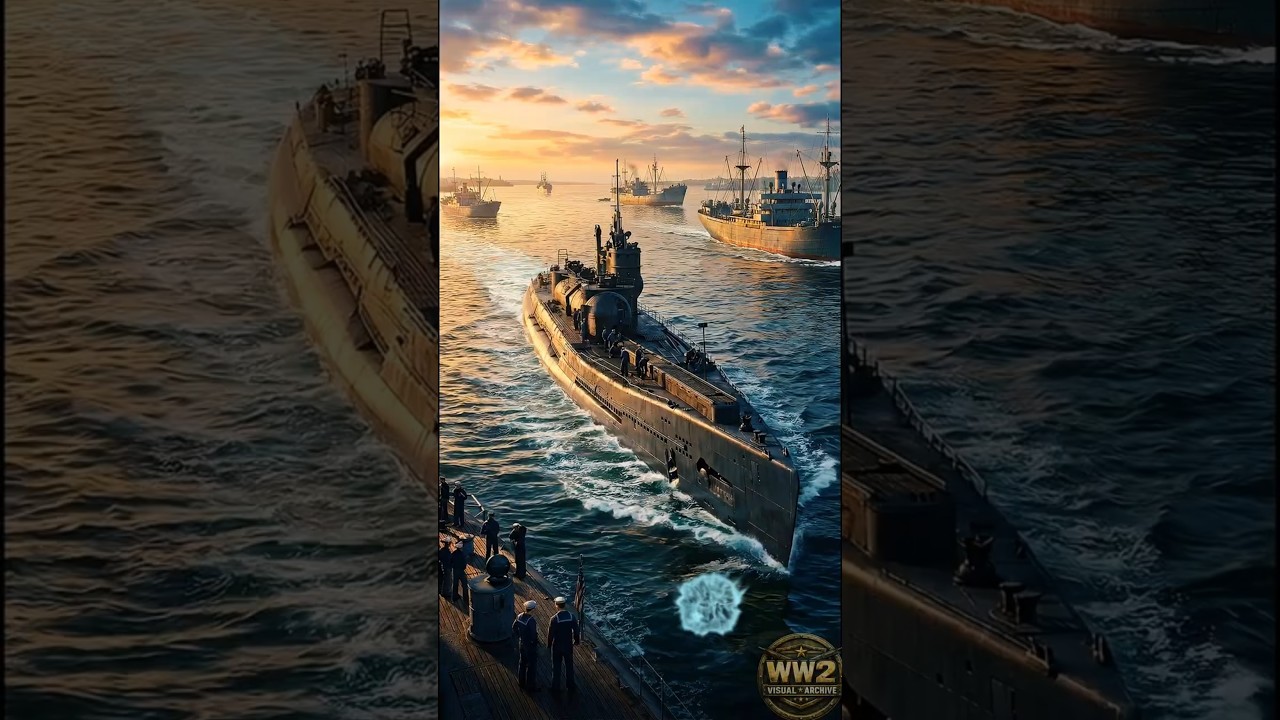
Color Tuning Notes. Our 4K color pass matches surviving Kure Dark Sea Gray paint samples across the hull and hangar. Furthermore, it restores natural cypress deck wood, red-oxide lower hull paint, and the deep green Seiran finish.
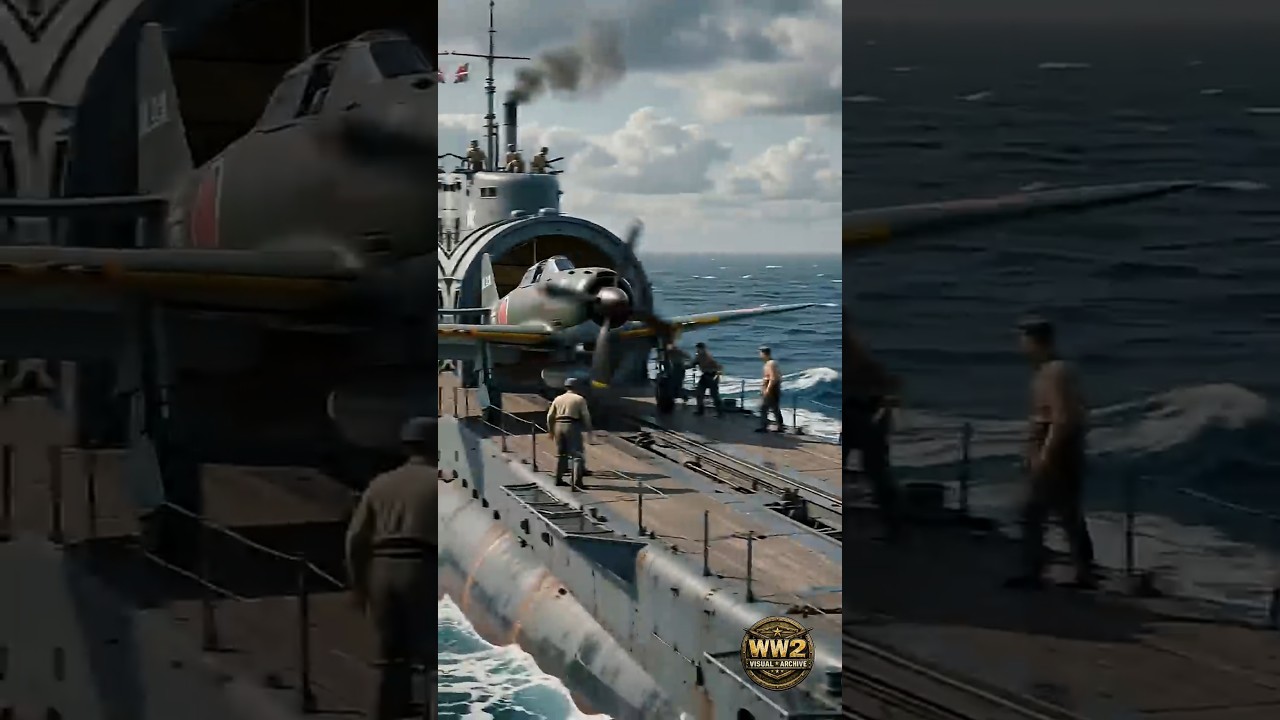
31m Hangar Hatch & Type 4 Catapult
Taken from Reel #02, this frame shows the open 3.5-meter hangar door and the inclined forward launch rail.
Port-Offset Bridge & Hangar Tube
Captured from Reel #01, this view shows how the bridge tower stepped seven feet to port to clear the catapult track.
Triple 25mm Type 96 AA Gun Tubs
Drawn from Reel #04, this shot highlights the three triple 25mm gun mounts crowning the hangar roof and aft deck.
OPERATION PX & PANAMA: TARGETING THE GATUN LOCKS
Commander Fujimori Yasuo’s Plan to Drain Gatun Lake and Halt Allied ShippingWhy Japanese Planners Aimed at the Gatun Locks
By late 1944, American yards sent carriers and USS Iowa-class battleships straight through the Panama Canal. For this reason, Commander Yasuo Fujimori studied the canal’s weak points. Soon, he picked the Caribbean Gatun Locks as the best spot to cut Allied supply lines.
Specifically, artificial Gatun Lake sat twenty-six meters (85 feet) above sea level behind massive concrete and steel lock gates. If Seiran bombers broke those outer gates with 800-kilogram bombs, Gatun Lake would drain into the sea. Once the lake drained, no large warship could cross between the Atlantic and Pacific Oceans for at least six months.
Intelligence Gathering and Toyama Bay Lock Rehearsals
Before finishing the plan, naval officers found a Japanese engineer who had helped build the Panama Canal. He handed over detailed blueprints of the lock walls and water valves. Furthermore, he noted that the Pacific locks had steep hills and heavy torpedo nets. By contrast, the Caribbean Gatun approach offered a flat water run for torpedo planes.
To prepare for the raid, workers built a full-scale floating wooden model of the Gatun Locks in Toyama Bay. Throughout early 1945, elite pilots of the 631st Naval Air Group trained there every night. Specifically, they practiced night launches, torpedo drops, and dive-bombing runs until every crew hit the wooden gates.
Forming the First Submarine Flotilla Under Captain Ariizumi
To lead the raid, the Navy formed the 1st Submarine Flotilla under Captain Tatsunosuke Ariizumi. This strike group paired the three-plane subs I-400 and I-401 with the two-plane boats I-13 and I-14. Together, those four submarines carried ten Aichi M6A1 Seiran bombers—six armed with aerial torpedoes and four carrying 800-kilogram bombs.
At first, the plan called for the four boats to sail east past the Galapagos Islands. From there, they would launch their ten planes off the coast of Colombia. After striking the Gatun Locks at dawn, the pilots would ditch beside the subs or fly on to neutral territory. However, by spring 1945, fuel shortages and the American invasion of Okinawa forced planners to rethink the long two-month voyage.
Why General Umezu Blocked the San Diego Plague Plan
Meanwhile, in December 1944, staff officers drafted a dark plan called Operation Cherry Blossoms at Night (Operation PX). Working with Unit 731, they proposed sailing the giant subs to Southern California. From there, Seiran planes would drop ceramic bombs filled with plague-infected fleas over San Diego and nearby coastal towns.
Fortunately, in late March 1945, Army Chief of Staff General Yoshijiro Umezu vetoed Operation PX. Umezu warned that germ attacks on American cities would spark global outrage and terrible counterattacks against Japan.
OPERATION ARASHI: THE ULITHI ATOLL SORTIE
Manchurian Fuel Runs, Silver-Painted Seirans & the Final Voyage of July–August 1945Shifting the Target from Panama to Ulithi Lagoon
By May 1945, Germany’s defeat and the fall of Okinawa forced Tokyo to drop the Panama raid. After US planes sank Battleship Yamato in April 1945, American carrier groups approached Japan. Therefore, in June 1945, fleet planners gave Captain Ariizumi a closer target: Ulithi Atoll in the Western Carolines.
Ulithi’s deep coral lagoon served as the main forward staging base for the U.S. Third and Fifth Fleets, often holding fifteen to twenty fleet aircraft carriers and Iowa-class battleships at anchor. The new plan joined two linked missions. First, under Operation Hikari (“Light”), subs I-13 and I-14 carried four crated Saiun scout planes to Truk. From Truk, high-flying cameras would map the anchored US carriers at Ulithi. Second, under Operation Arashi (“Storm”), I-400 and I-401 would launch six Seiran bombers against Ulithi on 17 August 1945.
Sailing to Manchuria for Low-Grade Shale Oil Fuel
Before the subs could sail south toward Ulithi, they needed more than three thousand tons of diesel fuel. By spring 1945, however, American B-29 mines and submarine blockades had emptied the oil tanks at Kure and Yokosuka. Consequently, I-400 and I-401 had to risk dangerous fuel runs across mine-filled seas. Both boats sailed to the port of Dairen in Manchuria.
In April 1945, I-400 dodged two US torpedoes, reached Dairen safely, and loaded Manchurian shale oil. However, when I-401 sailed out of the Seto Inland Sea in April, she hit an American B-29 mine. After drydock repairs at Kure, I-401 finished her own fuel run in June and joined I-400 at Nanao Bay.
FROM KURE DOCKYARD & ULITHI STRIKE TO THE 2,300-FOOT HAWAIIAN ABYSS
18 Jan 1943 – 30 Dec 1944 · Kure Naval Arsenal Construction
Laid down at Kure on 18 January 1943, the lead sub launched in January 1944. Next, she entered service on 30 December 1944 under Commander Toshio Kusaka. Meanwhile, sister boat I-401 joined the fleet nine days later at Sasebo.
Also shown: 31m hangar & deck crew stations.
Painting American Stars on Silver Seiran Bombers
Before leaving Ominato on 23 July 1945, mechanics removed the floats from all six Seiran bombers. Flying without floats added 50 km/h of speed to pierce Ulithi’s Bofors 40mm AA screen. Even more controversially, staff officers ordered painters to coat the six planes in silver. They also painted American white-star-and-bar markings on the wings.
That disguise order sparked bitter anger among the young pilots of the 631st Naval Air Group. Several pilots protested strongly to their flight commander. They argued that flying under enemy colors shamed their honor and broke the rules of war. Even so, flotilla staff overruled them. Officers claimed that confusing American lookouts for a few minutes was the only way to reach the carriers.
The Loss of I-13 and the Missed Rendezvous at Ponape
Meanwhile, bad luck struck the advance scouting subs. On 16 July 1945, patrol planes from the American escort carrier USS Anzio and destroyer escort USS Lawrence C. Taylor caught and sank I-13 in the North Pacific with all hands. Fortunately for the Japanese plan, sister boat I-14 slipped past American patrols. She delivered her two crated Saiun scout planes to Truk Lagoon on 4 August.
At the same time, I-400 and I-401 sailed south along separate paths toward a secret meeting point off Ponape Island. Along the way, however, a severe electrical fire broke out inside the main switchboard room aboard I-400. Thick smoke filled the hull, forcing Commander Kusaka to surface at night to clear the air. Because the fire knocked out I-400‘s radio, the two subs missed their first link-up. Meanwhile, atomic bombs fell on Hiroshima and Nagasaki.
CAPTURE AT SEA & COLD WAR SCUTTLING
Dumping the Silver Seirans, Boarding by USS Segundo & the 1946 Oahu Torpedo TestsPushing the Silver Bombers Into the Pacific After Surrender
On 15 August 1945—just two days before the Ulithi attack—Emperor Hirohito announced Japan’s surrender. When ceasefire orders reached I-400 and I-401 the next day, crews wept on the bridge. Obeying strict orders to destroy secret weapons, sailors set to work erasing every trace of their disguised bombers.
Aboard I-400, mechanics rolled all three silver bombers onto the launch track with folded wings. One by one, the catapult shot the dead planes into the deep ocean, hiding their American star markings. Similarly, sailors aboard I-401 pushed their three planes overboard and fired twenty unarmed torpedoes into the sea.
American Boarding Parties and the Death of Captain Ariizumi
For nearly two weeks, the giant subs steamed north toward Honshu flying black surrender flags from their periscope shears. Then, on 28 August 1945, a US patrol plane spotted I-400 about 500 miles east of Honshu. Soon after, destroyer USS Blue (DD-744) and sub USS Tigrone came alongside and boarded the giant vessel.
Early the next morning, on 29 August, the American submarine USS Segundo (SS-398) intercepted sister ship I-401 off Sanriku. American sailors stared in awe at a sub that dwarfed their own boat by nearly a hundred feet. Just before the US crew raised the Stars and Stripes over I-401 on 31 August, tragedy struck. Flotilla Commander Captain Tatsunosuke Ariizumi took his own life in his cabin rather than surrender.
Operation Road’s End and Drydock Tests at Pearl Harbor
When US Navy engineers walked inside the 31-meter hangar at Yokosuka, the sub’s scale stunned them. Until that week, Allied officers had no idea Japan owned a 6,560-ton underwater carrier. Under Operation Road’s End, US crews sailed I-400 and I-401 across the Pacific to Pearl Harbor in January 1946.
Over the next four months, US Navy teams placed I-400 in drydock at Pearl Harbor for deep study. Specifically, technicians measured the 50-millimeter steel plates and tested the hydraulic hangar door. They also mapped the oil pre-heating pipes and sampled the rubber sonar coating. Detailed blueprints and technical reports soon flowed back to the Bureau of Ships in Washington.
Torpedoing the Subs Off Oahu to Block Soviet Inspection
By spring 1946, however, tension between Washington and Moscow was turning into the Cold War. Earlier, Soviet officers had inspected the third sister boat, I-402, before US ships sank her off Japan in April 1946. Now, Moscow demanded permission for Soviet submarine engineers to travel to Pearl Harbor and inspect I-400 and I-401 in person.
US Navy leaders feared that Moscow might copy the figure-eight hull and hangar to launch missiles against America. Therefore, they ordered the captured subs at Pearl Harbor towed off Barbers Point, Oahu, as torpedo targets. On 31 May 1946, USS Cabezon sank I-401. Four days later, on 4 June 1946, USS Trumpetfish (SS-425) fired three Mark 18 torpedoes into I-400, sinking her 2,300 feet deep.
THE WRECK AT 700 METERS & COMPLETE SPECIFICATIONS
NOAA & Hawaii Undersea Research Lab Discoveries (2005 & 2013) + Full Design SpecsFinding I-401 (2005) and I-400 (2013) on the Hawaiian Seabed
For nearly sixty years after the 1946 sinkings, the exact wreck sites of I-400 and I-401 remained unknown. Then, on 17 March 2005, chief pilot Terry Kerby led a dive with the Hawaii Undersea Research Lab (HURL) and NOAA. Guiding the deep-sea craft Pisces IV and Pisces V, they found I-401 resting upright at 820 meters (2,690 feet).
Eight years later, in August 2013, Kerby and the HURL/NOAA team investigated a sharp sonar anomaly several miles away. At a depth of 700 meters (2,300 feet) southwest of Oahu, their lights revealed the giant hull of IJN I-400. After finishing site reviews with NOAA, the team announced the historic find to the public in December 2013.
What Deep-Sea Cameras Revealed Inside the Wreckage
Video shot by Pisces V showed where the three Mark 18 torpedoes hit I-400 in June 1946. As the boat plunged 2,300 feet, water pressure tore away the bow and separated the 26-meter catapult track.
Remarkably, however, the massive 31-meter waterproof aircraft hangar tube survived the blast and impact intact. Its thick round door frame still yawns open toward the bow, exactly as American crews left it in 1946. Above the tunnel, the port-offset bridge tower and twin bronze periscope masts remain in place. Furthermore, the three triple 25mm Type 96 AA gun mounts still stand upright in the cold current.
How the Sentoku Class Inspired Cold War Missile Subs
Although I-400 never launched a bomber in battle, historians view her as the forerunner of modern missile subs. Before 1942, navies used subs solely to sink ships. By contrast, Kure’s builders proved that a giant sub could cross the ocean unseen and strike targets far inland.
In fact, less than a decade after sinking I-400 off Oahu, the U.S. Navy borrowed her exact layout for its own Cold War Regulus nuclear cruise-missile submarines. Specifically, boats like USS Tunny, USS Grayback, and nuclear sub USS Halibut carried huge deck hangars forward of the bridge. From there, crews launched winged Regulus jet missiles off bow rails—repeating the exact concept born at Kure in 1943.
IJN I-400 (SENTOKU-CLASS) — HULL, DIMENSIONS & PROPULSION SPECS
Part 1 · Commissioned 30 December 1944 (Kure Naval Arsenal)- First Spec · Class & Official Name. Built as the Sentoku (Special Type) Submarine Aircraft Carrier (伊四百型潜水艦), this class led Sub Division 1.
- Second Spec · Completed Sister Boats. Japan finished three hulls: I-400 at Kure, plus I-401 and fuel-tanker I-402 at Sasebo.
- Third Spec · Cancelled Sister Hulls. Planners cut I-403 in 1943, while US planes sank I-404 at Kure and workers scrapped I-405.
- Fourth Spec · Surface & Dive Weight. Displacing 3,530 tons standard and 5,223 tons surfaced, the boat reached 6,560 metric tons when fully submerged.
- Fifth Spec · Overall Hull Dimensions. Measuring 122.0 meters (400 ft 3 in) long, the hull had a 12.0-meter beam and a 7.02-meter surface draft.
- Sixth Spec · Twin Pressure Hull Frame. Built with a figure-eight twin-tube midships hull of 50 mm Ducol steel, the boat safely dived 100 meters deep.
- Seventh Spec · Surface Diesel Engines. Four Kampon Type 22 Model 10 diesel engines produced 7,700 horsepower, driving twin shafts at 18.7 knots.
- Eighth Spec · Electric Motors & Range. Two electric motors delivered 2,400 horsepower for 6.5 knots submerged, while surface range hit 37,500 nautical miles.
IJN I-400 (SENTOKU-CLASS) — AVIATION, TORPEDO & FLAK ARMAMENT SPECS
Part 2 · Hangar, Air Wing, Guns & Radar Suite- First Feature · Waterproof Deck Hangar. Measuring 31.0 meters long by 3.5 meters wide, the deck cylinder fed onto a 26.0-meter Type 4 air catapult.
- Second Feature · Embarked Strike Planes. Three Aichi M6A1 Seiran two-seat bombers rode inside, each powered by a 1,400 hp Atsuta 32 V-12 engine.
- Third Feature · Aviation Bomb & Torpedo Load. Ordnance racks inside the tunnel held three 800 kg Type 91 aerial torpedoes, four 800 kg bombs, and twelve 250 kg bombs.
- Fourth Feature · Bow Torpedo Battery. Eight 533 mm (21-inch) bow torpedo tubes fired twenty Type 95 oxygen torpedoes carrying 405 kg warheads at 49 knots.
- Fifth Feature · Anti-Aircraft & Deck Guns. Ten 25 mm Type 96 AA cannons (three triple mounts and one single) joined one aft 14 cm/40 naval deck gun.
- Sixth Feature · Radar, Snorkel & Crew. Equipped with Type 22/Type 3 radars, German FuMO 29 gear, and a snorkel mast, the sub carried 144 to 157 crewmen.
Comparing I-400 Against Other Giant Submarines of World War II
To see how far the Sentoku class stood above other designs, we can compare I-400 against three famous boats. Below, our table contrasts I-400 with IJN I-13/I-14, the French cruiser sub Surcouf, and Germany’s Type XXI U-boat.
| Design Metric | IJN I-400 (Sentoku) | IJN I-13 / I-14 (Type AM) | French Surcouf (1934) | German Type XXI U-Boat |
|---|---|---|---|---|
| Primary Role | 3-Plane Strike Carrier Sub | 2-Plane Command Carrier Sub | Cruiser Sub (Twin 203mm Guns) | Fast “Elektroboot” Hunter |
| Submerged Weight | 6,560 metric tons | 4,762 metric tons | 4,304 metric tons | 2,100 metric tons |
| Overall Length | 122.0 meters (400 ft 3 in) | 113.7 meters (373 ft) | 110.0 meters (360 ft 11 in) | 76.7 meters (251 ft 8 in) |
| Carried Aircraft | 3 × Aichi M6A1 Seiran Bombers | 2 × Aichi M6A1 Seiran Bombers | 1 × Besson MB.411 Scout Plane | None (Torpedo Attack Only) |
| AA & Deck Guns | 10 × 25mm AA + 1 × 14cm Gun | 7 × 25mm AA + 1 × 14cm Gun | 2 × 203mm + 2 × 37mm AA | 4 × 20mm Flak / 3.7cm Flak |
| Maximum Range | 37,500 nmi at 14 knots | 21,000 nmi at 16 knots | 10,000 nmi at 10 knots | 15,500 nmi at 10 knots |
HISTORICAL RESOURCES, ARCHIVES & INTERNAL DOSSIERS
Verified Museum Collections, Deep-Sea Survey Reports & Connected WW2 Visual Archive DossiersPrimary Museum Archives and Deep-Ocean Wreck Reports
Piecing together the full story of the I-400 class requires pairing wartime Kure Naval Arsenal drawings with U.S. Naval Technical Mission to Japan (NavTechJap) inspection reports written in late 1945. In addition, deep-sea dives off Oahu between 2005 and 2013 mapped both wrecks in detail. Consequently, sonar scans confirmed the exact layout of the twin hulls, hangar doors, and AA guns. Below, we share direct links to primary museum collections, wreck surveys, and our connected 4K naval and ordnance dossiers.
PRIMARY HISTORICAL & ARCHIVAL SOURCES
- Smithsonian National Air and Space Museum — Aichi M6A1 Seiran Collection. ↗ First, read the official museum record for the sole surviving Aichi M6A1 Seiran sub-launched bomber on display at the Udvar-Hazy Center.
- U.S. Naval History and Heritage Command (NHHC) — I-400 Photo Archive. ↗ Second, browse official U.S. Navy boarding photos and drydock inspection records from the capture of I-400 and I-401 in 1945.
- NOAA Office of National Marine Sanctuaries & HURL Wreck Survey. ↗ Third, explore deep-sea dive reports from the Hawaii Undersea Research Lab covering the discovery of I-401 (2005) and I-400 (2013) off Oahu.
- CombinedFleet.com — IJN I-400 Movement Logs & Wreck Study. ↗ Finally, review day-by-day patrol logs, 1st Sub Flotilla crew lists, and sonar images of the Sentoku wrecks.
CONNECTED NAVAL & ORDNANCE DOSSIERS
- Battleship Yamato: Secret History & 4K Colorized Restoration. → Built right beside I-400 at Kure Yard, Japan’s 71,111-ton battleship shares the same Kure Gray paint and late-war history.
- German U-Boats of WW2: Wolfpack Doctrine, Type VII & Type XXI. → See how German U-boat hulls, FuMO 29 radar, snorkel masts, and rubber sonar coatings shaped late-war Japanese I-400 subs.
- Bofors 40mm Anti-Aircraft Gun: The Allied Fleet Air-Defense Shield. → Compare the quad 40mm cannon that guarded U.S. Navy carriers at Ulithi Atoll against I-400’s triple 25mm Type 96 AA mounts.
- Battleship Bismarck: Operation Rheinübung & 4K Visual Dossier. → Inside Germany’s 50,300-ton fast battleship, her 38 cm main guns, 10.5 cm heavy Flak, and the 4,791-meter Atlantic wreck.
- HMS Hood: The Royal Navy’s Mighty Battlecruiser & Denmark Strait. → Follow the design, 32-knot engines, anti-aircraft rocket mounts, and May 1941 loss of Britain’s famous flagship battlecruiser.
- USS Iowa-Class Battleships: High-Speed Pacific Firepower. → Built to fit the Panama Canal’s Gatun Locks and stage out of Ulithi Atoll, these 33-knot US battleships were I-400’s prime targets.
- The German M30 Luftwaffe Drilling Triple-Barrel Survival Rifle. → Inspect the finely crafted triple-barrel survival rifle issued to German Luftwaffe pilots flying over North Africa and Europe.
FREQUENTLY ASKED QUESTIONS
Hull Design, Aircraft Launch Speed, Anti-Aircraft Defense & Wreck LocationEach I-400 Sentoku-class sub carried three Aichi M6A1 Seiran two-seat attack bombers inside a 31-meter waterproof tube on deck. Before surfacing, mechanics pre-heated the plane engines with hot oil and water from the sub’s diesels. As a result, a trained crew could unfold, arm, and launch all three planes in 30 to 45 minutes. Moreover, when launching without floats, the crew fired all three bombers in just 15 to 20 minutes.
Japanese ship builders solved this balance problem with a Siamese “figure-eight” twin pressure hull. Specifically, they welded two steel tubes side by side to form a wide, steady base. In addition, they shifted the bridge tower seven feet to port to balance the heavy hangar tube.
Although Admiral Yamamoto asked for eighteen boats in 1942, steel shortages cut the plan to three finished subs. First, Kure Yard completed I-400 on 30 December 1944. Next, Sasebo Yard finished I-401 in January 1945 and completed I-402 in July 1945 as a fuel tanker. Meanwhile, US carrier planes sank a fourth hull, I-404, at Kure before completion.
Surfacing to prepare three bombers left the sub exposed to Allied planes, so I-400 mounted ten 25mm Type 96 AA cannons. Builders bolted three triple mounts atop the hangar roof and placed one single gun behind the bridge. Furthermore, the boat carried a 14 cm deck gun aft and eight 533mm bow torpedo tubes.
No, neither attack took place before the war ended. Aircrews trained for months against a wooden model of the Panama Canal’s Gatun Locks in Toyama Bay. However, Japanese leaders dropped the Panama raid in mid-1945 as Okinawa fell. Instead, I-400 and I-401 sailed in July 1945 under Operation Arashi to strike US carriers at Ulithi Atoll. When Emperor Hirohito announced Japan’s surrender on 15 August, both subs aborted the raid.
Before sailing for Ulithi, staff officers ordered crews to paint all six Seiran bombers silver with American star markings. Planners hoped the disguise would confuse US lookouts at dawn. Even so, many Japanese pilots objected to flying under enemy colors. After Japan surrendered on 15 August, crews dumped all six silver planes into the sea to hide them.
After US Navy teams captured I-400 and I-401 in August 1945, prize crews sailed both subs to Pearl Harbor. In spring 1946, Soviet diplomats demanded access to inspect the boats under Allied agreements. Rather than share the advanced hull technology with Moscow, the US Navy sank both subs off Oahu in May and June 1946.
Today, the wreck of IJN I-400 rests upright off southwest Oahu, Hawaii, at a depth of 700 meters (2,300 feet). Chief pilot Terry Kerby and researchers from HURL and NOAA found the hull in August 2013 aboard Pisces V. Earlier, in March 2005, the same team located sister ship I-401 nearby at 820 meters.
Yes, exactly one Aichi M6A1 Seiran (serial number 28, the last plane built at Aichi’s plant) survives today. US Navy officers shipped the plane to California in 1945, and it sat in storage for decades. Eventually, museum specialists completed a ten-year rebuild. Today, it stands on public view at the Smithsonian National Air and Space Museum in Virginia.
Before I-400, submarines served almost entirely as ship-hunters. By contrast, the Sentoku class proved that a long-range sub could cross an ocean unseen and strike targets far inland. During the 1950s, the US Navy adapted the I-400 deck hangar and launch rail for its Regulus missile subs. Boats like USS Tunny, USS Grayback, and USS Halibut paved the way for modern ballistic missile fleets.
MORE FROM THE WW2 VISUAL ARCHIVE
Explore All Connected Capital Ships, Submarine Fleets & Anti-Aircraft Ordnance DossiersBattleship Yamato: Inside the Secret History, 46 cm Main Battery & 4K Colorized Restoration
Built in secrecy at Kure Naval Arsenal alongside I-400, Yamato displaced 71,111 tons and carried nine 18.1-inch guns. Therefore, you can explore her armor design, Operation Ten-Go, and our Kure Gray 4K restoration.
German U-Boats in WW2: Type VII Wolfpacks, Flak-Traps & Type XXI
See how German sub hull frames, snorkel masts, FuMO 29 radar, and 2cm/3.7cm Flak mounts shaped Atlantic combat. In addition, learn how late-war Axis tech transfers aided Japan.
Battleship Bismarck: Operation Rheinübung, Denmark Strait & 4K Archive
Follow the eight-day May 1941 North Atlantic hunt for Germany’s 50,300-ton fast battleship. Moreover, inspect her 38 cm main turrets and Robert Ballard’s discovery of the wreck at 4,791 meters.
HMS Hood: Pride of the Royal Navy & the Battle of the Denmark Strait
Review the twenty-year service career, 32-knot steam turbines, and 15-inch main guns of Britain’s famous warship. Also, examine her tragic May 1941 magazine blast against Bismarck.
USS Iowa-Class Battleships: Panamax Engineering & 16-Inch Mark 7 Firepower
Built to fit the 110-foot width of the Panama Canal’s Gatun Locks, these 33-knot US battleships staged out of Ulithi Atoll. Consequently, they were the prime targets of the Japanese I-400 fleet.
Bofors 40mm Anti-Aircraft Gun: The Autocannon That Defined WW2 Air Defense
Compare the Swedish-designed 40mm L/60 cannon mounted across Allied warships with Japanese Type 96 25mm and German 3.7cm Flak guns. Thus, see why it ruled Pacific fleet defense.
The German M30 Luftwaffe Drilling: Inside the Triple-Barrel Aviation Survival Gun
Built by J.P. Sauer & Sohn in Suhl for Luftwaffe aircrews, the M30 Drilling joined twin 12-gauge shotgun barrels with a 9.3×74mmR rifle barrel. Furthermore, it packed neatly inside an aluminum survival case.
EXPLORE THE WW2 VISUAL ARCHIVE
From the slipways of Kure and Sasebo to the dockyards of Hamburg, our studio brings WW2 naval history into clear 4K focus. Therefore, browse our full video library below.