THE 40 MM BOFORS L/60 AUTOCANNON: SHIELD OF THE ALLIED FLEETS
Few weapons in twentieth-century military history reshaped three-dimensional warfare as decisively as the Bofors 40 mm Automatic Gun L/60. Engineered in neutral Sweden and mass-produced across the United States, Britain, and Canada, this medium-caliber autocannon bridged the deadly gap between light machine guns and heavy high-altitude artillery. Consequently, it saved dozens of Allied aircraft carriers and battleships from Axis dive-bombers and kamikaze strikes across every ocean of World War II.
Furthermore, no other artillery piece of the Second World War achieved such universal service across land and sea. From water-cooled quadruple mounts aboard Pacific fast carriers to towed four-wheel carriages along Normandy beachheads and Britain’s V-1 defense line, the Swedish 40 mm cannon set the benchmark for medium air defense.

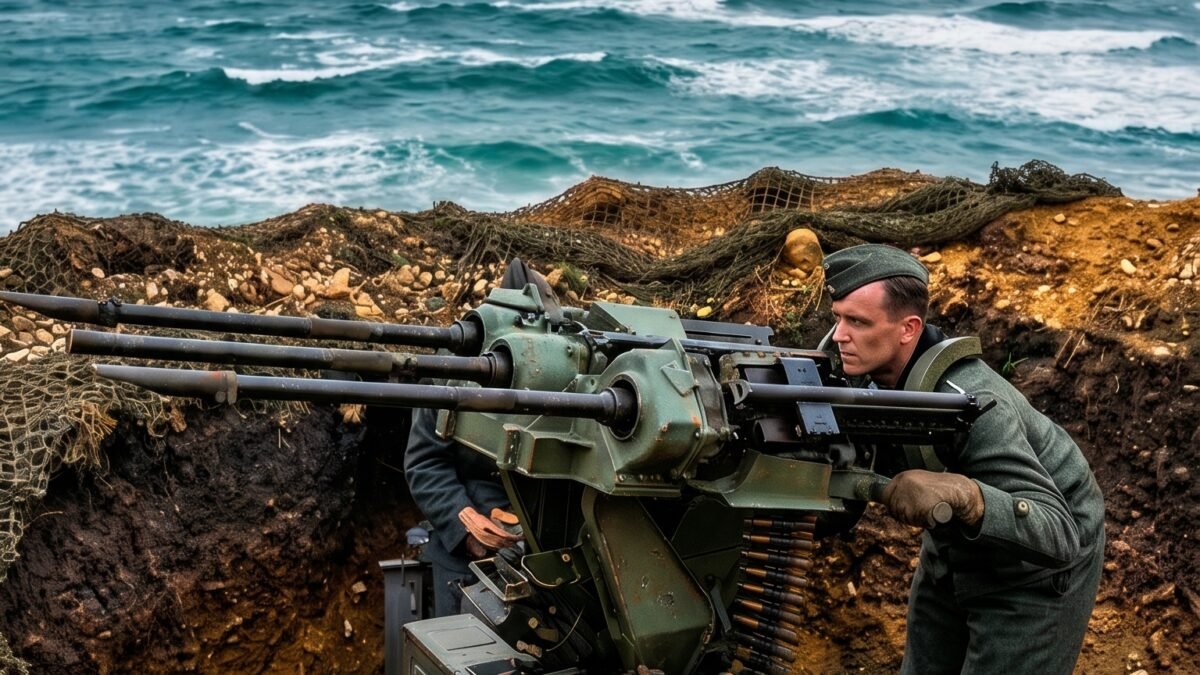
40 mm Bofors L/60 Twin Mount at Sea
Restored deck footage showing top-fed four-round clips and water-cooled barrels tracking aerial targets alongside a fleet destroyer escort.
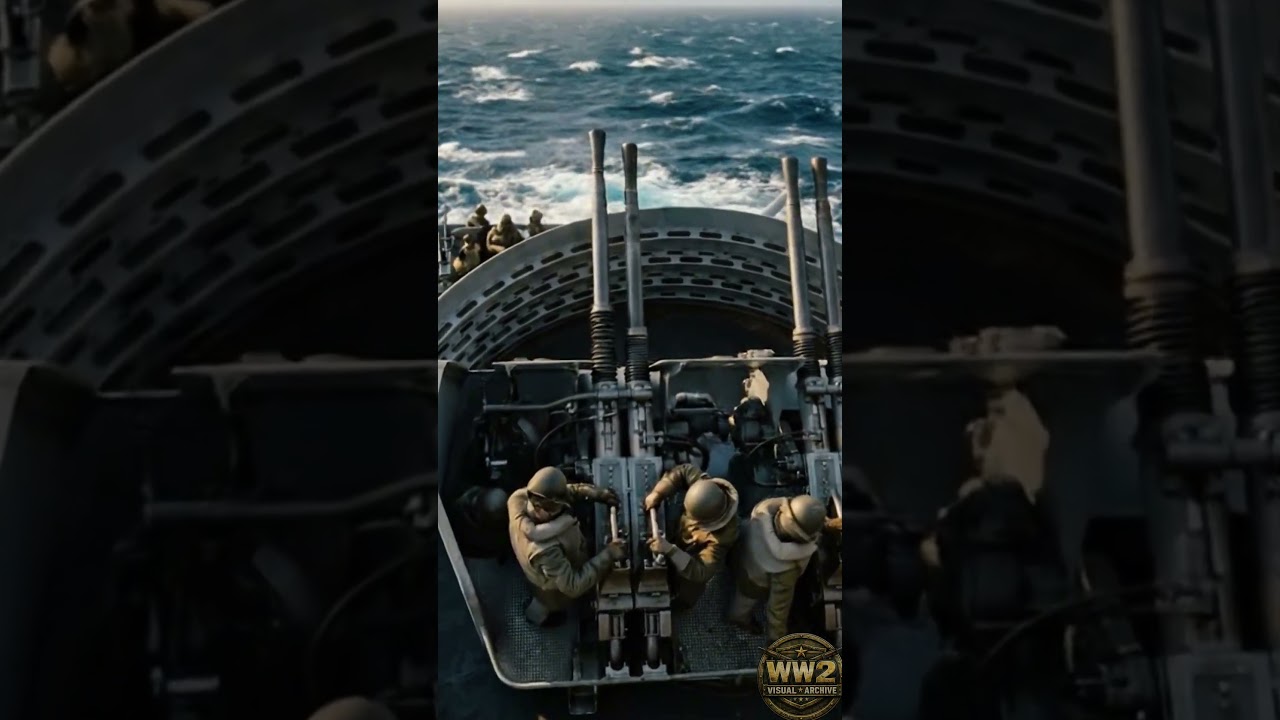
Paired with the Mark 51 Gun Director and Draper Mark 14 gyroscopic sight, the Bofors 40 mm accounted for more than half of all Japanese aircraft shot down by US Navy shipboard fire between late 1944 and August 1945.
SWEDISH ENGINEERING GENIUS: HOW AB BOFORS REDEFINED AIR DEFENSE
From Finspong Prototypes to the 1932 Karlskoga Breakthrough
During the late 1920s, naval architects across Europe recognized a dangerous vulnerability in fleet air defense. Specifically, high-altitude heavy guns fired too slowly to hit agile dive-bombers, whereas rifle-caliber machine guns lacked the punch to shatter all-metal monoplanes. Consequently, the Royal Swedish Navy commissioned AB Bofors of Karlskoga in 1928 to design a reliable medium-caliber automatic cannon. Initially, Swedish ordnance engineers examined the older 40 mm L/43 submarine gun and competing Vickers two-pounder mechanisms. However, chief designer Victor Hammar and his team rejected cloth belts and complex link extractors because salt spray and hull vibration caused frequent stoppages at sea.
Instead, Bofors engineers developed a revolutionary gravity-assisted feed system combined with a vertical sliding-wedge breechblock. In November 1931, the Karlskoga proving grounds tested the first prototype, and subsequently the company unveiled the production model in 1932. Although the barrel measured 56.25 calibers in actual bore length, marketing catalogs designated the weapon as the 40 mm L/60. Furthermore, Krupp held a one-third financial stake in Bofors during the interwar period, yet Swedish engineers kept the 40 mm L/60 development strictly independent of German heavy Flak doctrine.
Inside the Four-Round Charger Clip and Rammer Cycle
Mechanical simplicity made the Bofors 40 mm L/60 extraordinarily dependable under combat stress. Specifically, loaders dropped brass four-round horseshoe clips directly into the top of the spring-loaded auto-loader tray while the gun fired continuously. As the barrel recoiled between 190 and 210 millimeters on its hydraulic buffer, a mechanical rammer lever pushed the bottom cartridge forward into the chamber. Simultaneously, the vertical breech wedge rose to lock the bolt, while the extractor kicked the spent brass casing out through a chute beneath the receiver.
Because the firing pin released automatically the instant the breech closed in automatic mode, the weapon achieved a cyclic rate of 120 to 140 rounds per minute. Moreover, the tapered barrel featured progressive rifling that accelerated a 0.9-kilogram high-explosive tracer projectile to 881 meters per second. By contrast, Britain’s older QF 2-pounder Mark VIII “Pom-Pom” pushed its shell at just 732 meters per second, which forced gunners to calculate nearly twice as much lead against fast-moving torpedo bombers. Therefore, the flatter trajectory of the Swedish 40 mm shell dramatically increased first-burst hit probabilities.
Autofrettage Metallurgy, Quick-Change Barrels, and Self-Destroying Tracers
Beyond its feed tray, the Karlskoga design excelled in barrel metallurgy and ammunition safety. Specifically, Swedish metallurgists forged the monobloc 40 mm barrel from high-tensile chrome-nickel-molybdenum steel using radial hydraulic expansion known as autofrettage. Consequently, the bore withstood chamber pressures exceeding 3,150 atmospheres while maintaining pinpoint accuracy over thousands of rounds. Additionally, field crews on air-cooled carriages could unlock the interrupted-screw breech collar and swap an overheated barrel in less than 25 seconds using a simple crescent wrench.
Equally important, Bofors chemists engineered a pyrotechnic self-destruct relay inside every 40x311mmR high-explosive tracer shell. When a round missed its aerial target, the burning magnesium tracer column ignited a relay pellet after 8.5 to 10.5 seconds of flight, detonating the projectile harmlessly at roughly 4,200 meters altitude. As a result, Allied warships and dense urban batteries could fire thousands of shells overhead without raining live unexploded ordnance onto friendly decks or surrounding troops.
The 20 mm Bofors m/40 and Early Swedish Autocannon Lineage
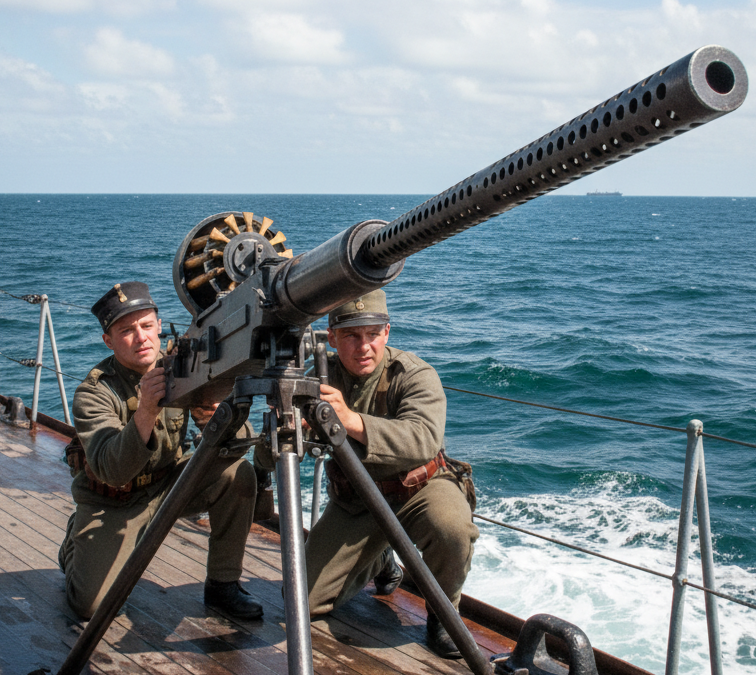
Alongside the famous 40 mm cannon, Swedish engineers also expanded the Karlskoga family into lighter calibers for coastal vessels, infantry regiments, and armored cars. Specifically, the Bofors 20 mm automatkanon m/40 paired a long 70-caliber perforated barrel with a quick-change 28-round drum magazine. Consequently, Swedish naval crews deployed the 20 mm m/40 on agile tripod mounts to intercept low-flying reconnaissance aircraft across the Baltic Sea. Meanwhile, export demand for the larger 40 mm L/60 surged across Poland, Hungary, the Netherlands, France, and the United Kingdom before September 1939.
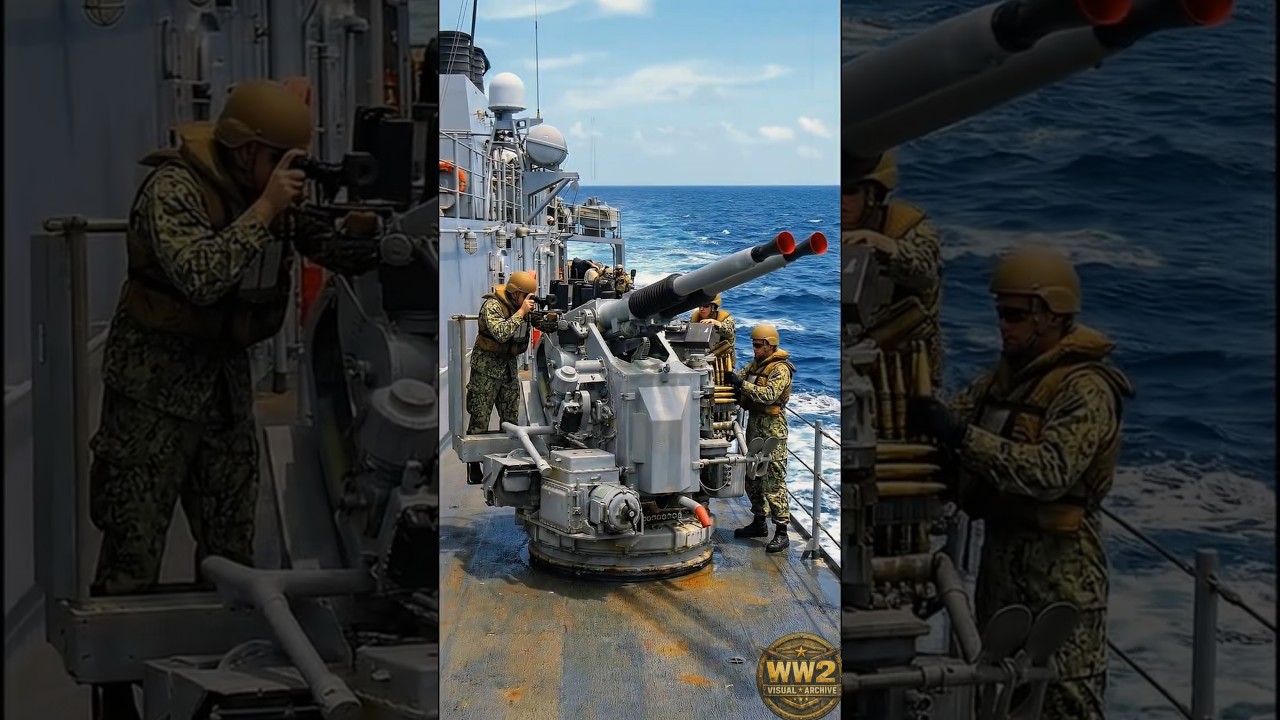
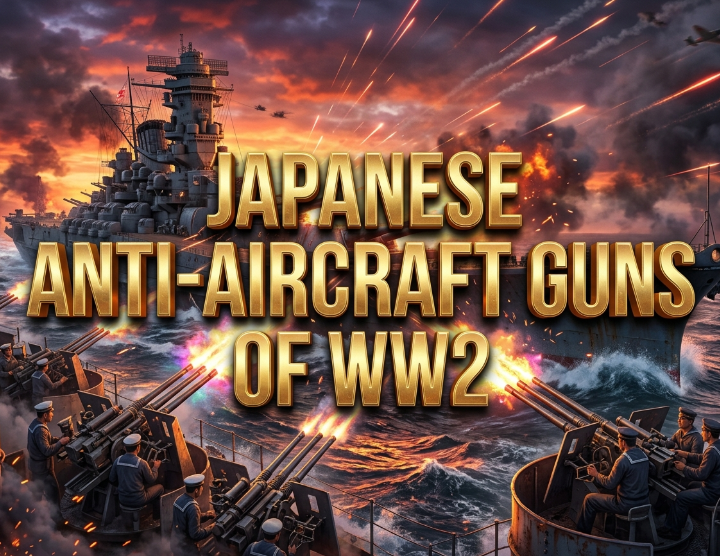
Bofors 40 mm L/60 Fleet Legend
Close-in naval firing sequence illustrating the hydraulic power drives and top-clip loading ergonomics at sea.

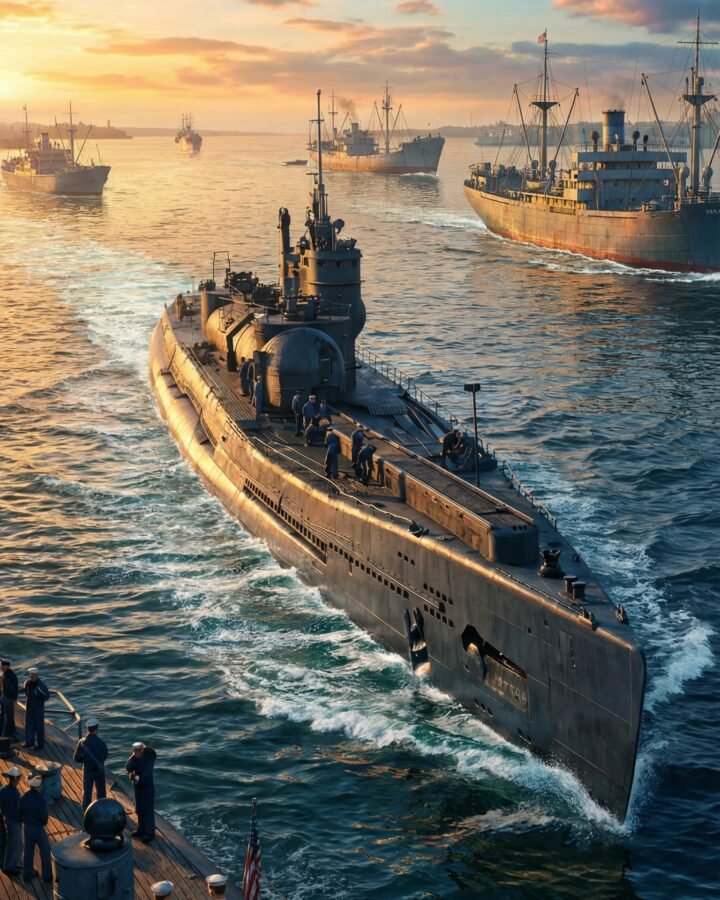
April 1944: D-Day Ordnance Park
Rows of Allied towed 40 mm Bofors carriages inspected in Britain prior to the Normandy amphibious landings.
By replacing Swedish hand-scraped tolerances with interchangeable SAE inch dimensions, Chrysler Corporation reduced the manufacturing time of each 40 mm Bofors barrel assembly by 45% while cutting unit costs by more than a third.
ARSENAL OF DEMOCRACY: SMUGGLED BLUEPRINTS & MASS PRODUCTION
HMS Flores and the 1940 Metric Blueprint Odyssey
Before the United States entered World War II, the US Navy Bureau of Ordnance struggled to find a dependable medium-range anti-aircraft gun. Specifically, the homegrown 1.1-inch/75 caliber Mark 1 quad mount—nicknamed the “Chicago Piano”—suffered from frequent cartridge jams and excessive weight. Meanwhile, Royal Netherlands Navy warships escaping the German invasion of May 1940 arrived in British ports carrying Dutch-built Hazemeyer twin 40 mm Bofors mounts stabilized by tri-axial gyroscopes.
Consequently, Captain Schuyler of the Bureau of Ordnance arranged to purchase an air-cooled twin Bofors mount and smuggled a full set of metric drawings out of Europe aboard the Dutch sloop Flores in August 1940. Furthermore, American naval officers tested the weapon aboard the experimental destroyer USS Semmes and immediately recognized its superiority. Although formal license negotiations with Sweden dragged into June 1941, the US Navy and US Army authorized urgent domestic tooling across American factories.
How Chrysler and York Safe Re-Engineered the Bofors
Initially, the metric Swedish blueprints posed a severe challenge for American mass-production plants. Because Karlskoga craftsmen hand-filed and custom-fitted hundreds of components during assembly, parts from one Swedish gun rarely fit another without manual scraping. Therefore, engineers at Chrysler Corporation, York Safe and Lock, and Pontiac Motor Division spent months translating over 2,000 metric blueprints into standardized imperial tolerances.
Additionally, American metallurgists substituted automatic welding, broaching, and precision stamping for slow milling operations. As a result, twelve Chrysler plants across Detroit, Evansville, and Dayton produced more than 60,000 complete 40 mm guns and 120,000 spare barrels before VJ-Day. Simultaneously, British factories in Nottingham, Coventry, and Glasgow—alongside the Otis-Fensom plant in Hamilton, Ontario—manufactured tens of thousands of QF 40 mm Mark I and Mark III land and naval guns for Commonwealth forces.
Ford Instrument Hydraulic Drives and Naval Water-Cooled Jackets
While the US Army retained air-cooled barrels for mobile field carriages, the US Navy demanded continuous sustained fire aboard fleet carriers and battleships. Accordingly, Bureau of Ordnance engineers encased each naval barrel inside a galvanized sheet-metal water jacket connected to an electric circulating pump. Furthermore, the Ford Instrument Company and Northern Pump Company designed compact electro-hydraulic power drives that slewed the ten-ton Quad Mark 2 mount at 30 degrees per second in train and 24 degrees per second in elevation. Thus, American industrial engineering transformed a hand-cranked European cannon into a remotely controlled naval turret.
THE THREE-RING SHIELD: HOW ALLIED CARRIERS SURVIVED AIR ATTACK
Outer Ring: The 5-Inch/38 Dual-Purpose Gun and VT Proximity Fuze
Allied naval air defense operated as an integrated three-ring concentric shield around high-value aircraft carriers and fast battleships. In the outer ring, extending from 4,000 out to 18,200 yards, US Navy warships relied on the legendary 5-inch/38 caliber Mark 12 dual-purpose gun. Controlled by the radar-equipped Mark 37 Gun Fire Control System, these twin and single turrets engaged incoming bomber formations long before they reached torpedo release range.
Furthermore, in January 1943 the cruiser USS Helena scored the first combat kill using the top-secret Mark 32 Variable Time (VT) radio proximity fuze. Because each VT-fuzed 5-inch nose cone contained a miniature Doppler radar transceiver that detonated the 55-pound shell within 70 feet of an airframe, outer-ring lethality increased more than threefold. Similarly, Royal Navy fleet carriers in the British Pacific Fleet relied on sixteen 4.5-inch QF dual-purpose guns directed by High Angle Control System radars to break up high-altitude formations.
Middle Ring: Why the 40 mm Bofors Replaced the 1.1-Inch “Chicago Piano”
When surviving enemy dive-bombers penetrated inside 4,500 yards, the middle defense ring took over immediately. During the early battles of Coral Sea, Midway, and Santa Cruz in 1942, American carriers depended on the quadruple 1.1-inch/75 caliber Mark 1 mount. Although crews praised its four-barrel concept, the 1.1-inch weapon jammed frequently and fired a light 0.92-pound shell that struggled to disintegrate Japanese Aichi D3A “Val” dive-bombers.
Consequently, beginning in the summer of 1942, shipyards stripped out the 1.1-inch mounts and installed water-cooled 40 mm Bofors Mark 1 Twin and Mark 2 Quadruple mounts across every carrier sponson and battleship superstructure. For example, our archival dossier on the USS Iowa-Class Battleships documents how each fast battleship carried twenty Quad 40 mm Bofors mounts—totaling 80 barrels—to escort Essex-class carriers through the Philippine Sea. Meanwhile, British warships supplemented their eight-barrel QF 2-pounder “Pom-Pom” batteries—which had defended older capital ships such as HMS Hood—with gyro-stabilized Hazemeyer, Buster, and STAAG 40 mm Bofors mounts.
Royal Navy Hazemeyer, Mk V “Utility,” and STAAG Radar Mountings
Across the Royal Navy and Commonwealth fleets, naval engineers developed specialized twin and six-barrel 40 mm Bofors mountings tailored for turbulent North Atlantic and Pacific seas. Initially, British shipyards copied the Dutch Hazemeyer Mark IV twin mount, which carried its own tri-axial gyro-stabilized platform and Type 282 radar antennas directly on the gun shield. Subsequently, the Admiralty introduced the lighter Twin Mark V “Utility” mount and the ambitious STAAG (Stabilised Tachymetric Anti-Aircraft Gun), which integrated a centimetre-wave Type 262 fire-control radar and analog tachymetric computer inside a self-contained armored turret.
Inner Ring: 20 mm Oerlikon Cannons and .50 Caliber M2 Brownings
Inside 1,500 yards, gun crews manned the inner last-ditch curtain using the Swiss-designed 20 mm Oerlikon Mark 4 autocannon and the .50 caliber M2 Browning heavy machine gun. Early in 1941, water-cooled .50 caliber Brownings lined carrier flight-deck catwalks; however, non-explosive bullets rarely stopped a committed torpedo plane before weapon release. Therefore, the 20 mm Oerlikon—firing 450 explosive shells per minute from a 60-round drum—became the universal close-in standard alongside the 40 mm Bofors.
QUAD 40 MM MOUNTS IN THE PACIFIC: FROM SANTA CRUZ TO OKINAWA KAMIKAZES
USS South Dakota and USS Enterprise at the Battle of Santa Cruz
The combat debut of the water-cooled Quad 40 mm Bofors Mark 2 occurred during the fierce carrier clash at the Battle of the Santa Cruz Islands on October 26, 1942. Operating alongside the carrier USS Enterprise (CV-6), the new battleship USS South Dakota (BB-57) mounted four Quad 40 mm batteries directed by early Mark 51 pedestals. During four coordinated waves of Japanese dive-bomber and torpedo-plane strikes, South Dakota and Enterprise threw up an unprecedented wall of 40 mm high-explosive tracer fire that downed 26 attacking aircraft in less than an hour.
Moreover, Admiral Chester Nimitz praised the new Swedish-designed autocannon in his official action report to Washington. Unlike air-cooled Army barrels that overheated after 90 continuous rounds, the Navy’s Mark 1 and Mark 2 mounts circulated 11.5 gallons of cooling water per minute around each barrel jacket via electrically driven centrifugal pumps. Consequently, naval gun crews sustained continuous full-automatic fire throughout prolonged aerial assaults without warping their rifling.
Inside the 11-Man Quad Gun Tub Choreography Under Fire
Operating a Quad 40 mm Mark 2 gun tub aboard a pitching fleet carrier or radar picket destroyer demanded athletic teamwork from an eleven-man crew. Seated on the forward cradles, the pointer and trainer monitored local optical sights in case battle damage severed electrical cables from the overhead Mark 51 director. Behind them, two first-loaders stood on the rotating platform and slammed four-round brass clips into the paired hoppers every two seconds.
Simultaneously, four second-loaders pulled fresh clips from the ready-service racks encircling the steel splinter shield and passed them forward in a rhythmic human chain. Below the guns, two “hot-shellmen” wearing heavy asbestos gauntlets kicked smoking brass casings clear of the rotating training ring so spent cartridges could never jam the traverse gears. Meanwhile, the gun captain coordinated target handoffs over sound-powered headphones while watching for torpedo wakes and low-flying attackers.
Why the Allied 40 mm Bofors Outclassed Axis Naval Anti-Aircraft Guns
A direct technical comparison reveals why Allied fleets gained a decisive anti-aircraft edge over both Imperial Japan and Nazi Germany. Specifically, the Imperial Japanese Navy relied almost exclusively on the French Hotchkiss-derived Type 96 25 mm triple and twin gun, which crowded the decks of giant warships such as Battleship Yamato. However, the Type 96 fed from small 15-round box magazines that loaders had to swap manually whenever a barrel ran dry, which slashed its practical rate of fire to just 110 rounds per minute. Furthermore, its slow hand-cranked training gears and tiny 250-gram projectile proved helpless against fast American carrier strike groups.
Similarly, the German Kriegsmarine equipped capital ships such as Battleship Bismarck with the semi-automatic 3.7 cm SK C/30. Because loaders had to breach-feed every single cartridge by hand, the 3.7 cm SK C/30 managed only 30 rounds per minute and failed to stop Royal Navy Fairey Swordfish biplanes in May 1941. By contrast, a single US Navy Quad 40 mm Bofors mount delivered sixteen times the sustained volume of fire while tracking high-speed targets at 30 degrees per second.
Kamikaze Physics and the Birth of the 3-Inch/50 Caliber Mark 22
Nevertheless, the emergence of Japanese Tokkōtai (kamikaze) suicide attacks at Leyte Gulf in October 1944 and Okinawa in April 1945 altered the physics of naval air defense overnight. Previously, a single 40 mm Bofors shell tearing off an aileron or puncturing an oil cooler forced a conventional bomber pilot to abort his run. Conversely, a kamikaze pilot turned his entire bomb-laden fighter into a guided missile; even if 40 mm shells killed the pilot at 1,500 yards, ballistic momentum carried the burning wreckage straight into the ship’s flight deck.
Because the 1.57-inch bore of the 40 mm Bofors was too narrow to house the vacuum tubes of a wartime VT radio proximity fuze, the US Navy Bureau of Ordnance rushed an emergency replacement into production: the 3-inch/50 caliber Mark 22 autoloading gun in the Twin Mark 33 mount. Firing a 13-pound VT-fuzed shell at 45 to 50 rounds per minute per barrel, the 3-inch/50 Mark 22 occupied the exact same deck footprint and weight class as a Quad 40 mm Bofors while obliterating kamikaze airframes in mid-air.
US Navy Quad 40 mm Bofors Tub
Overhead view of an 11-man US Navy gun tub crew feeding four-round clips into a water-cooled Quad Mark 2 mount at sea.

IJN Type 96 25 mm Triple Mount
Comparative Axis Pacific footage showing the 15-round box-magazine reloads that handicapped Japanese fleet air defense.
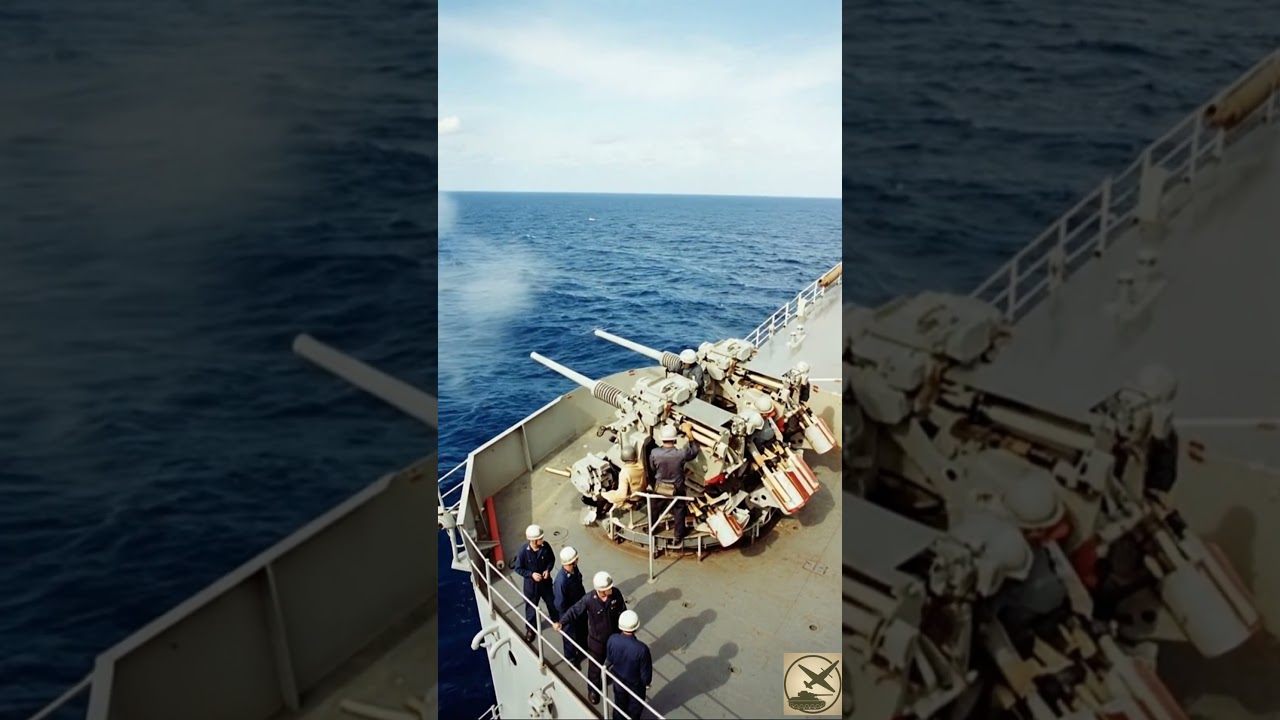
USN 3″/50 Mark 22 VT Successor
Developed in 1945 to replace Quad 40 mm Bofors mounts on one-for-one weight parity while firing VT proximity-fuzed shells.
Comparative Ballistic & Fire-Control Telemetry Table
| Weapon System | Caliber & Bore | Practical ROF (Per Barrel) | Muzzle Velocity | Shell Mass | Effective AA Slant Range | Primary Fire-Control Director |
|---|---|---|---|---|---|---|
| Bofors 40 mm L/60 (Mk 1/2) | 40 x 311 mm R | 90–120 RPM (Continuous Clip) | 881 m/s (2,890 fps) | 0.90 kg (1.98 lb) | 4,570 m (5,000 yd) | USN Mk 51 + Mk 14 Sight / RN STAAG & Hazemeyer |
| USN 5″/38 Cal Mark 12 DP | 127 x 679 mm | 15–22 RPM (Power Ram) | 792 m/s (2,600 fps) | 25.0 kg (55.1 lb) | 11,890 m (13,000 yd) | Mark 37 GFCS + FD / Mk 12 & Mk 22 Radar + VT Fuze |
| RN QF 2-pdr Mk VIII Pom-Pom | 40 x 158 mm R | 96–98 RPM (140-rd Belt) | 732 m/s (2,400 fps) | 0.82 kg (1.80 lb) | 3,475 m (3,800 yd) | Pom-Pom Director Mk IV + Type 282 Radar |
| USN 1.1″/75 Cal Mark 1 | 28 x 254 mm | 100 RPM (8-rd Clip) | 823 m/s (2,700 fps) | 0.42 kg (0.92 lb) | 2,740 m (3,000 yd) | Open Ring Sights / Early Mk 44 Director |
| Allied 20 mm Oerlikon L/70 | 20 x 110 mm RB | 285–320 RPM (60-rd Drum) | 844 m/s (2,770 fps) | 0.12 kg (0.27 lb) | 1,370 m (1,500 yd) | On-Mount Draper Mk 14 Gyro / Spider Ring Sight |
| USN 3″/50 Cal Mark 22 (1945) | 76.2 x 586 mm | 45–50 RPM (Rotary Loader) | 823 m/s (2,700 fps) | 5.90 kg (13.0 lb) | 8,960 m (9,800 yd) | Mark 56 Radar GFCS / Mark 63 Director + VT Fuze |
| IJN Type 96 25 mm L/60 | 25 x 163 mm | 110 RPM (15-rd Box Mag) | 900 m/s (2,953 fps) | 0.25 kg (0.55 lb) | 1,500 m (1,640 yd) | Type 95 Mechanical Lead-Computing Director |
FROM ALGERIAN BEACHES TO THE V-1 DIVER LINE: THE BOFORS ON LAND
Operation Torch and Coastal Air Defense in Algeria and Tunisia
While water-cooled Bofors batteries guarded Allied fleets offshore, air-cooled towed 40 mm carriages proved equally indispensable on land. When Anglo-American forces launched Operation Torch across Morocco and Algeria in November 1942, Luftwaffe Junkers Ju 88 and Messerschmitt Bf 109 fighter-bombers repeatedly strafed the Mediterranean unloading beaches. Consequently, US Army Coast Artillery battalions and British Light Anti-Aircraft (LAA) regiments manhandled four-wheeled M1 and QF Mark I Bofors carriages directly onto the sand dunes of Oran, Algiers, and Bône.
Furthermore, the cruciform outrigger platform allowed a well-drilled six-man detachment to drop the gun from traveling configuration into firing position in less than 60 seconds. Crew members folded the front and rear axles upward, lowered four leveling jacks onto the soil, and engaged targets through dual elevation and traverse handwheels. Additionally, during the Battle of El Alamein and the Tunisian campaign, British Bofors crews depressed their barrels horizontally to shatter lightly armored German reconnaissance cars and anti-tank positions.
Normandy Beachheads and the M19 Dual 40 mm Gun Motor Carriage
Prior to the D-Day landings of June 6, 1944, Allied ordnance depots across southern England stockpiled thousands of towed 40 mm M1 guns and self-propelled Crusader tractor units. Within hours of the first assault waves hitting Utah, Omaha, Gold, Juno, and Sword beaches, antiaircraft battalions emplaced dense 40 mm perimeters around the Mulberry artificial harbors and fuel pipelines. Because towed guns struggled to keep pace with General George Patton’s fast armored columns across France, American engineers also mounted twin 40 mm Bofors cannons onto a modified M24 Chaffee light tank chassis, creating the formidable M19 Gun Motor Carriage.
Operation Diver: Defending Britain Against the V-1 Flying Bomb
Starting on June 13, 1944, Nazi Germany launched more than 10,000 pulse-jet Fieseler Fi 103 (V-1) “Buzz Bombs” toward London. Flying at 400 miles per hour between 2,000 and 3,000 feet, these early cruise missiles flew too fast for manual hand-cranked traverse and too low for heavy 3.7-inch guns stationed inland. In response, General Sir Frederick Pile redeployed British and American anti-aircraft batteries to a coastal belt along the Kent and Sussex shoreline under Operation Diver.
There, 40 mm Bofors regiments worked alongside SCR-584 microwave radars and Bell Labs M9 electronic predictors to engage incoming V-1 missiles over the English Channel before they crossed populated towns. By August 1944, coastal anti-aircraft batteries destroyed up to 74% of all V-1 flying bombs entering their engagement zone. Today, military analysts studying modern counter-drone warfare against low-flying one-way attack UAVs cite the 1944 Diver Strip Bofors network as the direct doctrinal ancestor of programmable air-burst cannon defense.
Pacific Island Hopping: US Marine Corps Defense Battalions
Across the Pacific theater, US Marine Corps Defense Battalions and US Army Anti-Aircraft Artillery groups hauled towed 40 mm M1 Bofors carriages ashore through heavy surf from Guadalcanal and Bougainville to Peleliu, Iwo Jima, and Okinawa. Once bulldozers carved coral revetments around captured airstrips such as Henderson Field, four-gun 40 mm platoons linked their M5 and M7 mechanical directors to early-warning radar vans. Moreover, during fierce nocturnal Japanese infantry counterattacks in the Solomon Islands and the Philippines, Army and Marine gunners lowered their 40 mm muzzles to zero elevation and fired canister-like streams of high-explosive shells to clear reinforced jungle bunkers.
4K RESTORED ARCHIVAL PHOTOGRAPHIC PLATES

FROM THE COLD WAR TO ANTI-DRONE WARFARE: THE IMMORTAL 40 MM LEGACY
The Post-War Bofors 40 mm L/70 and AC-130 Aerial Gunships
Unlike almost every other World War II artillery piece, the Bofors 40 mm refused to fade into museum obsolescence after 1945. Specifically, as jet fighters pushed combat speeds toward the sound barrier in 1947, Swedish engineers introduced the Bofors 40 mm L/70 (Model 1948). By lengthening the barrel to 70 calibers and adopting a more powerful 40x365mmR cartridge, Bofors boosted muzzle velocity to 1,025 meters per second and increased the cyclic rate of fire to 240–330 rounds per minute.
Meanwhile, wartime L/60 barrels remained frontline staples for decades. During the Vietnam War, the US Army fielded the M42 Duster twin-40 mm tracked vehicle, while the US Air Force installed air-cooled 40 mm L/60 Bofors cannons inside the port fuselage of Lockheed AC-130A and AC-130H “Spectre” gunships. Orbiting at 7,000 feet above the Ho Chi Minh Trail, and later over Grenada, Panama, Afghanistan, and Iraq, the century-old Swedish breech mechanism delivered surgical fire support well into the twenty-first century.
Modern Naval CIWS, CV9040 IFVs, and 3P Programmable Ammunition
Today, the Karlskoga lineage thrives aboard modern stealth frigates and infantry fighting vehicles. For instance, the Swedish Army’s combat-proven Stridsfordon 90 (CV9040) mounts an inverted Bofors 40 mm L/70B cannon capable of piercing heavy armor with fin-stabilized tungsten darts. Furthermore, the naval BAE Systems Bofors 40 Mk4 turret fires 3P (Pre-fragmented, Programmable, Proximity-fuzed) smart ammunition at 300 rounds per minute. Because an inductive muzzle coil programs each 3P round to detonate into 1,100 tungsten pellets in front of miniature quadcopters or sea-skimming missiles, the 40 mm Bofors remains one of the world’s premier counter-drone weapons more than 90 years after its invention.
INSIDE OUR 4K UHD RESTORATION & COLORIZATION PIPELINE
Transforming 1940s Nitrate Combat Reels into 4K 60fps Historical Documents
Every archival combat clip embedded in this dossier originates from authentic 16 mm and 35 mm monochrome motion-picture reels captured by US Navy combat cameramen, US Army Signal Corps photographers, and British Admiralty film units between 1941 and 1945. Because wartime gun-tub cameras operated alongside concussive 40 mm muzzle blasts and corrosive salt spray, raw archival transfers exhibit severe emulsion scratches, frame jitter, flicker, and motion blur. Therefore, the WW2 Visual Archive engineering team applies a four-stage optical restoration workflow to recover crisp mechanical detail without distorting historical truth.
First, our pipeline stabilizes gate weave and removes nitrate chemical dust at the sub-pixel level while preserving authentic film grain structure. Next, neural optical-flow interpolation reconstructs clean intermediate frames to bring choppy 18-to-24 fps combat reels up to smooth 60 fps motion clarity. Finally, our historical colorists reference original Bureau of Ordnance paint specifications—including US Navy Measure 21 Navy Blue (5-N), Deck Blue (20-B), Haze Gray (5-H), British Khaki Green No. 3, and Cupro-Nickel brass cartridge cases—to ensure every restored frame reflects verified wartime chromatic standards.
Four-Stage Archival Optical Engineering Workflow
DE-SCRATCH & GATE STABILIZATION
Eliminates chemical emulsion pitting, splices, and deck-concussion camera shake from original 35 mm NARA and IWM nitrate reels.
60 FPS MOTION CADENCE
Recovers exact mechanical recoil cycles of the 120 RPM Bofors autoloader and top-clip rammer lever without ghosting artifacts.
SPECTRAL PAINT CALIBRATION
Matches warship camouflage measures (5-N Navy Blue, 5-H Haze Gray), olive-drab HBT utilities, and crimson tracer igniters.
4K UHD MASTER ENCODING
Upscales fine optical sights, water-cooling hoses, and brass clip markings to 3840×2160 resolution with synchronized acoustic design.
PRIMARY ARCHIVAL REPOSITORIES & ORDNANCE MANUALS
Official Naval Ordnance Archives, Museum Collections, and Technical Databases
Researchers, naval historians, and scale modelers seeking primary-source blueprints, Bureau of Ordnance maintenance pamphlets, and declassified World War II action reports can consult the official archival institutions linked below. Each repository preserves original firing tables, optical fire-control schematics, and wartime photographic records used to verify the technical data in this dossier.
Naval History & Heritage Command (NHHC)
Houses Bureau of Ordnance Pamphlet OP 862 (Quadruple 40 mm Mount Mark 2), Pacific Fleet anti-aircraft action summaries, and VT proximity fuze development records.
NavWeaps Naval Weapons Archive
Comprehensive technical engineering sheets covering the USN 40 mm/56 Mark 1 & 2, 5″/38 Mark 12, 20 mm Oerlikon, and Mark 51 FCS.
Imperial War Museums (IWM London)
Preserves surviving British QF 40 mm Mark I and Mark III land carriages, Diver Strip V-1 defense war diaries, and Royal Navy Hazemeyer mounting photographs.
U.S. Naval Institute (USNI Archives)
Features peer-reviewed naval history studies on the global licensing of the Swedish Bofors L/60 and MIT Draper Laboratory’s Mark 14 gyroscopic gunsight.
USS Slater (DE-766) Restoration
Maintains operational wartime 40 mm Bofors Twin and Single mounts alongside 20 mm Oerlikon batteries and Mark 51 directors aboard the last afloat Destroyer Escort in America.
Canadian War Museum Naval Collection
Documents Otis-Fensom Canadian production of the 40 mm Bofors and North Atlantic convoy escort operations aboard Royal Canadian Navy corvettes and destroyers.
EXPLORE CONNECTED 4K NAVAL & CAPITAL SHIP DOSSIERS
Continue your investigation across the WW2 Visual Archive fleet restoration series. Examine how anti-aircraft batteries, radar fire control, and armor metallurgy determined the fate of World War II’s greatest capital ships.
USS Iowa-Class Battleships: 80-Barrel Bofors Shield
Explore how twenty Quad 40 mm Bofors mounts and 5″/38 DP batteries turned the Iowa class into the ultimate Pacific carrier escorts.
Battleship Yamato: 4K Colorized Restoration
Inspect Yamato’s 152 barrels of Type 96 25 mm AA guns and see why Japanese close-in defense failed during Operation Ten-Go.
Battleship Bismarck: Fire Control & Final Hunt
Analyze why Bismarck’s single-shot 3.7 cm SK C/30 and 10.5 cm Flak batteries could not stop Royal Navy Swordfish torpedo bombers.
HMS Hood: Battlecruiser Evolution & Denmark Strait
Trace the evolution of British fleet air defense from octuple 2-pounder Pom-Poms and Unrotated Projectile launchers to the Bofors era.