The 8.8 cm Flak 18, 36, 37 & 41: Anatomy of the “Acht-Acht”
From Clandestine Krupp-Bofors Engineering to Dual-Role Battlefield Dominance
Few weapons in twentieth-century military history achieved the psychological omnipresence of the German 8.8 cm Flak 18/36/37/41 series. Known to Wehrmacht and Luftwaffe crews as the Acht-Acht (“eight-eight”) and to British and American soldiers simply as the dreaded “Eighty-Eight,” this high-velocity ordnance family gave the English language the very word “flak”—derived from the German contraction for Flugabwehrkanone (aircraft-defense cannon). Whether throwing a 9.2-kilogram high-explosive fragmentation shell 8,000 meters into the freezing contrails of an American Boeing B-17 Flying Fortress box or slamming an armor-piercing capped projectile through the glacis plate of a British Matilda II or Soviet KV-1 at a mile and a half, the 88mm gun defined three-dimensional warfare between 1936 and 1945.
“[American troops] knew that the greatest single weapon of the war, the atomic bomb excepted, was the German 88 mm flat-trajectory gun, which brought down thousands of bombers and tens of thousands of soldiers. The Allies had nothing as good, despite one of them designating itself the world’s greatest industrial power.” — Historian & WWII Infantry Officer Paul Fussell, Wartime: Understanding and Behavior in the Second World War (1989)
The Versailles Evasion and the 1928 Krupp-Bofors Breakthrough
The lineage of the wartime 88mm gun began in the final two years of the First World War, when the Imperial German Army and Kaiserliche Marine fielded the 8.8 cm Flak 16 (K.Zugflak L/45). Although the 88mm naval caliber—equivalent to 3.46 inches—was already standard aboard German torpedo boats and U-boats, the Treaty of Versailles strictly prohibited Weimar Germany from designing or manufacturing modern anti-aircraft artillery after 1919. Determined to preserve its ballistics expertise, the Essen steel conglomerate Friedrich Krupp AG secretly acquired a controlling financial stake in the Swedish ordnance firm AB Bofors in 1921, dispatching a team of German artillery engineers to Karlskoga, Sweden.
In Sweden, the Krupp-Bofors engineers initially drafted a 75mm high-velocity anti-aircraft prototype (which evolved into the Swedish 75mm Model 1929). When the clandestine Reichswehr ordnance office evaluated the 75mm trials, however, German ballisticians concluded that emerging all-metal monoplane bombers would soon fly above 6,000 meters, demanding a heavier projectile with a larger bursting charge and superior sectional density. Returning to the proven 88mm caliber in 1928, Krupp engineers completed the design for a 56-caliber-long barrel (4.938 meters / 16 feet 2 inches) chambered for a powerful fixed 88×571mmR brass cartridge. Smuggled back into Essen as the NSDAP seized power in 1933, the weapon entered clandestine mass production under a deliberately misleading model number—the 8.8 cm Flak 18—suggesting to foreign treaty inspectors that it was merely a World War I vintage design from 1918.
Cruciform Mobility, Semi-Automatic Breech Mechanics & Evolution from Flak 18 to Flak 41
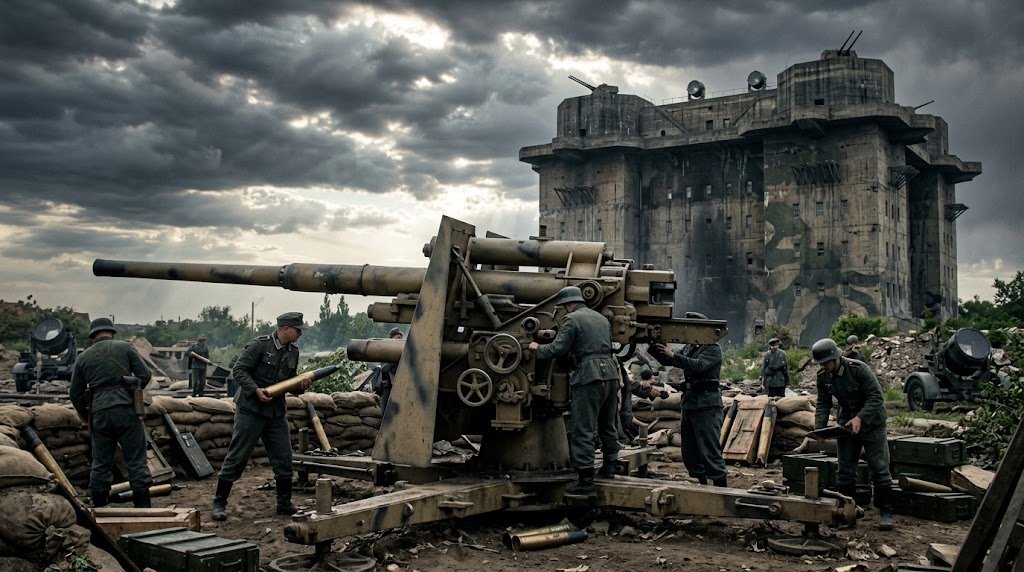
What separated the 8.8 cm Flak from contemporary Allied heavy anti-aircraft guns was its mechanical integration of speed, 360-degree traverse, and rapid emplacement. The gun rested on a folding cruciform platform (Kreuzlafette) carried between two detachable wheeled bogie trailers. On the original Flak 18, the asymmetric Sonderanhänger 201 trailer used a single-axle front bogie and a twin-axle rear bogie; on the improved 8.8 cm Flak 36 (introduced in 1936–1937 after combat lessons in the Spanish Civil War), Krupp introduced the symmetrical Sonderanhänger 202 (Sd.Ah. 202) carriage with identical twin-wheel bogies fore and aft, towed at road speeds by an 8-ton Sd.Kfz. 7 half-track prime mover.
A drilled ten-man Luftwaffe gun detachment could unlimber the 7,407-kilogram (16,330-pound) Flak 36 from traveling configuration into full four-point outrigger firing readiness in just two and a half minutes—or, in an emergency ambush against enemy armor, fire directly off its rubber-tired wheels with limited traverse. The Flak 36 also replaced the expensive one-piece monoblock barrel of the Flak 18 with a three-section barrel (Flakrohr 36) featuring a replaceable central rifled liner, allowing field ordnance workshops to swap out heat-eroded rifling grooves (which had a service life of roughly 900 to 1,500 full-charge rounds) without scrapping the entire gun tube.
During firing, the horizontal sliding-block breech operated semi-automatically. Once the first round was fired at 820 m/s (2,690 ft/s), the hydro-pneumatic recoil system absorbed the backward thrust; on the counter-recoil return stroke, mechanical levers snapped the breech open, flung the smoking brass casing backward clear of the cradle, and cocked the firing pin. The loader simply slapped the next 15-kilogram complete cartridge onto the loading tray, where the rim tripped the catch and rammed the breech shut—sustaining a blistering rate of fire of 15 to 20 rounds per minute.
While the 8.8 cm Flak 37 remained mechanically identical to the Flak 36 in its barrel and carriage, it introduced the Übertragungsgerät 37 (“follow-the-pointer” electrical data receiver dials), dedicating the variant to centralized radar-and-computer battery control. Meanwhile, to counter Allied bombers climbing above 8,000 meters, rival manufacturer Rheinmetall-Borsig engineered the second-generation 8.8 cm Flak 41. Firing a massive 88×855mmR cartridge through a 72-to-74-caliber barrel mounted on a low-silhouette turntable pedestal, the Flak 41 propelled its projectile at an astonishing 1,000 m/s (3,280 ft/s) to an effective ceiling of 11,300 meters (37,100 feet) and a maximum ceiling of 14,700 meters (48,200 feet)—though brass case extraction jams and extreme machining tolerances restricted total Flak 41 output to 556 guns alongside 20,754 Flak 18/36/37 pieces.
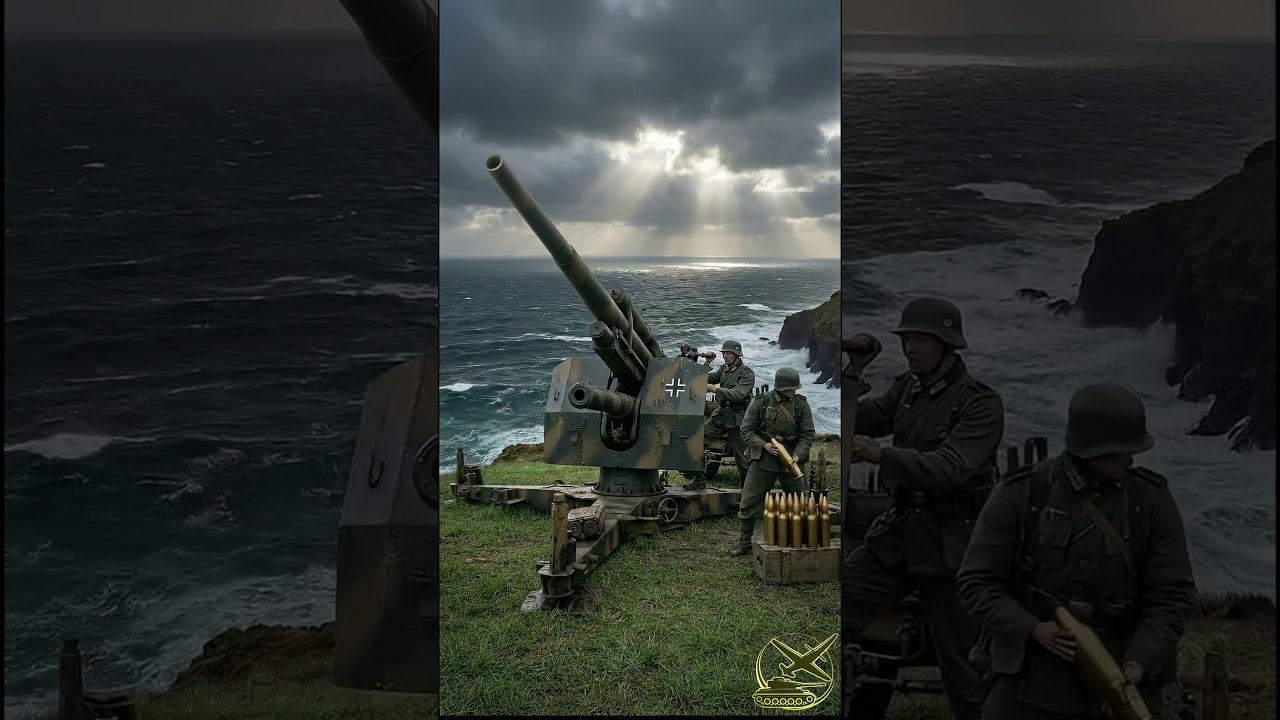
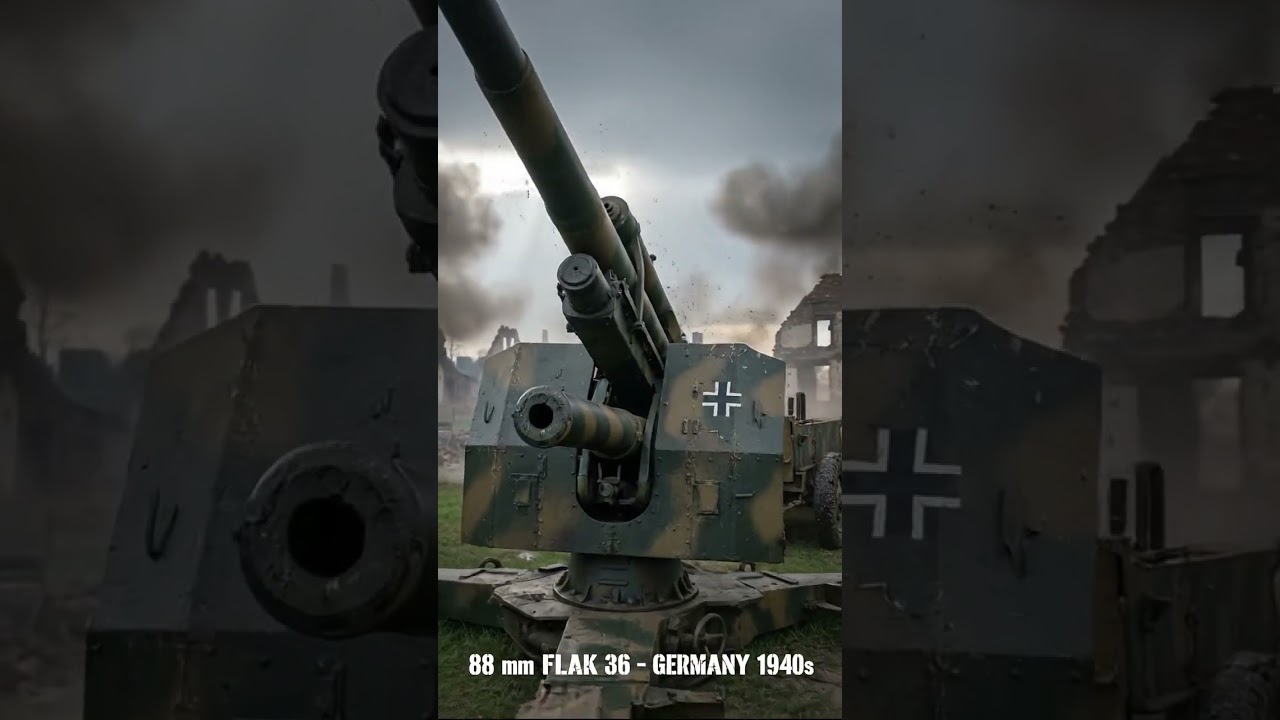 PLATE 01A · LAFETTE 36 CRUCIFORM
PLATE 01B · RECUPERATOR & SHIELD
Low-Altitude Sky Sweepers: 2 cm Flakvierling 38 & 3.7 cm Flak 43
High-Impulse Autocannons, Stamped-Steel Manufacturing & the “Möbelwagen” / “Wirbelwind” Umbrella
While heavy 88mm, 105mm, and 128mm batteries fought high-altitude bomber streams above 5,000 meters, the deadliest threat to German rail yards, river bridges, U-boat pens, and armored columns below 2,000 meters came from low-flying Allied fighter-bombers and ground-attack aircraft—Soviet Ilyushin Il-2 Shturmoviks, British Hawker Typhoons, and American Republic P-47 Thunderbolts. Tracking an aircraft crossing the tree line at 550 kilometers per hour was impossible for a heavy time-fuzed cannon. It demanded an immediate, blinding wall of impact-detonating high-explosive shells from the leichte Flak (light anti-aircraft) branch.
The most numerous artillery piece produced by the Third Reich was the 2 cm Flak 30 and Flak 38 family, with over 144,000 barrels manufactured between 1934 and 1945 at a unit cost of just 3,500 Reichsmarks for a single mount. Derived from the Swiss Solothurn ST-5 and chambered for the high-velocity 20×138mmB “Long Solothurn” belted cartridge (firing a 115-to-120-gram HE-Tracer shell at 900 m/s), the early Rheinmetall 2 cm Flak 30 suffered from a modest cyclic rate of 280 rounds per minute (120 rpm practical) and frequent feeding jams. In 1939, Mauser-Werke re-engineered the recoil mechanism to create the 2 cm Flak 38, boosting the cyclic rate to 450 rpm (180–220 rpm practical) while trimming the gun’s weight to 405 kilograms.
Even at 220 rounds per minute, however, a single 20mm barrel fed by 20-round box magazines struggled to guarantee a lethal hit during the fleeting three-to-five-second window of a dive-bombing pass. In 1940, Rheinmetall and Mauser unveiled a devastatingly simple multiplier: the 2 cm Flakvierling 38 (“quadruplet”). Mounting four synchronized 2 cm Flak 38 autocannons around a central seat on a triangular leveling base (towed on the two-wheeled Sonderanhänger 52 trailer), the Flakvierling 38 unleashed a combined cyclic storm of 1,400 to 1,800 rounds per minute (800 rounds per minute practical). The gunner sat nestled between the dual upper and lower gun pairs, traversing and elevating via two handwheels while pressing two foot pedals—each pedal firing two diametrically opposite barrels so recoil forces remained balanced and continuous fire could be maintained while two loaders slammed fresh 20-round magazines into the alternating pair every six seconds.
The 3.7 cm Flak 43: Gas-Operated Sheet-Metal Engineering
By 1942, combat analysis revealed a critical tactical gap between 2,000 meters (where 20mm tracer self-destruct fuzes detonated automatically) and 4,000 meters (where heavy 88mm fire became efficient). Furthermore, heavily armored Soviet Il-2 ground-attack aircraft frequently shrugged off 120-gram 20mm hits. The Wehrmacht needed a medium 37mm autocannon that fired a projectile nearly six times heavier—a 635-to-700-gram Sprenggranatpatrone or thin-walled Minengeschoss (mine-shell) packed with PETN and Hexogen/aluminum incendiary filler.
Earlier 3.7 cm Flak 18, 36, and 37 guns required complex machined forgings and took 4,320 man-hours to build. In a triumph of late-war industrial design, Rheinmetall-Borsig completely redesigned the weapon as the 3.7 cm Flak 43. Adopting a short-stroke gas-operated breech mechanism derived from the aviation MK 103 cannon and making extensive use of industrial sheet-metal stampings and spot-welding (Blechprägetechnik), Rheinmetall slashed production time by more than 76%—down to just 1,000 man-hours per gun—while dropping the weapon’s firing weight to a remarkably compact 355 kilograms (or 1,250 kg with its mount). Crucially, engineers positioned the 8-round horizontal feed tray directly through the center of gravity inside the oversized trunnions, allowing the loader to drop in new 37×263mmB clips without jarring the gunner’s crosshairs while firing at 250 rounds per minute cyclic (180 rpm practical) to a ceiling of 4,800 meters (15,700 feet). Mounted in single or vertical twin (3.7 cm Flakzwilling 43) configurations, it also armed the Panzer IV-based Möbelwagen and Ostwind self-propelled Flakpanzers.
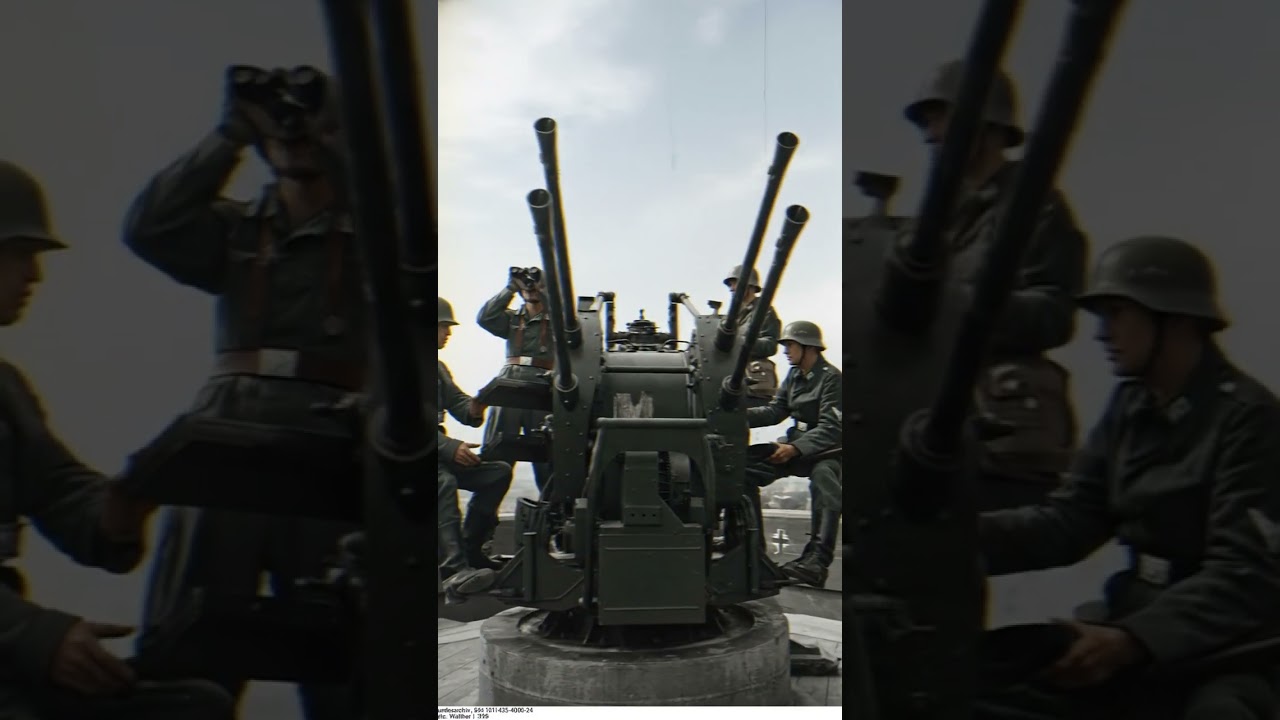
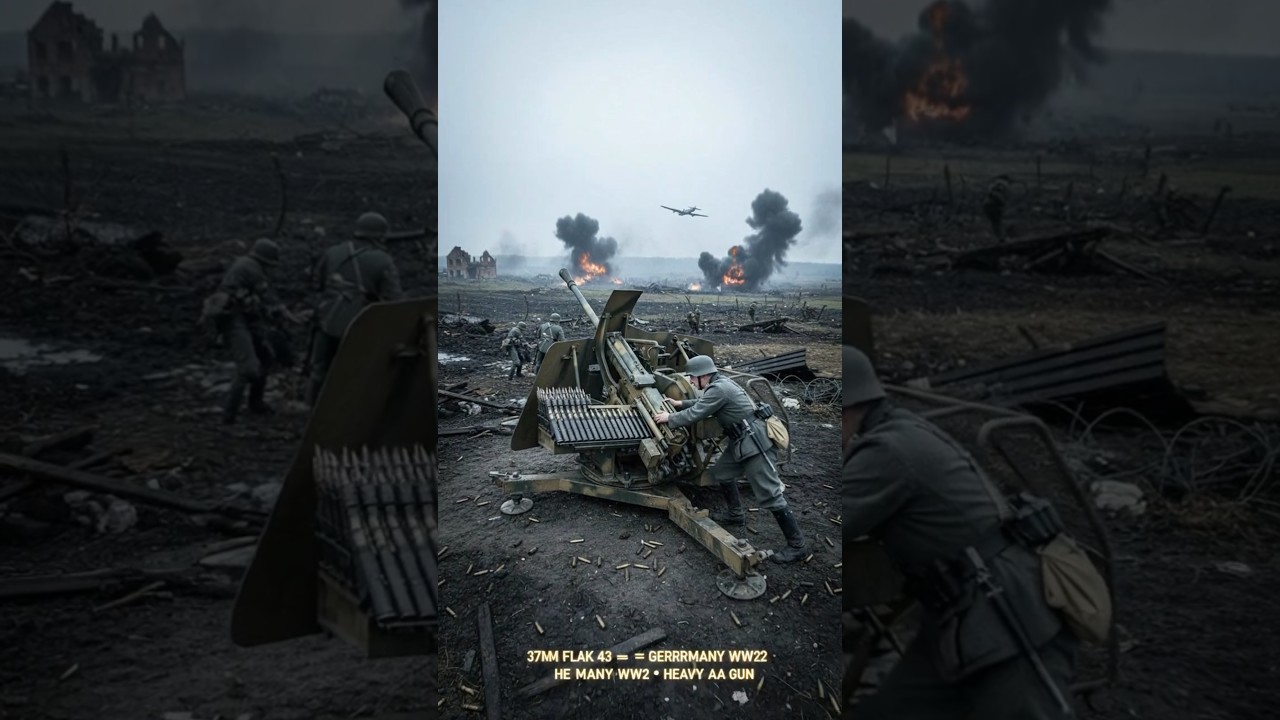
 PLATE 02A · 2 CM FLAKVIERLING 38
PLATE 02B · BLECHPRÄGETECHNIK RECEIVER
Stratospheric Titans: 10.5 cm Flak 39 & 12.8 cm Flak 40
Reaching 48,600 Feet with Four Times the Powder Charge of the 88mm Gun
As the Combined Bomber Offensive intensified over German industrial cities in 1943 and 1944, four-engine USAAF Boeing B-17 Flying Fortresses and Consolidated B-24 Liberators routinely bombed from altitudes between 6,400 and 8,200 meters (21,000 to 27,000 feet), while RAF De Havilland Mosquito pathfinders operated even higher. At 7,500 meters, an 8.8 cm Flak 36 shell took more than 21 seconds to climb to the target’s altitude. During those 21 seconds, a bomber formation flying at 110 meters per second traveled over 2.3 kilometers across the sky, allowing even minor pilot evasive maneuvers to throw off predicted time-fuze bursts.
To shrink projectile time-of-flight and expand the lethal fragmentation radius of each burst, the Luftwaffe turned to two super-heavy calibers designed by Rheinmetall-Borsig: the 10.5 cm Flak 38 and Flak 39, and the monstrous 12.8 cm Flak 40. Originally developed as a heavy competitor to the 88mm gun and closely related to the Kriegsmarine’s dual-mount 10.5 cm SK C/33 naval cannon aboard the battleship Bismarck, the 10.5 cm Flak 39 weighed 10,224 kilograms in firing position and fired a 15.1-kilogram (33.3-pound) shell at 881 m/s (2,890 ft/s) through an L/52.8 barrel with progressive rifling twist (increasing from 1/48 to 1/36). With an effective ceiling of 9,450 meters (31,003 feet), a maximum ceiling of 11,400 meters, and a power-assisted rammer sustaining 15 to 18 rounds per minute, more than 4,181 of these 105mm guns guarded German synthetic oil refineries, ports, and industrial rings.
The 12.8 cm Flak 40 and 26.5-Tonne Flakzwilling 40/2
The undisputed apex predator of Axis anti-aircraft artillery, however, was the 12.8 cm Flak 40 (128mm / 5.04-inch caliber), developed by Rheinmetall-Borsig under a 1936 contract (initially designated Gerät 40 to conceal its caliber). Measuring 7.835 meters (25 feet 8 inches, L/61) in length, the gun fired a massive one-piece 128×958mmR cartridge weighing nearly 48 kilograms complete, propelling a 26.0-to-27.9-kilogram (57.3-to-61.5-pound) projectile at a muzzle velocity of 880 m/s (2,887 ft/s).
Because its propellant charge was four times larger than that of the 8.8 cm Flak 36, a 12.8 cm shell climbed to bomber altitude in roughly one-third the flight time of an 88mm round, reaching a staggering maximum ceiling of 14,800 meters (48,600 feet) and an effective engagement ceiling of 10,700 meters (35,100 feet). Furthermore, when a 26-kilogram 128mm shell detonated, its high-explosive charge unleashed heavy jagged steel splinters across a lethal radius more than double that of an 88mm burst.
When prototype trials in 1937–1938 demonstrated that towing a 12-to-17-tonne cannon on multi-axle road trailers (the Sonderanhänger 220) required dismantling the barrel with a gantry crane, the Luftwaffe simplified the mount for fixed concrete emplacements (12.8 cm Flak 40 ortsfest) and heavy four-axle railway flatcars (Flak-Eisenbahnlafette), which could be shunted rapidly across Europe to protect high-value targets like the Ploiești oil fields in Romania. For maximum firepower atop urban Flak Towers, Rheinmetall mounted two 12.8 cm Flak 40 barrels side-by-side on a single electrically driven 26.5-tonne pedestal to create the 12.8 cm Flakzwilling 40/2. Assisted by electrical fuze setters and mechanical power rammers, a 22-man twin-mount crew could hurl 20 to 24 rounds of 128mm ordnance per minute into the stratosphere. Across the war, German factories completed 1,125 barrels of the 12.8 cm Flak 40 series, including 34 operational Flakzwilling 40/2 twin mounts by February 1945.


| Ordnance System | Caliber & Barrel | Shell Mass & Muzzle Vel | Effective / Max Ceiling | Practical Rate of Fire | Firing Mass & Total Built |
|---|---|---|---|---|---|
| 2 cm Flakvierling 38 | 4× 20 mm (L/65) | 0.12 kg @ 900 m/s | 2,200 m / 3,700 m | 800 rpm (1,800 cyclic) | 1,509 kg · 3,768 Quad Mounts |
| 3.7 cm Flak 43 | 37 mm (L/57) | 0.68 kg @ 820 m/s | 4,800 m / 6,585 m (Gnd) | 180 rpm (250 cyclic) | 355 kg (Gun) · ~7,216 Barrels |
| 8.8 cm Flak 18/36/37 | 88 mm (L/56) | 9.2 kg @ 820 m/s | 8,000 m / 9,900 m | 15–20 rpm | 7,407 kg · 20,754 Units |
| 8.8 cm Flak 41 | 88 mm (L/72–74) | 9.4 kg @ 1,000 m/s | 11,300 m / 14,700 m | 20–25 rpm | 7,840 kg · 556 Units |
| 10.5 cm Flak 38/39 | 105 mm (L/52.8) | 15.1 kg @ 881 m/s | 9,450 m / 11,400 m | 15–18 rpm | 10,224 kg · 4,181+ Units |
| 12.8 cm Flak 40 / Zwilling | 128 mm (L/61) | 27.9 kg @ 880 m/s | 10,700 m / 14,800 m | 10–12 rpm (20–24 Twin) | 17,000–26,500 kg · 1,125 Barrels |
| US 90 mm Gun M1/M2 (Allied Ref) | 90 mm (L/50) | 10.0 kg @ 823 m/s | 10,300 m / 11,800 m | 15–22 rpm (VT Fuze) | 8,618 kg · SCR-584 + M9 Director |
| UK QF 3.7-Inch Mk III (Allied Ref) | 94 mm (L/50) | 12.7 kg @ 792 m/s | 9,750 m / 13,700 m | 10–18 rpm (VT Fuze) | 9,317 kg · GL Mk III Radar |
Concrete Citadels: Inside the 200-Foot Flak Towers (Flaktürme)
3.5-Meter Reinforced Concrete Walls, Retractable Radar Domes & Subterranean Cities for 15,000+ Civilians
After a small force of Royal Air Force bombers penetrated Berlin’s outer air defenses on the night of August 25–26, 1940, Adolf Hitler ordered the immediate construction of colossal, above-ground reinforced-concrete anti-aircraft blockhouses—the Flaktürme (Flak Towers). Personally sketched by Hitler and engineered in detail by modernist architect Friedrich Tamms alongside the Organisation Todt, eight massive Flak Tower complexes were erected between 1940 and 1944: three forming a defensive fire triangle around central Berlin (Flakturm I Berliner Zoo, Flakturm II Friedrichshain, and Flakturm III Humboldthain), two guarding the port of Hamburg (Flakturm IV Heiligengeistfeld and Flakturm VI Wilhelmsburg), and three towering over Vienna (Flakturm V Stiftskaserne, Flakturm VII Augarten, and Flakturm VIII Arenbergpark). So urgent was the program that Germany’s national railway timetable was reorganized to haul hundreds of thousands of tons of Portland cement, structural rebar, and aggregate to the sites, allowing the first towers to rise in just six months.
Every Flak Tower complex operated as a synchronized pair positioned 300 to 500 meters apart—far enough that the deafening muzzle blast, vibration, and cordite smoke of the heavy guns would not blind the delicate optical rangefinders and radar dishes:
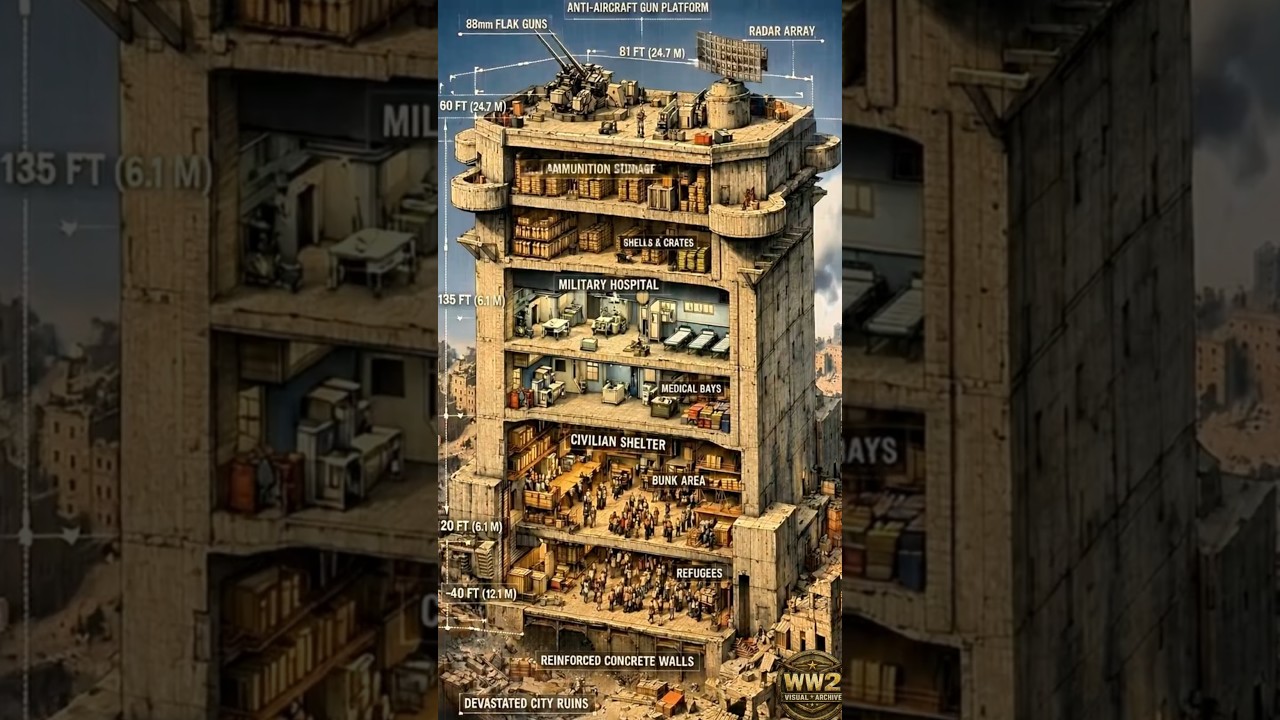
1. The Gefechtsturm (G-Tower / Combat Tower): The primary gun fortress. Across three design generations—from the huge 70.5 × 70.5 × 39-meter Generation I fortresses in Berlin and Hamburg Heiligengeistfeld, to the 57 × 57 × 41.6-meter Generation II towers, and the taller 43 × 43 × 54-meter (177-to-200-foot) Generation III towers in Vienna—each G-Tower mounted four twin 12.8 cm Flakzwilling 40/2 turrets (eight 128mm barrels total) on its upper corner cupolas, ringed by a lower cantilevered gallery (“Schwalbennester” or swallow’s nests) bristling with up to thirty-two 20mm barrels (eight 2 cm Flakvierling 38 mounts) and 3.7 cm Flak 43 autocannons.
2. The Leitturm (L-Tower / Fire-Control Lead Tower): Connected to the G-Tower by buried armored telephone and 108-core data-transmission conduits, the L-Tower housed the battery command post, optical 10-meter base rangefinders, the Kommandogerät 40 analog computer, and a massive 7.5-meter parabolic FuMG 65 Würzburg-Riese (“Giant Würzburg”) tracking radar—mounted on an hydraulic elevator platform that could retract inside a thick concrete-and-steel armored cupola (“Eisenbetonkuppel“) during daylight bombing runs.
Life and Combat Inside the Indestructible Keep
With exterior walls up to 2.5 to 3.5 meters (8 to 11.5 feet) thick and roofs poured to 3.5 to 5.0 meters of steel-mesh concrete, the Flak Towers were completely impervious to standard RAF and USAAF general-purpose bombs. Inside, each G-Tower functioned as a self-contained vertical city with its own deep-well water supply, diesel electrical generators, positive-pressure NBC poison-gas filtration chambers, and automated Paternoster chain hoists lifting 128mm shells from basement magazines straight to the roof turntables.
Designed officially to shelter 10,000 to 15,000 civilians across multiple lower decks, the Berlin Zoo and Humboldthain towers packed in up to 30,000 terrified Berliners during the final Soviet assault in April 1945. On the third floor of the Berlin Zoo G-Tower stood a fully equipped 85-to-95-bed military hospital with operating theaters where surgeons operated throughout heavy bombing raids, while vaulted climate-controlled rooms stored priceless treasures from the Pergamon and Kaiser Friedrich Museums—including the Pergamon Altar friezes and the bust of Nefertiti.
During the Battle of Berlin in late April 1945, even point-blank fire from Soviet 203 mm B-4 M1931 howitzers failed to breach the Zoo Tower’s main concrete walls. Turning their rooftop 12.8 cm Flakzwilling 40 guns downward into the Tiergarten and toward the Moltke Bridge, the Zoo Tower’s Luftwaffe gunners obliterated dozens of Red Army T-34/85 and IS-2 tanks in direct fire until the garrison finally capitulated after midnight on May 1–2, 1945. After the war, the British Royal Engineers required two separate demolition attempts and up to 35 tons of explosives to collapse the Zoo Tower in 1947, while the surviving towers in Hamburg (Heiligengeistfeld—now topped by a 58-meter hotel and rooftop forest opened in 2024) and Vienna (Augarten, Arenbergpark, and the Stiftskaserne/Esterházypark Haus des Meeres aquarium) still dominate their city skylines today.
ROOF · GUNS & RADAR
MID · HOSPITAL & AMMO
BASE · 15K+ REFUGEES
Fire Control & Armor Killers: Kommandogerät 40, Würzburg & Anti-Tank Warfare
How 108-Pin Analog Computers Aimed Heavy Batteries—and How the 88mm Halted Allied Tank Offensives
A single 8.8 cm or 12.8 cm cannon firing blindly into the sky had virtually zero probability of hitting an aircraft four miles up. What made a Luftwaffe heavy Flak battery (schwere Flakbatterie—typically four or six 8.8 cm Flak 36/37 guns, plus two 2 cm light guns for close protection) lethal was its centralized fire-control network. At the heart of the battery stood the Kommandogerät 40 (Kdo.Gr. 40), a masterpiece of three-dimensional mechanical analog computing developed by Carl Zeiss and Askania, paired with the four-meter stereoscopic optical rangefinder Entfernungsmesser 4m R.40 (EM 4m).
Operated by a five-man fire-control team, the Kommandogerät 40 continuously ingested the target aircraft’s slant range, azimuth bearing, and angular elevation, along with manual corrections for barometric air density, wind velocity at altitude, propellant temperature, and individual gun barrel wear (muzzle velocity drop). Inside its weatherproof casing, precision-milled three-dimensional ballistic cams rotated and slid against mechanical followers to solve the lead-angle equation in real time—calculating exactly where the bomber would be 15 to 28 seconds in the future, and even compensating automatically for the physical distance offset (parallax) between the director post and the gun pit.
These electrical firing solutions flowed instantly through heavy 108-pin multi-core cables to the Übertragungsgerät 37 dial receivers mounted on each gun in the battery. On an 8.8 cm Flak 37, the gun layers did not even look at the sky through optical sights: the azimuth layer, elevation layer, and fuze-setter operator simply turned their handwheels to align their mechanical gun pointers with the moving electrical command needles transmitted from the Kommandogerät. Simultaneously, the automatic dual cup fuze-setter (Zünderstellmaschine) twisted the nose of the 9.2-kilogram shell to set its Zünderstellwerk Zt.Z. S/30 clockwork time fuze (manufactured by watchmakers like Junghans and Thiel) to detonate within a tenth of a second of reaching the predicted intercept point.
Blind-Fire Radar: Freya, Würzburg-D, and the Giant Würzburg
When nightfall, winter cloud cover over the Reich, or artificial smoke screens blinded optical rangefinders, the battery switched to radar fire control (Funkmessgeräte). Early warning came from the long-wavelength FuMG 80 Freya radar (operating at 2.4 meters / 125 MHz out to 120 km), which handed off approaching bomber streams to the Telefunken FuMG 62 Würzburg decimetric tracking radar (operating at 53.6 cm / 560 MHz with a 3-meter parabolic dish). Introduced with a rotating dipole feed (Quirl) for conical lobing on the Würzburg-D (1941) and scaled up to a 7.5-meter dish on the 15-tonne FuMG 65 Würzburg-Riese (“Giant Würzburg”), the radar achieved a range accuracy of ±15 to ±25 meters and an angular precision of ±0.15 degrees out to 70 kilometers.
Feeding radar coordinates into the Kommandogerät 40 via the Malsi-Umwertegerät conversion table allowed Flak batteries to fire synchronized box barrages (Sperrfeuer) or predicted tracking salvos (begleitendes Wirkungschießen) in pitch darkness. When the Royal Air Force introduced “Window” (aluminized paper chaff strips cut to half the 53.6 cm Würzburg wavelength) during Operation Gomorrah over Hamburg in July 1943, Telefunken engineers scrambled to fit Doppler frequency-shift filters ( Würzlaus, which distinguished fast-moving aircraft propellers and airframes from slowly drifting foil strips) and frequency-hopping receivers (Nürnberg and Stendal) across the more than 4,000 Würzburg sets built during the war.
Depressing the Muzzle: Arras, “Hellfire Pass,” Barbarossa & Operation Goodwood
Why did an anti-aircraft cannon become the most feared anti-tank gun of World War II? The answer lies in Newtonian physics and an early doctrinal decision. Unlike British and American heavy anti-aircraft mounts—which initially lacked direct-fire telescopic sights, armor-piercing ammunition, or reliable below-horizontal barrel depression—the German Heereswaffenamt and Luftwaffe insisted that every 8.8 cm Flak mount be able to depress to -3 degrees below the horizontal and carry dedicated armor-piercing rounds alongside its high-explosive anti-aircraft shells.
Firing the 10.2-kilogram Panzergranate 39 (PzGr. 39) Armor-Piercing Capped Ballistic Cap (APCBC-HE-T) round at a muzzle velocity of 795 to 800 m/s, the 8.8 cm L/56 barrel generated a flat, laser-like trajectory that required minimal range estimation out to 1,200 meters and could penetrate 110 mm of rolled homogeneous armor (sloped at 30 degrees from vertical) at 500 meters, 100 mm at 1,000 meters, and 84 mm at 2,000 meters. With the sub-caliber tungsten-cored Panzergranate 40 (PzGr. 40 APCR) leaving the muzzle at 930 m/s, close-range penetration rose to 150 mm at 500 meters and 126 mm at 1,000 meters.
This capability repeatedly rescued German armies from operational disaster. On May 21, 1940, at Arras in northern France, British Matilda I and heavily armored Matilda II infantry tanks (78 mm frontal armor) shrugged off every round from German 3.7 cm Pak 36 anti-tank guns and overran Generalmajor Erwin Rommel’s 7th Panzer Division infantry until Rommel personally ordered Luftwaffe 8.8 cm Flak batteries to level their barrels and blast the Matildas at point-blank range. Across the 1940 French campaign alone, twenty-four mixed Flak battalions knocked out 152 Allied tanks and 151 concrete bunkers.
In the Western Desert of North Africa (1941–1943), where treeless salt flats and heat haze allowed visibility past 3,000 meters, Rommel turned the 88mm gun into the tactical anvil of the Afrika Korps. Instead of charging British armor head-on, German panzers feigned retreat to lure British Crusader, Valentine, and Grant squadrons onto concealed lines of 8.8 cm Flak guns dug into reverse slopes with sandbags piled around their gun shields. During the June 1941 Battles of Halfaya Pass (Operation Battleaxe), a handful of dug-in 88mm guns decimated attacking British squadrons over 1,500 meters away—long before the British 2-pounder (40mm) tank guns could even reply—earning the defile the immortal Allied nickname “Hellfire Pass.” Two Luftwaffe Flak battalions alone accounted for 264 British tanks in 1941.
A month later, during Operation Barbarossa (June 1941), the fifty-one mixed Flak battalions attached to invading Wehrmacht corps proved to be the only frontline weapons capable of reliably stopping the sloped armor of the Soviet T-34/76 and the thick plates of the KV-1 and KV-2 at normal battle ranges. So decisive was the 8.8 cm Flak 36 against Soviet armor that Krupp directly adapted its ballistics and 88×571mmR chamber into the 8.8 cm KwK 36 L/56 turret cannon of the Panzerkampfwagen VI Tiger I heavy tank, while Krupp’s longer 71-caliber competition rival to the Flak 41 became the legendary 8.8 cm Pak 43 and KwK 43 L/71 (firing the 88×822mmR cartridge at 1,000 m/s, penetrating over 200 mm of armor at 1,000 meters) mounted on the Nashorn, Elefant, Jagdpanther, and Tiger II (King Tiger). Even as late as July 18, 1944, during Operation Goodwood in Normandy, Major Hans von Luck of the 21st Panzer Division commandeered a Luftwaffe 8.8 cm Flak battery in the orchards of Cagny; firing on the flank of the British 11th Armoured Division, those four 88mm guns knocked out 20 British Sherman tanks in the opening seconds and over 40 tanks before the afternoon ended.
Strategic Balance Sheet: The Industrial Price of the Flak Umbrella
39 Million Reichsmarks a Month, the Proximity Fuze Gap & 1.25 Million Personnel
How effective was Germany’s gigantic anti-aircraft effort in the strategic air war, and what did it cost the Wehrmacht’s frontline armies? Historians such as Edward B. Westermann and Donald Nijboer have demonstrated that the Luftwaffe’s Flakwaffe was simultaneously an engineering marvel and a colossal industrial drain on the Third Reich. In January 1943—the very month the German 6th Army was being annihilated at Stalingrad—expenditures on anti-aircraft guns and ammunition consumed 39 million Reichsmarks, representing nearly 30% of Germany’s entire weapons and munitions budget (compared to 93 million Reichsmarks for all other army, naval, and aviation weapons combined). By August 1944, the Luftwaffe operated 10,704 heavy 8.8 cm Flak 18/36/37 guns alongside more than 4,181 heavy 10.5 cm guns, 1,125 super-heavy 12.8 cm barrels, and tens of thousands of 20mm and 37mm autocannons, manned by over 1.25 million personnel—including hundreds of thousands of Flakhelfer (15-to-17-year-old high school auxiliaries), Flakwaffenhelferinnen (female radar and searchlight operators), and Soviet prisoners of war (Hiwis).
Because German heavy Flak relied on mechanical clockwork time fuzes (Zt.Z. S/30) rather than miniature Doppler radio proximity fuzes (like the Allied Mark 53 VT fuze, which Germany never successfully mass-produced despite developing prototypes like Kugelblitz and Marabu), shooting down a high-altitude heavy bomber required an enormous expenditure of ammunition: wartime Luftwaffe statistical audits calculated that it took an average of 3,343 rounds of 8.8 cm Flak 36 ammunition to bring down a single four-engine Allied bomber, whereas the higher-velocity 8.8 cm Flak 41 reduced that figure to roughly 800 rounds and the 12.8 cm Flak 40 required approximately 3,000 rounds at extreme altitudes where 88mm guns could not reach at all.
Yet raw shoot-down statistics tell only half the tactical story. Between 1943 and 1945, German Flak guns accounted for roughly half of all USAAF Eighth and Fifteenth Air Force aircraft lost over Europe (destroying over 5,400 American aircraft and damaging more than 65,000 others) and shot down more than 2,200 RAF Bomber Command aircraft. Even more importantly, heavy Flak batteries forced Allied bomber groups to fly 1,500 to 2,500 meters higher than optimal bombing altitude, degrading visual and radar bomb-aiming accuracy by more than 40% while punching shrapnel holes through wings and engines that turned straggling bombers into easy prey for Luftwaffe Messerschmitt Bf 109 and Focke-Wulf Fw 190 day fighters. From the sun-baked ridges of Halfaya Pass to the 200-foot concrete battlements of the Berlin Zoo Tower, German Flak artillery stood as the most versatile, technologically integrated, and fiercely contested artillery system of the Second World War.