SECTION 01 · AERIAL ORDNANCE GENESIS
From Luftwaffe Sky Cannon to Ground Flakdrilling
The Strategic Crisis That Forced Aircraft Cannons Onto the Ground
By early 1944, Allied fighter-bombers dominated the low-altitude skies over both Normandy and the Eastern Front. Consequently, German mechanized columns faced relentless strafing from Republic P-47 Thunderbolts, Hawker Typhoons, and Ilyushin Il-2 Sturmoviks during daylight road marches. Meanwhile, conventional towed anti-aircraft batteries struggled to unlimber fast enough when sudden aerial ambushes struck moving armor. Therefore, frontline ordnance officers searched urgently for a compact, belt-fed weapon that could unleash an immediate wall of explosive shells without pausing to reload small box magazines.
Fortunately for German quartermasters, Luftwaffe depots held thousands of surplus Mauser autocannons originally manufactured for fighter wings and bomber turrets. Specifically, bombed-out airframe factories and acute aviation fuel shortages left vast stockpiles of the Maschinengewehr 151 sitting idle in underground warehouses. Rather than letting these precision weapons gather dust, engineers mounted three synchronized cannons onto a single high-angle pedestal. Thus, the famous MG 151/20 Drilling triple anti-aircraft gun emerged as one of the deadliest close-range defense systems of the Second World War.
How Waffenfabrik Mauser Engineered the Original MG 151 Series
To understand why the triple mount performed so fiercely on the ground, one must first examine its aviation pedigree at Waffenfabrik Mauser in Oberndorf. Beginning in 1934, Reich Air Ministry planners requested a high-velocity autocannon compact enough to fit between the cylinder banks of a V-12 aero engine. Previously, German fighters relied on the drum-fed 20mm MG FF cannon, which suffered from a sluggish 580-meter-per-second muzzle velocity and limited 60-round ammunition drums. By contrast, Mauser engineers designed a streamlined, short-recoil, belt-fed mechanism that entered production in 1940 as the 15.1mm MG 151/15.
Initially, the 15×96mm cartridge delivered an impressive 850 to 960 meters per second in muzzle velocity and penetrated 18 millimeters of steel armor at 300 meters. However, combat evaluations aboard early Messerschmitt Bf 109F-2 interceptors revealed a critical tactical lesson. High velocity alone rarely downed sturdy Allied aircraft quickly; instead, aircrews needed devastating chemical blast effect inside enemy wing structures. Consequently, Mauser rechambered the weapon in 1941 to fire a wider 20mm shell, creating the iconic MG 151/20.
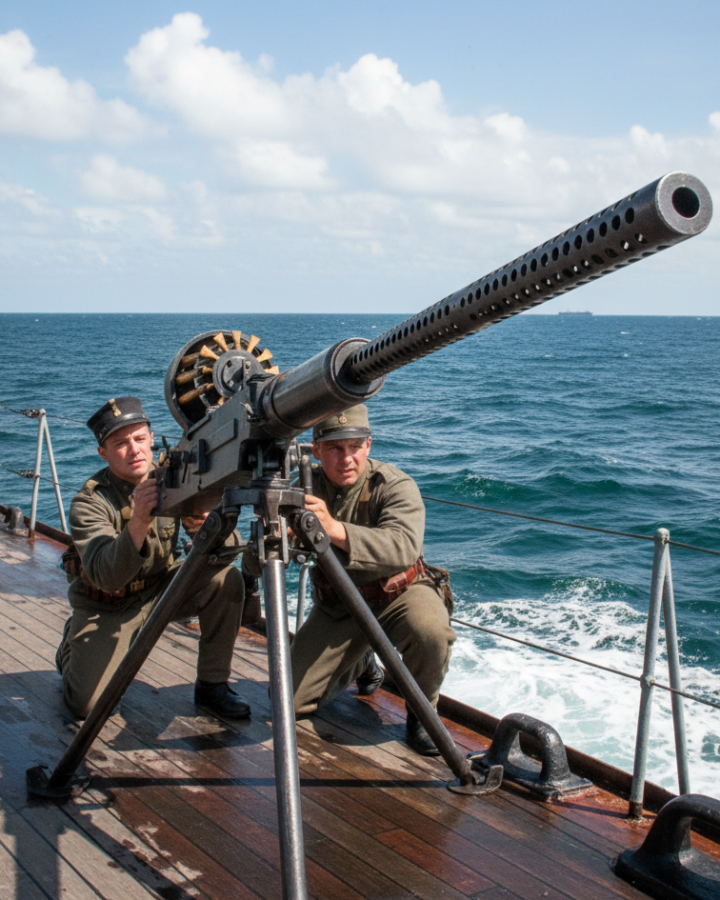
MG 151/20 Drilling — Triple Cannon Burst Luftwaffe Anti-Aircraft Gun
Restored 4K sequence capturing both a German coastal gunner firing the triple-mounted MG 151/20 from a fortified seaside pit and Allied ordnance personnel examining a captured conical pedestal mount in the field. Therefore, viewers can observe the simultaneous three-barrel recoil impulse and the right-hand cartridge belt chute geometry in full color.


SECTION 02 · CARTRIDGE & MINENGESCHOSS CHEMISTRY
Inside the 20×82mm Mauser Cartridge and Mine-Shell Physics
Necking Up the 15mm Case for Maximum Structural Destruction
Converting the 15mm cannon into a 20mm weapon required clever metallurgical compromise inside the Mauser design bureau. Specifically, engineers expanded the neck of the 15×96mm brass case to accept the 20mm projectile already proven in the older MG FF/M cannon. Simultaneously, they shortened the cartridge case to 82 millimeters so that the complete 20×82mm Mauser round matched the exact overall length of the earlier 15mm ammunition. As a result, armorers could convert an existing MG 151/15 into an MG 151/20 simply by swapping the barrel and minor feed components.
Admittedly, pushing a heavier 20mm projectile with a shorter powder case reduced the muzzle velocity to between 705 and 805 meters per second. Nevertheless, this velocity still exceeded the older MG FF by more than 120 meters per second and produced a flatter, far more predictable trajectory out to 800 meters. Furthermore, each cannon weighed just 42.7 kilograms and measured 1.766 meters in total length, making it remarkably light for a 20mm automatic weapon. Because the gun cycled at 600 to 750 rounds per minute per barrel, clustering three barrels together created a ferocious firehose of steel.
Why the Thin-Walled Minengeschoss Shattered Airframes on Impact
The true secret behind the MG 151/20’s lethality lay inside its thin-walled high-explosive shell, known in German ordnance doctrine as the Minengeschoss (mine shell). Traditional anti-aircraft projectiles used thick forged-steel walls that fragmented upon detonation, leaving very little internal volume for chemical explosives. Conversely, German metallurgists drew high-grade steel into ultra-thin, deep-drawn casings that maximized internal cavity space. While a standard 20mm fragmentation round held only 6 to 7 grams of explosive, the 20mm Minengeschoss packed 18.6 to 25 grams of incendiary high-explosive filler.
More importantly, ordnance chemists loaded these shells with potent HA 41 and compressed MX mixtures combining hexogen (RDX) and fine aluminum powder. When a delay-fuzed mine shell pierced an aircraft’s duralumin skin, it detonated inside the wing spar rather than on the outer surface. Consequently, the overpressure wave and white-hot aluminum flash blew entire control surfaces and fuel tanks apart from within. Moreover, tracer rounds featured a built-in Zerleger self-destruct relay that detonated the shell automatically after five seconds if it missed its target.
ORDNANCE DATA SHEET · FILE 151-A
Mauser MG 151/15 vs. MG 151/20 Cannon Specs
| Parameter | MG 151/15 (1940) | MG 151/20 (1941–45) |
|---|---|---|
| Manufacturer | Waffenfabrik Mauser AG | Waffenfabrik Mauser AG |
| Caliber & Shell | 15.1 mm (15×96mm Mauser) | 20 mm (20×82mm Mauser) |
| Weapon Mass | 38.1 kg (84.0 lb) | 42.7 kg (94.2 lb) |
| Overall Length | 1,916 mm (6 ft 3.4 in) | 1,766 mm (5 ft 9.5 in) |
| Barrel Length | 1,254 mm (L/83 · 8 grooves) | 1,104 mm (L/55 · 1-in-23 twist) |
| Operating Action | Short-recoil, open-bolt | Short-recoil, percussion or electric |
| Rate of Fire (Single) | 680–740 rounds/min | 650–750 rounds/min (up to 800 sync) |
| Rate of Fire (Drilling 3×) | ~2,100 rounds/min combined | 2,100–2,250 rounds/min combined |
| Muzzle Velocity | 850 m/s (AP-T) – 960 m/s (HE) | 705 m/s (AP/HE-T) – 805 m/s (M-Shell) |
| Armor Penetration | 18 mm at 300 m (60° impact) | 10–12 mm at 300 m (60° impact) |
CARRIER DATA SHEET · FILE 251-21
Sd.Kfz. 251/21 Ausf. D “Drilling” Half-Track Specs
| Specification | Sd.Kfz. 251/21 (Schützenpanzerwagen Drilling) |
|---|---|
| Official Designation | M.G. 151/15 u. 151/20 Drilling auf m. S.P.W. |
| Combat Weight | 8.0 tons (7.26 metric tonnes) |
| Dimensions (L × W) | 5.80 m (19 ft) × 2.10 m (7 ft) |
| Primary Armament | 3 × 15mm MG 151/15 or 3 × 20mm MG 151/20 |
| Secondary Armament | 1 × 7.92mm MG 42 (hull defense) |
| Ammunition Stowed | 3,000 rounds belted in 3 sheet-steel boxes |
| Mount Traverse & Elevation | 360° manual shoulder traverse; −5° to +49° (+85° field) |
| Optical Fire Control | 3× telescopic sight (8° FOV) + Spider-web AA sight + 8× periscope |
| Powerplant & Speed | Maybach HL 42 TUKRR 6-cyl (100 hp) · 48 km/h (30 mph) |
| Operational Range & Crew | 300 km (186 miles) road radius · 4 Crew |
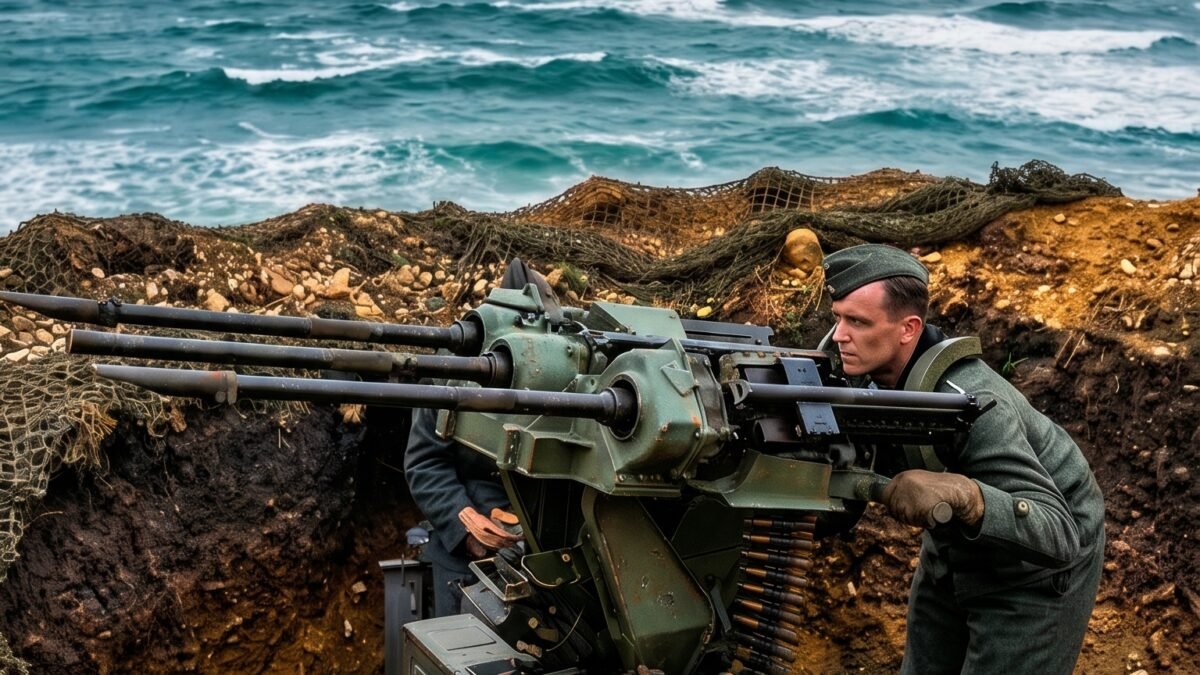
MG 151/20 “Drilling” Triple Gun — Coastal Cliffside Pedestal & Belt Array
High-altitude coastal cliff emplacement showcasing the wheeled armored-shield MG 151/20 Drilling mount with linked 20×82mm ammunition belts arrayed across the timber firing deck. Moreover, the close-up camera pass highlights the three long flash-suppressor barrels elevated at a steep anti-aircraft interception angle.


SECTION 03 · TRIPLE MOUNT ENGINEERING
Mechanical Anatomy of the MG 151/20 Drilling Mount
Coaxial Trunnions, Belt Chutes, and 2,100 Rounds Per Minute
When German engineers adapted the Mauser cannon for ground and naval air defense, they created the MG 151 Drilling—literally meaning “triplet.” In this compact configuration, three MG 151/15 or MG 151/20 cannons sat side by side in the same horizontal plane inside standard aircraft cradles. Mechanics bolted these three cradles onto a unified steel trunnion block atop a conical rotating pedestal. Because each barrel fired approximately 700 to 750 rounds per minute, triggering all three barrels simultaneously unleashed an astonishing 2,100 to 2,250 rounds per minute.
Unlike the standard Army 2 cm Flak 38, which relied on 20-round box magazines that loaders had to swap every few seconds, the Drilling fed from continuous disintegrating-link belts. Specifically, three heavy sheet-steel ammunition boxes flanked and sat beneath the mount, feeding flexible metal chutes directly into each breech. Therefore, a single gunner could sustain continuous burst fire across an entire strafing pass without pausing for magazine changes. In addition, early ground mounts used manual cocking cables and percussion primers, whereas late-war aircraft variants often employed electrical ignition.
Shoulder-Controlled Traverse, Pedestal Ergonomics, and Sighting Optics
Operating the Drilling required physical coordination rather than complex handwheel cranking. Instead of turning slow geared traverse wheels during a high-speed fighter attack, the gunner strapped into padded shoulder rests and gripped dual spade handles behind the receiver block. By shifting his body weight and pivoting on his feet, the operator swung the entire triple assembly through a full 360 degrees of azimuth and elevated the barrels from minus 5 degrees to plus 49 degrees (and up to 85 degrees on modified naval and field pedestals). Meanwhile, a friction brake lock secured the pedestal during transport or fixed-sector ground firing.
For target acquisition, crews utilized two distinct sighting systems tailored to different combat threats. Against low-flying aircraft, gunners tracked targets through an open spider-web ring sight (Kreiskornvisier) that helped estimate lead angles against 500-kilometer-per-hour fighter-bombers. Conversely, when engaging infantry positions, light armored cars, or urban strongpoints, the gunner looked through a 3× magnification telescopic sight offering an 8-degree field of view. Furthermore, armored half-track installations included an 8× hand periscope so the commander could observe fall of shot from behind steel plate.
SECTION 04 · ARMORED HALF-TRACK INTEGRATION
The Sd.Kfz. 251/21 Schützenpanzerwagen Drilling in Combat
Transforming the Hanomag Half-Track into a Mobile Flak Battery
Although stationary pedestal mounts guarded airfields, bridges, and coastal cliffs, the Drilling achieved its greatest tactical fame aboard the Sd.Kfz. 251/21 armored half-track. Introduced in mid-1944 on the simplified Ausf. D hull, this vehicle answered the Panzergrenadier regiments’ desperate plea for organic, mobile air defense. Workers bolted the conical Drilling pedestal directly to the reinforced floor of the open fighting compartment. To protect the gunner’s head and torso from shell splinters and strafing bullets, fabricators welded a compact, three-sided armored shield directly onto the upper gun cradle.
Powered by a 100-horsepower Maybach HL 42 six-cylinder engine, the 8-ton half-track reached road speeds of 48 kilometers per hour (30 mph) and covered 300 kilometers on internal fuel. Inside the hull, racks held 3,000 rounds of belted 15mm or 20mm ammunition alongside a secondary 7.92mm MG 42 machine gun for local defense. A four-man crew—comprising a commander, gunner, loader, and driver—operated the vehicle in tight coordination. Because the half-track shared the exact chassis of standard infantry carriers, maintenance companies could service it easily in the field.
Dual-Role Devastation in Normandy, the Ardennes, and Hungary
Once deployed to the fronts in the summer and autumn of 1944, the Sd.Kfz. 251/21 quickly proved that its value extended far beyond shooting down aircraft. Indeed, US Army intelligence manuals explicitly classified the vehicle as an assault weapon for ground combat first and a low-altitude anti-aircraft system second. When depressed to minus 5 degrees, the three synchronized cannons shredded wooden buildings, tree-line anti-tank gun emplacements, and Allied half-tracks within seconds. Consequently, Panzergrenadier commanders frequently pushed their Drilling carriers to the front of mechanized spearheads during the Ardennes Offensive and the battles around Lake Balaton.
Nevertheless, the vehicle had notable vulnerabilities that crews respected in combat. Because the fighting compartment remained open at the top to vent propellant gases and allow high-angle sky tracking, mortar airbursts and artillery shrapnel posed a constant danger. Moreover, changing heavy ammunition belts inside the cramped side sponsons demanded strenuous effort under fire. Despite these challenges, captured soldiers and Allied after-action reports consistently described the triple MG 151/20 burst as one of the most terrifying acoustic and physical shocks on the late-war battlefield.
SECTION 05 · COASTAL, FIELD & VOLKSSTURM MOUNTS
Coastal Bunkers, Kriegsmarine Decks, and Field Pedestals
Defending Atlantic Wall Cliffs, Mediterranean Ports, and Schnellboote
Beyond armored half-tracks, the MG 151/20 Drilling served across a remarkable variety of fixed and semi-mobile emplacements from the North Sea to the Mediterranean coast. Along rocky headlands in Italy, Norway, and France, Luftwaffe field divisions and Kriegsmarine coastal artillery units bolted the conical pedestal directly onto concrete Tobruk pits or timber firing platforms. Often, crews attached two pneumatic transport wheels and a folding tow bar to the armored ammunition base, allowing a light truck or crew team to roll the mount between prepared cliffside positions.
At sea, the Kriegsmarine eagerly adopted both twin and triple 20mm mounts to protect fast attack craft (Schnellboote), minesweepers, and Siebel landing ferries against Royal Air Force Coastal Command strike wings. Saltwater spray and steep deck roll demanded rugged, simple weapons that could fire instantly without electrical power failures. Because the MG 151/20 used a self-contained short-recoil cycle and sealed belt boxes, naval gunners could sweep low-flying Bristol Beaufighters and De Havilland Mosquitoes with dense curtains of 20mm mine shells.
Last-Ditch Improvisations from Airfield Trenches to Berlin Barricades
As Allied armies crossed the borders of the Reich in late 1944 and early 1945, German ordnance depots stripped every remaining MG 151/15 and MG 151/20 from damaged aircraft. In November 1944, photographs from Posen in the Wartheland documented Volkssturm militia battalions parading with improvised single, twin, and triple MG 151 ground mounts fitted onto simple tubular tripods and two-wheeled carts. Similarly, Luftwaffe ground crews surrounded fighter airfields with sunken earthen revetments housing Drilling pedestals to fend off Mustang and Tempest fighters hunting Me 262 jets during takeoff and landing.
Even after Germany’s surrender in May 1945, the Mauser MG 151/20 refused to fade into history. Postwar France salvaged thousands of cannons and mounted them on AMX-13 chassis and aboard Sikorsky H-34 and Alouette III helicopter gunships during the Algerian and Cold War conflicts. Likewise, Finland deployed twin MG 151/20 naval AA mounts for decades, while South Africa eventually adopted the exact 20×82mm Mauser cartridge for its modern Denel NTW-20 anti-materiel rifle.
4K Optical Restoration & Colorization Pipeline
Original wartime combat reels of the MG 151/20 Drilling and Kriegsmarine Flak batteries survive only on scratched 16mm and 35mm nitrate film stock. Consequently, our restoration team at WW2 Visual Archive processes every frame through a multi-stage optical and historical calibration pipeline before publication. Drag the interactive comparison slider below to inspect the transformation from raw monochrome archival grain to full 4K spectral color.
 4K COLORIZED RESTORATION
RAW 35MM NITRATE MONOCHROME
Motion Stabilization & Nitrate Scratch Removal
First, optical flow algorithms eliminate severe camera gate weave caused by concussive 2,100-RPM gun vibration while preserving genuine muzzle blast dust and ejected brass links.
Authentic RAL Ordnance Paint & Uniform Calibration
Next, colorists reference surviving museum ordnance to match authentic RAL 7028 Dunkelgelb (dark yellow), RAL 6003 Olivgrün, and Luftwaffe field-blue wool uniforms under natural coastal daylight.
4K Detail Upscaling & Ballistic Audio Mastering
Finally, neural super-resolution reconstructs crisp trunnion rivets, belt-link stampings, and tracer glow, paired with synchronized 20mm Mauser cyclic acoustic transients.
SECTION 05B · BATTLEFIELD DOCTRINE & CREW DRILLS
Combat Tactics, Crew Drills, and Flak Ambush Operations
How Panzergrenadier Flak Platoons Organized Mobile Air Defense
Within late-war German mechanized formations, the Sd.Kfz. 251/21 Drilling operated inside specialized heavy weapons and anti-aircraft platoons attached directly to Panzergrenadier battalions. Typically, a platoon deployed three to six Drilling half-tracks distributed along the march column or positioned around the battalion command post and fuel supply trains. Instead of bunching together on open highways where Allied fighter-bombers could spot dust plumes from miles away, drivers tucked their camouflaged half-tracks beneath orchard canopies, stone barn overhangs, and sunken country lanes.
Meanwhile, spotters scanned the horizon with scissor binoculars and listened for incoming radial and inline aero engines. Furthermore, radio operators monitored Luftwaffe fighter-control frequencies to receive early warning whenever Allied tactical air formations crossed the front line. Once enemy fighter-bombers committed to a diving strafing run, all three Drilling mounts in the platoon opened fire simultaneously at 600 to 800 meters, weaving an intersecting cone of 20mm tracers that forced attacking pilots to pull up prematurely or fly straight through a lethal curtain of Minengeschoss bursts.
Barrel Cooling, Belt Reloading, and Recoil Management Under Fire
Sustaining a combined cyclic rate above 2,100 rounds per minute placed immense thermal and mechanical stress on the three Mauser barrels. Consequently, German gunnery manuals trained Drilling operators to fire sharp, disciplined bursts lasting one to two seconds—sending 35 to 70 rounds downrange—rather than holding the triggers down continuously until the barrels overheated. Between passes, the loader inspected the three belt chutes, cleared ejected brass links from the floor grating, and checked barrel temperature.
Whenever a barrel lining wore down or overheated during prolonged ground fighting, the MG 151/20’s clever aviation design allowed rapid field replacement. Specifically, a trained crew could unlock the barrel retaining latch, twist and withdraw the hot barrel assembly forward through the cradle, and slide a fresh cold barrel into battery in under a minute. Because the left and right outer guns fed from externally hung 250-to-400-round steel belt drums while the center gun drew from a lower central chest, loaders practiced synchronized reloading drills so all three barrels stayed ready for the next aerial wave.
Urban Street Fighting and Foliage Suppression on the Eastern and Western Fronts
During the bitter autumn and winter campaigns of 1944–1945, Allied and Soviet infantry feared the MG 151/20 Drilling just as much as low-flying pilots did. In dense forest battles such as the Hürtgenwald and the Ardennes, Panzergrenadier commanders used the Drilling to sweep tree crowns and trigger devastating airbursts among concealed infantry foxholes. Similarly, during urban combat in Aachen, Budapest, and Königsberg, a single two-second burst of 20mm mine shells tore through brick apartment walls, sandbagged sniper nests, and upper-story anti-tank rifle positions that conventional 7.92mm MG 42 fire could not penetrate.
Moreover, the psychological impact of the weapon often decided local firefights immediately. Because the three barrels fired slightly out of phase once triggered, the acoustic signature produced a deafening, tearing roar completely distinct from a single Flak 38 or a rhythmic Bofors 40mm gun. Combined with bright daytime glow-tracers and exploding impact flashes, a single Drilling half-track or emplaced pedestal mount could pin down an entire infantry company while armored assault teams maneuvered onto their flank.
SECTION 06 · WEHRMACHT & LUFTWAFFE FLAK DOCTRINE
The Broader German Flak Artillery Ecosystem (2 cm to 12.8 cm)
Light Flak Workhorses: The 2 cm Flak 30/38 and Quad Flakvierling 38
To appreciate where the MG 151/20 Drilling fit within Germany’s air-defense umbrella, one must examine the layered hierarchy of German Flugabwehrkanone (Flak) artillery. At the lowest tier stood the ubiquitous 2 cm Flak 30 and Flak 38, which became the most numerously produced German artillery pieces of the entire war with more than 144,000 barrels built. Firing the longer 20×138mmB Solothurn cartridge at 900 meters per second, the single Flak 38 reached a cyclic rate of 450 rounds per minute and an effective vertical ceiling of 2,200 meters.
However, because each gun fed from a small 20-round box magazine, practical rate of fire dropped to roughly 180 rounds per minute. To overcome this limitation, Rheinmetall and Mauser introduced the formidable 2 cm Flakvierling 38 in 1940, combining four Flak 38 barrels onto a single triangular carriage with dual foot-firing pedals. Capable of 1,800 rounds per minute cyclic (800 practical), the Flakvierling defended everything from U-boat pens and armored trains to Panzer columns—yet its 1,509-kilogram weight and constant four-loader magazine changes made the lighter, belt-fed MG 151/20 Drilling far more convenient inside cramped half-tracks.
Medium Stopping Power: The 3.7 cm Flak 18/36/37 and Gas-Operated Flak 43
When engaging heavily armored attack aircraft like the Soviet Il-2 Sturmovik beyond 1,500 meters, 20mm shells often lacked sufficient range and kinetic punch. Consequently, German batteries relied on medium 3.7 cm Flak 18, 36, and 37 cannons firing a 635-gram projectile (nearly six times heavier than a 20mm shell) to an effective ceiling of 4,800 meters. Although effective, the early 3.7 cm series required expensive machining and fired at a modest 160 rounds per minute cyclic rate.
Therefore, Rheinmetall-Borsig radically redesigned the weapon in 1943, borrowing a gas-operated breech mechanism from the 30mm MK 103 aviation cannon to create the 3.7 cm Flak 43. By placing a horizontal 8-round clip feed tray directly through the center of gravity at the trunnions, loaders could feed clips continuously without disturbing the gunner’s aim. As a result, cyclic rate of fire jumped to 250 rounds per minute (and 500 rpm in the stacked Flak 43 Zwilling twin mount), while manufacturing time plummeted from 4,320 man-hours to just 1,000 man-hours per gun.
Heavy Sky Titans: The 8.8 cm Acht-Acht, 10.5 cm SK C/33, and 12.8 cm Flak 40
Above the low-altitude umbrella stood the legendary heavy Flak batteries that defended German cities, industrial plants, and capital ships against high-altitude strategic bombers. Foremost among them was the 8.8 cm Flak 18/36/37 and Flak 41 (“Acht-Acht”), with 21,310 units built. Directed by mechanical Kommandogerät 40 analog computers and Würzburg radars, four-gun 88mm batteries hurled 9.2-kilogram time-fuzed shells to 8,000 meters (and 11,300 meters with the long-barreled Flak 41), while doubling as the war’s most feared anti-tank gun from Arras and Halfaya Pass to Kursk.
For heavier strategic and naval defense, Rheinmetall produced over 4,180 units of the 10.5 cm Flak 38/39, whose naval counterpart—the tri-axially stabilized twin 10.5 cm/65 SK C/33—guarded battleships like Bismarck with 15.1-kilogram shells up to 10,300 meters. Finally, at the apex of German anti-aircraft engineering stood the colossal 12.8 cm Flak 40 and twin Flakzwilling 40/2. Mounted atop concrete Flak Towers in Berlin, Hamburg, and Vienna, the 26.5-tonne twin 128mm mounts fired 27.9-kilogram projectiles at 880 meters per second to a ceiling of 14,800 meters.
SECTION 07 · ARMORED FLAKPANZER EVOLUTION
Evolution of German Self-Propelled AA Carriers (1940–1945)
Early Half-Track Prime Movers: Sd.Kfz. 10/4, Sd.Kfz. 7/1, and Sd.Kfz. 7/2
Germany’s quest for mobile anti-aircraft protection evolved through three distinct generations as Allied air power grew stronger. Initially, during the 1939–1941 Blitzkrieg campaigns, the Wehrmacht mounted single 2 cm Flak 30/38 guns onto unarmored light 1-ton half-tracks (Sd.Kfz. 10/4 and 10/5) and heavy 8-ton Krauss-Maffei Sd.Kfz. 7 prime movers. Specifically, the Sd.Kfz. 7/1 carried a 2 cm Flakvierling 38 quad mount (~800 built), while the Sd.Kfz. 7/2 mounted a 3.7 cm Flak 36 or 43 cannon (~1,000 built).
With folded drop-sides and an 11.5-tonne chassis capable of 50 kilometers per hour, these 8-ton half-tracks gave Panzer divisions lethal mobile firepower. However, their high silhouettes and thin 8mm cab armor left gun crews completely exposed to strafing .50-caliber machine guns and fragmentation rockets. Consequently, by 1943, General Heinz Guderian and the Inspectorate of Panzer Troops demanded fully tracked, armored Flakpanzers built directly on battle-tank hulls.
Stopgap Tank Conversions: Flakpanzer 38(t) and Flakpanzer IV Möbelwagen
As an immediate interim measure between November 1943 and February 1944, BMM converted 141 Czech-designed Ausf. M tank chassis into the Flakpanzer 38(t) (Sd.Kfz. 140). Weighing 9.8 tonnes with a mid-mounted Praga engine and folding rear armor plates housing a single 2 cm Flak 38, the vehicle fought in Normandy with units such as the 12th SS Panzer Division—yet a single 20mm barrel proved too light against 1944 fighter-bombers.
Simultaneously, Deutsche Eisenwerke built 240 units of the Flakpanzer IV “Möbelwagen” (Sd.Kfz. 161/3) on battle-damaged Panzer IV hulls returned from the Eastern Front. Armed with a hard-hitting 3.7 cm Flak 43, the 24-tonne vehicle earned the nickname “Moving Van” because of its four tall, boxy 20mm–25mm hinged armor walls. Although the gun packed a deadly punch, crews had to drop the four armored walls flat to traverse 360 degrees at low angles, exposing themselves at the exact moment combat began.
Turreted Perfection: Wirbelwind, Ostwind, and the Spherical Kugelblitz
To keep crews protected while firing, SS-Hauptsturmführer Karl Wilhelm Krause pioneered mounting a nine-sided, open-topped rotating turret onto a Panzer IV hull in summer 1944, creating the Flakpanzer IV “Wirbelwind”. Produced by Ostbau Werke in Sagan (87 to 105 built), its “biscuit tin” (Keksdose) turret housed a 2 cm Flakvierling 38 with 3,200 rounds. Shortly thereafter, Ostbau introduced the 25-tonne Flakpanzer IV “Ostwind” (44 built), replacing the quad 20mm with a 3.7 cm Flak 43 inside a hexagonal armored turret for superior range.
Finally, in early 1945, Daimler-Benz and Rheinmetall engineered the ultimate wartime SPAAG: the 23-tonne Flakpanzer IV “Kugelblitz” (“Ball Lightning”). Fitted with a fully enclosed, overhead-armored oscillating spherical turret inside a modified Tiger I turret ring, the Kugelblitz mounted twin 30mm MK 103/38 Zwillingsflak cannons firing 900 rounds per minute combined. Although Allied bombing limited production to five pilot vehicles before May 1945, the Kugelblitz established the blueprint for modern Cold War anti-aircraft tanks.
Tactical Firepower Reels & Visual Evidence
Select any of the four restored archival reels below to inspect the MG 151/20 Drilling and Kriegsmarine 10.5 cm SK C/33 anti-aircraft systems in high-definition motion, or click directly on any card to launch the zero-blocking inline player.
MG 151/20 Drilling — Triple Cannon Burst Luftwaffe Anti-Aircraft Gun
Demonstrates the compact three-barrel coaxial cradle firing over coastal surf, followed by captured field-pedestal inspection showing the conical base skirt and manual elevation ergonomics.
MG 151/20 “Drilling” Triple Gun — Luftwaffe 20mm Firepower Aircraft Cannon
Examines the Mediterranean cliffside battery configuration with pneumatic transport wheels, splinter-shielded ammunition base, and 20mm disintegrating-link belts staged for rapid reloading.
German Triple Drilling MG 151/20 Anti-Aircraft Gun In Action
Captures the full anti-aircraft engagement sequence as three synchronized 20mm Mauser barrels send high-explosive incendiary tracer streams into a low-altitude maritime attack aircraft.
10.5 cm/65 SK C/33 — Kriegsmarine Heavy Anti-Aircraft Naval Gun
Showcases the tri-axially stabilized twin 105mm naval Flak mount that defended capital ships like Bismarck and Scharnhorst, illustrating how heavy naval AA complemented 20mm deck mounts.
SECTION 08 · COMPARATIVE BALLISTIC ANALYSIS
Why the MG 151/20 Drilling Outperformed Box-Fed Light Flak at Close Range
Burst Density vs. Effective Range in the Crucial 3-Second Engagement Window
Tactical air-defense engagements during the final year of World War II rarely lasted more than a few seconds. Specifically, an Allied fighter-bomber diving at 150 meters per second remained within effective 20mm gun range for roughly four to six seconds before releasing its bombs or rockets. During that narrow window, a magazine-fed single Flak 38 often ran dry after firing just 20 shells, forcing the loader to swap boxes while the aircraft escaped unscathed.
By contrast, the belt-fed MG 151/20 Drilling suffered no magazine interruption during the decisive engagement window. In a single three-second burst, its three synchronized barrels placed approximately 105 to 112 high-explosive Minengeschoss and armor-piercing incendiary rounds directly into the target’s flight path. Even though the 20×82mm Mauser cartridge carried a shorter maximum ceiling than the 20×138mmB Flak 38 round, its unmatched burst density within 800 meters made it far more lethal during sudden low-level ambushes.
Logistical Synergy Between Luftwaffe Stockpiles and Heer Mechanized Units
Furthermore, the Drilling solved a critical industrial bottleneck for Germany’s overstretched war economy in 1944 and 1945. Manufacturing a complete Flakvierling 38 or 3.7 cm Flak 43 required specialized artillery forging plants and precision optical gears that Allied bombers targeted relentlessly. Conversely, tens of thousands of Mauser MG 151/15 and MG 151/20 barrels and millions of linked 20×82mm rounds already existed in dispersed Luftwaffe dispersal depots.
By pairing these existing aviation cannons with simple welded pedestal mounts and standard Sd.Kfz. 251 half-track hulls, German ordnance workshops fielded hundreds of high-output anti-aircraft systems at a fraction of the cost of a dedicated tank conversion. Consequently, the MG 151/20 Drilling stands as one of history’s clearest examples of cross-branch weapon adaptation under extreme wartime pressure.
SECTION 09 · HISTORICAL VERDICT & TECHNICAL FAQ
Historical Legacy and Frequently Asked Questions
What Was the Exact Rate of Fire of the MG 151/20 Drilling?
Each individual Mauser MG 151/20 autocannon achieved a cyclic rate of fire between 650 and 750 rounds per minute (typically rated at 700 rpm in ground mounts and up to 750–800 rpm in synchronized late-war variants). Consequently, when all three barrels fired together on the Drilling mount, the system delivered a combined cyclic burst of 2,100 to 2,250 rounds per minute—roughly 35 to 37 high-explosive 20mm shells every single second.
What Was the Difference Between the MG 151/15 and MG 151/20 Drilling?
Early production Sd.Kfz. 251/21 half-tracks and field pedestals often mounted three 15.1mm MG 151/15 cannons, which fired a high-velocity (850–960 m/s) armor-piercing round capable of piercing 18mm of armor at 300 meters. However, later mounts transitioned to three 20mm MG 151/20 cannons firing the 20×82mm Minengeschoss cartridge (705–805 m/s), trading some armor penetration for vastly superior explosive blast against both aircraft structures and infantry targets.
How Did the Drilling Compare to the US M45 Quadmount?
The American M45 Maxson Quadmount clustered four .50-caliber (12.7mm) Browning M2HB heavy machine guns on an electrically powered turret (mounted on the M16 half-track), firing roughly 2,000 to 2,300 solid kinetic/incendiary bullets per minute. While the M45 had faster powered traverse, the German MG 151/20 Drilling fired true 20mm high-explosive chemical mine shells rather than .50-caliber bullets, giving each individual German hit dramatically greater structural destructive power.
Final Assessment: A Compact Hurricane of 20mm Firepower
Ultimately, the MG 151/20 Drilling could not reverse Allied air supremacy over Europe, as strategic fuel shortages and overwhelming Allied aircraft production decided the air war long before gunners pulled their triggers. Nevertheless, as a piece of ordnance engineering, the triple Mauser mount remains extraordinary. By uniting aviation cannon technology, continuous belt feed, and chemical mine-shell ballistics on a 360-degree pedestal, German engineers created one of the most formidable close-range firepower systems of the Second World War.
Continue the Archive Record
From the 10.5 cm SK C/33 and 20mm Flak batteries guarding Germany’s capital ships to the Pacific and Atlantic super-dreadnoughts they confronted, explore our companion restored dossiers below.
Bismarck: The Story of Germany’s Most Famous Battleship
Examine Bismarck’s construction at Blohm & Voss, her eight 38 cm main guns, her sixteen 10.5 cm SK C/33 and 20mm anti-aircraft mounts, Operation Rheinübung, the Battle of the Denmark Strait, and Robert Ballard’s deep-sea wreck survey.
HMS Hood: Pride of the Royal Navy & the Denmark Strait
Trace the twenty-year career of the Admiral-class battlecruiser HMS Hood—for two decades the symbol of British imperial sea power—through her final high-speed gunnery duel against Bismarck and Prinz Eugen on 24 May 1941.
Battleship Yamato: Historical 4K Colorized Restoration
Step aboard the heaviest and most powerfully armed battleship ever constructed. Explore Yamato’s 46 cm (18.1-inch) main battery, her massive array of over 150 triple 25mm Type 96 anti-aircraft autocannons, and Operation Ten-Go in 4K color.
USS Iowa-Class Battleships: Ultimate Fast Dreadnoughts
Discover how American naval architects combined 33-knot carrier-escort speed, nine 16-inch/50 caliber Mk 7 guns, radar-directed 5-inch/38 DP mounts, and quad 40mm Bofors batteries into the longest-serving battleships in naval history.