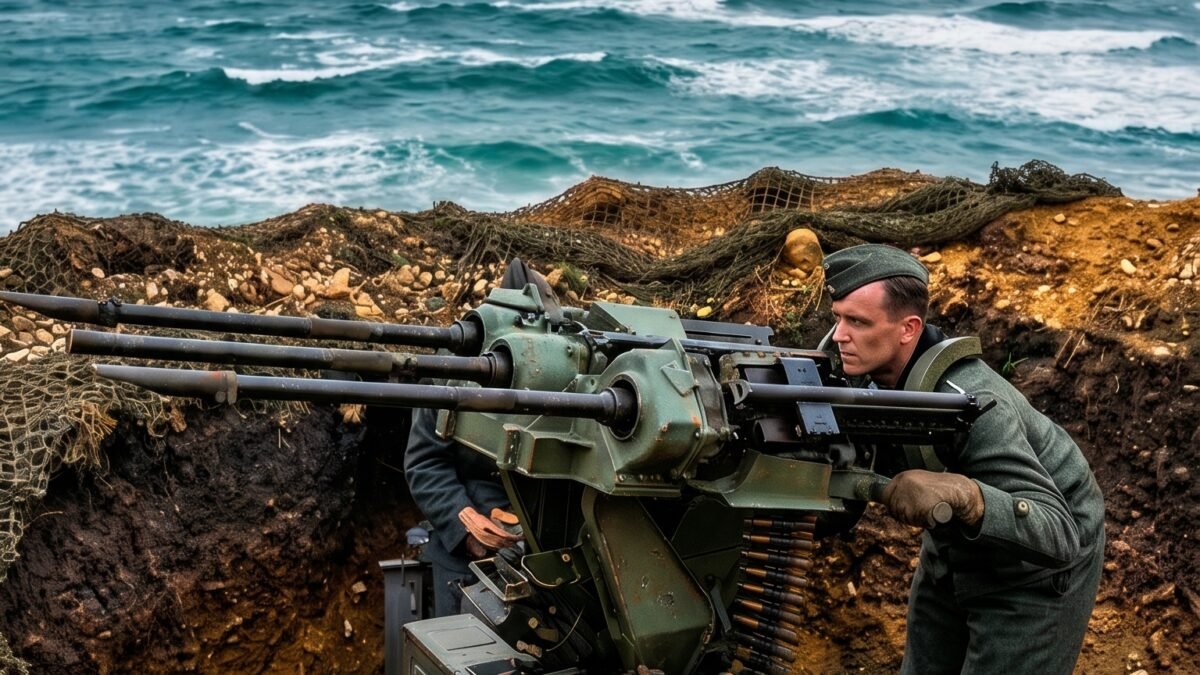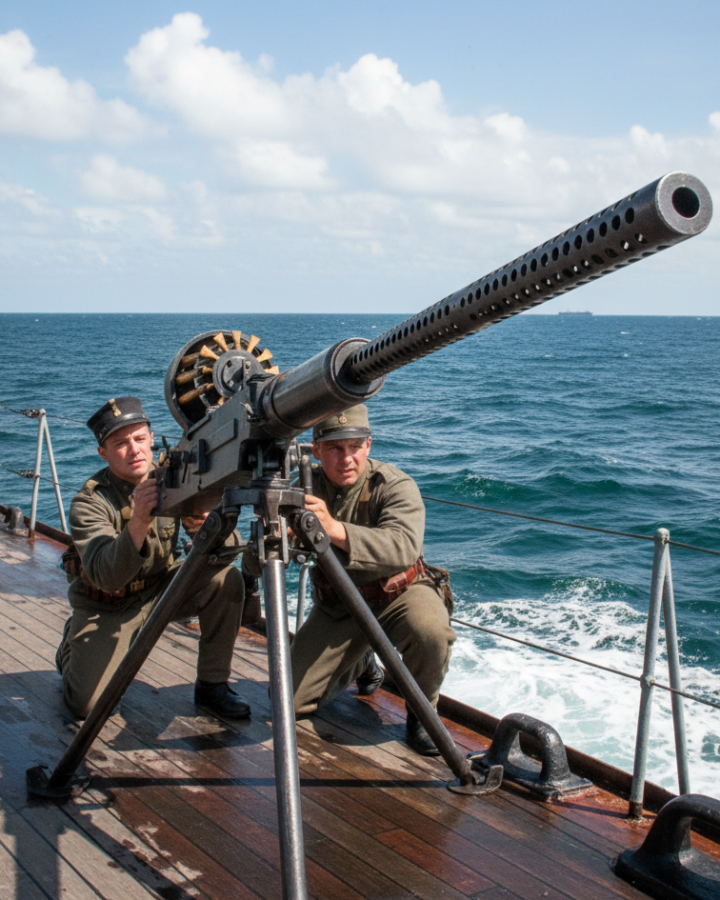
Type 96 25mm/60 Machine Cannon
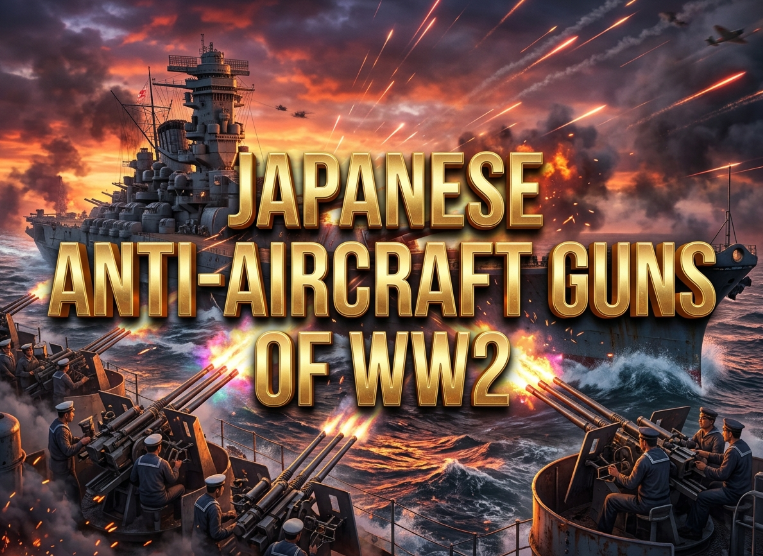
九六式二十五粍高角機銃 · Adopted 1936 (Kōki 2596) · Imperial Japanese NavyStandard close-range anti-aircraft weapon aboard virtually every Imperial Japanese Navy warship of World War II, adapted from the French 25mm Hotchkiss design. Deployed in single, twin, and triple mounts (including 150 barrels aboard Yamato in April 1945), its effectiveness against fast post-1943 U.S. aircraft was severely hampered by its 15-round box magazine, slow manual training/elevation, and lack of radar-directed fire control.
When the first American carrier-based Hellcats swept over the Philippine Sea in June 1944, Japan’s anti-aircraft gunners faced a reckoning that had been building for years. Their guns were not inadequate by the standards of 1936 — but 1944 was a different war entirely, fought at different altitudes, different speeds, and with an American proximity fuse that Tokyo’s engineers could not yet match.
Japan entered the Pacific War with a doctrine shaped by the Mahanian ideal of the decisive surface engagement. Anti-aircraft defence was treated, at the highest levels of the Imperial Japanese Navy, as a secondary concern — a defensive afterthought bolted to hulls designed for the torpedo run and the shell duel. What emerged was a patchwork of capable individual weapons undermined by systemic failures: inadequate fire control, lethal ammunition-feed limitations, and a production apparatus that prioritised tonnage over the integrated radar-and-director networks that Allied forces were deploying at scale by 1942.
The WW2 Visual Archive has spent two years sourcing, digitising, and colourising the original 16mm and 35mm gun-camera and ship-board footage that captures these weapons in action — footage from the US National Archives, the Australian War Memorial, and the British Imperial War Museum. When you watch a Type 96 triple mount traverse against an incoming dive-bomber in restored 4K colour, the IJN grey-green of the gun shield and the Kure Arsenal red-brown of the deck stanchions are not artistic guesses. They are derived from surviving paint samples, Imperial Japanese Navy Technical Bureau records, and cross-referenced survivor testimony. This is the standard we apply to every frame we release.
This dossier examines every major Japanese AA gun system deployed in the Pacific War, the doctrine that shaped their use, the tactical failures and occasional genuine successes, and the photographic record that allows us — at last — to see these weapons as the men who served them did.
THE DOCTRINE GAP
Understanding Japan’s anti-aircraft failure requires going back to the 1930 London Naval Treaty negotiations and the institutional culture of the Imperial Japanese Navy’s Naval General Staff. The big-gun admirals — the heirs of Tōgō Heihachirō’s decisive victory at Tsushima in 1905 — controlled procurement priorities with an iron grip. In their worldview, the battleship and the heavy cruiser were the instruments of national power projection. Anti-aircraft weapons were defensive, and defence was, philosophically, an admission of weakness.
The result was not ignorance of the aerial threat — the IJN was acutely aware of it, having watched European navies struggle in the Mediterranean — but a consistent underinvestment in the systems that turned individual gun quality into fleet-level protection: centralised fire control directors, radar-integrated height-finders, and proximity-fused ammunition. Japan invested heavily in the first element of a modern AA defence — the gun itself — but never built the architecture that made guns effective.
Compare this to the Royal Navy’s trajectory after HMS Courageous was torpedoed in 1939. Within eighteen months, British fleet architects had prioritised close-range AA density on every new escort design, and by 1942 the QF 2-pounder “pom-pom” multiple mount was being supplemented by Oerlikon 20mm guns procured from Switzerland and manufactured under licence. The US Navy moved even faster after Pearl Harbor: between December 1941 and January 1943, the number of 40mm Bofors mounts on US fleet destroyers tripled, and the first proximity-fused 5″/38 shells reached fleet units in January 1943 — a gap of roughly two years ahead of anything Japan could field.
Japan’s doctrinal failure had a logistical corollary. Because AA weapons were not priority systems, the production queues for their components — barrel liners, magazine springs, fire-control optics — were always subordinated to capital-ship and torpedo requirements. The Type 96 25mm gun suffered chronic barrel wear after 2,000 rounds; replacement liners were perpetually scarce. By the Okinawa campaign of 1945, some shipboard Type 96 mounts were firing worn barrels whose accuracy was so degraded that effective range had dropped below 1,500 metres — half the design specification.
Offensive Priority
Resources directed toward Long Lance torpedoes and 46cm battleship guns. AA was funded from budget margins, not core allocations. Naval General Staff classified AA defence as secondary fleet function through 1942.
Layered Defence
After Pearl Harbor, USN prioritised a three-tier AA architecture: long-range (5″/38 gun), medium (40mm Bofors), close (20mm Oerlikon). Proximity fuses introduced at fleet scale by early 1943, eighteen months ahead of Japan.
Type 94 Director — Optical Only
The Type 94 High Angle fire-control director was a capable mechanical analogue computer, but relied entirely on optical rangefinding. Against low-altitude fast movers — torpedo bombers and strafing fighters — it was too slow to generate a valid firing solution before the threat was inside minimum range.
Radar-Integrated Directors
The Mark 37 director (USN) integrated surface-search and fire-control radar by mid-1942. By 1943, the Mark 63 gun director with its own radar dish was tracking individual aircraft in real time, feeding continuous lead-angle corrections to 40mm batteries without human rangefinder intervention.
Contact and Time Fuzes
Japanese AA shells used Type 91 contact-and-graze fuzes or time-set fuzes that required manual fuze-setting based on estimated target range. Miss distance as small as five metres was non-lethal. No proximity fuse reached operational IJN units before the war’s end.
VT Proximity Fuse
The Variable Time (VT) fuze, developed at the Johns Hopkins Applied Physics Laboratory and first issued to the Pacific Fleet in January 1943, detonated shells within lethal radius of the target without a direct hit. Analysis suggested it increased AA lethality by a factor of four against dive-bombers.
IJN Fleet AA Disposition, 1941–42
Colorized 4K restoration from original US National Archives footage. Note the early-war spacing of single 25mm mounts along destroyer flanks, reflecting the pre-war doctrinal underinvestment in close AA density.
THE BACKBONE — TYPE 96 25MM
If any single weapon defined Japan’s anti-aircraft effort in the Pacific War, it was the Type 96 25mm automatic cannon — a weapon with French blood, a German-influenced mount design, and a fundamental flaw that its designers had failed to anticipate in a world of 1935-era aircraft speeds.
In 1935, the Imperial Japanese Navy sent a technical mission to the Hotchkiss et Cie factory in Saint-Denis, France. The French company had been manufacturing automatic cannon since the 1890s, and their 25mm Model 1938 automatic cannon impressed the Japanese delegation for its combination of firepower and compact weight. A licence agreement was signed, and the Imperial Naval Arsenal at Kure undertook the task of adapting the Hotchkiss design to Japanese manufacturing standards, Japanese ammunition metrics, and Japanese mount configurations. The result, adopted in 1936, was the Type 96 25mm Machine Cannon — designated for its year of adoption in the Japanese Imperial calendar, Kōki 2596.
In its technical specifications, the Type 96 was a genuinely capable weapon for its era. A muzzle velocity of 820 m/s gave it flat trajectory out to its effective range. The triple-barrelled mount, which became the dominant configuration on major surface combatants, could sustain a cyclic rate of 200–260 rounds per minute across all three barrels. Against the relatively slow, high-altitude level bombers that pre-war planners expected to face, it was adequate.
The problem was the magazine. The Type 96 fed from a detachable 15-round box magazine — a direct inheritance from the Hotchkiss design heritage, which had prioritised compactness and simplicity over sustained rate of fire. Fifteen rounds, at a cyclic rate of 260 rpm, lasted approximately 3.5 seconds of firing before the gunner had to stop, remove the empty magazine, and snap in a fresh one. On a triple mount, the three barrels cycled independently, but each still ran dry after the same 3.5-second burst, with reload crews scrambling around a mount that was simultaneously trying to track a target now closing at 500 kilometres per hour.
Compare this to the Oerlikon 20mm cannon fielded by the Allies, which used a 60-round drum — four times the magazine capacity — allowing sustained firing of over 13 seconds before a reload. Or the 40mm Bofors, fed in four-round clips by a two-man loader team but capable of sustained fire at 120 rounds per minute through a well-trained crew. The difference was not merely statistical: in the engagement envelopes opened by fast-diving Helldivers and low-skimming torpedo bombers after 1943, those additional seconds of continuous fire were often the difference between a hit and a near-miss.
Japanese crews improvised heroically. On many ships, dedicated reload crews — sometimes three men per barrel on a triple mount — were positioned to snap in fresh magazines the instant the previous one emptied, cutting reload time from the design-standard four seconds to under two. Some mount commanders lashed extra magazines to the mount itself with wire, creating a small ready-ammunition cache that could be grabbed without the loader turning away from the gun. These adaptations were valiant, but they never addressed the root problem: the gun was architecturally limited to a sustained effective rate of 110 rounds per minute per barrel, against a standard of 150–180 for comparable Allied weapons.
Production numbers tell a story of desperate priority-shifting. From 1,800 units in 1941, output climbed to over 8,000 in 1944, and by war’s end more than 33,000 Type 96 guns had been manufactured in single, twin, and triple mount configurations. On Yamato alone — the world’s largest battleship — the final complement included 150 individual 25mm barrels, a staggering density that still proved insufficient at the Battle of the East China Sea in April 1945.
The Type 96’s 15-round magazine provided approximately 3.5 seconds of cyclic fire — one-quarter the sustained burst of the Oerlikon 20mm. Against kamikaze and fast dive-bomber attacks from 1944 onwards, this disparity proved catastrophic.
Type 96 Crew Drill — 4K Colorized
Magazine reload sequence · Source: US National Archives.
Triple Mount in Action — Restored Footage
Japanese destroyer AA defence · Australian War Memorial collection.
THE HEAVY BATTERIES
While the Type 96 25mm shouldered the close-in defence burden, Japan’s heavy anti-aircraft weapons formed the outer layer of fleet and shore-based air defence. The two most significant were the Imperial Japanese Navy’s Type 89 127mm high-angle gun and the Imperial Japanese Army’s Type 88 75mm field AA gun — weapons that reveal the institutional divide between the two services as clearly as any strategic document.
The Type 89 127mm was, by the standards of its 1932 design date, an impressive weapon. With a muzzle velocity of 720–725 m/s and an effective ceiling of 9,440 metres, it could engage high-altitude level bombers at ranges that left the Type 96 uselessly silent. The 20.9-kilogram shell carried sufficient explosive mass to destroy an aircraft with a near-miss within 15 metres — a meaningful lethality radius. The gun was designed as a dual-purpose weapon from the outset, capable of surface fire against light surface targets, which made it attractive to naval architects fitting out destroyers and the secondary batteries of battleships and cruisers.
Its genuine weakness was rate of fire. The manual-loading mechanism, even with a well-drilled crew, yielded only 8–14 rounds per minute — adequate against the level bombers of 1932 but dangerously slow against the dive-bombing attacks that defined Pacific air-sea combat after Coral Sea. A Douglas Dauntless diving at 275 knots on a 70-degree attack profile crossed the Type 89’s effective engagement window in under 12 seconds. At 10 rounds per minute, a twin-mount had time to fire perhaps two aimed salvoes — and that assumed the Type 94 director had already generated a valid solution before the aircraft commenced its dive, which it often had not.
The Type 88 75mm was the Imperial Japanese Army’s primary mobile AA gun, and it represented a different philosophy entirely. Designed in 1928 around a wheeled carriage for field deployment, it was intended to protect ground installations — airfields, port facilities, dockyards — rather than ship hulls. With a muzzle velocity of 720 m/s and an effective ceiling of 7,000 metres, it was well-matched against the medium-altitude formations of USAAF B-24s and B-29s in the early island campaign period. Approximately 3,000 were produced, and they served across every contested island group from the Marianas to Okinawa.
Where the Type 88 fell short was in the integration problem. Army AA units and Navy surface units operated under separate command chains, with separate ammunition supply systems and separate fire-control philosophies. On Saipan in June 1944, Army Type 88 batteries and Navy Type 96 shipboard mounts engaging the same incoming strike packages were functionally unable to coordinate because they had no shared communications protocol. The Americans, by contrast, had by 1944 established Combat Information Centres aboard carriers and cruisers that integrated radar tracks from multiple ships and allocated engagement sectors to prevent both friendly-fire incidents and gaps in the defensive pattern.
It is worth acknowledging what the heavy guns did achieve. At Rabaul in November 1943, Japanese AA fire — primarily heavy-calibre — damaged or destroyed 11 of 97 attacking US aircraft during a single strike, a loss rate that gave USAAF planners pause. At Truk in February 1944, the concentrated AA defence of the anchorage, though ultimately overwhelmed, inflicted meaningful casualties on Operation Hailstone’s attackers. These were not negligible performances, and the colorised archive footage of Truk’s defence — available in the WW2 Visual Archive’s restoration vault — shows the genuine density and apparent organisation of the Japanese response, even as American aircraft overwhelm it.
Type 89 127mm — High Angle Engagement, 4K
Naval heavy AA · Source: US National Archives / WW2 Visual Archive restoration.
Type 88 Army AA Battery
Field deployment · Colorized archive.
Rabaul Heavy AA Defence — Full Sequence, Colorized 4K
November 1943 strike defence · WW2 Visual Archive 4K neural restoration · Source: US Navy Gun Camera / Australian War Memorial.
FIRE CONTROL — THE TYPE 94 DIRECTOR PROBLEM
Fire control sequence · British IWM archive, 4K restored.
The Type 94 High Angle Fire Control Director was the centrepiece of Japanese naval AA fire control — a precision mechanical analogue computer that calculated lead angles, fuze-setting times, and gun elevation corrections based on optical rangefinder inputs. Against a stable, predictable target, it performed creditably. Against the erratic, high-speed, low-altitude profiles that defined American attack patterns after Midway, it was too slow to be decisive.
The Type 94’s fundamental process required a human rangefinder operator to continuously track the target through a stereoscopic coincidence rangefinder and feed range-rate data to the computing unit. The computing unit then generated firing solutions with a mechanical lag of 4–6 seconds — time in which a Grumman TBF Avenger flying at 160 knots covered roughly 230 metres of horizontal distance. For high-altitude level bombers, this lag was tolerable. For steep-diving or low-flying targets, it was often fatal.
The United States Navy solved this problem with silicon — or more precisely, with the early vacuum-tube radar systems integrated into the Mark 37 director by 1942. The Mark 37 continuously updated its firing solution from a radar track without human rangefinder intervention, reducing solution lag to under one second. When the VT proximity fuse arrived in January 1943, this system became genuinely lethal: radar-guided directors, firing radar-detonated shells, created a defensive envelope that Japanese pilots described in post-war interrogation as “a wall of steel” at medium altitudes.
Japan was not ignorant of proximity fuze technology. The Naval Technical Bureau began investigating radio-frequency proximity fuzes in 1942, and at least two experimental designs reached prototype stage before the war’s end. But the precision electronics manufacturing base required to produce them in quantity — miniature vacuum tubes capable of surviving the acceleration of gun firing — was beyond Japanese industrial capacity in wartime conditions. The gap was not one of engineering insight; it was one of industrial infrastructure. And that gap cost Japan the air-sea war as much as any specific tactical failure.
BATTLE RECORD — PHILIPPINE SEA TO OKINAWA
The Battle of the Philippine Sea in June 1944 brought the accumulated failures of Japanese AA doctrine into brutal focus. On 19 June, Vice Admiral Marc Mitscher’s Task Force 58 launched its fighters in the largest carrier-aircraft combat of the war. Japanese air groups, flying from the carriers of the Mobile Fleet, ran into a combination of radar-directed F6F Hellcats, radar-guided fighter direction from CIC-equipped cruisers, and — when they closed to ship-defence range — the newly proximity-fused 5″/38 batteries of the escorting cruisers and battleships.
The results were catastrophic. Japan lost 243 carrier aircraft in a single day, against US losses of 29. The performance of Japanese AA on their own ships — defending the carriers from the American strikes that came later that afternoon — was adequate enough: US losses in the counter-strike were heavier than expected. But the destruction of the Japanese carrier air arm meant that those AA guns, however capable individually, would never again have aircraft to protect. A fleet stripped of its air cover was a fleet awaiting its death sentence.
Leyte Gulf in October 1944 introduced a new variable: the kamikaze. The Special Attack Corps, born of desperation after the Marianas losses, represented a tactical inversion of the AA problem. Instead of defenders attempting to shoot down attackers, the attacker became its own weapon — a manned, manoeuvring, deliberately sacrificial guided missile against which the conventional advantages of fire-control calculation were only partially applicable. A kamikaze had no escape vector; the director crews had no target manoeuvre to lead. The guns had to fire faster, aim truer, and maintain a denser barrage simply to put enough metal in the air to stop an aircraft that was not deviating, not jinking, just diving.
The Okinawa campaign from April to June 1945 became the most sustained and intense AA combat in Japanese military history — not for Japan’s ships, but for American ones. Japanese kamikaze attacks sank or damaged over 400 US naval vessels during the campaign, despite the most concentrated AA firepower ever assembled in any battle. For the Japanese gunners remaining on shore and the few surface units still operational, the Okinawa period was one of improvisation and scarcity: Type 96 mounts being fired by inexperienced crews, Type 88 batteries repositioned nightly to avoid air attack, supply lines cut by US air supremacy.
What the Okinawa record does confirm is the raw physical courage of Japanese AA crews operating under conditions of total Allied air dominance. Archive footage — much of it captured by US aircraft overflying shore positions — shows Type 88 crews continuing to fire as strafing aircraft make successive passes. This footage, when properly colourised from its original high-contrast black-and-white, reveals details invisible to the original viewers: the distinctive olive-drab of army uniforms against the tan dust, the particular shade of the gun shields, the human faces that the grainy original never permitted you to see. This is what the restoration work means — not artistic embellishment, but historical revelation.
THE WW2 VISUAL ARCHIVE RESTORATION PROCESS
The archive footage that survives from the Pacific War is, in its original form, a documentary tragedy. Acetate-base film stock exposed in tropical conditions — humidity, temperature extremes, salt air — suffers from what archivists call “vinegar syndrome”: a slow chemical decomposition that causes the base to buckle, the emulsion to crack, and the image to blur and distort across the frame. The US National Archives holds thousands of reels in this condition. The Australian War Memorial holds hundreds more. The British Imperial War Museum’s Pacific collection is similarly compromised. Even the Japanese Yasukuni Yushukan archive — which holds some of the only surviving IJN footage shot from the Japanese perspective — contains significant deteriorated material.
The WW2 Visual Archive’s restoration pipeline begins with high-resolution scanning at 4K+ resolution of the original physical film, capturing every grain and defect. Frame stabilisation follows: AI-assisted optical flow analysis identifies the difference between intentional camera motion and the mechanical instability caused by warped film running through a deteriorated projector mechanism, and corrects the latter without destroying the documentary authenticity of the former.
Damage repair is the most painstaking stage. Scratches, splice marks, emulsion bubbles, and frame-edge deterioration are addressed using a combination of neural inpainting — where the model learns the visual context of surrounding frames to reconstruct damaged regions — and human expert review, frame by frame, to ensure the reconstruction does not introduce anachronistic visual artefacts. Every restored frame is reviewed by a human historian before it passes to colourisation.
The colourisation stage is where historical research becomes most critical. Neural colourisation models, if applied naively to WW2 footage, produce colours that are statistically probable but historically inaccurate — American aircraft appearing in the wrong shade of blue-grey, Japanese deck equipment painted in olive drab instead of the correct IJN grey-green. The WW2 Visual Archive maintains a proprietary colour reference database built from paint chip archives (the Kure Naval Arsenal’s surviving specification records), surviving equipment held in museums (the Yamato Museum in Kure, the National Naval Aviation Museum in Pensacola), and chemical analysis of paint samples from recovered artefacts.
For Japanese AA guns specifically, this means the distinctive IJN grey-green — approximately #3D4A3A in modern hex notation — applied to gun shields and mount structures, with Kure Arsenal red-brown (closer to #6B3A2A) used for primer coats visible on worn surfaces and interior components. The same methodology that Robert Ballard applied to the Bismarck wreck — cross-referencing physical evidence against the documentary record to confirm the historical narrative — is what we apply to every colourisation project. The films, properly restored, confirm what the paint samples and survivor testimony suggested. They become primary evidence, not merely illustration.
The final 4K master output is graded for display on modern screens while preserving the tonal character of the original film stock. We resist the temptation to make these films look like they were shot yesterday — a 1943 film should feel like 1943, even in 4K. The grain, the contrast roll-off, the slightly unsaturated sky — these are authentic attributes of the documentary record, and they matter.
WW2 Visual Archive — 4K Neural Colourization Showcase
Original wartime footage of Japanese anti-aircraft crews in action, restored using the five-stage pipeline described above. IJN grey-green and Kure Arsenal colour references applied throughout. Source: US National Archives, Record Group 80.
MYTHS VS. HISTORICAL RECORD
“Japanese AA was simply inferior in every respect to Allied AA guns.”
Individual Japanese weapons — particularly the Type 89 127mm and the Type 96 in triple mount — were technically competitive with contemporary Allied designs. The failure was systemic: inadequate fire-control integration, lack of proximity fuses, and command-structure fragmentation. The guns themselves were not the primary problem; the architecture around them was.
“The kamikaze made conventional AA defence useless by 1944–45.”
Partly true but overstated. American proximity-fused 5″/38 batteries and radar-directed 40mm Bofors mounts stopped roughly 85% of kamikaze attacks at Okinawa. The remaining 15% caused severe damage precisely because of the weapon’s deliberate crash profile, not because AA had failed entirely. Better AA — specifically the proximity fuse — significantly improved performance against the kamikaze versus the contact-fuse era.
“The 15-round magazine was the Type 96’s single most critical operational flaw.”
Post-war IJN officer testimony and US Naval Intelligence interrogation records (ATIS documents, 1945–46) consistently identify the reload limitation as the primary crew-level tactical problem. Gun commander accounts from destroyer actions at Leyte Gulf and Okinawa specifically cite reload interruptions as the reason fast-moving targets escaped engagement windows. This verdict aligns with engineering analysis of the weapon’s ballistic performance versus its reload cycle time.
“Japan had no radar-integrated AA fire control by the war’s end.”
Japan did develop and deploy shipborne radar (Type 21 from 1942, Type 13 from 1943) and experimented with radar-director integration. However, the integration never reached the operational coherence of the USN Mark 37 system, and production volumes were too small to equip more than a fraction of surface combatants. The statement is directionally accurate but technically an overstatement of Japan’s complete absence in this domain.
COMPLETE GUN SPECIFICATIONS LEDGER
| Specification | Type 96 25mm | Type 89 127mm | Type 88 75mm | Type 98 20mm | Type 3 120mm |
|---|---|---|---|---|---|
| Adopted | 1936 | 1929 (Service 1932) | 1928 | 1938 | 1943 |
| Calibre | 25 × 163mm | 127 × 580mm R | 75 × 497mm R | 20 × 142mm | 120 × 851mm R |
| Muzzle Velocity | 820–900 m/s | 720–725 m/s | 720 m/s | 830–835 m/s | 853–860 m/s |
| Rate of Fire | 200–260 rpm (cyclic) 110 rpm (effective) |
8–14 rpm | 15–20 rpm | 300 rpm (cyclic) ~120 rpm (practical) |
~10–20 rpm |
| Effective AA Ceiling | 3,000 m | 9,440 m | 7,000–7,250 m | ~2,000–3,500 m | ~8,100–12,000 m |
| Horizontal Range | 5,500–6,800 m | 14,800 m | ~13,000 m | ~4,500–5,500 m | ~16,000–20,500 m |
| Shell Weight | 243–250 g | 20.9–23.45 kg | ~6.5–6.6 kg | ~126–136 g | ~19.3–20.6 kg |
| Feed System | 15-rd box magazine | Manual fixed rounds | Manual fixed rounds | 20-rd box magazine | Manual fixed / power ram |
| Platform | Naval (all warships) | Naval (destroyers, cruisers, BBs) | Army (field / island) | Army / Naval light | Army / Naval heavy defense |
| Units Produced | 33,000+ | 1,306–3,100 guns | 2,000–3,000 | ~2,500–3,241 | Limited (~157–200) |
FREQUENTLY ASKED QUESTIONS
CONTINUE THE RESEARCH: ARCHIVE DOSSIERS
Compare Imperial Japanese Navy anti-aircraft doctrine and shipboard armament directly with the primary capital ship dossiers in the WW2 Visual Archive:
 Archive Dossier · IJN
Battleship Yamato — Historical Colorized Restoration
Secret history, 4K neural restoration, and the full technical record of the world’s largest battleship — including the 24 × 12.7cm Type 89 guns and 150 × Type 96 25mm barrels on her final 1945 configuration.
 Archive Dossier · File 019
Eight Days in May — The Bismarck
From the Denmark Strait to the Atlantic floor — the complete operational history of Germany’s most famous battleship, with 4K colourised film, Swordfish torpedo analysis, and Robert Ballard’s 4,791m wreck confirmation evidence.
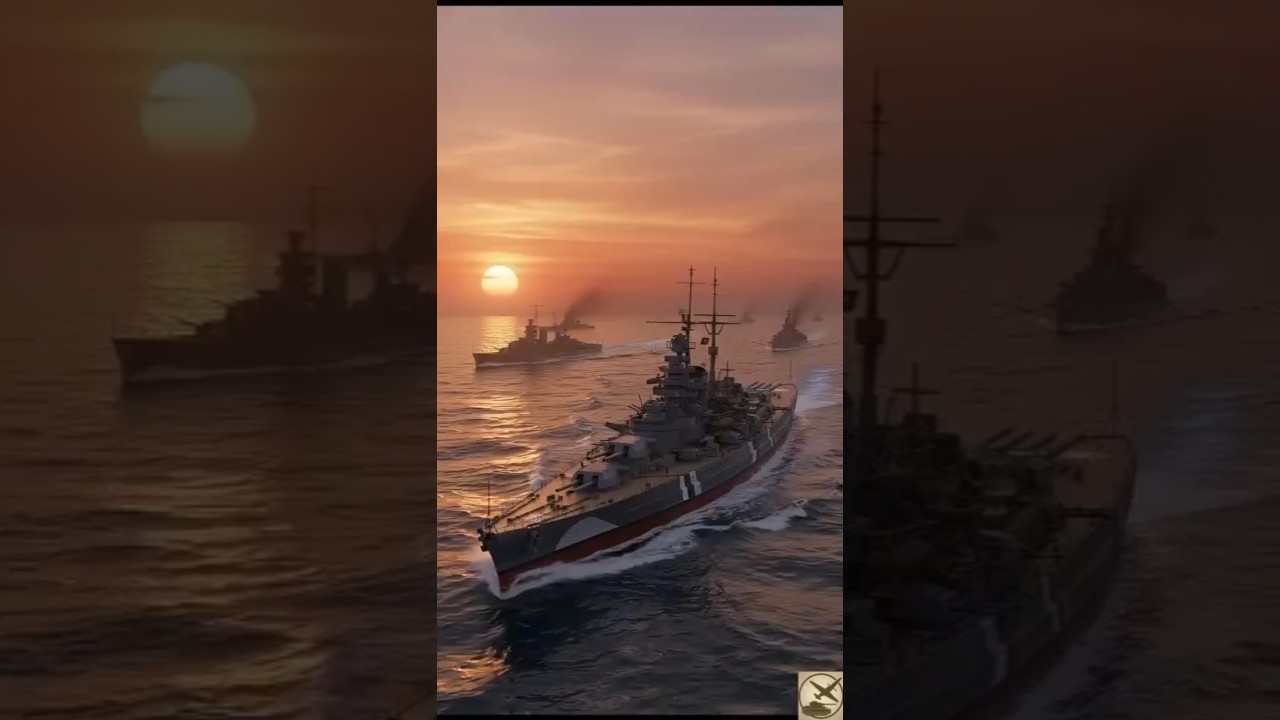 Archive Dossier · Royal Navy
HMS Hood — Pride of the Royal Navy
Inside the design, interwar fleet service, QF 2-pounder “pom-pom” close-range AA fit, and the catastrophic 24 May 1941 Denmark Strait engagement.
 Archive Dossier · USN
USS Iowa-Class Battleships — The Allied AA Standard
Examine the Allied counterpoint discussed in this dossier: Mark 37 radar-integrated directors, proximity-fused 5″/38 dual-purpose batteries, quad 40mm Bofors, and 20mm Oerlikon shields in the Pacific.
HISTORICAL SOURCES & FURTHER READING
Every Short in this archive has been scanned from original wartime film, restored frame by frame, and colourised against verified historical references. Subscribe to receive new restorations — the Saipan and Iwo Jima AA sequences are in production now.