The ship
that kept
coming back
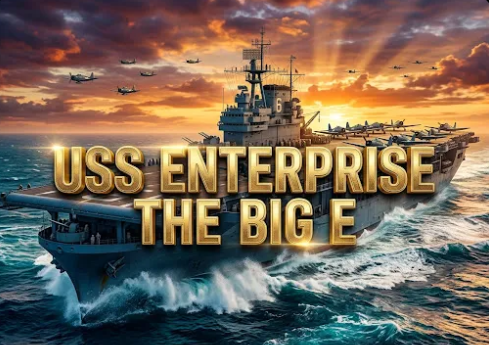
She was never the newest carrier in the Pacific and never the largest. USS Enterprise was something rarer: the one still afloat, still launching, still in the line when the smoke cleared — at Midway, off Santa Cruz, in the Philippine Sea and off Okinawa.

On the morning of 7 December 1941, USS Enterprise was not in Pearl Harbor. She was roughly 215 miles west of Oahu, coming back from the delivery of a dozen Wildcat fighters to Wake Island, and her scout bombers were already in the air ahead of her, due over Ford Island a little after eight. They flew into the middle of the attack. Japanese fighters attacked them; their own anti-aircraft gunners fired on them too. The carrier that would become the most decorated United States warship of the Second World War began her war by missing the disaster that started it — and by flying straight into it anyway.
The usual way to introduce Enterprise is with a list of superlatives: twenty battle stars, the Presidential Unit Citation, seventy-one ships sunk, nine hundred and eleven aircraft destroyed. Those numbers are real. But they describe the result, not the reason. The reason Enterprise mattered is that she was available. The Pacific war was decided less by any single clash of designs than by which navy could keep carriers in the water, keep air groups trained, and keep damage-control parties working through the night. Enterprise was a treaty-era hull with a 1930s air group, repeatedly hit, repeatedly patched, and repeatedly sent back.
That is a less romantic story than the one about the unsinkable ship, and a more useful one. What follows is an operational account: what the ship was built to do, what her crews actually did with her, what the record credits her with, and where the record has been stretched. It ends not with a wreck on the seabed but with a tow rope in New Jersey and a name that outlived the steel.
Pearl Harbor, seen from the air
Enterprise is 215 miles west of Oahu, returning from the Wake Island ferry run. Her scout bombers arrive over Ford Island in the middle of the attack; her fighters are fired on by their own gunners. The carrier spends the next days searching an empty ocean.
The contract: a carrier built to a budget
Enterprise was ordered into a navy that was still arguing about what an aircraft carrier was for. The Washington Naval Treaty of 1922 had handed the United States a generous but finite slice of carrier tonnage, and the first American carriers — Lexington and Saratoga — were battlecruiser hulls converted because the treaty said those hulls had to go somewhere. They were fast, enormous, and expensive. Ranger, commissioned in 1934, was the first purpose-built American carrier, and she was small enough to be a disappointment. The Yorktown class was the answer: a carrier designed from the keel up, big enough to matter, small enough to buy in numbers.
The design brief was a compromise between three demands that could not all be satisfied. The fleet wanted speed to keep up with cruisers and to generate wind over the deck for heavily loaded aircraft. It wanted a large air group, because a carrier’s striking power is measured in aircraft, not guns. And it wanted survivability in a world where the ship would operate far from friendly repair yards. The Yorktowns settled at roughly 19,800 tons standard, 809 feet 6 inches overall, and a design speed of 32.5 knots from 120,000 shaft horsepower. The air group was planned around 90 aircraft. The armour was thin: a 2.5-to-4-inch waterline belt and a 1.5-inch protective deck.
That trade was not an oversight. A carrier’s protection is a layered problem, and much of it sits outside the hull: combat air patrol, radar, screening destroyers, and the discipline of the deck cycle. Armour sufficient to stop an eight-inch cruiser shell would have consumed weight that the design needed for aviation fuel, bomb storage, and the enormous hangar. The Yorktowns were therefore built to spend their protection budget on the things that let them keep flying. It was a gamble that looked reasonable in 1936 and looked very different in 1942, when Japanese bombs came through the flight deck and detonated among parked aircraft.
Enterprise was laid down at Newport News Shipbuilding on 16 July 1934, launched on 3 October 1936, and commissioned on 12 May 1938. Her sisters were Yorktown (CV-5) and Hornet (CV-8). The class introduced a starboard island large enough to hold the bridge, the radar office, and eventually a fighter-direction plot; three deck elevators; two hydraulic catapults; and the 5-inch/38 dual-purpose gun, probably the best naval anti-aircraft gun of the war. The weak point was the quadruple 1.1-inch mount, an unreliable weapon that would be replaced in 1943 by the 40 mm Bofors.
By the autumn of 1941 Enterprise was a worked-up ship with an experienced air group and a captain, George D. Murray, who had spent most of his career in naval aviation. She was not the most powerful carrier afloat. The Japanese Shōkaku class was larger and carried a heavier air group; the British were operating armoured-deck carriers designed for a different sea and a different war. But Enterprise was fast, well-drilled, and available — and in the first year of the Pacific war, availability was the rarest quality in the American fleet.
Seven December: the carrier that wasn’t there
The last week of peace found Enterprise doing the unglamorous work that carriers actually do. On 28 November she had sailed from Pearl Harbor with Task Force 8, carrying twelve Grumman F4F-3 Wildcats for the Marine garrison on Wake Island. The fighters were flown off on 4 December. The carrier turned for home, was delayed by heavy weather, and was still at sea when the first Japanese bombs fell on Battleship Row.
Her absence was an accident of scheduling, not foresight. The Pacific Fleet’s carriers happened to be out of port that weekend — Lexington was ferrying aircraft toward Midway, Saratoga was in San Diego, and Enterprise was returning from Wake. Had the Japanese waited two days, the attack might have caught Enterprise alongside the battle line. Instead it caught none, which is the single most consequential piece of luck in the Pacific war’s opening chapter.
The ship’s introduction to the war was nevertheless violent. At dawn on 7 December, eighteen Dauntless scout bombers were launched ahead of the carrier to land at Ford Island. They arrived over Oahu in the middle of the raid, unarmed for air combat and low on fuel. Japanese fighters attacked them; nervous anti-aircraft gunners ashore and afloat fired on them too. Seven of the eighteen were shot down and eight airmen were killed. The survivors landed on torn-up fields and taxied clear while smoke from the battleships climbed over the harbour. That evening she launched a search for a Japanese fleet that had already turned away.
The strategic result was immediate. Eight American battleships had been sunk or damaged, and the battle line that the pre-war Navy had built its doctrine around was out of action for months. The Pacific Fleet’s striking power now consisted of its carriers and the submarines that had been largely ignored before the war. Enterprise did not become important because the battleships were destroyed; she became important because there was nothing else left. That is a harsh way to inherit a war, and it shaped everything the ship did for the next three and a half years.

First blood: the raids that bought time
In the first months of 1942 the United States could not yet fight a fleet action, so it did the next best thing: it made the Japanese spend time and fuel looking for carriers that had already gone. Enterprise was at the centre of that campaign. On 1 February she screened Task Force 8 in strikes against Wotje, Taroa and Kwajalein in the Marshall Islands. On 24 February her aircraft hit Wake Island. On 4 March they struck Marcus Island, less than a thousand miles from Tokyo. The damage was modest. The signal was not.
Those operations were a laboratory. Air groups learned to navigate over open ocean without landmarks, to coordinate fighters and dive bombers, and to recover aircraft after a long strike while the task force turned into the wind. They also learned how quickly things go wrong: strikes arrived over empty anchorages, formations separated, and aircraft were lost to fuel exhaustion and navigation errors as often as to the enemy. The officers who would command at Midway four months later were writing their doctrine in the air, one raid at a time.
The most famous of the early operations was also the least conventional. On 18 April 1942, Enterprise sailed with Hornet and their escorts deep into the North Pacific, carrying sixteen B-25 bombers under Lieutenant Colonel James Doolittle. The plan was to launch the army bombers within range of Japan, bomb the home islands, and recover them in China. On the morning of the launch, an Enterprise scout sighted the Japanese picket boat Nitto Maru; the cruiser Nashville sank it, but its warning was already in the air. The bombers took off early, from further out than planned, and every one of them was lost at the far end of the mission.
Enterprise‘s role was escort and cover. Her fighters flew combat air patrol over the task force while the B-25s lumbered off Hornet‘s deck, and her scouts watched for Japanese ships. She never came within sight of Japan. Yet the raid mattered enormously. It forced the Japanese to keep fighter squadrons at home, embarrassed the navy that had promised the home islands were safe, and gave the American public a victory at a moment when there were very few. It also helped push the Japanese timetable toward Midway, where the reckoning would come.
| Date | Operation | Enterprise role | Outcome |
|---|---|---|---|
| 1 Feb 1942 | Marshall Islands raid | Carrier strikes on Wotje, Taroa, Kwajalein | First U.S. offensive of the war |
| 24 Feb 1942 | Wake Island raid | Air group attack on the Japanese garrison | Wake hit; task force withdrawn |
| 4 Mar 1942 | Marcus Island raid | Strike on a garrison close to Japan | Demonstration of reach |
| 18 Apr 1942 | Doolittle Raid | Escort and combat air patrol for Hornet | Tokyo bombed; all 16 B-25s lost |
Midway: six minutes that decided the Pacific
Midway was not a lucky accident, although luck played its part. It was an ambush built out of codebreaking, a gambled carrier force, and a Japanese plan that assumed the Americans would arrive late and in small numbers. The Japanese intended to seize Midway Atoll, extend their defensive perimeter, and destroy the American carriers when they came out to fight. The Americans, reading Japanese naval traffic at the HYPO station in Hawaii, knew the target was Midway and knew roughly when the attack would come. Admiral Chester Nimitz put every carrier he had in the path: Enterprise and Hornet under Rear Admiral Raymond Spruance, and Yorktown under Rear Admiral Frank Jack Fletcher, patched up at Pearl Harbor in seventy-two hours after damage at Coral Sea.
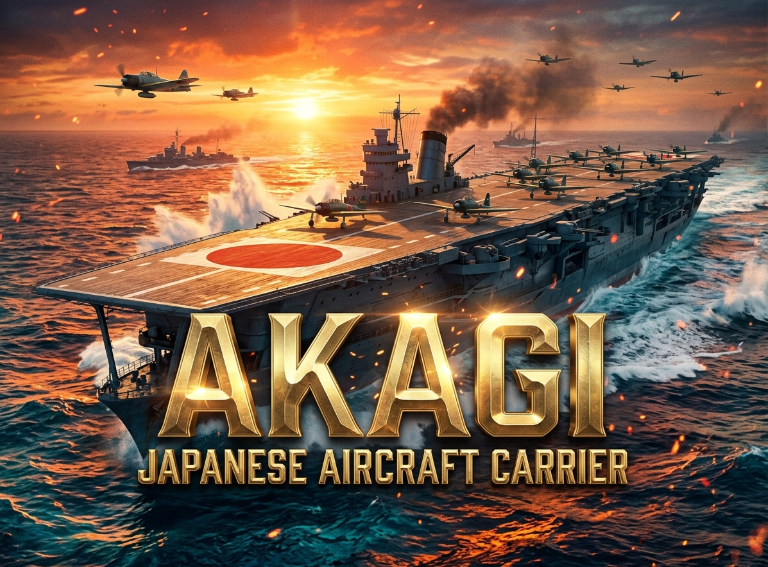
On the morning of 4 June, Vice Admiral Chuichi Nagumo’s four fleet carriers — Akagi, Kaga, Soryu and Hiryu — launched a strike on Midway. The attack went in, the reports came back, and Nagumo was caught in the classic carrier dilemma: rearm for a second strike on the island, or keep his aircraft configured for ships? He was still working through that problem when American torpedo bombers began arriving.
The torpedo attacks were slaughtered. Hornet‘s VT-8 lost all fifteen aircraft; Enterprise‘s VT-6 lost ten of fourteen; Yorktown‘s VT-3 was cut apart as well. Not one torpedo hit. But the attacks dragged the Japanese combat air patrol down to the water, scattered its formations, and left the sky above the carriers temporarily empty. At about 10:20, Lieutenant Commander C. Wade McClusky arrived over the Japanese fleet with Enterprise‘s dive bombers after a long, fuel-critical search. He had followed the wake of a Japanese destroyer, Arashi, which had been depth-charging an American submarine. That decision — a guess made with a map, a sighting report and a dwindling fuel gauge — put more than thirty Dauntlesses over the Japanese carriers at the moment their decks were crowded with fuel, bombs and torpedoes.
The six minutes, reconstructed
What followed took roughly six minutes. Kaga was hit by at least four bombs and became a floating furnace. Akagi took a single bomb from Lieutenant Commander Richard Best’s section, but it detonated among aircraft and ordnance in the hangar and doomed the ship. Soryu, hit by Yorktown‘s dive bombers, followed. Hiryu survived long enough to launch two counterstrikes that crippled Yorktown, and was then hit by a mixed strike of Enterprise and Yorktown aircraft flying from Enterprise‘s deck. By nightfall Japan had lost four fleet carriers and the trained aircrews that could not be replaced.
The usual telling of Midway makes it a story of five minutes and a miracle. The more useful telling is about preparation meeting opportunity. The codebreakers had given Nimitz the target. Yorktown‘s repair crews had given Fletcher a third flight deck. The torpedo squadrons had given McClusky an opening, at the cost of their own lives. And Enterprise‘s dive bombers, flying at the edge of their endurance, had been trained well enough to find the target when the plan fell apart. Midway was a system victory, not a ship’s victory — but the system ran through CV-6’s flight deck that morning.


The torpedo squadrons did not sink a single carrier. They made it possible for the dive bombers to sink four.
What the dive bombers owed the TBDsThe long 1942: damage, repair, return
Midway did not end the war; it changed its arithmetic. Japan still had carriers, still had night-fighting destroyers, and still held the Solomons. What Japan did not have was the industrial base to replace four fleet carriers and several hundred irreplaceable aircrew. The United States had both, and from the summer of 1942 the Pacific war became a contest in which American losses could be absorbed and Japanese losses could not. Enterprise was the instrument through which that arithmetic was applied.
On 24 August 1942, covering the landings on Guadalcanal, Enterprise was hit by three Japanese bombs in the Battle of the Eastern Solomons. The attacks started fires aft and killed seventy-four men. Damage-control parties saved the ship, and she steamed to Pearl Harbor for repairs — the first of several cycles that would define her war. She was back at sea in time for the next fight.
That fight came on 26 October at Santa Cruz. Enterprise was damaged again, and Hornet was lost. When the survivors withdrew, Enterprise was the only operational American carrier in the Pacific. As she retired, a sign went up on her flight deck: “ENTERPRISE VS JAPAN.” It was bravado, but it was also an accurate description of the strategic situation. For several weeks, one ship carried the carrier war.
She did not do it alone, and she did not do it undamaged. At Santa Cruz she had been hit forward, and repair crews from the repair ship Vestal worked on her at Nouméa and then sailed with her, still making repairs at sea. In November her aircraft helped cripple the Japanese battleship Hiei during the Naval Battle of Guadalcanal; Hiei was scuttled the next day. Her planes also helped sink the heavy cruiser Kinugasa and shared in the destruction of seven transports. By the end of 1942 the Japanese attempt to retake Guadalcanal had failed, and the carrier that had been reported sunk more than once was still afloat.
The lesson of that year is not that Enterprise was indestructible. It is that she was repairable, and that the navy had built the repair yards, the repair ships and the training pipeline to make repairability matter. A carrier that could be patched in weeks was worth more than a perfect carrier that could not be replaced at all.

“Enterprise vs Japan.”
Sign displayed aboard CV-6, October 1942Fast carriers: one ship inside a fleet
By 1943 the war had outgrown the single-carrier raid. The United States was building Essex-class carriers at a rate Japan could not match, and the navy was learning to operate them in task groups of three or four, screened by fast battleships and cruisers, refuelled at sea, and coordinated by radar and radio into a single striking organism. Enterprise, a 1930s hull in a 1944 fleet, was no longer the biggest or the newest carrier in the Pacific. She was still one of the most experienced.
Her aircraft supported the Gilberts operation in November 1943 and the Marshall Islands campaign in early 1944. By then she was one of a dozen fast carriers rather than the last one standing, but her deck crew and air department had something the newer ships did not: years of practice at keeping a damaged carrier in the fight. Late in 1944 that experience was put to a new use when she embarked a night air group built around radar-equipped F6F-5N Hellcats and TBM-3D Avengers. The concept was new, dangerous and imperfect. It was also the kind of problem a veteran ship was best placed to solve.
At the Battle of the Philippine Sea in June 1944, the Japanese fleet committed its rebuilt carrier air power and lost it in two days. The first day became the “Great Marianas Turkey Shoot”: Japanese aircraft, many flown by hastily trained replacement pilots, were caught by massed Hellcats and shipboard anti-aircraft fire and destroyed in numbers they could not sustain. On the second day, American carriers launched a long-range twilight strike against the retiring Japanese fleet. Enterprise, one of four carriers in Task Group 58.3, flew in that attack. The Japanese carrier Hiyo was sunk, and the Japanese navy’s carrier aviation never recovered.
Four months later, at Leyte Gulf, the Japanese tried to break the American landing with a complex plan built around decoy carriers. Enterprise was with the fast carriers that went north after the decoys. Her aircraft helped sink Zuiho, shared in the destruction of Zuikaku and damaged Hyuga at Cape Engaño; the day before, her planes had been among those that hit Musashi. It was a one-sided victory, and it came with a strategic cost: the lure worked well enough to pull the American carriers away from the San Bernardino Strait, where a Japanese battleship force came close to reaching the invasion beaches. The war at sea was no longer a duel between ships. It was a problem of coordination at a scale no one had managed before.
The aircraft that made the deck matter
An air group is a system of complementary aircraft: fighters to defend the fleet, dive bombers to break ships, torpedo planes to finish them, and, by 1944, radar-equipped night fighters and bombers to keep the pressure on after dark. The types that flew from Enterprise‘s deck changed more than the ship did.
Grumman F4F-4 Wildcat
The Navy’s standard carrier fighter in 1942. It was slower and less agile than the Japanese Zero, so pilots learned to fight in pairs, use hit-and-run diving attacks, and rely on armour and self-sealing tanks to survive mistakes. At Midway, Enterprise carried twenty-seven.
- Role
- Carrier fighter
- Top speed
- 318 mph
- Armament
- 6 × .50 cal
- Combat range
- ~770 mi
Douglas SBD-3 Dauntless
The dive bomber that did more damage to the Japanese fleet than any other American aircraft of 1942. Slow, rugged and accurate, it could put a 1,000-pound bomb on a carrier deck from a near-vertical dive. At Midway, Enterprise’s SBDs flew the strike that caught Kaga and Akagi.
- Role
- Scout / dive bomber
- Top speed
- 255 mph
- Bomb load
- Up to 1,200 lb
- Range
- ~1,115 mi
Douglas TBD-1 Devastator
Modern in 1937, obsolete in 1942. The Devastator was too slow, too lightly armed and too vulnerable to fighter attack, and its torpedo was unreliable. At Midway, VT-6 lost ten of fourteen aircraft and scored no hits. The crews flew anyway, and their sacrifice pulled the Japanese combat air patrol down to the water.
- Role
- Torpedo bomber
- Top speed
- ~206 mph
- Armament
- 1 torpedo
- Range
- ~435 mi
Grumman TBF / TBM Avenger
The Devastator’s replacement, and a far better aircraft: faster, longer-ranged, heavily armed and able to carry either a torpedo or a heavy bomb load. By 1944 it was also flying from Enterprise as a radar-equipped night bomber, hunting Japanese ships in darkness.
- Role
- Torpedo / level bomber
- Top speed
- ~275 mph
- Load
- 1 torpedo or 4 × 500 lb
- Range
- ~1,000 mi
Grumman F6F-5 Hellcat
The fighter that won the air war in the Pacific. Powerful, heavily armed, and tough enough to bring its pilot home after serious damage, the Hellcat gave American pilots an aircraft that could outfight the Zero on its own terms. By 1944 it equipped most of the fast carriers, including Enterprise.
- Role
- Carrier fighter
- Top speed
- ~380 mph
- Armament
- 6 × .50 cal
- Range
- ~1,530 mi with tank
F6F-5N Night Hellcat
A Hellcat with a radar set and a dedicated radar operator, flown by the small night-fighter detachments that turned Enterprise into a night carrier. The aircraft was heavier and slower than a day fighter, but it could find and kill intruders in darkness, when the Japanese had previously owned the night.
- Role
- Night interceptor
- Radar
- AN/APS-6
- Armament
- 2 × 20 mm + 4 × .50
- Top speed
- ~370 mph
Kamikaze: the war comes through the flight deck
In the last year of the war the Japanese navy could no longer contest the sea with ships or aircraft in conventional battles. It contested it with pilots willing to fly their aircraft into American carriers. The kamikaze was not a tactic of despair alone; it was a rational response to an enemy whose ships were better, whose pilots were better, and whose industrial output could not be matched. It was also terrifyingly effective.
Enterprise supported the Iwo Jima landings in February 1945 and then joined the immense fleet off Okinawa. On 11 April a Japanese dive bomber got through and hit her aft; the bomb detonated near the after machinery spaces, wounding five men and blowing one overboard. She was repaired at Ulithi in sixteen days and back on station on 6 May. On 14 May a kamikaze dove through the anti-aircraft fire; its bomb detonated under the forward elevator and threw the elevator itself clear of the ship. Fourteen men were killed and thirty-four wounded. The ship was still afloat, still under control and still capable of being repaired — but she had taken all the war she could usefully absorb.
She sailed for the United States for permanent repairs and was in Puget Sound when Japan surrendered. Her war ended not with a dramatic final battle but with a repair yard, a paperwork trail and a generation of sailors who had spent four years learning how to keep a damaged ship in the fight. In that sense her ending was entirely characteristic.

The record: what the numbers actually mean
Enterprise‘s final scorecard is unusual because it measures two different things at once. The first is a credit ledger: ships sunk, ships damaged, aircraft destroyed. The second is endurance: twenty battle stars, a Presidential Unit Citation and a Navy Unit Commendation. The first number belongs to her air groups. The second belongs to the ship, and to the crews who kept her in the water.
The citation history is worth stating precisely. In May 1943 Enterprise became the first aircraft carrier to receive the Presidential Unit Citation; the award covered 7 December 1941 to 15 November 1942 and credited her air group with thirty-five vessels sunk or damaged and 185 aircraft destroyed. She also received the Navy Unit Commendation. Her wartime credits are usually given as 71 ships sunk, 192 damaged and 911 aircraft destroyed, and she finished the war with twenty battle stars — more than any other United States warship.
Reading a wartime scoreboard
Those figures need a caveat, because wartime credits were compiled from combat reports and combat reports were generous. A ship that was hit by aircraft from three carriers might be counted by all three. A transport that was already burning when a second strike arrived could appear twice in the ledger. The totals are best read as an index of how much fighting Enterprise was involved in, not as a precise audit of Japanese losses. The battle stars are a cleaner measure, and a humbler one. They were awarded for participation in designated campaigns and operations, not for victories. Twenty battle stars means twenty qualifying operations survived — a record of presence rather than of genius.
It is also worth remembering what the record leaves out. Enterprise missed the Battle of the Coral Sea, where Lexington was lost and Yorktown was damaged, because she returned from the Doolittle Raid too late to reach the battle. She was not at Pearl Harbor on 7 December. She spent long stretches in repair yards while newer carriers took the war forward. The most decorated ship in the navy was also, for much of 1942, the only one available — and availability, not invincibility, is what the numbers really record.
After the war: the long tow to the breakers
Enterprise came home to a victory she had helped win. In October 1945 she steamed into New York for Navy Day, a war-worn carrier with a crew that had spent years repairing her, and the city turned out to see her. Then came the less celebrated work. Through the winter of 1945–46 she flew Operation Magic Carpet missions, bringing home servicemen from Europe: three voyages carried 12,638 veterans, and an earlier run from Pearl Harbor added another 1,141.
She was decommissioned at Bayonne, New Jersey, on 17 February 1947 and laid up with the reserve fleet. A plan to transfer her to New York as a memorial was put forward in 1946 and suspended in 1949. Fundraising efforts continued for years and never produced the money or the political support needed to keep a 25,000-ton ship afloat as a museum. She was stricken from the Navy list on 2 October 1956 and sold for scrap on 1 July 1958 to Lipsett Incorporated. The ship that had survived four years of war was broken up at Kearny, New Jersey, with the work complete by May 1960.
There is no wreck to visit and no memorial hull to walk. What survives is a name, a collection of artefacts, a very large photographic record, and the fact that the United States Navy has kept the word Enterprise in service almost continuously since the Revolution. The name passed to CVN-65, the world’s first nuclear-powered aircraft carrier, commissioned in 1961 and decommissioned in 2017. It is now assigned to CVN-80, under construction at Newport News with delivery projected for the early 2030s.

Myths: the Big E and the stories that grew
Enterprise is a ship that attracts superlatives, and superlatives attract errors. The most persistent myths are not malicious; they are the natural result of a wartime legend being repeated without the paperwork. Here are six claims worth correcting, starting with the one that refuses to die.
“Enterprise was in Pearl Harbor and was sunk there.”
She was about 215 miles west of Oahu, returning from the Wake Island ferry run, and she survived the war. The confusion usually comes from her air group’s presence over the harbour that morning — and from later Japanese claims that she had been sunk.
“Enterprise won Midway by herself.”
Her dive bombers destroyed Kaga and Akagi, but Yorktown‘s aircraft sank Soryu, and Hiryu was crippled by a mixed Enterprise/Yorktown strike flying from Enterprise. The victory also depended on codebreaking, on Hornet‘s torpedo squadron drawing down the Japanese combat air patrol, and on the repair crews who put Yorktown back to sea.
“She was the largest and most powerful carrier of the war.”
At 19,800 tons standard she was smaller than the converted Lexington and Saratoga, and considerably smaller than the Essex class that followed her. Her Midway air group numbered 78 aircraft. She was formidable because of her crew, her experience and her availability, not her displacement.
“The Japanese reported her sunk five times.”
Japanese broadcasts did announce her destruction on more than one occasion — three documented announcements are usually cited, and they are the origin of the “Grey Ghost” nickname. The exact number has grown in the retelling. The underlying point stands: she was reported sunk and kept coming back.
“She was the only pre-war carrier to survive the war.”
Saratoga and Ranger also survived. Enterprise was the only Yorktown-class carrier to do so — Yorktown was lost at Midway and Hornet at Santa Cruz — which is a narrower and more accurate claim.
“She was preserved as a museum, or her wreck can be dived.”
Neither is true. A memorial plan was suspended in 1949, fundraising failed, and the ship was sold for scrap in 1958 and broken up at Kearny, New Jersey, by 1960. There is no Enterprise wreck from the Second World War. CVN-65, the nuclear successor, is being recycled ashore, not sunk as an artificial reef.
What the Big E left behind
What survives of Enterprise is not a hull. It is a service record, a photographic archive, a name, and a set of lessons the navy applied to every carrier that followed: build them in numbers, train the crews to control damage, repair them quickly, and keep them at sea. The ship herself was sold for scrap in 1958, and the men who saved her at Santa Cruz and off Okinawa are almost gone.
The argument of this file is that her importance was never mystical. She was a well-built treaty carrier with a good air group, an exceptional deck crew and the luck to be in the right places. The United States could replace her, and did — with the Essex class, with the nuclear Enterprise, with the fleet that operates in the Pacific today. What it could not replace was the example: a ship that was hit, repaired, and sent back. The ninth Enterprise is under construction at Newport News. The name is doing what it has always done. It is coming back.
Where this file comes from
This article rests on the Navy’s administrative record, the photographic record, and the memoir and secondary literature. Where those sources conflict — and on damage reports they often do — the account follows the official damage and award record and flags the disagreement rather than smoothing it over.
Official histories & archives
Books
- Edward P. Stafford, The Big E: The Story of the USS Enterprise (1962) — the classic crew-level account.
- Barrett Tillman, Enterprise: America’s Fightingest Ship and the Men Who Helped Win World War II (2012).
- Gordon W. Prange, Miracle at Midway (1982) — the standard narrative of the battle.
- James D. Hornfischer, Neptune’s Inferno (2011) — the Guadalcanal campaign and the naval battles of 1942.
• Enterprise under way, Gilberts, 24 November 1943 — U.S. Navy 80-G-366884.
• Enterprise at Ford Island, May 1942 — U.S. Navy 19-LCM-CV6-29695.
• SBD-3 of VB-6 taking off, May 1942 — U.S. Navy film 428-NPC-2704.
• Enterprise burning, Eastern Solomons, 24 August 1942 — U.S. Navy NH 97778.
• Kamikaze hit on Enterprise, 14 May 1945 — U.S. Navy 80-G-323565, photographed from USS Bataan.
• Enterprise arriving in New York, 17 October 1945 — U.S. Navy 80-G-K-6557.
• Enterprise (CVN-65) under way, 14 June 2004 — U.S. Navy photograph by Rob Gaston.
• Japanese carrier Hiryu burning, 5 June 1942 — Japanese Navy photograph, U.S. Navy NH 73065 collection.
Video credits. The archive reels are published by WW2 Visual Archive on YouTube and are embedded here from that channel. Only the poster frame loads with this page; the player is created after a click.
Frequently asked questions
01What was USS Enterprise (CV-6)?+
USS Enterprise (CV-6) was a Yorktown-class aircraft carrier commissioned on 12 May 1938. She displaced about 19,800 tons standard, carried roughly 80–90 aircraft, and served through almost the entire Pacific war, from the Pearl Harbor attack to the Okinawa campaign. She earned twenty battle stars, more than any other United States warship, and was scrapped between 1958 and 1960.
02Why was she called the Big E and the Grey Ghost?+
Big E was the service nickname, short for Enterprise and used by her crew and the press. Grey Ghost came from the repeated Japanese announcements that she had been sunk: she was reported destroyed, then reappeared. The name also suited a ship wearing haze-grey camouflage in the Pacific.
03How many battle stars did Enterprise earn?+
Twenty — the most awarded to any United States ship in the Second World War. Battle stars were given for participation in designated campaigns and operations rather than for victories, so the total is a measure of how many qualifying operations the ship and her crew took part in between 1941 and 1945.
04Was Enterprise at Pearl Harbor on 7 December 1941?+
No. She was about 215 miles west of Oahu, returning from the delivery of twelve Wildcat fighters to Wake Island. Eighteen of her scout bombers flew ahead to Ford Island and arrived during the attack; seven were lost and eight airmen were killed. The carrier herself was unharmed.
05Did Enterprise sink four Japanese carriers at Midway?+
Not by herself. Her dive bombers destroyed Kaga and Akagi; Yorktown‘s aircraft sank Soryu; and Hiryu was crippled by a mixed Enterprise/Yorktown strike flying from Enterprise‘s deck. The victory also depended on codebreaking, the sacrifice of the torpedo squadrons and the repair effort that returned Yorktown to sea.
06How many ships and aircraft did Enterprise destroy?+
Wartime credits attribute 71 ships sunk, 192 ships damaged and 911 aircraft destroyed to her air groups. These are aggregate claims compiled from combat reports, and many of the ships were shared with other carriers’ aircraft, so the figures are best treated as an index of her involvement rather than an exact audit.
07How many times was Enterprise damaged in the war?+
She took serious damage at the Eastern Solomons (three bomb hits, 74 killed), at Santa Cruz (two bomb hits, 44 killed), and off Okinawa in 1945 — a bomb hit aft on 11 April and a kamikaze that destroyed the forward elevator on 14 May, killing fourteen men. She was repaired and returned to service after each of the first three; the last repairs were still in progress when the war ended.
08Was Enterprise ever sunk?+
No. She was reported sunk more than once, which is where the “Grey Ghost” nickname came from, but she survived the war. She was decommissioned in 1947 and sold for scrap in 1958.
09Where is USS Enterprise now? Is there a wreck?+
There is no Enterprise wreck. The ship was broken up at Kearny, New Jersey, between 1958 and 1960. Her name passed to the nuclear-powered CVN-65 (1961–2017) and now to CVN-80, under construction at Newport News. Artefacts and documents from CV-6 are held by museums and archives in the United States.
10What is the difference between CV-6 and CVN-65?+
CV-6 was the Second World War Yorktown-class carrier, conventionally powered and armed with 5-inch guns and anti-aircraft batteries. CVN-65 was the world’s first nuclear-powered aircraft carrier, commissioned in 1961 and decommissioned in 2017; she was far larger and carried jet aircraft. The two ships share a name and a lineage, not a design.
Connected dossiers
 FILE 01
KriegsmarineBismarck: eight days in MayRead dossier →
 FILE 02
Royal NavyHMS Hood: the mighty HoodRead dossier →
 FILE 03
Imperial Japanese NavyYamato: the steel titanRead dossier →
 FILE 04
U.S. NavyIowa class: the last battleshipsRead dossier →
From the flight deck of CV-6 to the gun line of the Atlantic, our archive restores Second World War naval film and pairs it with the operational record. Browse the full collection of restorations, dossiers and campaign files.