Article 191 of the 1919 Treaty of Versailles was unambiguous: “The construction or acquisition of any submarine, even for commercial purposes, shall be forbidden in Germany.” Yet the institutional memory of the Imperial German Navy’s World War I U-Bootwaffe—which had pushed Great Britain within six weeks of grain starvation in the spring of 1917—never dissolved. In July 1922, German naval constructors backed by Krupp Germaniawerft at Kiel and AG Weser at Bremen quietly incorporated a Dutch shell engineering firm in The Hague: NV Ingenieurskantoor voor Scheepsbouw (IvS). Operating out of neutral Holland under Chief Engineer Hans Techel and Dr. Ulrich Gabler, IvS designed and supervised the construction of experimental submarines for Finland (Vetehinen and the coastal Vesikko, prototype of the German Type II), Spain (the ocean-going E-1, prototype of the Type I), and Turkey (Gür).
When the Anglo-German Naval Agreement of June 18, 1935 legally authorized the newly renamed Kriegsmarine to build submarine tonnage up to 45 percent of the Royal Navy’s submersible fleet—and up to 100 percent parity under exceptional notice—the components of Germany’s first post-Versailles submarines were already waiting in numbered crates inside Kiel warehouses. Eleven days later, on June 29, 1935, the coastal 250-ton U-1 (Type IIA) was commissioned, and the former World War I submarine commander Kapitän zur See Karl Dönitz (who had been captured when his UB-68 suffered a fatal depth-keeping mechanical failure off Malta in October 1918) assumed command of the fledgling Weddigen U-boat Flotilla.
“The enemy in the Atlantic is the British merchant fleet. The warship is only a means to an end; the sinking of merchant tonnage is the sole decisive factor. A U-boat on the surface at night is nothing more than a torpedo boat with the ability to submerge when dawn breaks.”
Grand Admiral Raeder’s Plan Z vs. Karl Dönitz’s 300-Boat Arithmetic
During the late 1930s, a fierce doctrinal rift divided the German naval high command (Oberkommando der Marine, or OKM). Commander-in-Chief Großadmiral Erich Raeder championed Plan Z—a balanced surface battle fleet centered on super-battleships (Bismarck, Tirpitz, and the H-class), heavy cruisers, and long-range cruiser-submarines designed to fight conventional fleet actions by 1945. Karl Dönitz, promoted to Befehlshaber der U-Boote (BdU), argued from ruthless logistical math. To keep a single U-boat continuously on station in the Western Approaches of the North Atlantic required three hulls in total: one on patrol in the combat zone, one in transit to or from base, and one undergoing overhaul and torpedo replenishment in dockyard hands.
Dönitz calculated that decisive victory over Britain’s maritime arteries required a frontline force of 300 medium ocean-going U-boats operating simultaneously in coordinated packs. Instead, when Britain and France declared war on September 3, 1939, Germany possessed just 57 commissioned U-boats. Worse still, 35 of those were diminutive 250- to 290-ton Type II coastal “dugout canoes” (Einbäume) confined to the North Sea and Baltic, leaving Dönitz with a mere 22 Atlantic-capable submarines—meaning that on any given day in late 1939 and early 1940, an average of only six to eight German U-boats were actually hunting in the North Atlantic shipping lanes.
Early-War Crucible: Type VIIA U-33 and Günther Prien’s Type VIIB U-47 at Scapa Flow
Despite their tiny numbers, the early Type VIIA and Type VIIB boats immediately shocked the Royal Navy. Designed around a single riveted-and-welded cylindrical pressure hull flanked by external saddle tanks (Satteltanks) that carried diesel fuel and main ballast water, the Type VIIA (U-27 through U-36) displaced 626 tons surfaced and 745 tons submerged. It carried 11 torpedoes fired from four internal bow tubes and a single external stern tube integrated into the upper superstructure casing above the propellers. One of these early boats, U-33 under Kapitänleutnant Hans-Wilhelm von Dresky, completed three war patrols sinking 10 ships before being cornered on February 12, 1940 by the Royal Navy minesweeper HMS Gleaner while laying mines in the Firth of Clyde off Scotland. Forced to the surface after seven hours of depth-charging, U-33’s crew distributed the boat’s top-secret Enigma rotors with instructions to drop them into deep water—instructions that went unfulfilled in the chaos of abandonment, allowing British intelligence to recover three priceless rotors (including the naval-exclusive Rotors VI and VII) from a crewman’s pockets, delivering an early cryptographic windfall to Bletchley Park.
The subsequent Type VIIB (24 boats built, including the immortal U-47, U-48, U-99, and U-100) solved the Type VIIA’s cramped stern and limited fuel capacity. By lengthening the hull by two meters to 66.5 meters (218 feet 2 inches), moving the single stern torpedo tube inside the pressure hull underneath the aft crew quarters, adding twin rudders directly in the slipstream of the twin propellers for razor-sharp underwater turning, and expanding saddle-tank fuel capacity by 33 tons, the Type VIIB boosted surface range to 8,700 nautical miles at 10 knots and carried 14 torpedoes.
On the night of October 13–14, 1939, the 31-year-old Kapitänleutnant Günther Prien piloted the Type VIIB U-47 through the treacherous, tidal-ripped Kirk Sound into the Royal Navy’s primary fleet anchorage at Scapa Flow in the Orkney Islands. Threading on the surface between sunken blockships illuminated by the flickering green curtains of the Aurora Borealis, Prien fired two salvos of G7e electric torpedoes into the 29,150-ton British battleship HMS Royal Oak, tearing open her starboard barbettes and magazines and sending her to the bottom with 835 officers and men. Returning to Wilhelmshaven to be decorated personally with the Knight’s Cross, Prien’s crew painted the snorting bull emblem—Der Stier von Scapa Flow—on U-47’s conning tower, an insignia that became the official badge of the 7th U-boat Flotilla based at Saint-Nazaire.

U-33 (Type VIIA) — Early-War 5-Tube Raider & The Firth of Clyde Enigma Capture
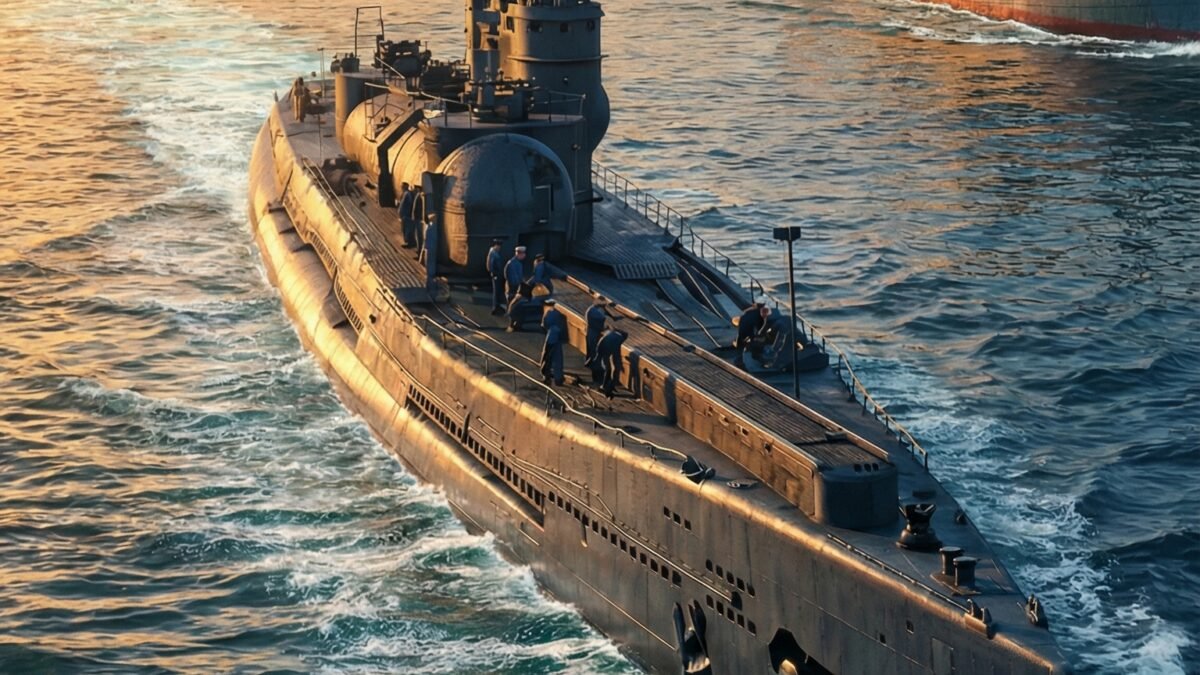
High-angle colorized aerial inspection of U-33 steaming in pre-war splinter camouflage. Notice the compact pre-VIIC conning tower and the external stern torpedo casing aft of the saddle tanks.

U-47 (Type VIIB) — Kptlt. Günther Prien’s 14-Torpedo Scapa Flow Penetrator
Archival sequence of U-47 parading her crew at Kiel and maneuvering on the surface past a burning merchantman. Across 10 combat patrols before disappearing in March 1941, Prien sank 31 Allied vessels totaling 191,919 tons.
Structural Evolution: Why the Type VIIC Became the Backbone of the Battle of the Atlantic
To equip incoming boats with the new Gruppenhorchgerät (GHG) passive hydrophone array (24 crystal microphones flush-mounted into the port and starboard bow casing) and updated electrical switchboards for active sonar, German constructors stretched the Type VIIB hull by another 65 centimeters (2 feet 1.5 inches) to create the Type VIIC. Entering service in 1940 with U-69, the Type VIIC became the most heavily produced submarine design in naval history: 568 Type VIIC boats and 91 deep-diving Type VIIC/41 boats were commissioned across 17 German shipyards.
Measuring 67.10 meters (220 feet 2 inches) overall with a beam of 6.20 meters (20 feet 4 inches), the Type VIIC was built around an internal cylindrical pressure hull (Druckkörper) 4.70 meters (15 feet 5 inches) in diameter welded from 18.5-millimeter (0.73-inch) St 52 high-tensile steel plates. Why did Dönitz overwhelmingly favor the compact 769-ton Type VIIC over the larger 1,120-ton Type IXC long-range boat? In the knife-fight conditions of North Atlantic convoy battles, the Type VIIC’s lower conning tower silhouette made it far harder for destroyer lookouts to spot against dark swells at night. Even more critically, its compact hull volume and saddle tanks allowed a seasoned crew to execute an emergency Alarmtauchen (crash dive) from full surface trim to periscope depth in 25 to 30 seconds—nearly 15 seconds faster than a cumbersome Type IX, a margin that routinely separated survival from obliteration under the bombs of a diving RAF Coastal Command Liberator or Sunderland flying boat.



Type VIIC Submerged Hydrodynamics — Saddle Tanks, Flood Slits & Forward Hydroplanes
Underwater inspection of a Type VIIC hull (U-997 profile) gliding on silent battery power. Observe the rows of free-flooding ballast slits along the upper casing and the bulging port/starboard Satteltanks that gave the Type VII its buoyancy and range.

Type VIIC Bow-On Sea Keeping — Net Cutter, Saddle Ballast & Wintergarten
Bow-quarter study of a Type VIIC slicing through heavy Atlantic swells on its twin Germaniawerft supercharged 6-cylinder diesel engines (3,200 bhp total). Notice the jumping wire stretching from bow to conning tower to deflect anti-submarine nets and mines.
⚓ Interactive Zentrale 01: Kriegsmarine U-Boat Class Blueprint & Trim Comparator
Every wartime German U-boat was an intricate balance of two incompatible propulsion plants packed inside a narrow steel tube. On the surface, a Type VIIC relied on two supercharged 6-cylinder four-stroke Germaniawerft F46 or MAN M6V 40/46 diesel engines delivering 2,800 to 3,200 brake horsepower, driving the boat at up to 17.7 knots while simultaneously recharging the batteries. The moment the Diving Klaxon sounded and the main air induction valves slammed shut to prevent thousands of gallons of seawater from flooding the engine room, the crew declutched the diesels and engaged two AEG GU 460/8-276 or Brown, Boveri & Cie (BBC) GG UB 720/8 electric motors. Drawing power from two 62-cell AFA (Accumulatoren-Fabrik AG) 27 MAK 800 W lead-acid battery banks weighing 124 metric tons stowed beneath the deck plates of the accommodation and control rooms, the electric motors produced 750 shaft horsepower—propelling the submerged U-boat at a maximum burst speed of 7.6 knots for barely 45 minutes, or a creeping 2 to 4 knots for up to 80 nautical miles before toxic chlorine gas risks and depleted voltage forced the boat back to the surface to breathe.
The Torpedo Crisis of 1940 and the G7a / G7e Arsenal
The primary offensive punch of the Kriegsmarine’s U-Bootwaffe was the 53.3-centimeter (21-inch) 7.16-meter-long G7 torpedo family, stowed in internal racks and external pressure-tight deck canisters. Two standard variants filled the forward and aft torpedo rooms during the first three years of the war:
First was the G7a (TI) wet-heater steam-gas torpedo, driven by a 4-cylinder Brotherhood radial piston engine burning decalin fuel, compressed air, and water steam. Capable of three selectable speed settings—44 knots out to 6,000 meters, 40 knots out to 8,000 meters, or 30 knots out to 12,500 meters—the G7a carried a 280-kilogram (617-pound) Schießwolle 36 hexanite warhead. Its fatal drawback in daylight attacks was its exhaust: compressed nitrogen and steam left a boiling white bubble track across the ocean surface that pointed escorting destroyers straight back to the firing submarine’s periscope.
Second was the wakeless G7e (TII and TIII) electric torpedo, powered by a 52-cell lead-acid battery driving a 100-horsepower electric motor at 30 knots out to 5,000 meters. Because its lead-acid cells lost chemical efficiency in freezing waters, torpedo mechanics had to pre-heat G7e batteries inside the torpedo tubes to 28°C (82°F) to guarantee full combat speed. During the April 1940 Norwegian Campaign (Operation Weserübung), U-boat commanders repeatedly ambushed British battleships (including HMS Warspite), cruisers, and troop transports at point-blank range, only to watch in horror as their torpedoes either exploded prematurely in the wake or struck British hulls with a metallic clang and failed to detonate.
Investigations ordered by a furious Karl Dönitz exposed a twin engineering scandal inside the Torpedo Experimental Establishment (Torpedoversuchsanstalt, or TVA) at Eckernförde. First, the G7’s depth-keeping hydrostatic diaphragm lacked pressure compensation when fired from a U-boat carrying high internal air pressure, causing torpedoes to run 2 to 3 meters deeper than set and pass harmlessly beneath shallow-draft warships. Second, the complex Pi 1 (Pistole 1) magnetic influence pistol malfunctioned wildly inside the high-latitude geomagnetic anomalies off northern Norway, while its backup contact whiskers jammed if the torpedo struck a ship’s hull at an oblique angle sharper than 50 degrees. Only after the Kriegsmarine deactivated the magnetic coils in mid-1940 and introduced the redesigned Pi 2 magnetic/contact pistol and FAT (Federapparat-Torpedo) pattern-running gyroscopes in late 1942 did U-boat torpedo reliability reach lethal maturity. By September 1943, Germany introduced the G7es (TV) Zaunkönig (“Wren”) passive acoustic homing torpedo, which used four magnetostrictive hydrophones in its nose to home in on the cavitation noise of an escort ship’s propellers spinning between 10 and 18 knots.
Mechanical Analog Brilliance: The Vorhaltrechner (Torpedo Data Computer)
Unlike early submarine navies that forced captains to align the entire submarine hull to point the bow tubes at a moving target, German U-boats aimed their torpedoes using an electro-mechanical analog computer manufactured by Siemens Apparate und Maschinen GmbH: the Torpedovorhaltrechner (TDC, Models S3 and C37), housed in the conning tower alongside the attack periscope (Angriffsehrohr) or coupled optically to the bridge’s UZO (Überwasserzieloptik) night-attack binocular pedestal.
As the commander or First Watch Officer (I. Wachoffizier, or 1WO) tracked a merchantman in the crosshairs, he called out four parameters: target bearing (transmitted automatically by synchro repeaters from the periscope or UZO pedestal), estimated target range (measured via the periscope’s split-image stadimeter against the target’s known masthead height), estimated target speed (judged by bow wave height and funnel smoke angle), and Lagewinkel (Angle on the Bow—the aspect angle at which the target was steaming relative to the U-boat’s line of sight). The Vorhaltrechner continuously integrated the U-boat’s own gyrocompass heading and speed with the target’s vector, automatically calculating the required Vorhaltwinkel (lead angle) and continuously setting the Schusswinkel (gyro deflection angle) inside the torpedoes waiting in the tubes via mechanical spindle shafts. The result was devastating: a U-boat could fire a spread (Fächer) of four bow torpedoes while maneuvering up to 90 degrees off the target’s bearing; moments after clearing the bow shutters, each torpedo’s internal gyroscope snapped its rudders hard over, turning the weapon onto its computed intercept course.
Surface Artillery & Rocket Experiments: The 10.5cm SK C/32 Deck Gun and Wurfgerät Salvos
Torpedoes were precious, expensive, and bulky—a Type VIIC carried only 14, and a Type IXC carried 22. Against lone, unescorted merchantmen or stragglers crippled behind a convoy, U-boat commanders preferred to surface and sink their quarry with deck gun fire, conserving torpedoes for heavily defended convoy screens. While the Type VII carried the quick-firing 8.8 cm (3.46-inch) SK C/35 naval gun forward of the conning tower (with 220 rounds stored in the keel magazine), the ocean-going Type I and Type IX classes (Type IXA, IXB, IXC, and IXC/40) mounted a far heavier weapon inherited from Kriegsmarine fleet torpedo boats: the 10.5 cm (4.1-inch) SK C/32 naval gun on an U-Bootslafette C/32 pedestal mount.
Constructed with a monobloc steel barrel, vertical sliding-wedge breech block, and hydropneumatic recoil cylinders underneath the cradle, the 10.5 cm SK C/32 weighed 4.98 metric tons and fired a 15.1-kilogram (33.3-pound) high-explosive or incendiary shell at a muzzle velocity of 785 meters per second out to a maximum surface range of 15,175 meters (16,595 yards). A well-drilled five-man gun crew passing fixed 24-kilogram brass cartridges up through the pressure-tight deck ammunition scuttle could sustain a rate of fire of 15 rounds per minute, turning an unarmored freighter’s waterline and bridge into a blazing wreck within three minutes.
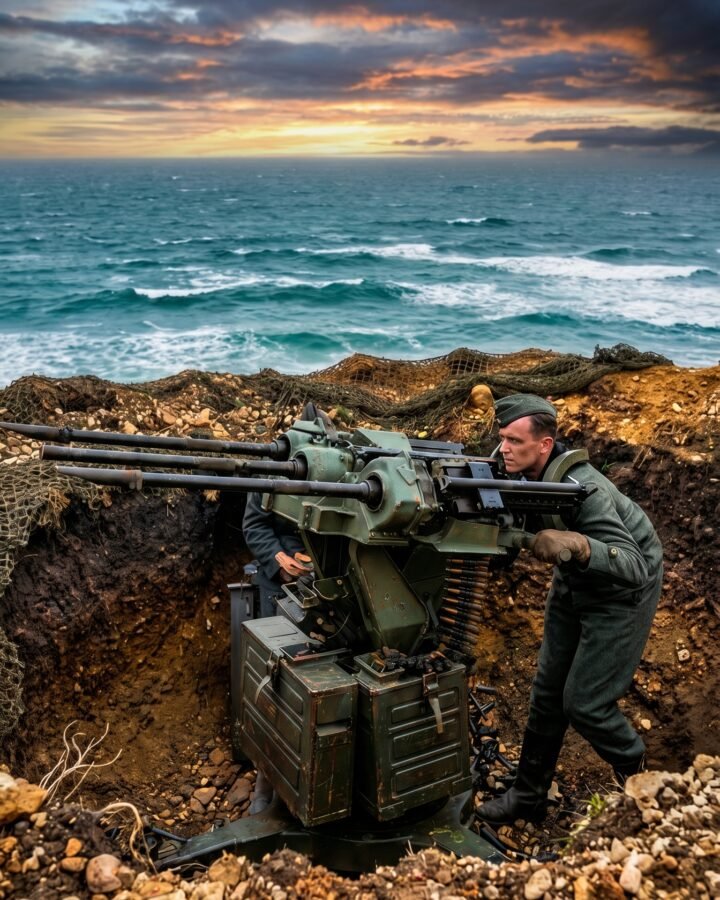
Even more audaciously, in May and June 1942 at Peenemünde on the Baltic coast, Kapitänleutnant Friedrich Steinhoff (commander of the Type IXC U-511) collaborated with his brother, the rocket scientist Dr. Ernst Steinhoff, to bolt a tubular steel rack of six 30 cm Schweres Wurfgerät 42 (sWG 42) solid-fuel Nebelwerfer artillery rockets onto U-511’s casing deck. Designed to be fired both on the surface and while submerged at a depth of 12 meters (39 feet) by waterproofing the solid-propellant rocket motors with wax-sealed diaphragms and igniting them electrically from the control room, all 24 test rockets roaring out of the Baltic sea struck their target grid over 3,000 meters away. Although the German Navy Bureau of Ordnance ultimately rejected the submerged rocket battery because the external racks degraded underwater speed and could not be aimed accurately against moving ships, Steinhoff’s 1942 Peenemünde trials aboard U-511 marked the direct technological ancestor of the Cold War submarine-launched ballistic missile (SLBM).

10.5 cm SK C/32 — Kriegsmarine Type IX U-Boat & Torpedo-Boat Main Gun
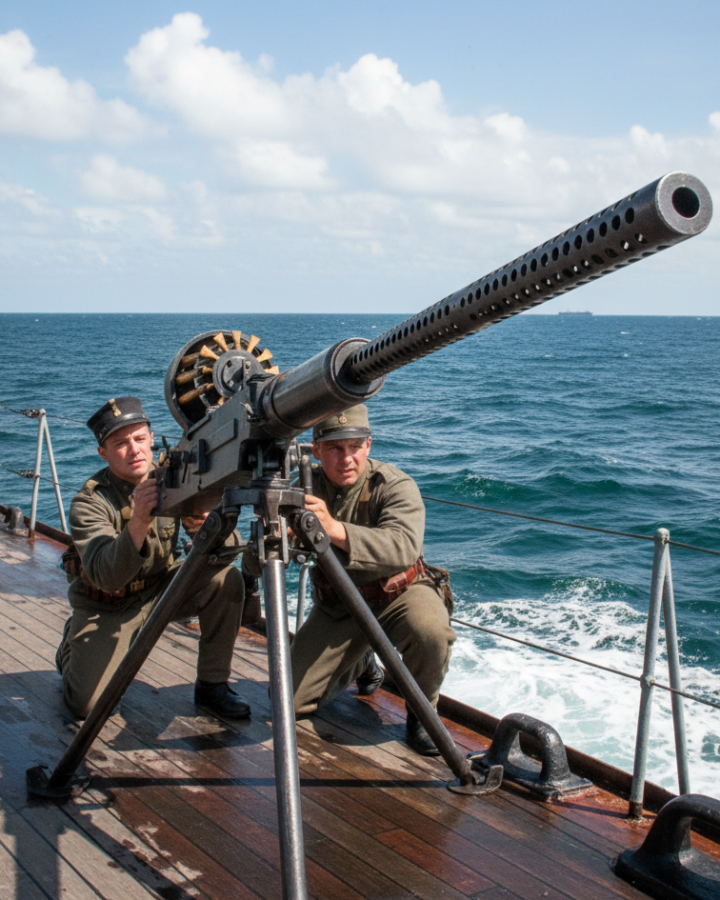
Close-quarters inspection of the quick-loading 105mm SK C/32 naval cannon, showing its dual elevation/traverse handwheels, sliding-wedge breech, and steel gun shield on a Kriegsmarine vessel.
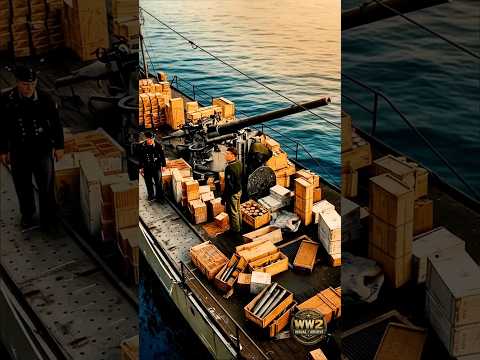
10.5 cm SK C/32 Deck Mount — 15.1 kg Shell Crates & Surface Gunnery
Colorized archival footage of Kriegsmarine sailors stacking wooden ordnance crates packed with fixed 105×658mmR brass rounds around the SK C/32 pedestal mount prior to an Atlantic patrol.

Type VIIC U-96 Profile & The Kriegsmarine’s Experimental Submarine Rocket Salvos
Dramatic study of U-96 battling North Atlantic swells, paired with the history of the Kriegsmarine’s 1942 Peenemünde deck-mounted Wurfgerät 42 underwater rocket artillery tests.
🎯 Interactive Zentrale 02: Siemens TDC (Vorhaltrechner) Torpedo Intercept Calculator
The fall of France in June 1940 transformed the strategic geometry of the Battle of the Atlantic overnight. No longer forced to thread the heavily mined North Sea and the Fair Isle passage around Scotland—a transit that consumed nearly 40 percent of a Type VII’s fuel before it ever reached the Atlantic shipping lanes—Dönitz relocated his U-boat flotillas directly onto the French Bay of Biscay coast at Brest (1st and 9th Flotillas), Lorient (2nd and 10th Flotillas), Saint-Nazaire (6th and 7th Flotillas), La Pallice/La Rochelle (3rd Flotilla), and Bordeaux (12th Flotilla). Moving forward by 450 nautical miles extended the patrol endurance of every Type VIIC westward into the Mid-Atlantic “Black Pit”—the lethal ocean zone south of Greenland where Allied convoys steamed outside the operational radius of land-based RAF Coastal Command aircraft.
How a Wolfpack (Rudeltaktik) Actually Hunted
Popular mythology imagines a German Wolfpack (Wolfsrudel) submerged in formation peering through periscopes. In reality, a submerged Type VIIC creeping at 3 to 4 knots was slower than a 9-knot merchant convoy and virtually blind beyond a few thousand yards. Dönitz’s Rudeltaktik exploited two critical facts: a surfaced U-boat making 17 knots was faster than both the convoy and many British Flower-class corvettes (which topped out at 16 knots), and a U-boat’s low silhouette was invisible to early British Type 271/286 radar or naked-eye lookouts on moonless nights, while also immune to underwater ASDIC (sonar), which could not detect a hull riding on the surface.
Directed from Dönitz’s operations room at Château de Kernevel overlooking Lorient harbor, eight to twenty U-boats were deployed across a likely convoy route in a long north-south scouting line (Vorpostenkette) spaced 15 to 25 nautical miles apart. When one boat spotted smoke stacks or masts on the horizon, its commander was strictly forbidden to attack alone. Instead, the discovering boat became the Fühlungshalter (contact-keeper): shadowing the convoy just beyond visual horizon, transmitting periodic encrypted short-wave bearings, course, and speed to BdU headquarters, and holding down its transmitter key so sister boats equipped with loop radio direction-finders (Peilrahmen) could home in on the beacon. Once six to twelve U-boats had concentrated ahead of the convoy after nightfall, BdU flashed the order “Ran!” (“Get at them!”). Operating independently on the surface in the dark, the U-boats slipped between the thin screen of escorting corvettes, firing wakeless G7e torpedoes at point-blank range from inside the merchant columns before racing away on their diesels or crash-diving as snowflake flares turned the night sky white.
During the First “Happy Time” (Die Glückliche Zeit, June 1940–February 1941), German U-boat aces (Experten) inflicted catastrophic losses for minimal cost: Otto Kretschmer (U-99)—whose motto was “One torpedo, one ship”—sank 47 ships totaling 274,333 tons before being captured in March 1941; Joachim Schepke (U-100) sank 37 ships (155,882 tons); and Engelbert Endrass (U-46) sank 22 ships (118,528 tons). When the United States entered the war in December 1941 without coastal blackouts or an organized East Coast convoy network, Dönitz launched Operation Paukenschlag (“Drumbeat”, January–July 1942). Initially dispatching just five Type IX boats to the American seaboard from Cape Hatteras to the Gulf of Mexico, German U-boats enjoyed a Second Happy Time, sinking 609 Allied ships totaling 3.1 million gross register tons within sight of illuminated beachfront hotels in Florida, North Carolina, and New Jersey at the cost of just 22 U-boats.
U-96, The Laughing Sawfish, and the Claustrophobic Reality of “Das Boot”
No single vessel captured the visceral reality of the Atlantic U-boat campaign more vividly than U-96, a Type VIIC submarine commissioned at Krupp Germaniawerft on September 14, 1940 under Kapitänleutnant Heinrich Lehmann-Willenbrock (“Der Alte”—The Old Man, then just 29 years old). Bearing the iconic green Laughing Sawfish (Lachender Sägefisch) emblem of the 9th Flotilla on her conning tower, U-96 completed 11 combat patrols, sinking 27 merchant ships (181,206 GRT) and damaging four more, plus another 8,888-ton transport declared a total constructive loss. In Autumn 1941, propaganda company war correspondent Leutnant Lothar-Günther Buchheim sailed aboard U-96 on her tumultuous seventh patrol—taking over 5,000 Leica photographs that later formed the basis for his 1973 novel and Wolfgang Petersen’s 1981 cinematic masterpiece, Das Boot.
Life inside a Type VIIC on a 50-day North Atlantic or Arctic patrol—such as those endured by U-278 under Kapitänleutnant Joachim Franze in the freezing Barents and Norwegian Seas—was an endurance test of filth, condensation, and terror. Fifty men lived inside a usable living cylinder barely 48 meters long and 3 meters wide. Three of the four bow torpedo tubes were reloaded only after the crew ate their way through the crates of tinned bread, sausages, and cabbages stacked over the deck plates; until then, hammocks were slung directly over the greased G7e torpedoes, while off-watch sailors practiced “hot-bunking” in sweat-soaked bunks still warm from the men going on watch.
Fresh water was strictly rationed to drinking and topping up battery cells; washing was impossible, leaving all 50 crewmen crusted in salt, diesel oil film, and weeks-old beards reeking of damp wool, bilge water, frying onions, and Kolibri lemon cologne used to wipe salt sores off their necks. Only two tiny heads (toilets) existed aboard, and one was packed to the ceiling with provisions for the first half of the patrol; moreover, the high-pressure waste discharge valve could not be operated below 25 meters depth because external sea pressure would blow sewage back into the boat.

U-96 (1941) — The Laughing Sawfish & 27-Second Crash Dive Into the Abyss
High-impact visualization of Kptlt. Lehmann-Willenbrock’s U-96 venting main ballast tanks in a roaring white plume of air bubbles as the bow planes drive the boat beneath the North Atlantic waves.

U-96 at Sea — The Historical Type VIIC Behind Buchheim’s “Das Boot”
Surface action study of U-96 launching ordnance across Atlantic rollers. Survived 11 combat patrols from Saint-Nazaire before serving as a Baltic training boat until bombed at Wilhelmshaven on March 30, 1945.

U-278 (Type VIIC) in Color — High-Latitude Convoy Hunter
Restored color archival footage of U-278 (Bremer Vulkan yard, Kptlt. Joachim Franze) crashing through whitecaps. On January 30, 1944, U-278 sank the British destroyer HMS Hardy on Arctic Convoy JW-56B.
🌊 Interactive Zentrale 03: Type VIIC Papenberg Depth Gauge & Hydrostatic Hull Stress Simulator
The ferocious climax of the Battle of the Atlantic between late 1942 and May 1943 was fought as much inside cryptographic laboratories and electronics workshops as on the heaving swells between Newfoundland and Ireland. For the first two years of the war, Germany’s Naval Signals Intelligence Service—the Beobachtungsdienst (B-Dienst) under Wilhelm Tranow—regularly broke the British Admiralty’s Naval Cypher No. 3, feeding Dönitz real-time convoy routing diversions. Simultaneously, Bletchley Park’s Hut 8 under Alan Turing and Hugh Alexander had penetrated the Kriegsmarine’s 3-rotor Enigma M3 (Hydra network) after the Royal Navy captured weather ship München, trawler Lauenburg, and Kapitänleutnant Fritz-Julius Lemp’s sinking U-110 in May 1941.
On February 1, 1942, however, BdU introduced the 4-rotor Enigma M4 machine and the exclusive Atlantic U-boat cipher network known to Bletchley Park as Shark (Triton). Adding a thin fourth reflector-rotor (Zusatzwalze Beta or Gamma) multiplied the cryptographic keyspace twenty-six-fold, plunging Allied codebreakers into a devastating ten-month “Enigma Blackout” until the heroic seizure of Kurzsignalheft weather codebooks from the sinking U-559 in the eastern Mediterranean on October 30, 1942 enabled Bletchley Park’s electro-mechanical Bombes to crack Shark again in December 1942.
The Five Technologies That Shattered the Wolfpacks in “Black May” 1943
In March 1943, during the mammoth running battle around Convoys HX-229 and SC-122, forty U-boats sank 22 Allied merchant ships totaling 146,596 tons while losing only a single submarine—prompting the British Admiralty to admit privately that the Germans had never come closer to severing communications between the New World and the Old. Yet just eight weeks later, in “Black May” (May 1943), the entire Wolfpack system collapsed when five interlocking Allied technologies converged simultaneously:
1. 10-Centimeter (S-Band) Cavity Magnetron Radar: Early metric-wavelength British radar (1.5-meter ASV Mk II) could be detected miles away by the German FuMB 1 Metox (“Biscay Cross”) radar warning receiver, giving U-boats ample warning to dive. In early 1943, Allied warships fitted the Type 271 and Coastal Command aircraft fitted the ASV Mk III 10-centimeter radar. Operating at 3,000 MHz, the 10-centimeter beam was completely invisible to Metox and narrow enough to detect a U-boat’s conning tower or even a raised periscope amidst heavy sea clutter.
2. Shipborne HF/DF (“Huff-Duff”): Because Dönitz’s Rudeltaktik required U-boats to transmit frequent short-wave contact reports, Allied escort commanders installed masthead FH3 / FH4 High-Frequency Direction Finding cathode-ray oscilloscopes. The instant a shadowing U-boat keyed its transmitter for even fifteen seconds, two escort ships took cross-bearings, pinpointed the submarine’s exact range and azimuth, and raced down the bearing to force the shadower underwater.
3. Closing the Mid-Atlantic Air Gap: Deployment of Very Long Range (VLR) Consolidated B-24 Liberators fitted with auxiliary fuselage fuel tanks—paired with American Bogue-class and British Archer-class Escort Carriers (CVEs)—eliminated the Mid-Atlantic “Black Pit.” Equipped with 22-million-candlepower Leigh Light searchlights slaved directly to centimetric radar and Mark 24 “Fido” acoustic homing torpedoes, aircraft ambushed surfaced U-boats charging their batteries at night.
4. Forward-Throwing ASW Weapons (Hedgehog & Squid): Traditional stern-dropped depth charges forced an attacking destroyer to steam directly over a submerged U-boat, blinding its bow ASDIC transducer during the final 250 yards of the run and giving the U-boat captain time to turn hard under the destroyer’s wake. The British Hedgehog spigot mortar fired a circular pattern of 24 contact-fuzed 65-pound Torpex bombs 250 yards ahead of the ship while maintaining continuous sonar lock; a single contact detonation ruptured a Type VIIC’s pressure hull instantly.
5. Dedicated Hunter-Killer Support Groups: Commanded by relentless tacticians such as Captain Frederic “Johnny” Walker RN (2nd Support Group, HMS Starling), roving sloops and destroyer escort groups reinforced threatened convoys and stayed over a sonar contact for twenty hours until the U-boat’s batteries died. In May 1943 alone, 43 German U-boats were destroyed—more than a quarter of the operational Atlantic force—forcing Dönitz on May 24, 1943 to order a temporary withdrawal from the North Atlantic.
Fortress Europe’s Submarine Bunkers, Type IXD2 U-861, and the Capture of U-505
As Allied air power intensified over the Bay of Biscay, Organisation Todt poured over 4.1 million cubic meters of steel-reinforced concrete to construct indestructible submarine pens at Brest, Lorient (Keroman I, II, and III), Saint-Nazaire, La Pallice, Bordeaux, and Trondheim in Norway (Dora I). Featuring roof slabs 3.5 to 7.3 meters (11.5 to 24 feet) thick interlaced with “Fangrost” bomb-detonating air-gap beams, these wet and dry bunkers withstood even RAF 12,000-pound Tallboy earthquake bombs.
From these pens sailed the giant 1,616-ton Type IXD2 long-range cruiser U-boats, which possessed an extraordinary surface range of 31,500 nautical miles at 10 knots by combining two supercharged MAN 9-cylinder combat diesels with two smaller Daimler-Benz high-speed cruising diesels. Boats like U-861 under Kapitänleutnant Jürgen Oesten operated as part of the Monsun Gruppe (Monsoon Group), sailing around the Cape of Good Hope to hunt in the Indian Ocean, refuel from Japanese bases at Penang (Malaya) and Batavia, and haul strategic tungsten, quinine, and natural rubber back to Europe. On her grueling 161-day patrol from April to September 1944, U-861 sank four ships off Brazil and Madagascar before escaping through the Allied blockade to reach the concrete pens of Dora I at Trondheim.
Yet the most dramatic surface-and-boarding prize in modern U.S. naval history occurred off Cape Blanco, French West Africa, on June 4, 1944—just 48 hours before the Normandy D-Day landings. Operating with the escort carrier USS Guadalcanal (CVE-60) and five destroyer escorts, Captain Daniel V. Gallery’s Task Group 22.3 gained sonar contact on the Type IXC U-505 (Oberleutnant zur See Harald Lange). Blown to the surface with a jammed rudder by depth charges from USS Chatelain and raked by 20mm wildfire from Wildcat fighters, U-505 was abandoned by her crew while still circling at 7 knots with her scuttling strainer cover open. Led by Lieutenant (jg) Albert L. David (who received the Medal of Honor), an eight-man boarding party from USS Pillsbury leaped down U-505’s conning tower hatch, slammed the 18-centimeter sea-strainer cover shut, disarmed 13 demolition charges, and captured intact a four-rotor Enigma M4 machine, current June/July cipher settings, and two acoustic T5 Zaunkönig torpedoes—towed 1,700 miles in strict secrecy to Bermuda, U-505 became the first foreign warship captured on the high seas by the U.S. Navy since the War of 1812, and stands preserved today at the Griffin Museum of Science and Industry in Chicago.


U-505 (Type IXC) — The Only German Submarine Captured at Sea by the U.S. Navy
Restored color footage of U-505 under U.S. Navy prize crew command on June 4, 1944, with the 48-star American flag flying above her battered Turm IV conning tower and U.S. star painted on her casing.

U-861 (Type IXD2) — 31,500-Mile Indian Ocean Raider at Bunker Dora I
Colorized dockside footage of Kptlt. Jürgen Oesten’s 87.6-meter-long Type IXD2 U-861 moored outside the massive reinforced-concrete submarine pens at Trondheim after her Indian Ocean patrol.
By mid-1943, surfacing to recharge batteries within range of Allied land-based or carrier aircraft was tantamount to suicide. To keep existing Type VIIC and Type IXC boats alive, German engineers retrofitted two stopgap survival technologies. The first was the Schnorchel (Snorkel)—adapted from Dutch O-21 class submarines captured in 1940—a hinged hollow mast mounted beside the conning tower that combined a fresh-air intake pipe equipped with a float-operated Ring-Schwimmerventil head valve and a diesel exhaust pipe discharging just below the waves. Using the Schnorchel, a U-boat could run its diesel engines and recharge its batteries while remaining submerged at periscope depth (12 to 14 meters). Yet “snorkeling” was agony for the crew: whenever an Atlantic wave slapped the float valve shut, the roaring diesel engines sucked the air directly out of the boat’s interior in seconds, dropping barometric cabin pressure violently, rupturing eardrums, and filling the hull with blinding blue diesel exhaust back-pressure if the waves prevented exhaust gas from escaping.
The second stopgap was Alberich (named after the invisible dwarf of the Nibelungenlied): a 4-millimeter-thick synthetic Buna rubber anechoic tile perforated with precisely tuned 2-millimeter and 4-millimeter air cavities glued across the submarine’s outer hull. Tested aboard U-11, U-67, and U-480, Alberich absorbed 85 percent of Allied ASDIC sonar pings between 10 and 18 kHz, cutting enemy active sonar detection range in half.
The Type XXI “Elektroboot”: The First True Modern Submarine
Both the Schnorchel and Alberich were merely bandages on an obsolete surface-torpedo-boat hull form. While Professor Hellmuth Walter experimented with closed-cycle hydrogen-peroxide (Ingolin) turbine submarines (the Type XVII), two naval constructors—Heep and Ehrenberg—proposed a brilliant shortcut in November 1942: take the streamlined hydrodynamic figure-eight double-hull profile developed for the Walter turbine submarine, eliminate the volatile hydrogen peroxide, and pack the enormous lower lobe of the figure-eight pressure hull with three times the battery capacity of a Type VIIC (372 AFA 44 MAL 740 W battery cells).
The result was the Type XXI Elektroboot (“Electric Boat”), supplemented by its smaller coastal sister, the two-tube Type XXIII. Displacing 1,621 tons surfaced and 1,819 tons submerged on a 76.7-meter hull, the Type XXI discarded every drag-inducing appendage of the old U-boat era: the deck gun was eliminated, the forward diving planes retracted flush into the hull, and the open conning tower was replaced by a knife-edged, hydrodynamically faired step-sail enclosing a snorkel, radar detector, and periscopes.
Underwater, the Type XXI was a revelation that rendered every Allied convoy escort tactic obsolete overnight. Driven by two 2,000-horsepower SSW GU 365/30 electric motors, a submerged Type XXI achieved 17.2 knots—faster underwater than a Type VIIC could steam on the surface, and faster than the Flower- and River-class frigates hunting it. It could cruise submerged at 6 knots for 48 hours straight (285 nautical miles) without snorkeling, or glide in utter silence at 5 knots on two belt-driven 113-horsepower SSW GV 232/28 silent “creeper” motors (Schleichfahrtmotoren). Inside the spacious bow torpedo room, six 53.3cm bow tubes were served by an electrically powered hydraulic rack-and-pinion rapid-reloading system that loaded all six tubes in just 12 minutes—allowing a Type XXI to fire 18 acoustic or pattern-running torpedoes in under 20 minutes while tracking targets entirely blind via its high-precision Balkongerät 48-hydrophone chin array and Nibelung ultrasonic active sonar without ever raising a periscope!
To mass-produce the Type XXI despite Allied strategic bombing, Reich Minister of Armaments Albert Speer handed production to industrialist Otto Merker, who pioneered modular submarine prefabrication: 32 inland steel firms fabricated eight separate hull rings, trucked and barged them to three final assembly shipyards (Blohm & Voss in Hamburg, AG Weser in Bremen, and Schichau in Danzig), and welded them together on slipways. Although 118 Type XXI boats were commissioned before May 1945, quality-control defects from dispersed bombing and the need for crew work-ups meant only two—U-2511 under Korvettenkapitän Adalbert Schnee and U-3008—put to sea on combat patrols in the final days of April 1945. On May 4, 1945, hours after Dönitz’s ceasefire order took effect, Schnee’s U-2511 encountered the British cruiser HMS Norfolk and her destroyer screen off Bergen; using his silent creeper motors and 17-knot underwater speed, Schnee effortlessly penetrated inside the destroyer screen to within 500 yards of Norfolk’s beam, conducted a simulated torpedo attack without being detected by British ASDIC, and slipped away unseen—a chilling preview of Cold War submarine warfare.

Type XXI “Elektroboot” (1944–1945) — The World’s First True Modern Attack Submarine
Submerged hydrodynamic study of the Type XXI Elektroboot running at 17 knots underwater. Note the clean gunless foredeck, retractable hydroplanes, streamlined step-sail housing twin 2cm Flak C/38 turrets, and figure-eight pressure hull packing 372 high-capacity battery cells. Captured Type XXI hulls directly birthed the U.S. Navy Tang class, Soviet Project 613 (Whiskey class), and HMS Explorer.
| Technical Parameter | KM Type VIIC | KM Type IXC/40 | KM Type XXI Elektroboot | USN Gato-Class | RN T-Class (Group 3) |
|---|---|---|---|---|---|
| Displacement (Surf / Sub) | 769 t / 871 t | 1,144 t / 1,257 t | 1,621 t / 1,819 t | 1,525 t / 2,424 t | 1,090 t / 1,575 t |
| Dimensions (LOA × Beam) | 67.1 m × 6.2 m | 76.8 m × 6.9 m | 76.7 m × 8.0 m | 95.0 m × 8.3 m | 84.2 m × 8.1 m |
| Max Speed (Surf / Sub) | 17.7 kts / 7.6 kts | 18.3 kts / 7.3 kts | 15.6 kts / 17.2 kts | 20.25 kts / 8.75 kts | 15.25 kts / 9.0 kts |
| Range (Surface / Submerged) | 8,500 NM / 80 NM | 13,850 NM / 63 NM | 15,500 NM / 340 NM | 11,000 NM / 48 NM | 8,000 NM / 70 NM |
| Torpedo Tubes & Loadout | 5 Tubes (14 Rounds) | 6 Tubes (22 Rounds) | 6 Bow Hydraulic (23 Rds) | 10 Tubes (24 Rounds) | 11 Tubes (17 Rounds) |
| Calculated Crush Depth | 250 m (280 m VIIC/41) | 230 m (755 ft) | 280 m (920 ft) | 180 m (600 ft) | 150 m (500 ft) |
Operation Regenbogen, Operation Deadlight, and the 75% Human Cost
No branch of any armed service in World War II—save only Japanese Kamikaze units—suffered a higher proportional loss of human life than the German U-Bootwaffe. Between September 1939 and May 1945, out of 1,153 commissioned U-boats and 863 that sailed on active combat patrols, 785 U-boats were destroyed by Allied warships, aircraft, mines, submarines, or bombing raids. In the final days of May 1945, despite Dönitz revoking the traditional self-scuttling codeword (Regenbogen / “Rainbow”), U-boat crews scuttled 221 submarines in shallow Baltic and North Sea anchorages, while 156 surviving U-boats surrendered to Allied ports—116 of which were subsequently towed into deep water northwest of Ireland and sunk by the Royal Navy during Operation Deadlight between November 1945 and February 1946.
Of the 40,900 young German officers and sailors who went to sea aboard frontline combat U-boats, 30,003 never returned—a staggering 75 percent fatality rate entombed forever inside crushed steel cylinders across the floor of the Atlantic, Arctic, Mediterranean, and Indian Oceans. Yet the technological DNA of their late-war boats—especially the Type XXI Elektroboot (one example of which, U-2540 / Wilhelm Bauer, was raised in 1957 and remains a floating museum in Bremerhaven)—directly shaped the postwar U.S. Navy Tang class and GUPPY program, the Soviet Navy’s Project 613 Whiskey and Project 611 Zulu classes, the French Narval class, and the modern tear-drop hull nuclear attack submarines that patrol the world’s oceans today.
🕹️ Interactive Zentrale 04: B-Dienst vs. Allied ASW Tactical Recognition Console
Q1: Which Type VIIB U-boat commanded by Kptlt. Günther Prien penetrated the Royal Navy fleet anchorage at Scapa Flow on October 14, 1939 and sank the battleship HMS Royal Oak?
Did a family member serve in the Battle of the Atlantic aboard Allied convoy escorts, merchantmen, or Kriegsmarine U-boats, or do you have primary-source patrol logs (Kriegstagebücher), technical notes, or museum observations on U-995, U-505, or Wilhelm Bauer (U-2540) to share? Submit your dispatch to the permanent archive record below.