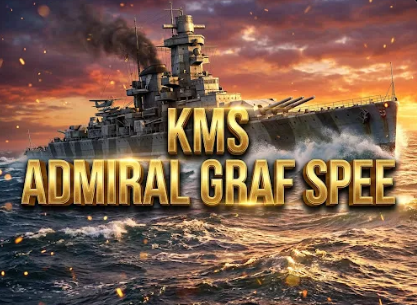
KMS Admiral Graf Spee: Germany’s South Atlantic Pocket Battleship
Few warships in modern naval history sparked more pre-war anxiety than KMS Admiral Graf Spee. German engineers designed this sleek, diesel-powered Panzerschiff to bypass the strict tonnage ceilings of the 1919 Treaty of Versailles while outgunning every treaty cruiser afloat. Consequently, British naval planners dubbed her a “pocket battleship” long before she fired a single shell in combat.
Between September and December 1939, Captain Hans Langsdorff led KMS Admiral Graf Spee on an audacious commerce-raiding cruise across the South Atlantic and Indian Oceans. Remarkably, his crew sank nine Allied merchant ships totaling 50,089 gross register tons without causing a single merchant sailor fatality. However, her hunt ended abruptly during the Battle of the River Plate on 13 December 1939, when three agile Royal Navy cruisers cornered her near neutral Uruguay.
Four days later, twenty thousand spectators lined the Montevideo waterfront as Langsdorff detonated scuttling charges inside his own flagship. In this complete visual and historical dossier, we examine her revolutionary diesel engineering, her nine-ship raiding campaign, the tactical clash at the River Plate, and the modern controversy surrounding her salvaged bronze stern eagle.
Featured KMS Admiral Graf Spee & Kriegsmarine Shorts
Watch our restored 4K/60fps colorized footage of KMS Admiral Graf Spee, her sister-class raiders, and Kriegsmarine naval firepower. Every video card uses instant click-to-load playback so your browser stays fast and responsive.


WW2 Visual Archive Partners
Defying Versailles: How Germany Built a Pocket Battleship
The Treaty of Versailles Loophole and Welded Hull Revolution
After World War I, the 1919 Treaty of Versailles restricted the German Reichsmarine to replacement warships displacing no more than 10,000 long tons. Allied diplomats intended this strict ceiling to prevent Germany from ever building modern capital ships again. However, German naval architects treated the restriction as an engineering puzzle rather than a permanent barrier. Consequently, they conceived the Panzerschiff, or armored ship, a hybrid raider built to outgun any cruiser fast enough to catch her and outrun any battleship strong enough to sink her.
Workers at the Reichsmarinewerft shipyard in Wilhelmshaven laid down KMS Admiral Graf Spee on 1 October 1932 as the third and most refined unit of the Deutschland class. Instead of relying on heavy overlapping steel rivets, shipbuilders electrically welded roughly ninety percent of her hull structure. Furthermore, they used lightweight alloys inside non-vital bulkheads and fittings to save hundreds of tons of deadweight. Even with these dramatic weight reductions, Germany quietly ignored the legal limit. While Berlin officially declared her displacement at 10,000 long tons, her actual design displacement reached 14,890 metric tons and surged to 16,020 long tons at full combat load.
Diesel Propulsion and Unmatched Ocean Endurance
Traditional 1930s cruisers burned heavy fuel oil inside massive high-pressure steam boilers to drive geared turbines. In contrast, German engineers equipped KMS Admiral Graf Spee with eight MAN 9-cylinder double-acting two-stroke diesel engines arranged in four paired sets driving two propeller shafts. Together, these innovative powerplants generated 54,000 metric horsepower and propelled the 186-meter hull to a top speed of 28.5 knots.
More importantly, diesel propulsion transformed strategic commerce raiding across open oceans. Because diesel engines consumed far less fuel than steam turbines, KMS Admiral Graf Spee achieved an astonishing cruising range of 16,300 nautical miles at 18.69 knots. Therefore, she could prowl the South Atlantic and Indian Oceans for months without returning to a German dockyard. In addition, diesel machinery required no lengthy warm-up period to build steam pressure, allowing the raider to surge to flank speed within minutes of spotting a target or an enemy patrol. Nevertheless, the complex engines vibrated intensely at high revolutions and depended on delicate fuel purification systems that later proved fatal in battle.
Main Battery Firepower, Heavy Flak, and Early Seetakt Radar
Firepower formed the core of the pocket battleship doctrine. German ordnance makers mounted six 28 cm (11-inch) SK C/28 naval rifles inside two armored triple turrets positioned fore and aft of the superstructure. Each massive gun hurled a 300-kilogram armor-piercing or high-explosive shell beyond 30 kilometers, completely outranging the 8-inch and 6-inch batteries of British treaty cruisers. Alongside her main battery, she carried eight 15 cm (5.9-inch) SK C/28 secondary guns in single turrets amidships plus eight 53.3 cm (21-inch) torpedo tubes in two quadruple stern mounts.
To defend against air attack, engineers installed three twin 10.5 cm (4.1-inch) SK C/33 heavy anti-aircraft mounts directed by stabilized fire-control posts, backed by eight 3.7 cm guns and ten 2 cm autocannons. Equally significant, KMS Admiral Graf Spee became the first German warship equipped with radar. Technicians mounted a pioneering FMG 39 G(gO) “Seetakt” radar antenna directly onto her forward rangefinder tower. Meanwhile, an amidships catapult launched an Arado Ar 196 reconnaissance floatplane that extended her visual scouting horizon across hundreds of square miles of empty ocean.
Armor Protection and the Cruiser Trade-Off
Despite her intimidating British nickname, KMS Admiral Graf Spee never possessed true battleship armor. Designers had to balance heavy guns and long-range diesel tanks against hull weight. As a result, they gave her a main waterline armor belt measuring 100 mm (3.9 inches) thick, backed by a 45 to 70 mm main armored deck and 17 mm upper splinter deck. Her triple main turret faces carried 140 mm (5.5 inches) of steel, while turret sides dropped to 80 mm.
This armor scheme protected her magazines and engine rooms from light cruiser shells at long ranges. However, heavy 8-inch armor-piercing rounds from British heavy cruisers could punch through her belt at medium combat distances. Moreover, her unarmored bow and upper superstructure remained vulnerable to rapid-fire 6-inch high-explosive salvos. German admirals accepted this calculated risk because pre-war orders instructed commerce raiders to avoid pitched duels with enemy warships altogether. When Captain Hans Langsdorff later broke that rule off Uruguay, the ship’s thin upper hull paid an immediate price.
Sister Ships Deutschland and Admiral Scheer
Germany built three ships in the Deutschland class between 1931 and 1936: Deutschland (later renamed Lützow so the enemy could never sink a ship bearing the Fatherland’s name), Admiral Scheer, and KMS Admiral Graf Spee. Although all three shared the same fundamental diesel hull and six 28 cm main guns, naval architects refined each successive vessel. Consequently, Graf Spee featured a heavier, more enclosed tower bridge, improved internal armor subdivision, and slightly broader beam stability than her older sisters.
Their wartime fates diverged dramatically after 1939. While Graf Spee met her sudden end off Montevideo during the first winter of the war, Admiral Scheer later executed the Kriegsmarine’s most successful surface raiding cruise, sailing over 46,000 miles and sinking seventeen Allied ships across the Atlantic and Indian Oceans. Both Admiral Scheer and Lützow survived until the final weeks of the war in spring 1945 before Allied bombers finally destroyed them in German ports.
Crew Expansion and Life Aboard a Long-Range Raider
Naval planners originally designed KMS Admiral Graf Spee for a peacetime complement of 33 officers and 586 enlisted sailors. However, mounting additional anti-aircraft batteries, radar stations, and wartime damage-control teams forced the Kriegsmarine to expand her crew dramatically after 1935. By the time she departed Wilhelmshaven in August 1939, roughly 1,001 to 1,150 officers and men lived inside her compact cruiser hull.
Living aboard a diesel raider in tropical South Atlantic latitudes tested every sailor’s endurance. Because the hull packed massive fuel bunkers, ammunition magazines, and eight roaring diesel engines into tight compartments, interior mess decks stayed hot, noisy, and crowded. Nevertheless, Captain Langsdorff maintained exceptional morale through strict fairness, athletic drills on the open quarterdeck, and fresh provisions transferred from captured merchantmen. That deep mutual trust explains why his crew obeyed every order calmly during the brutal River Plate gunfire and the heartbreak of scuttling.
River Plate Matchup: Graf Spee vs. Royal Navy Force G
Select any of Commodore Henry Harwood’s three cruisers below to compare displacement, main battery caliber, speed, armor, and River Plate combat casualties directly against KMS Admiral Graf Spee.
KMS Admiral Graf Spee
HMS Exeter (68)
Ghost of the South Atlantic: Nine Ships Sunk, Zero Lives Lost
Pre-War Deployment and Secret Supply Lines
Germany commissioned KMS Admiral Graf Spee on 6 January 1936, and she quickly served as the pride of the rebuilt Kriegsmarine. Between 1936 and 1938, she completed five non-intervention patrols off the Spanish coast during the Spanish Civil War and represented Germany at King George VI’s Coronation Fleet Review at Spithead in May 1937. In late 1938, Kapitän zur See Hans Langsdorff assumed command—an experienced, chivalrous officer who had grown up next door to World War I hero Admiral Maximilian von Spee.
Eleven days before Germany invaded Poland, KMS Admiral Graf Spee slipped quietly out of Wilhelmshaven on 21 August 1939. Steering wide around Iceland and the British Isles, Langsdorff guided his ship deep into the empty central Atlantic. There, she linked up with her dedicated fleet oiler and prison ship, the Altmark. When Britain and France declared war on 3 September, Hitler initially held the raider back, hoping London would negotiate peace. Finally, on 26 September 1939, Naval High Command authorized unrestricted commerce raiding against Allied shipping lanes.
Disguises, Deception, and Captain Langsdorff’s Prize Rules
Langsdorff immediately proved himself a master of maritime deception. While refueling from Altmark, German carpenters built a fake canvas-and-wood gun turret on the forward superstructure and erected a dummy second funnel behind the catapult. From several miles away, this clever camouflage altered her silhouette to resemble a British Renown-class battlecruiser or a French battleship. Consequently, approaching Allied merchant captains often mistook the approaching warship for a friendly escort until German signal lamps flashed orders to stop.
Equally remarkable was Langsdorff’s strict adherence to international Prize Rules. Unlike submarine commanders who torpedoed freighters without warning, Langsdorff halted every merchant vessel, allowed crews ample time to gather personal belongings, and safely boarded them onto KMS Admiral Graf Spee or Altmark before sinking the empty hulls. He even invited captured British merchant officers to dine in his wardroom and ensured injured sailors received prompt medical care. As a result, across three months of relentless commerce raiding, his ship destroyed over 50,000 tons of vital Allied shipping without killing a single merchant mariner.
The Altmark Supply Network and the Allied Ocean Hunt
No surface raider could operate across the vast South Atlantic without a stealthy logistics partner. The fast naval tanker Altmark met KMS Admiral Graf Spee repeatedly in deserted mid-ocean rendezvous zones to transfer thousands of tons of diesel fuel, lubricating oil, and fresh water. In addition, Altmark served as a floating prison transport, absorbing nearly three hundred captured British merchant sailors so Langsdorff’s combat decks remained uncluttered. Later, in February 1940, the Royal Navy destroyer HMS Cossack boarded Altmark inside neutral Norwegian waters in Jøssingfjord to rescue those prisoners.
Meanwhile, news of the mysterious raider sent shockwaves through the British Admiralty. Because Graf Spee struck off Brazil, crossed toward West Africa, and even slipped around South Africa into the Indian Ocean, Allied planners had to deploy multiple hunting groups comprising aircraft carriers, battlecruisers, and heavy cruisers. Thus, a single German warship tied down dozens of scarce Allied capital vessels across two hemispheres for nearly three months.
Complete Raiding Ledger: The Nine Allied Merchant Victims
Starting off Pernambuco, Brazil, on 30 September 1939, KMS Admiral Graf Spee ranged from the South American coast across the Cape of Good Hope into the southern Indian Ocean before looping back toward South America. Her sudden appearances triggered massive Royal Navy search operations across two oceans. Below is the verified ledger of all nine Allied vessels sunk during her cruise (Wreck Site & Historical Records).
| # | Vessel Name | Date Sunk / Captured | Tonnage (GRT) | Operating Zone & Notes |
|---|---|---|---|---|
| 1 | SS Clement | 30 September 1939 | 5,051 GRT | Off Pernambuco, Brazil; crew allowed to reach shore in boats. |
| 2 | SS Newton Beech | 5 October 1939 | 4,651 GRT | Mid-South Atlantic; held briefly as prison ship before scuttling. |
| 3 | SS Ashlea | 7 October 1939 | 4,222 GRT | South Atlantic; sunk with scuttling charges after cargo inspection. |
| 4 | SS Huntsman | 10 October 1939 | 8,196 GRT | South Atlantic; largest prize until December; scuttled 17 October. |
| 5 | MV Trevanion | 22 October 1939 | 5,299 GRT | Off West Africa; broadcast a brief distress call before capture. |
| 6 | MV Africa Shell | 15 November 1939 | 706 GRT | Indian Ocean off Mozambique; diverted British hunting groups east. |
| 7 | SS Doric Star | 2 December 1939 | 10,086 GRT | South Atlantic; sent critical RRR raider alert that exposed Graf Spee. |
| 8 | SS Tairoa | 3 December 1939 | 7,983 GRT | South Atlantic; 140 prisoners transferred to Altmark on 6 December. |
| 9 | SS Streonshalh | 7 December 1939 | 3,895 GRT | Off Uruguay; yielded shipping route charts leading toward River Plate. |
| Total Confirmed Merchant Losses | 50,089 GRT | 9 Allied Vessels Destroyed • 0 Merchant Crew Fatalities | ||
The Fatal Doric Star Broadcast and Breakdown of Reconnaissance
Success eventually bred overconfidence. On 2 December 1939, KMS Admiral Graf Spee intercepted the refrigerated cargo liner SS Doric Star. Although Langsdorff ordered her radio silenced, the British operator heroically transmitted repeated “RRR” (raider sighted) distress signals before German boarding parties smashed the transmitter. That single broadcast changed the entire campaign. Thousands of miles away, Commodore Henry Harwood—commanding South American Division Force G—studied shipping charts and correctly deduced that the German raider would next strike the rich grain and beef convoys leaving the River Plate estuary.
Meanwhile, bad luck struck Langsdorff’s own scouting capability. On 12 December 1939, the ship’s sole Arado Ar 196 floatplane suffered a mechanical breakdown that engineers could not repair at sea. Blinded in the air, Langsdorff dismantled his dummy turret and funnel disguises so they would not obstruct gun arcs in combat. Early the next morning, without aerial warning, his lookouts spotted masts rising over the horizon off Uruguay.
The Battle of the River Plate and the 72-Hour Trap
Dawn Ambush and Commodore Harwood’s Split-Force Tactic
At 06:14 on 13 December 1939, lookouts aboard KMS Admiral Graf Spee sighted three warships steaming roughly 250 miles east of Uruguay. At first, Langsdorff misidentified the silhouette of the light cruisers as destroyers escorting a merchant convoy. Instead of turning away at 28 knots—as his standing orders dictated—he closed the distance aggressively to destroy what he assumed was easy prey. Moments later, he realized his mistake: he faced Force G, consisting of the 8-inch heavy cruiser HMS Exeter alongside the 6-inch light cruisers HMS Ajax and New Zealand-crewed HMNZS Achilles.
Commodore Harwood had rehearsed this exact scenario the previous evening. Rather than keeping his smaller ships bunched together, he immediately split his squadron into two divisions attacking from opposite bearings. Consequently, HMS Exeter turned west to draw fire while Ajax and Achilles raced north at over 31 knots to flank the German warship. This brilliant maneuver forced Langsdorff to divide his two triple 28 cm turrets between widely separated targets, blunting his overwhelming firepower advantage.
Battering HMS Exeter While Taking Critical Fuel Damage
At 06:18, KMS Admiral Graf Spee opened fire with thunderous precision. Within thirty minutes, her 11-inch shells devastated HMS Exeter, knocking out both forward 8-inch turrets, wrecking her bridge, and igniting fierce fires across her decks. By the time Exeter limped south toward the Falkland Islands with a heavy list, she had suffered 61 dead and 23 wounded. At 07:25, another massive 11-inch shell smashed into HMS Ajax, disabling both of her aft 6-inch turrets and killing seven sailors, while near-misses killed four men aboard Achilles.
However, the relentless British counterfire inflicted subtle yet fatal wounds on the pocket battleship. Across the eighty-minute running battle, roughly seventy British shells struck Graf Spee, killing 36 German sailors and wounding 60 more—including Langsdorff himself, who took shrapnel wounds twice on the open bridge. Worse still, an 8-inch shell from Exeter tore through the unarmored hull and wrecked the ship’s raw diesel fuel purification plant, leaving only sixteen hours of usable refined fuel. Another hit destroyed her galley and freshwater evaporators, turning a long breakout across the winter North Atlantic into a logistical nightmare.
The Montevideo Ultimatum and British Psychological Warfare
At midnight on 14 December, KMS Admiral Graf Spee dropped anchor inside neutral Montevideo harbor, Uruguay, while Ajax and Achilles prowled just outside territorial waters. Historians still consider Montevideo a grave political error, because Uruguay maintained strong economic ties with Britain. Under the 1907 Hague Convention, a belligerent warship could only stay in a neutral port for 24 hours unless granted extra time to restore seaworthiness. After tense diplomatic wrangling, Uruguayan authorities granted Langsdorff exactly 72 hours, setting a strict departure deadline of 20:00 on 17 December 1939.
Meanwhile, British intelligence launched one of World War II’s smartest deception campaigns. In reality, only the heavy cruiser HMS Cumberland had reinforced the battered Ajax and Achilles offshore. The mighty battlecruiser HMS Renown and aircraft carrier HMS Ark Royal remained over a thousand miles away refueling in Rio de Janeiro. Nevertheless, British diplomats deliberately leaked fake radio traffic, placed bogus bulk food orders in Buenos Aires, and planted newspaper rumors claiming a massive British capital fleet waited beyond the horizon. Trapped by dwindling ammunition and false intelligence, Langsdorff concluded a breakout meant senseless slaughter for his crew.
Scuttling Before 20,000 Spectators and Langsdorff’s Final Duty
On the evening of 17 December 1939, Langsdorff transferred over a thousand sailors onto the German merchant ship Tacoma, leaving only himself and forty demolition specialists aboard the flagship. At 18:15, KMS Admiral Graf Spee weighed anchor and steamed slowly into the outer River Plate roadstead as an estimated 20,000 spectators and international radio broadcasters watched from the shore. After boarding an Argentine tugboat, the demolition party triggered distributed ammunition charges at 20:55.
Colossal orange fireballs ripped through the hull, sending thick black smoke billowing across the sunset sky as the proud pocket battleship settled into the shallow mud and burned for two days. Two days later, in Buenos Aires, Captain Hans Langsdorff ensured his crew’s safe internment in Argentina, wrote a dignified letter explaining his decision to save his men, and ended his own life on 20 December 1939 while lying on the Imperial German naval ensign.
Internment in Argentina and Strategic Impact During the Phoney War
Following the scuttling, Argentine authorities interned more than 1,000 German crewmen on 22 December 1939 for the duration of World War II. Officials dispersed the sailors across interior towns including Rosario, Club Hotel de la Ventana, and Villa General Belgrano, where dozens eventually married and settled permanently after 1945. Meanwhile, rows of simple crosses at Cementerio del Norte in Montevideo still mark the graves of the thirty-six German sailors killed in action, while three fallen crewmen from HMNZS Achilles rest nearby in Montevideo’s British Cemetery.
Strategically, the Battle of the River Plate delivered a massive morale surge for Britain and the Commonwealth during the bleak “Phoney War” winter of 1939–1940. London immediately promoted Henry Harwood to Rear Admiral and awarded him a knighthood. Furthermore, New Zealand celebrated HMNZS Achilles with triumphal parades in Auckland and Wellington, and Canada later named the Ontario town of Ajax in honor of Harwood’s flagship. Conversely, Adolf Hitler reacted with fury at the loss of his prestige raider and grew deeply distrustful of the Kriegsmarine’s surface fleet.
Graf Spee engages Exeter, Ajax, and Achilles. Exeter loses her turrets, but 70 Allied hits wreck Graf Spee’s fuel purifiers.
Uruguay sets a 72-hour deadline while British intelligence spreads rumors that HMS Renown and Ark Royal wait offshore.
Scuttling charges destroy the ship at 20:55 before 20,000 witnesses. Three days later, Langsdorff takes his own life in Buenos Aires.
Test Your River Plate Naval Intelligence
Answer five rapid historical questions to test your mastery of KMS Admiral Graf Spee’s engineering, raiding record, and final stand.
From Shallow Mud to Global Debate: The Wreck and Bronze Eagle
Allied Radar Espionage Inside the Burning Wreck
Because the River Plate estuary is remarkably shallow, large sections of KMS Admiral Graf Spee’s charred superstructure remained protruding above the waterline for years. That shallow resting place handed British naval intelligence an unexpected treasure trove. Although Langsdorff tried to demolish all classified gear, his scuttling charges failed to destroy the pioneering FMG 39 G(gO) Seetakt radar antenna perched atop the foretop tower.
Within days, British technical experts quietly bought salvage rights through a Montevideo front company and climbed aboard the smoldering wreck. They carefully photographed and dismantled the radar array, giving London its first concrete proof that Germany possessed operational naval gunnery radar. Meanwhile, in late January 1940, sailors from the neutral American light cruiser USS Helena also visited the hulk and spoke directly with interned German crewmen in Montevideo.
The 2004–2006 Salvage and the 800-Pound Bronze Eagle
Over the following decades, shifting silt slowly swallowed most of the broken hull until it became an underwater navigation hazard. In February 2004, a privately funded salvage consortium began recovering major artifacts, starting with the warship’s massive 27-ton optical gunnery rangefinder, which went on public display near Montevideo’s port. Two years later, on 10 February 2006, divers raised the most iconic and divisive relic of all: the ship’s 1.8-meter-tall, 800-pound bronze stern eagle clutching a swastika wreath.
Since its recovery, the bronze eagle has sparked a twenty-year legal and ethical tug-of-war in Uruguay. After a brief public exhibition drew protests, Uruguayan authorities locked the sculpture inside a sealed wooden navy crate. In 2019, a Uruguayan court ordered the state to sell the eagle and split proceeds with the salvors, prompting strong objections from Germany and Jewish organizations worried it might end up in neo-Nazi hands. Later, in 2023, President Luis Lacalle Pou announced plans to melt the bronze into a peace dove—only to reverse course days later amid public backlash. Even as recently as 2024–2026, proposals to display the eagle on Isla Gorriti failed, leaving this haunting artifact locked away as a stark reminder of the Second World War’s first great naval drama.
Frequently Asked Questions About KMS Admiral Graf Spee
Was KMS Admiral Graf Spee a battleship or a heavy cruiser? Officially, Germany classified her as a Panzerschiff (armored ship) before reclassifying the class as heavy cruisers in 1940. Because she combined cruiser-grade 100 mm belt armor with battleship-caliber 11-inch guns, British journalists coined the lasting nickname “pocket battleship.”
Why did Captain Hans Langsdorff scuttle KMS Admiral Graf Spee instead of fighting? Several converging factors sealed her fate: ruined fuel purifiers, low 11-inch ammunition reserves, Uruguay’s strict 72-hour deadline, and convincing British radio deception suggesting HMS Renown and HMS Ark Royal waited offshore. Rather than sacrifice over 1,000 young sailors in a hopeless breakout, Langsdorff destroyed the hull in shallow water.
Where does the wreck of KMS Admiral Graf Spee rest today? Her broken steel hull still lies buried in the muddy silt of the Río de la Plata estuary just outside Montevideo harbor in Uruguay, while salvaged relics like her anchor and 27-ton rangefinder stand on display in Montevideo.
How WW2 Visual Archive Restores Graf Spee in 4K / 60fps
Archival Frame Stabilization & Authentic Colorization
Original 1930s Kriegsmarine newsreels and Montevideo port reels survive today as scratched, flickering black-and-white prints shot at irregular 16 to 24 frames per second. Our restoration pipeline stabilizes every frame, removes chemical emulsion grain, and reconstructs authentic Kriegsmarine paint schemes—matching historical Hellgrau superstructure tones, dark hull waterline bands, and natural South Atlantic sea reflections.
Next, precision AI motion interpolation raises playback to fluid 60 frames per second without distorting gun barrels, rigging, or signal flags. Finally, layered naval sound design restores the deep thrum of MAN diesel engines and the acoustic shockwave of 28 cm salvos.
Follow the 4K Restoration Channels
Join over 52 million organic viewers exploring restored World War II naval power, aviation, and artillery history across our verified channels:
- YouTube Flagship: @ww2visualarchive (4K/60fps Shorts) ↗
- Facebook Meta Verified: Watch the Featured Graf Spee Reel ↗
- Complete Record Index: Browse All WW2 Visual Archive Dossiers ↗
Historical Sources & Related Naval Power Dossiers
Verified Historical References
- German Cruiser Admiral Graf Spee — Technical & Operational Record ↗
- Battle of the River Plate (13 December 1939) — Full Action Analysis ↗
- Torpedo Bay Navy Museum — Royal New Zealand Navy River Plate Archive ↗
- HMS Ajax & River Plate Veterans Association — Graf Spee Profile ↗
- The Guardian — Modern Debate Over the Salvaged Graf Spee Eagle ↗
Explore the WW2 Naval Power Wing
- WW2 Naval Power Wing — Complete Fleet Index
- Bismarck — Germany’s Mightiest Battleship Dossier
- HMS Hood — Pride of the Royal Navy Dossier
- Battleship Yamato — Imperial Japan’s 18.1-Inch Titan
- USS Iowa-Class & USS Missouri (BB-63) — Fast Battleship Dossiers
- German U-Boats — Wolfpacks of the Battle of the Atlantic