Inside the American PT Boat: The 4,500-HP Plywood Mosquitoes That Charged Capital Warships
During the late 1930s, American naval planners realized that massive battleships could not protect shallow archipelagos alone. Consequently, the United States Navy initiated a competitive design contest to produce fast, expendable motor torpedo boats. Chief of Naval Operations William D. Leahy pushed for aggressive coastal defense vessels that could ambush capital ships in restricted waters. Therefore, the Navy Department commissioned Elco, Higgins, and Huckins to produce high-speed combat hulls capable of delivering devastating torpedo salvos.
Double-Planked Honduran Mahogany and Triple Supercharged Packard V-12 Muscle
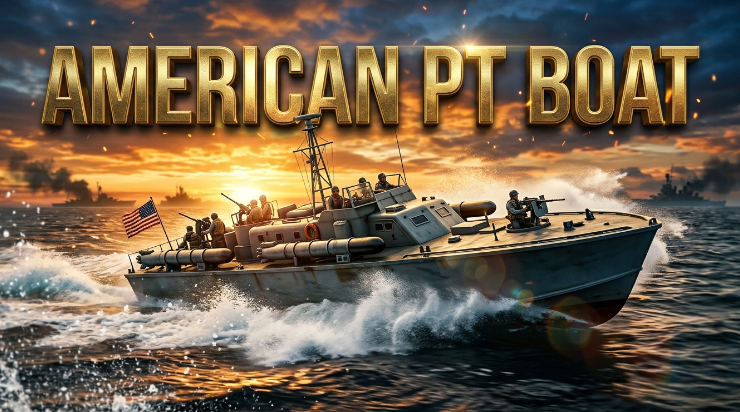
Popular wartime lore frequently called PT boats “the plywood fleet.” However, this nickname represents an enduring historical misconception. In reality, shipwrights constructed the hard-chine planing hulls from solid two-ply Honduran mahogany planks laid diagonally over white oak frames with aviation cotton saturated in marine glue sandwiched between them. Powered by three supercharged Packard 4M-2500 V-12 engines delivering 4,500 horsepower, a 56-ton combat hull planed across rolling Pacific swells at speeds exceeding 41 knots, hunting destroyers through pitch-black channels from Guadalcanal to Surigao Strait.
Elco 80-Foot Patrol Torpedo Boat Cutaway & Weapon Stations Inspector
Restoring the Mosquito Fleet in True 4K 60fps Color & Packard V-12 Audio
Original 1942–1945 Pacific combat reels recorded on hand-held 35mm Eyemo cameras suffered from violent ocean gate shudder, nitrate shrinkage, and salt-spray emulsion fading. Therefore, our restoration team stabilized each combat short frame by frame in 4K resolution at 60fps, calibrated against verified US Navy Bureau of Ships Camouflage Measure 31/20L pigment standards.
Bureau of Ships Measure 31/20L Tropical Camouflage Forensic Calibration
First, our research historians cross-referenced declassified DuPont chemical paint codes preserved in the National Archives. Consequently, our grading pipeline renders the authentic weathered hues of Tropical Green, Light Green, Ocean Green, and Dull Black, along with oxidized red-lead anti-fouling bottom paint and scorched cordite muzzle burns.
Moreover, our sound engineers recorded authentic multi-channel acoustics from surviving Packard 4M-2500 V-12 marine engines on dynamometer benches, mapping the mechanical supercharger whine and twin .50-caliber Browning M2 muzzle crack directly to archival film frames. Click any capture below to test optical plates, or launch any of the 11 restored combat reels.

WW2 Visual Archive 4K Colorized Cinema Telemetry Deck (Click Any Card to Play In-Place)
US Navy Patrol PT-Boat Fast Attack — 41-Knot Combat Velocity
Specifically, this primary 4K 60fps restoration captures Elco 80-foot hulls planing over Pacific swells, demonstrating the hard-chine modified V-bottom and acoustic wake characteristics.
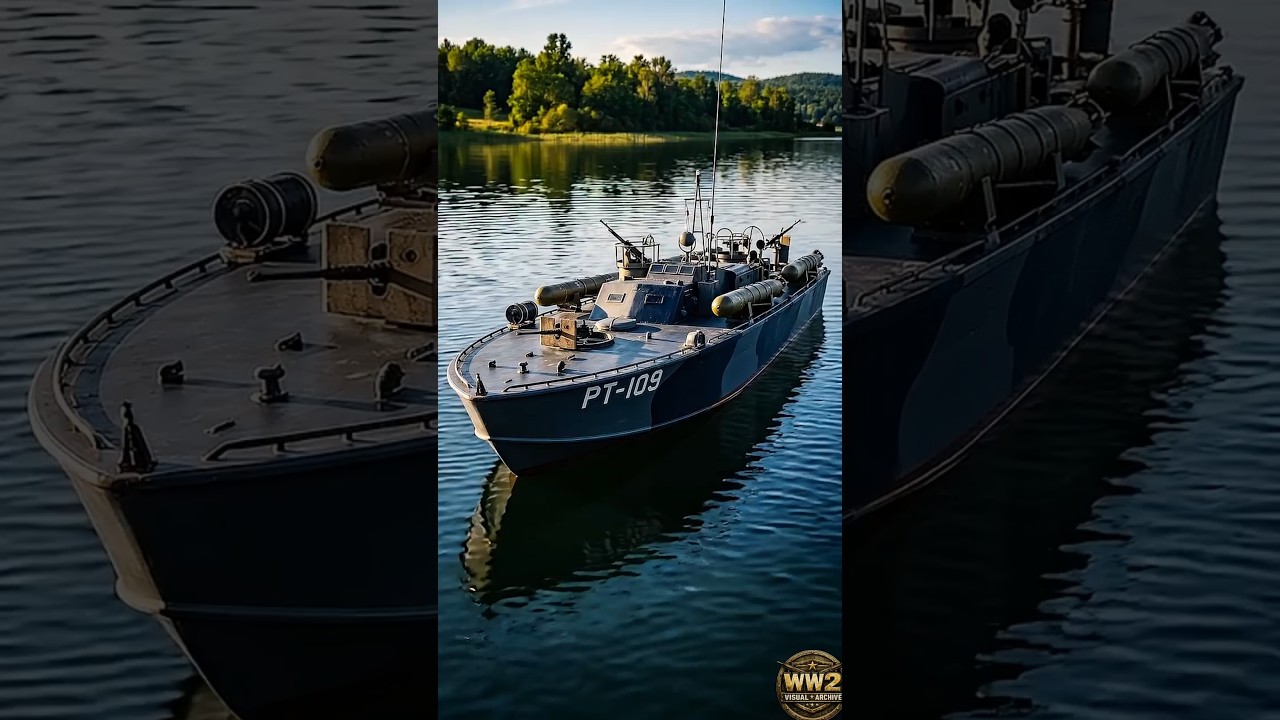
PT-109: The Legendary Solomons Combatant & Blackett Strait Collision
Furthermore, this historical analysis examines Lieutenant John F. Kennedy’s Elco 80-footer in Blackett Strait, the night collision with destroyer Amagiri, and the dramatic Olasana coconut rescue.

Elco 80′ Live Torpedo Practice Launch Sequence
Watch dual torpedo practice launches demonstrating release dynamics and wake dispersion.

Schnellboot Type S-100 — German E-Boat Competitor
Tactical analysis of the armored Kalotte bridge, Mercedes diesel engines, and enclosed tubes.

Twin .50 M2 Browning Close-In Defense Telemetry
Close telemetry of the Dewey 360-degree rotating ring mount laying down 1,600 rounds/min.
Additional Restored Operational Combat Reels (Click Any Card to Launch In-Place)

PT-196 Shark Mouth Livery
Squadron 40 aggressive shark nose art deployed in the Med and Pacific.

PT-810 High-Speed Trials
Post-war test run highlighting advanced aluminum hull & uprated acoustics.
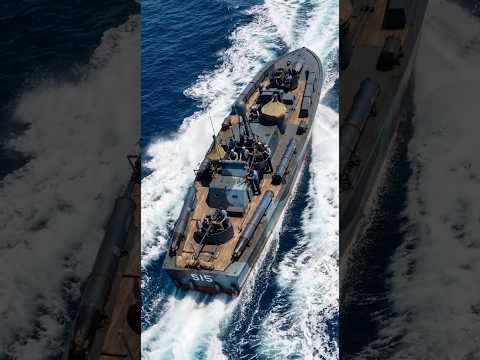
PT-515 Pamlico Sound Sortie
MTBRon 35 operations showing Mark 8 torpedo tubes and deck layout.

Massed Mosquito Fleet on Ramp
Rare archival pan across dozens of PT boats staging for Pacific action.

PT-105 Fast Attack Craft
Cutting through chop carrying four Mark 8 torpedo tubes in convoy interdiction.

PT-109 Night Striker Profile
Nocturnal engagement against the Tokyo Express in New Georgia waters.
Genesis of the Mosquito Fleet: The 1938 Naval Expansion & Plywood Derby
During the late 1930s, American naval planners realized that massive battleships could not protect shallow archipelagos alone. Consequently, the United States Navy initiated a competitive design contest to produce fast, expendable motor torpedo boats. Chief of Naval Operations William D. Leahy pushed for aggressive coastal defense vessels that could ambush capital ships in restricted waters. Therefore, the Navy Department issued experimental contracts to several private boatbuilders.
Henry Sutphen’s British PT-9 Acquisition and Hull Redesign
Meanwhile, European navies had already deployed formidable motor torpedo craft across the North Sea and English Channel. In particular, the British Power Boat Company developed lightweight hulls that captured American attention. Henry R. Sutphen, the astute executive vice president of the Electric Launch Company (Elco), traveled directly to England in 1939. Sutphen purchased a 70-foot British motor torpedo boat designed by George Selman and shipped it back to Bayonne, New Jersey.
Subsequently, Elco engineers thoroughly evaluated this British craft, designated PT-9, during grueling offshore trials. American naval architects recognized its exceptional handling, yet they immediately discovered several structural shortcomings in heavy Atlantic swells. As a result, Elco redesigned the hull framework, strengthening the longitudinal stringers to absorb bone-jarring ocean impacts. This decisive cross-Atlantic acquisition accelerated American torpedo boat production by at least two crucial years.
The Plywood Myth: Honduran Mahogany and Marine Joinery
Popular wartime lore frequently called PT boats ‘the plywood fleet.’ However, this famous nickname represents an enduring historical misconception. In reality, Elco and Higgins constructed their hulls from solid two-ply Honduran mahogany planks rather than common plywood sheets. Expert shipwrights laid these double plankings diagonally across white oak frames at opposing 45-degree angles. Furthermore, craftsmen sandwiched a layer of aviation-grade cotton fabric saturated with marine glue between the inner and outer mahogany planks.
Consequently, this layered composite construction yielded astonishing tensile strength and flexibility in pounding seas. While ordinary steel hulls cracked or buckled under severe hydrostatic shockwaves, the double-mahogany skin flexed and absorbed explosive concussions without catastrophic failure. In addition, shipwrights fastened the hull assembly together using more than two hundred thousand bronze screws and copper rivets.
The July 1941 Plywood Derby: Elco Versus Higgins & Huckins
To determine the ultimate production contract, the Navy staged a legendary offshore trial in July 1941. Naval personnel christened this grueling competition the ‘Plywood Derby.’ Specifically, the Board of Inspection and Survey tested prototypes from Elco, Higgins Industries, Huckins Yacht Corporation, and the Philadelphia Navy Yard across open ocean waves off New London, Connecticut.
During the punishing offshore trials, crews ran the boats across a demanding 190-mile open-water course at maximum throttle. Elco’s 77-foot prototype achieved 44.1 knots, while Andrew Higgins’ rugged 78-foot boat proved exceptionally sea-kindly in turbulent chop. Consequently, the Navy awarded high-volume contracts to both Elco (focusing on the iconic 80-foot hull in Bayonne) and Higgins (building the 78-footer in New Orleans).

The Packard 4M-2500 V-12: Supercharged Aviation Muscle & 100-Octane Fuel
Underneath the mahogany deckboards roared the mechanical soul of the American PT boat: three Packard 4M-2500 marine engines. Specifically, the Packard Motor Car Company adapted these massive liquid-cooled 12-cylinder powerplants directly from legendary aircraft engine designs. Each engine displaced a gargantuan 2,490 cubic inches (40.8 liters) and featured a centrifugal supercharger to force dense air-fuel charges into the cylinders.
From 3,600 to 4,500 Horsepower: The Triple Shaft Drivetrain
In early production variants, each Packard produced 1,200 brake horsepower, giving the boat an aggregate output of 3,600 horsepower. Later engineering revisions, designated the 4M-2500 W-14 series, boosted individual output to 1,500 horsepower, pushing total vessel propulsion to 4,500 horsepower. Consequently, these three spinning shafts drove three bronze propellers, propelling a 56-ton fully loaded combat hull across the water at speeds exceeding 41 knots.
However, maintaining three high-performance aero engines in remote jungle outposts demanded relentless technical labor. Engine room crews endured deafening noise, stifling heat, and choking oil fumes while monitoring complex gauge clusters. Furthermore, mechanics synchronized the throttles manually, adjusting mixture ratios to prevent backfires during sudden acceleration. Despite these mechanical maintenance burdens, the Packard V-12 provided unmatched power-to-weight performance throughout the conflict.
Volatility of 100-Octane Fuel and Self-Sealing Pliocel Cells
To extract maximum output from supercharged Packard engines, PT boats burned specialized 100-octane aviation gasoline. Consequently, each vessel carried approximately 3,000 gallons of high-octane fuel inside four massive tanks. In early boats, aluminum fuel tanks sat directly behind the engine room, creating a catastrophic fire hazard when enemy bullets penetrated the bilge. Therefore, naval engineers soon replaced rigid metal tanks with self-sealing rubber cells called Pliocels.
Nevertheless, 100-octane gasoline remained an intensely volatile substance in active combat theaters. For instance, a single incendiary round or electrical spark in the fuel compartment could ignite explosive vapors instantly. Moreover, fuel consumption rose drastically at high speeds, devouring up to 300 gallons per hour when skippers ran all three engines at wide-open throttle.
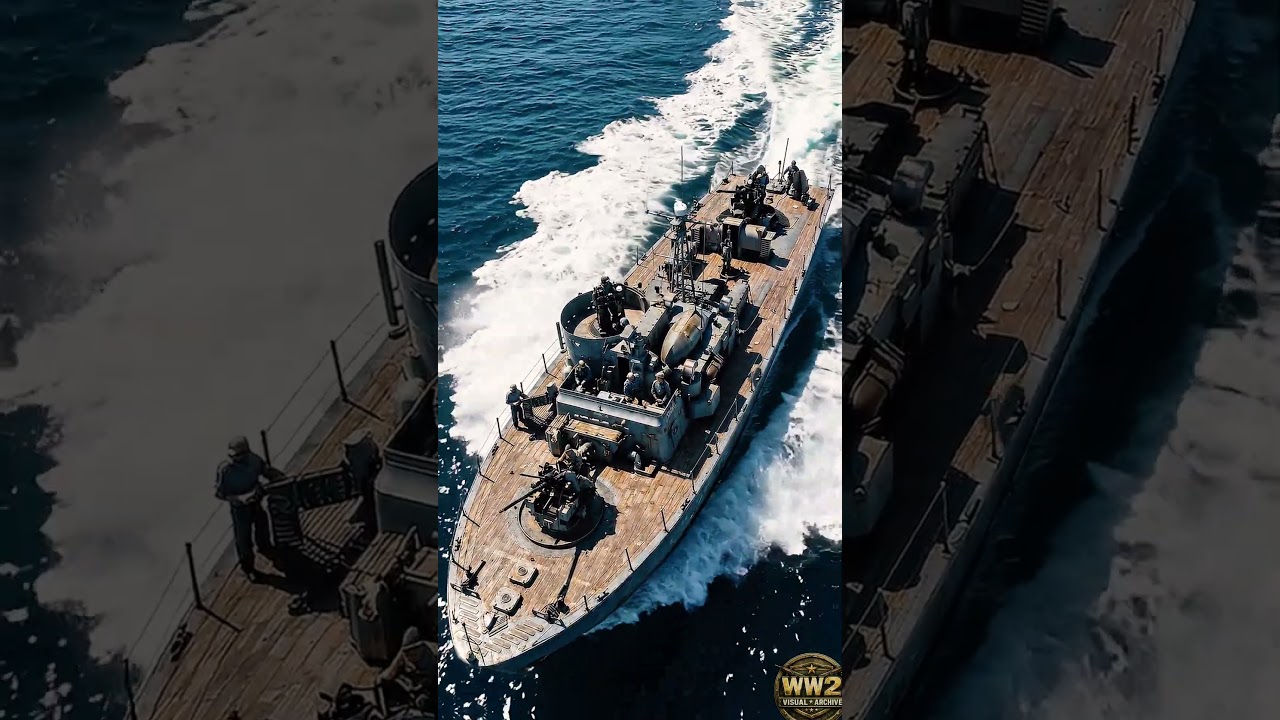
Planing Hydrodynamics and the Physical Toll of Wave Pounding
The Elco 80-foot PT boat utilized a hard-chine, modified V-bottom planing hull engineered to lift clear of the water at high speeds. When the skipper opened the throttles, the bow rose steeply before the boat planed across its dynamic hydrodynamic wake. Consequently, hydrodynamic drag dropped dramatically, allowing the vessel to skim over coastal swells rather than plowing through displacement waves.
However, slamming into choppy head seas at 35 knots inflicted terrible physical punishment upon the crew. Because the vessel possessed no shock-absorbing suspension, bone-jarring vertical impacts traveled directly through the deck timbers into the sailors’ legs and spines. Many PT boat crewmen suffered chronic back compression injuries, fractured ankles, and severe concussions during heavy-weather patrols.
Radar Ambush, Underwater Mufflers, and Phosphorescent Bioluminescence
In the pitch-black waters of the Solomon Islands, human vision proved dangerously inadequate for naval combat. Consequently, the introduction of the Raytheon SO series 3cm surface search radar in late 1942 completely transformed PT boat operations. Technicians mounted the compact radar antenna inside a protective radome perched atop the vessel’s wooden mast.
The SO Radar Revolution and PPI Cathode-Ray Scope
Inside the tiny chart house, the radar operator stared intently into a circular green Plan Position Indicator (PPI) cathode-ray tube. This revolutionary display painted glowing phosphor blips representing surrounding islands, reefs, and hostile surface contacts. Furthermore, the SO radar could detect a moving Japanese destroyer at ranges exceeding eight nautical miles in zero-visibility squalls.
As a result, PT boats gained the priceless ability to track enemy convoys while remaining completely invisible to human lookouts. Radar operators guided the skipper directly into optimal torpedo firing positions through voice conduits. Meanwhile, Japanese lookouts scanned the dark horizons with high-powered night binoculars, unaware that American radar pulses tracked their every maneuver.
Underwater Muffler Bypass Valves & Bioluminescent Ocean Wakes
Executing a successful night torpedo ambush demanded absolute acoustic and visual stealth. Therefore, Elco and Higgins engineers routed the exhaust piping through underwater muffler bypass systems located below the stern transom. When approaching an interception zone, the engineer flipped heavy bronze butterfly valves, diverting roaring exhaust gases through perforated cooling tubes beneath the waterline.
Consequently, the ear-splitting roar of three 1,500-horsepower Packard engines dropped to a muted, rhythmic gurgling sound that vanished across quiet water. Skippers frequently cut two engines entirely, creeping through narrow reef passages on a single engine running at minimal idle rpm. However, tropical seawater created a persistent visual hazard: bioluminescent dinoflagellates. When the boat’s propellers churned through plankton-rich seas, mechanical agitation triggered brilliant blue-green luminescence, creating glowing white highways visible to enemy night reconnaissance planes.
Chemical Smoke Screens and High-Speed Evasive Zigzags
The instant a PT boat launched its torpedo spread, stealth evaporated into violent chaos. Japanese destroyers illuminated the waters with blinding searchlights and opened fire with secondary batteries. To survive this retaliatory barrage, American skippers executed rapid evasive maneuvers at maximum throttle while laying dense chemical smoke screens.
To create artificial fog, boats carried chemical smoke generators mounted on the stern deck spraying chlorosulfonic acid or titanium tetrachloride into hot exhaust gases. A billowing white fog bank spread rapidly across the water, blinding optical rangefinders and searchlight crews while the helmsman threw the wheel into violent zigzags, escaping into shallow coral reefs where deep-draft destroyers could not follow.

Tactical Ordnance, Throttle & Ambush Telemetry Lab
Configure your PT boat weapon payload, engine throttle speed profile, and combat target below. The tactical computer calculates velocity, explosive yield, effective combat range, armor perforation, and declassified battle damage assessment.
Computed Combat Telemetry & Ballistic Solution
Declassified MTBRon Combat Log: Guadalcanal to Surigao Strait
Click any of the eight documented fleet actions below to inspect the date, squadron, combatants, weapon telemetry, and declassified battle damage assessment from historical US Navy action reports.
Ironbottom Sound Night Intercept & Guadalcanal Supply Denial
Operating from a primitive advance base at Tulagi, young PT boat officers embarked on nightly patrols through the slot to sever nocturnal Japanese destroyer supply runs to Guadalcanal.
All Major WWII Motor Torpedo Boats Compared: Axis & Allied Fast Attack Craft
Compare the American Elco 80′ and Higgins 78′ PT boats directly against their chief wartime competitors and adversaries: Germany’s armored Schnellboot S-100, Britain’s Fairmile D and Vosper, Japan’s Type Otsu, Italy’s MAS 500, and the Soviet G-5.
US Navy Elco 80-Foot Patrol Torpedo Boat
The iconic American Mosquito Fleet strike hull: double-diagonal Honduran mahogany planking, three supercharged Packard V-12s, 4x Mark 13 Torpex torpedoes, and Raytheon SO radar.
Play “PT-Boat Combat Command: Ironbottom Night Raid”
Take command of an Elco 80′ PT boat in the pitch-black waters of Ironbottom Sound. Steer through tropical squalls, launch Mark 13 Torpex torpedoes into Japanese destroyers, shred armored Daihatsu barges with twin .50-calibers, and deploy dense chemical smoke screens when trapped in enemy searchlights!
MTB Squadron Tactical Qualification Quiz
Test your knowledge on American PT boat engineering, armament modifications, the PT-109 incident, and Surigao Strait fleet tactics.
Explore Connected Capital Warships, Flak & Ordnance Dossiers
Discover our comprehensive interactive archives covering capital warships, super-heavy artillery, seismic ordnance, and naval anti-aircraft weapons.
German Battleship Bismarck
Detailed operational breakdown of the legendary 50,000-ton dreadnought, her Rheinübung sortie, and torpedo steering damage.
HMS Hood Battlecruiser
Comprehensive architectural study of the Mighty Hood, Denmark Strait engagement, and catastrophic magazine explosion.
Battleship Yamato 4K Restoration
4K multi-spectral restoration of the world’s largest 72,800-ton battleship, featuring 46cm main batteries and Operation Ten-Go.
USS Iowa-Class Fast Battleships
Engineering analysis of the 33-knot Iowa class, 16-inch Mark 7 guns, advanced radar fire control, and Pacific carrier escorts.
German U-Boats of WWII
Technical dossier covering Type VII and Type IX submarine fleets, Atlantic wolfpack doctrine, and acoustic homing torpedoes.
Bofors 40mm Anti-Aircraft Gun
The gold-standard naval AA weapon: detailed breakdown of the 40mm single and quad mounts that protected PT boats and fleet carriers.
German 15mm Drilling Triple MG
Technical analysis of the high-rate triple 15mm MG 151/15 mount deployed on German light surface vessels and armored halftracks.
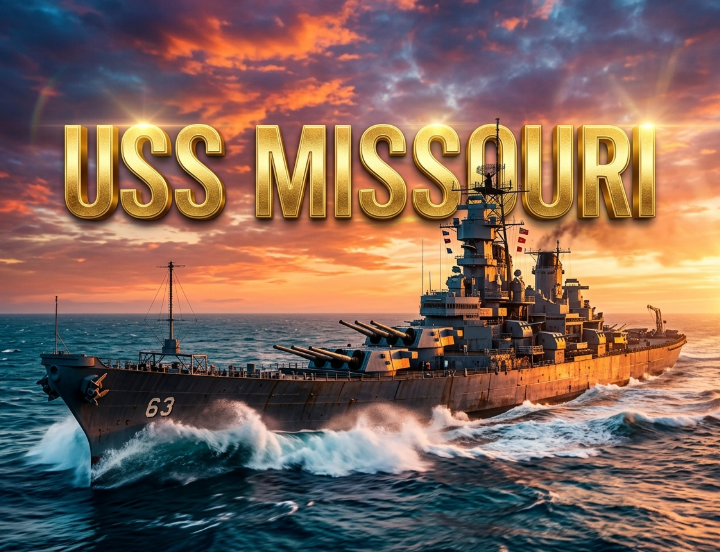
USS Missouri (BB-63) Battleship
The historical legacy of Mighty Mo: Tokyo Bay surrender ceremonies, Pacific shore bombardments, and armor defense systems.
Tallboy 12,000 lb Seismic Bomb
Barnes Wallis’ revolutionary deep-penetration seismic bomb that capsized the German battleship Tirpitz in Norwegian fjords.
Schwerer Gustav 80cm Railway Gun
The largest rifled artillery weapon ever built: 80cm siege gun employed at the Siege of Sevastopol, firing 7-ton concrete-piercing shells.
Japanese Imperial Naval AA Guns
Comprehensive dossier on the 25mm Type 96 autocannon, doctrine limitations, vibration issues, and late-war fleet defense.
German Flak Artillery Systems
From 2cm Flak 38 to 12.8cm Flakzwilling and Berlin Flaktürme: complete technical telemetry and radar fire-control analysis.
IJN I-400 Submarine Aircraft Carrier
The giant Sen-Toku submarines carrying three folding-wing M6A1 Seiran attack floatplanes engineered to strike the Panama Canal.
Primary Archival Resources & Declassified Naval Records
Every technical dimension, engine telemetry parameter, and tactical engagement cited within this dossier has been verified against declassified wartime documentation.
Record Group 19 (Records of the Bureau of Ships): Elco 80′ General Arrangement Blueprints and Higgins 78′ Hull Scantling Tables. Record Group 38 (Chief of Naval Operations): MTBRon Pacific Action Reports.
02 — Naval History and Heritage Command (NHHC)Official War Diaries: Motor Torpedo Boat Squadrons 2, 3, 5, 10, and 22. Battle of Surigao Strait Action Reports, Task Group 70.1 Tactical Telemetry Records (October 1944).
03 — Bureau of Ordnance Technical ManualsOP 1046: 21-inch Torpedoes Mark 8 and Mark 14 Maintenance & Firing Procedures; OP 950: Mark 13 Aircraft Torpedo Roll-Off Rack Assemblies; NAVPERS 10830: Motor Torpedo Boat Gunner’s Handbook.
04 — Museum & Maritime Preservation RecordsPT Boat Museum & Archives at Battleship Cove (Fall River, MA): Restoration Logs for PT-617 (Elco 80′) and PT-796 (Higgins 78′). National WWII Museum (New Orleans, LA): PT-305 Seaworthy Restoration Records.
05 — Standard Naval & Squadron HistoriographyRobert J. Bulkley Jr., At Close Quarters: PT Boats in the United States Navy (Naval History Division); Frank D. Johnson, United States PT Boats of World War II in Action (Blanford Press); Curtis L. Nelson, Hunters in the Shallows (Brassey’s).
06 — Pacific War & Surigao Strait Operations ScholarshipSamuel Eliot Morison, History of United States Naval Operations in World War II (Vols. V, XII); Anthony P. Tully, Battle of Surigao Strait (Indiana University Press); Robert J. Donovan, PT 109: John F. Kennedy in WWII.