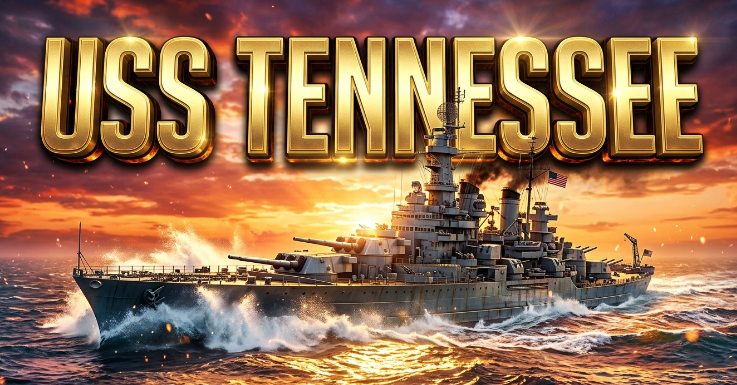
USS Tennessee (BB-43): How a Burned Pearl Harbor Veteran Rebuilt Into a Night-Fighting Titan
Commissioned in June 1920, USS Tennessee (BB-43) pioneered turbo-electric propulsion and heavy underwater protection for the United States Navy. On 7 December 1941, Japanese bombers trapped her along Battleship Row at Pearl Harbor, scorching her stern in burning oil from USS Arizona. However, engineers refused to retire the rugged dreadnought.
Instead, Puget Sound Navy Yard completely transformed her into a 114-foot-wide coastal fortress armed with sixteen 5-inch/38 dual-purpose guns and modern Mark 8 radar. Consequently, she spearheaded Admiral Jesse Oldendorf’s battle line at Surigao Strait in October 1944, helping win the last battleship-versus-battleship duel in history.

Watch USS Tennessee (BB-43) in 4K Restored Action
To keep page speed fast and Total Blocking Time near zero, every video card loads a crisp high-resolution preview first. Tap any card below to stream our 4K 60fps colorized restoration directly inside the dossier.
 FEATURED REEL 01 // 4K 60FPS
TAP TO STREAM 4K MASTER
USS Tennessee (BB-43) — From Battleship Row to Pacific Titan
Experience 12 fourteen-inch guns firing in full 4K 60fps color, highlighting her massive 1943 Puget Sound bridge tower and Measure 22 Pacific paint.
 REEL 02 // PEARL HARBOR
Trapped on Battleship Row — 7 December 1941
See how Tennessee survived two bomb hits and blazing oil fires alongside West Virginia.
 REEL 03 // 1943 REBUILD
The 114-Foot Widening — Puget Sound Rebirth
Explore the new torpedo blisters, 5-inch/38 twin turrets, and armored citadel superstructure.
 REEL 04 // SURIGAO STRAIT
Crossing the “T” — Surigao Strait 1944
Watch radar-guided 14-inch salvos smash Admiral Nishimura’s fleet in total darkness.
 REEL 05 // IWO & OKINAWA
Iwo Jima, Kamikazes & Ten Battle Stars
Witness BB-43 pounding Mount Suribachi and enduring fierce kamikaze raids off Okinawa.
Restoring BB-43 From 1921 Cage Masts to 1945 Measure 22 Color
Archival 16mm and 35mm Navy films of USS Tennessee span a remarkable quarter-century of naval transformation. Therefore, our restoration pipeline de-flickers nitrate reels, interpolates motion to 60 frames per second, and grades hull tones to match authentic Navy Bureau of Ships paint specifications.
Specifically, we calibrate pre-war Light Gray (#5) decks, Pearl Harbor fuel-smoke patina, and 1943 Measure 22 Navy Blue gradients. Use the plate selector opposite to compare our 4K colorized captures against raw wartime negatives.
From Brooklyn’s Slipway to the Flames of Battleship Row
Authorized by Congress on 3 March 1915, USS Tennessee (BB-43) and her sister ship California represented the culmination of America’s “Standard-type” battleship philosophy. Rather than chasing high top speed, Navy planners demanded a uniform 21-knot battle line capable of absorbing punishment and fighting cohesively across the vast Pacific Ocean. Consequently, New York Navy Yard laid Tennessee‘s keel on 14 May 1917, launched her on 30 April 1919, and commissioned her on 3 June 1920.
Moving Secondary Guns Out of Wet Hull Casemates
Originally, U.S. Navy blueprints planned to mount twenty-two 5-inch/51 caliber secondary guns along Tennessee‘s sides. However, British and American experiences in rough North Sea swells during World War I proved that low hull casemates flooded constantly in heavy weather. Consequently, naval architects plated over the lower hull openings and clustered fourteen 5-inch/51 guns higher on the superstructure deck. Meanwhile, designers equipped the ship with two submerged 21-inch torpedo tubes, though wartime commanders eventually removed those tubes during later refits.
All-or-Nothing Citadel Armor and Multi-Layer Torpedo Defense
Furthermore, Tennessee perfected the U.S. Navy’s “all-or-nothing” armor scheme, concentrating thick Krupp cemented steel strictly around vital magazines, turrets, and propulsion spaces. Specifically, her main armored belt measured 13.5 inches thick along the waterline, tapering to 8 inches at its lower edge, while her main battery turret faces boasted 18 inches of solid steel. Additionally, engineers surrounded her hull core with a deep five-compartment torpedo defense system alternating liquid-filled fuel tanks and empty void spaces to absorb underwater explosions.
Turbo-Electric Propulsion and Post-Jutland Gun Elevation
Unlike earlier steam-turbine warships, Tennessee introduced Westinghouse turbo-electric drive to capital-ship design. Specifically, eight oil-fired Babcock & Wilcox boilers spun two massive steam-driven electric generators, which then powered four separate electric motors turning her propellers. Because this arrangement allowed engineers to isolate machinery inside dozens of small watertight compartments, Tennessee gained exceptional resistance against underwater torpedo flooding. Moreover, lessons from the 1916 Battle of Jutland prompted designers to modify her four triple 14-inch/50 caliber turrets during construction so every barrel could elevate independently up to 30 degrees for long-range plunging fire.
Interwar Pacific Fleet Problems and the Move to Oahu
Throughout the 1920s and 1930s, Tennessee served as a cornerstone of the U.S. Battle Fleet based in San Pedro, California. Notably, her gunnery and engineering crews repeatedly won the Navy’s coveted Battle Efficiency Pennant during annual Fleet Problems across the Caribbean and Central Pacific. When President Franklin D. Roosevelt ordered the fleet forward to Hawaii in 1940 as a deterrent against Japanese expansion, Tennessee shifted her homeport to Pearl Harbor. Unfortunately, crowded moorings inside the harbor soon placed America’s battle line in grave danger.
Trapped Inboard of USS West Virginia on 7 December 1941
When Japanese carrier aircraft struck Pearl Harbor at 07:55 on Sunday morning, 7 December 1941, Tennessee lay moored inboard along Ford Island beside USS West Virginia (BB-48) and astern of USS Maryland (BB-46). Although West Virginia absorbed seven torpedo hits that shielded Tennessee‘s hull from underwater blasts, Japanese high-altitude bombers targeted the inner berth directly. Soon after, two armor-piercing bombs slammed into Tennessee‘s main battery turrets. One bomb disabled the center gun of Turret 2 and killed five sailors, while a second penetrated Turret 3’s thick roof plate without detonating fully.
Nevertheless, a far deadlier threat surrounded the battleship within minutes. As West Virginia sank onto the harbor floor and USS Arizona exploded astern, rivers of burning fuel oil engulfed Tennessee‘s stern quarters. Simultaneously, West Virginia‘s listing hull pinned Tennessee tightly against the concrete mooring quays along Ford Island. For ten grueling days, salvage crews fought raging fires while Captain Charles E. Reordan directed damage-control teams to cool warped hull plates and prevent magazine explosions. Meanwhile, burning oil scorched the battleship’s quarterdeck and buckled aft hull frames where West Virginia‘s listing superstructure pressed inward. Finally, on 16 December 1941, Navy divers blasted away the concrete mooring quays with dynamite so powerful harbor tugs could pull BB-43 free.

A Temporary Patch and a Bold Strategic Decision
After escaping Pearl Harbor, Tennessee steamed to Puget Sound Navy Yard for emergency hull patches in early 1942. However, Navy strategists soon realized that mounting rapid-fire anti-aircraft defenses and modern radar onto old 1920 lattice masts would fall short in Pacific carrier warfare.
Therefore, following brief patrol duties off San Francisco in mid-1942, Tennessee returned to Puget Sound in August 1942 for one of the most radical warship reconstructions in naval history—emerging in May 1943 almost unrecognizable to her original builders.
Compare BB-43: 1920 Lattice-Mast Dreadnought vs. 1943 Super-Dreadnought
Switch between USS Tennessee‘s original 1920 configuration and her 1943 Puget Sound rebuild—or inspect her individual radar, armor, and turret upgrades—to see how engineers turned a Pearl Harbor survivor into a modern Pacific powerhouse.
Crossing the “T” at Surigao Strait: The Last Battleship Duel in History
Emerging from Puget Sound in May 1943 with massive 114-foot torpedo blisters, Tennessee could no longer fit through the Panama Canal—yet she had become virtually unstoppable against coastal forts and night surface raiders. Immediately, she sailed north to bombard Kiska in the Aleutians in August 1943, then steamed south to join the Central Pacific offensive at Tarawa in November 1943. Throughout early 1944, her twelve 14-inch rifles hammered Kwajalein, Eniwetok, New Ireland, Saipan, Tinian, Guam, and Peleliu.
Inside the Radical 1943 Puget Sound Transformation
Before returning to combat, Tennessee underwent an extraordinary eight-month transformation at Puget Sound Naval Shipyard between August 1942 and May 1943. Specifically, shipyard workers torched off her twin lattice cage masts, single-purpose 5-inch/51 casemate guns, and crowded conning bridge. Next, they welded massive anti-torpedo blisters onto both flanks, widening her beam from 97 feet 5 inches to 114 feet and boosting full-load displacement to 40,350 long tons. Furthermore, engineers installed an armored tower bridge, sixteen 5-inch/38 dual-purpose guns in eight twin turrets, forty 40mm Bofors autocannons, and Mark 8 microwave fire-control radar.
From Aleutian Fog at Kiska to the Coral Reefs of Tarawa
Thus reborn, Tennessee steamed north in August 1943 to shell Japanese positions on Kiska Island amid dense Aleutian fog. Soon after, she joined the Central Pacific amphibious campaign at Tarawa in November 1943, blasting reinforced coconut-log bunkers at point-blank range so Marines could storm Betio’s beaches. During January and February 1944, her 14-inch guns hammered Kwajalein and Eniwetok before she conducted a diversionary bombardment of Kavieng on New Ireland in March 1944 to mask Allied landings on Emirau.
Taking Shore Battery Hits at Saipan and Preparing for Leyte
Closing near the beaches to support Marine landings demanded immense courage from old-line battleship crews. On 14 June 1944 off Saipan, hidden Japanese coastal artillery scored three direct hits on Tennessee, killing eight sailors and damaging a 5-inch mount. Nevertheless, repair crews patched the steel plates at sea, and she continued firing thousands of shells into enemy bunkers. Meanwhile, faster battleships like USS Iowa (BB-61) and USS Missouri (BB-63) escorted fast carriers, leaving the rebuilt Pearl Harbor veterans to form Task Group 77.2’s bombardment line.
03:51 AM, 25 October 1944: Radar Victory in Surigao Strait
History’s defining moment for Tennessee arrived in the pitch-black waters of Surigao Strait during the Battle of Leyte Gulf. Serving as flagship for Rear Admiral Jesse B. Oldendorf alongside five fellow Pearl Harbor veterans—West Virginia, California, Maryland, Mississippi, and Pennsylvania—Tennessee formed an impenetrable six-mile horizontal battle line across the northern mouth of the strait. Below them, Vice Admiral Shoji Nishimura’s Southern Force steamed straight into the trap with the battleships Yamashiro and Fuso.
After American PT boats and destroyers crippled Fuso with torpedoes, Oldendorf’s battleships waited in silent ambush. At 03:51 on 25 October 1944, guided by Mark 8 microwave fire-control radar at 20,000 yards, West Virginia and Tennessee opened fire in classic “crossing the T” formation. Over the next twenty minutes, Tennessee fired 69 fourteen-inch armor-piercing shells into Yamashiro, helping sink the Japanese flagship and winning the final battleship-versus-battleship surface engagement in world history.
Why Radar-Guided Crossing the “T” Ended the Battleship Era
Tactically, the Battle of Surigao Strait showcased how modern electronics transformed World War I-era dreadnoughts into deadly night fighters. While Admiral Nishimura’s crews relied on optical rangefinders and star shells in the pitch-black channel, Tennessee‘s Mark 8 radar operators tracked every Japanese silhouette from 20,000 yards away. Consequently, American 14-inch and 16-inch salvos straddled Yamashiro within minutes of opening fire, proving that radar-directed fire control had permanently eclipsed daylight visual gunnery.
Iwo Jima, Kamikaze Survival at Okinawa, and Postwar Farewell
Victory at Leyte Gulf did not end Tennessee‘s war. In February 1945, she steamed within 3,000 yards of Iwo Jima’s volcanic beaches to blast pillboxes guarding Mount Suribachi. Next, off Okinawa in April 1945, her gunners fought off relentless kamikaze waves, aided by dense curtains of 40mm Bofors anti-aircraft fire that outmatched Japanese shipboard anti-aircraft guns. Even when a suicide bomber crashed into her signal bridge on 12 April 1945—killing 25 sailors and wounding 104—crews extinguished the fires and kept BB-43 on the firing line for months. At 14:50 on 12 April 1945 off Okinawa, an Aichi D3A “Val” dive bomber evaded heavy flak and slammed directly into Tennessee‘s signal bridge, scattering burning aviation fuel across her 20mm gun galleries. Tragically, the kamikaze strike killed 25 crewmen and wounded 104 others, yet damage-control parties doused the flames within minutes. Rather than retreating for repairs, Tennessee buried her fallen sailors at sea and remained on the firing line off Okinawa for weeks. After Japan’s surrender, she covered occupation landings at Wakayama, sailed home via Singapore and the Cape of Good Hope because her 114-foot beam could no longer transit the Panama Canal, and earned ten battle stars before her 1959 scrapping.
Pounding the Volcanic Shores of Iwo Jima (19 February 1945)
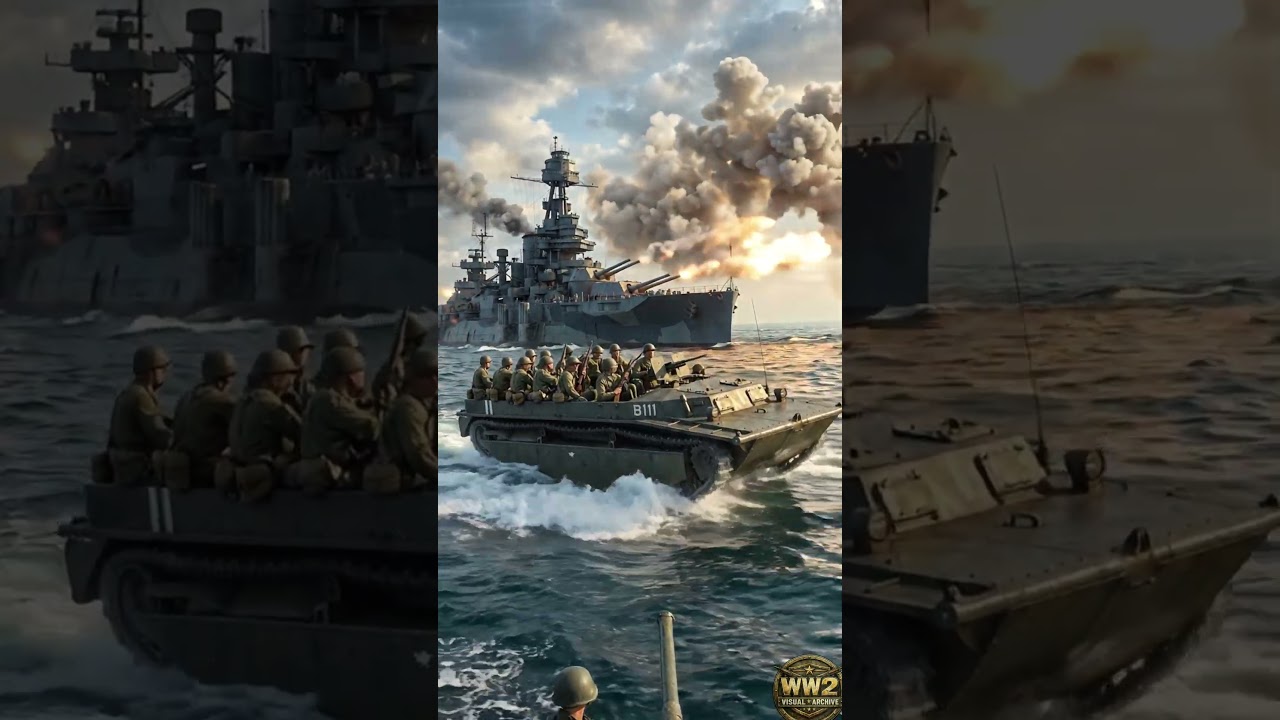
On D-Day at Iwo Jima, Tennessee moved remarkably close to the black-sand landing beaches while LVTs and landing craft churned past her widened hull. Her sixteen 5-inch/38 dual-purpose guns and twelve 14-inch rifles delivered pinpoint fire against fortified Japanese caves that had survived days of aerial bombing.
Across her 1943–1945 Pacific campaigns, Tennessee expended tens of thousands of heavy projectiles, proving that America’s resurrected “Old Ironclads” remained indispensable amphibious siege engines right alongside modern super-battleships like Yamato.

Compare USS Tennessee Against Her Pearl Harbor Sisters & Axis Rivals
Filter by fleet or sort by tonnage, gun caliber, speed, or belt armor to compare USS Tennessee (BB-43) against the warships she fought beside—and against—across the Pacific.
USS Tennessee (BB-43) — Rebuilt 1943
Heavily rebuilt at Puget Sound in 1942–1943, Tennessee combined twelve 14-inch/50 rifles with sixteen 5-inch/38 twin turrets, 114-foot torpedo blisters, and Mark 8 radar.
Explore 13 Connected Warships, Superguns & Air Defense Dossiers
Continue exploring our 4K colorized historical archive. Each interactive dossier below connects directly to the battleships, submarines, and artillery systems that defined World War II.

German Battleship Bismarck
Inspect the 38cm SK C/34 turrets, Wotan armor belt, and May 1941 Atlantic breakout of Germany’s premier capital ship.

HMS Hood — Pride of the Royal Navy
Analyze the 15-inch Denmark Strait duel and why interwar deck armor vulnerabilities proved fatal against plunging fire.

Battleship Yamato — 4K Restoration
Compare USS Tennessee’s 14-inch rifles against Yamato’s 72,800-ton hull and record-breaking 46cm naval guns.

USS Iowa-Class Fast Battleships
Explore the 33-knot fast battleships armed with 16-inch/50 Mark 7 guns and Ford Mark 1A fire-control computers.

USS Missouri (BB-63) — Mighty Mo
Follow the Iowa-class battleship that hosted the 2 September 1945 Japanese surrender ceremony in Tokyo Bay.

German U-Boats of World War II
Examine the wolfpack submarine war in the North Atlantic and the bunker pens targeted by Allied bombers.

Bofors 40mm Anti-Aircraft Gun
Discover the rapid-fire quad 40mm mount that protected USS Tennessee against kamikaze waves off Okinawa.

Japanese Anti-Aircraft Guns of WWII
Contrast Imperial Japanese 25mm Type 96 and 127mm AA mounts against the U.S. Navy’s radar-directed VT-fuzed shield.

German Flak Guns — 88mm & 128mm
Study the lethal high-altitude Flak batteries that defended German cities, coastal fortresses, and railway spurs.

Schwerer Gustav 80cm Railway Gun
Compare naval 14-inch broadsides against the 1,350-ton Krupp railway cannon that fired 7.1-ton shells at Sevastopol.

Tallboy 12,000-lb Seismic Bomb
See how Barnes Wallis’s supersonic earthquake bomb sank the German battleship Tirpitz and cracked fortified bunkers.

I-400 Submarine Aircraft Carrier
Explore Japan’s 400-foot underwater aircraft carrier built to launch Seiran bombers against the Panama Canal locks.

German M30 Drilling Triple-Barrel Gun
Inspect the precision Sauer & Sohn three-barrel combination rifle issued to Luftwaffe reconnaissance crews.
Primary Archival Resources & Reference Bibliography
Official U.S. Navy Bureau of Ships blueprints, action reports, and public domain photographic collections verify every specification, battle star, and combat date in this dossier.
Official wartime deck logs, Pearl Harbor damage reports, and Surigao Strait action summaries for USS Tennessee (BB-43) are preserved in the Dictionary of American Naval Fighting Ships (DANFS).
02 — Puget Sound Naval Shipyard & Bureau of Ships RecordsTechnical documentation covering BB-43’s 1942–1943 torpedo-blister widening, 5-inch/38 twin mounts, and Westinghouse turbo-electric drive is archived by the U.S. National Archives (NARA).
03 — Wikimedia Commons Public Domain Photographic ArchiveVerified wartime photographs include Guantanamo Bay 1921, Puget Sound 12 May 1943 (19-N-45071), and Iwo Jima Invasion Fleet 1945.
04 — Standard Naval Architecture & Surigao Strait HistoriographyAuthoritative monographs include Norman Friedman, U.S. Battleships: An Illustrated Design History (Naval Institute Press), and Anthony P. Tully, Battle of Surigao Strait (Indiana University Press).