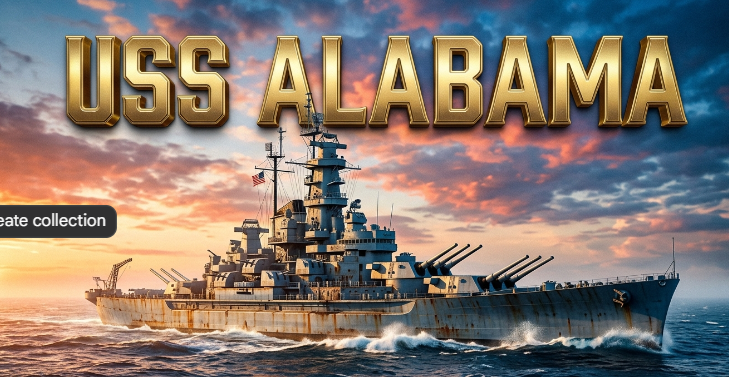
USS Alabama (BB-60): The 45,000-Ton “Mighty A” That Never Lost a Sailor to Enemy Fire
Commissioned in August 1942, USS Alabama (BB-60) stood as the fourth and final vessel of the treaty-forged South Dakota class. Engineers packed nine 16-inch guns, 12.2-inch inclined belt armor, and 130,000 shaft horsepower into a remarkably compact 680-foot hull. Consequently, “The Mighty A” fought across both the Arctic Circle and the Central Pacific without ever suffering battle damage from Japanese guns or bombs.
Moreover, her radar operators detected incoming Japanese carrier aircraft at a record 120 miles during the Battle of the Philippine Sea. Later, Alabama’s schoolchildren raised funds to rescue her from the scrapyard and tow her home to Mobile Bay. Today, she remains one of America’s best-preserved floating World War II fortresses.

Restoring “The Mighty A” in True 4K 60fps Naval Color
Surviving 1942–1945 Navy motion picture reels of USS Alabama often suffer from nitrate flicker, salt-spray haze, and washed-out monochrome contrast. Therefore, our studio stabilizes every frame at 60 frames per second and restores accurate U.S. Navy camouflage schemes—including Measure 12 (Modified) sea-blue mottling and Measure 22 Navy Blue hull grading.
Furthermore, we reconstruct spatial audio for the 2,700-pound 16-inch Mark 8 armor-piercing salvo blasts and rapid-fire quad 40mm Bofors barrages. Use the plate selector opposite to compare our 4K colorized reel captures against raw 1942 Navy negatives.

Watch USS Alabama (BB-60) in 4K Colorized Motion
Each video card below loads a crisp high-resolution thumbnail first to protect your page speed and Total Blocking Time. Simply click any preview screen to stream the full 4K restoration directly inside this dossier.
REEL 01 // MAIN BATTERY
TAP TO PLAY 4K
Mark 6 16″/45 Naval Gun — USS Alabama’s Triple Main Battery
Inspect the 18-inch armored turret faces and nine 16-inch barrels that hurled 2,700-pound Mark 8 super-heavy shells over 21 miles.
 REEL 02 // NORFOLK YARD
TAP TO PLAY 4K
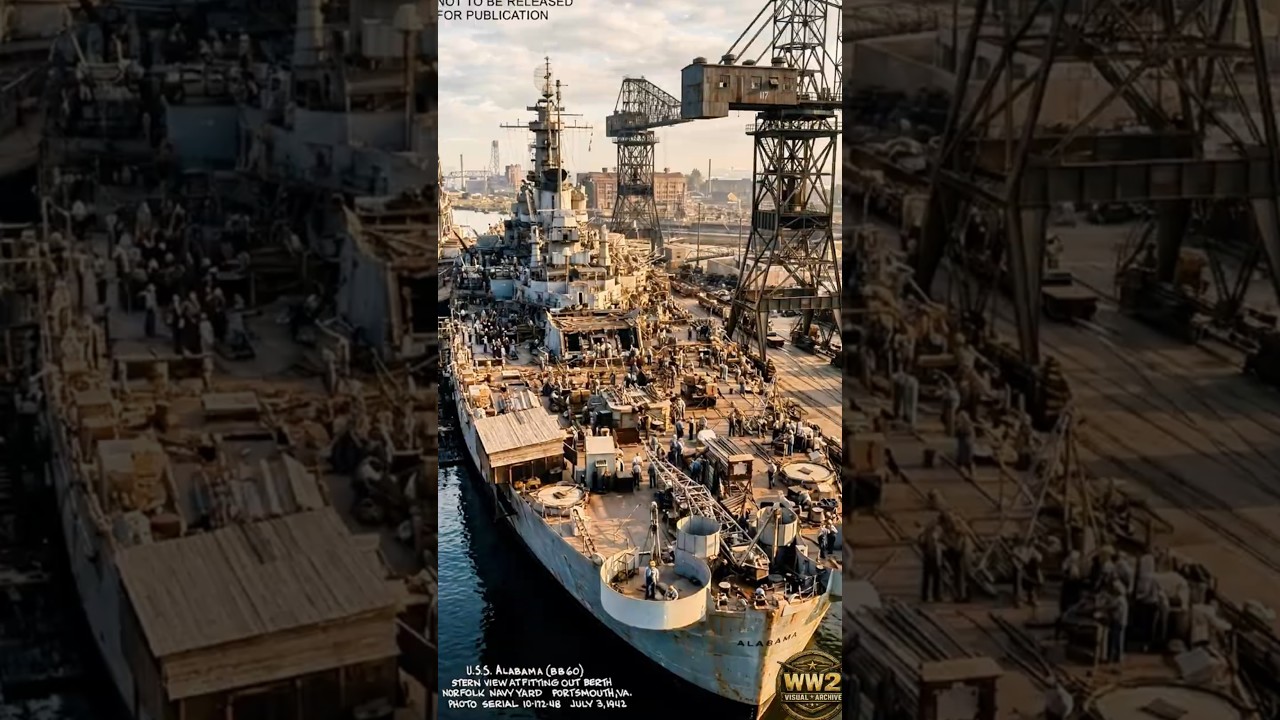
USS Alabama Under Construction — Standing Tall at Norfolk
Witness the massive steel hull rising on Slipway No. 5 at Norfolk Navy Yard before her historic February 1942 launch.
 REEL 03 // LIVING MUSEUM
The 45,000-Ton Battleship That Became a Living Museum
Explore how citizens and schoolchildren rescued BB-60 for permanent display in Mobile Bay.
 REEL 04 // COMBAT LOG
USS Alabama BB-60 — Broadside Firepower & Pacific Ops
Colorized fleet action showcasing BB-60 escorting fast carriers across the Central Pacific.
 REEL 05 // RADAR & AA
Air Defense Shield — 5-Inch/38 & Quad 40mm Bofors
See how Alabama’s layered radar and anti-aircraft batteries downed 22 enemy aircraft.
 REEL 06 // LEGACY
Inside “The Mighty A” — Deck Scale & Wartime Survival
Walk the teak decks and armored citadel that carried 2,500 sailors through Typhoon Cobra.
How Naval Engineers Crammed 16-Inch Power Into a Compact Hull
During the late 1930s, global naval treaties placed strict limits on battleship construction. Specifically, the Second London Naval Treaty capped standard displacement at 35,000 long tons while allowing 16-inch guns under an emergency “escalator clause.” Consequently, U.S. Navy architects faced a brutal engineering puzzle when designing the South Dakota class. They had to protect the vessel against its own 16-inch shells while keeping the hull short enough to save thousands of tons of steel.
Shortened Hull Geometry and the Inclined Internal Armor Belt
To solve that weight problem, Bureau of Construction and Repair engineers shortened the hull to 680 feet overall—nearly 50 feet shorter than the preceding North Carolina class. Furthermore, they tucked a 12.2-inch Class A armor belt inside the outer hull plating at a steep 19-degree angle. Because an angled plate increases the effective thickness a shell must penetrate, this internal belt defeated heavy armor-piercing rounds without adding extra tonnage. Meanwhile, four General Electric geared steam turbines produced 130,000 shaft horsepower, driving the 44,519-ton full-load ship at 27.5 knots alongside fast aircraft carriers.
Workers at the Norfolk Navy Yard in Portsmouth, Virginia, laid Alabama‘s keel on 1 February 1940. Just two months after the attack on Pearl Harbor, Mrs. Henrietta McCormick Hill christened the battleship on 16 February 1942 with Secretary of the Navy Frank Knox watching. Soon after, Captain George B. Wilson commissioned USS Alabama (BB-60) on 16 August 1942, and her crew immediately began intensive gunnery shakedown drills in Chesapeake Bay and Casco Bay, Maine.
Packing 2,500 Sailors Into a High-Density Wartime Citadel
However, cramming immense firepower into a 680-foot hull demanded real sacrifices in crew living space. Although peacetime blueprints called for 1,793 officers and enlisted sailors, wartime radar and anti-aircraft expansions swelled Alabama‘s complement to roughly 2,500 men. Consequently, naval constructors eliminated wide promenade decks and tucked berthing compartments around ammunition hoists and ventilation trunks. Yet sailors appreciated the ship’s modern air-conditioned plotting rooms, freshwater evaporators, and well-organized mess decks. Furthermore, twenty 5-inch/38 dual-purpose guns in ten twin turrets lined her waist, giving the crew rapid-firing protection against both surface destroyers and high-flying bombers.
Wartime Camouflage Evolution: Measure 12 Modified to Measure 22
Throughout her service life, Alabama wore several distinct U.S. Navy camouflage patterns to confuse enemy rangefinders and submarine periscopes. Initially, painters applied Measure 12 (Modified), combining sea-blue lower hulls with mottled ocean-gray upper surfaces during her 1942 Atlantic shakedown. Later, shipyard crews repainted the battleship in Measure 22, featuring a crisp horizontal demarcation of dark Navy Blue along the lower hull and Haze Gray across the upper superstructure. Consequently, spotters aboard enemy reconnaissance aircraft struggled to judge her true course and speed at horizon distances.
Guarding the Arctic Approaches at Scapa Flow (April–August 1943)
Before heading to the Pacific, Alabama answered an urgent British request for heavy reinforcements in the North Atlantic. Because the Royal Navy had shifted several capital ships to the Mediterranean for the Sicily invasion, the British Home Fleet needed modern firepower to contain Germany’s battleship Tirpitz and German U-boats lurking in Norwegian fjords. Therefore, Alabama and her sister ship South Dakota crossed the stormy Atlantic in April 1943 to join Task Force 61 at Scapa Flow in the Orkney Islands.
Operating alongside HMS Anson and HMS Duke of York, American gunners drilled relentlessly in freezing North Sea swells. In June 1943, the combined Allied battle squadron covered Operation Gearbox, reinforcing the vital Arctic weather garrison on Spitsbergen. Next, in July 1943, Alabama sailed toward southern Norway during Operation Governor to distract German intelligence before the Sicily landings. Although Tirpitz never sortied to challenge the Allied battleships—just as her sister Bismarck had fallen two years earlier after sinking HMS Hood—the joint deployment forged seamless Anglo-American fleet coordination.
Braving Arctic Gales and Sub-Zero Atlantic Watchkeeping
Sailing out of Casco Bay on 2 April 1943 as part of Task Force 22, Alabama battled towering North Atlantic waves before anchoring at Scapa Flow under Rear Admiral Olaf M. Hustvedt. During those spring patrols, freezing spray coated her forward 16-inch turrets and teak decks in thick sheets of ice. Nevertheless, watch crews maintained constant radar vigilance against German reconnaissance planes and surface raiders. Moreover, joint maneuvers with Royal Navy battleships taught American signalmen British flag codes and convoy screening tactics. As a result, when Allied armies stormed Sicily in July 1943, the German Kriegsmarine kept its heavy surface units pinned inside Norwegian fjords.
Joint Fleet Gunnery Practice With HMS Anson
While stationed at Scapa Flow, Alabama conducted live-fire main battery exercises under the watchful eyes of British naval observers aboard HMS Anson. Notably, the compact South Dakota hull proved remarkably steady in heavy North Atlantic swells, allowing her Mark 8 fire-control radar to track surface targets accurately even through dense Arctic fog.
On 1 August 1943, orders detached Alabama from the British Home Fleet for immediate reassignment to the Pacific Theater. After a brief overhaul at Norfolk and a tight transit through the Panama Canal on 25 August, she reached Efate in the New Hebrides on 14 September 1943 to join the fast carrier task forces.

Inspect “The Mighty A” Anatomy: Weapons, Armor & Radar
Select any of the five structural zones below to inspect USS Alabama‘s offensive firepower, internal citadel armor, microwave radar suite, anti-aircraft batteries, and 130,000-horsepower propulsion plant.
From Tarawa to Tokyo Bay: Nine Battle Stars Across the Pacific
Joining the Fifth Fleet in November 1943, USS Alabama plunged immediately into Operation Galvanic—the amphibious assault on the Gilbert Islands. On 8 December 1943, she teamed with five other fast battleships to unleash the first massed fast-battleship shore bombardment of the Pacific War. During that single strike against Japanese phosphate facilities and coastal defenses on Nauru Island, Alabama fired 535 sixteen-inch shells and helped escort the damaged destroyer USS Boyd back to safety.
Crushing Nauru, Kwajalein, and Truk Lagoon With Fast Carriers
Earlier in that campaign, on 20 November 1943, Alabama screened the carrier task groups supporting the bloody Marine landings at Tarawa and Makin. Soon after, on the night of 26 November, her anti-aircraft gunners opened fire twice to drive off Japanese torpedo planes probing the darkened formation. Entering 1944, she underwent brief dry-dock maintenance at Pearl Harbor before rejoining the fleet for the invasion of the Marshall Islands. In February 1944, her 16-inch batteries pounded Kwajalein Atoll, and she swept the waters off Truk Lagoon during Operation Hailstone to trap fleeing Japanese warships.
Additionally, in March and April 1944, Alabama escorted USS Yorktown and the veteran carrier USS Enterprise during long-range strikes on Palau, Yap, Ulithi, and Hollandia in New Guinea. On 1 May 1944, she joined five sister battleships in a thunderous surface bombardment of Japanese coastal fortifications on Pohnpei before returning to Eniwetok to prepare for the Marianas invasion.
Detecting the Japanese Raid at 120 Miles in the Philippine Sea
Throughout early 1944, Alabama shielded aircraft carriers such as USS Yorktown and USS Enterprise during strikes against Kwajalein, Truk Lagoon, Palau, and Hollandia. Then came her finest defensive hour on 19 June 1944 during the Battle of the Philippine Sea. While screening Task Force 58, radar technical officer Lieutenant Eugene S. Pennebaker and his crew spotted the first massive wave of incoming Japanese carrier aircraft on Alabama‘s SK air-search radar at an extraordinary range of 120 miles—more than half an hour before enemy planes arrived overhead.
That early warning allowed U.S. Hellcat fighters to intercept and shatter the Japanese air groups in what pilots famously dubbed the “Great Marianas Turkey Shoot.” When surviving enemy bombers broke through the fighter screen, Alabama‘s dense curtain of 5-inch/38 proximity shells and quad 40mm Bofors anti-aircraft guns knocked attackers out of the sky—outperforming even heavy Japanese shipboard anti-aircraft batteries in volume and fire-control accuracy. Notably, Baseball Hall of Fame pitcher Chief Specialist Bob Feller commanded Gun Mount 2 (a quad 40mm Bofors battery) aboard Alabama, earning multiple combat decorations as the battleship racked up 22 confirmed aircraft kills over the war.
Inside the Combat Information Center on 19 June 1944
Declassified radar logs reveal just how sharply Alabama‘s Combat Information Center tracked the battle. At 10:30 that morning, operators spotted “Bogey 1” bearing 268 degrees at 49 miles and “Bogey 2” at 59 miles, guiding friendly Hellcat fighters directly into the intercept zone. Four minutes later, her secondary fire-control director locked onto incoming raiders at 98,000 yards, prompting officers to order extra 5-inch ammunition hoisted to the ready boxes. Because of that decisive radar performance, Secretary of the Navy James Forrestal awarded Lieutenant Pennebaker the Bronze Star. Meanwhile, Alabama became flagship of Battleship Division 9 under Rear Admiral Edward Hanson during the subsequent liberation of Guam.

Surviving Typhoon Cobra and Shelling the Japanese Mainland
Following the Battle of Leyte Gulf in October 1944—where Admiral Halsey’s fast battleships raced north toward Cape Engaño before turning back—Alabama confronted a deadlier foe than the Imperial Japanese Navy. On 18 December 1944, Typhoon Cobra slammed into Third Fleet with 83-knot (96 mph) gusts, rolling the 45,000-ton battleship up to 30 degrees and smashing both of her OS2U Kingfisher floatplanes. Although three destroyers capsized in the storm, Alabama rode out the tempest with only minor superstructure damage.
After a spring 1945 overhaul at Puget Sound, she returned for the Battle of Okinawa and final strikes against Japan itself. On the night of 17–18 July 1945—with famed polar explorer Rear Admiral Richard E. Byrd aboard—Alabama bombarded industrial plants at Hitachi-Mito northeast of Tokyo, followed by coastal steelworks at Kamaishi on 9 August. When Japan surrendered, she steamed into Tokyo Bay alongside USS Missouri (BB-63) and USS Iowa (BB-61), then carried 700 Seabees home during Operation Magic Carpet.
Final Strikes on Okinawa, Kamaishi, and Tokyo Bay
Throughout May and June 1945, Alabama shielded Third Fleet carriers off Okinawa against relentless kamikaze raids before shelling Japanese positions on Minami Daito Shima on 10 June. On 9 August 1945, while bombarding Kamaishi alongside American and British cruisers, she also dispatched an emergency medical party via the destroyer USS Ault to treat wounded sailors aboard the kamikaze-struck destroyer USS Borie. Remarkably, across 1,250+ sixteen-inch shells fired in combat and 37 months of frontline service, enemy action never claimed a single life aboard Alabama; her only five wartime fatalities occurred during a tragic friendly-fire turret mishap. Finally, after anchoring in Tokyo Bay on 5 September 1945, she sailed home to San Francisco, where 9,000 cheering citizens toured her decks on Navy Day.
How USS Alabama Stacked Up Against Every Major WWII Battleship
Filter by fleet or sort by displacement, main gun caliber, belt armor, or top speed to compare USS Alabama (BB-60) directly against her American sisters and Axis and Allied rivals.
USS Alabama (BB-60) — “The Mighty A”
Designed under the 35,000-ton treaty ceiling, the South Dakota class combined 16-inch/45 Mark 6 firepower with an inclined 12.2-inch internal belt and 27.5-knot speed.
How Alabama’s Schoolchildren Rescued a 45,000-Ton Battleship From Scrap
Following her Pacific triumphs, the Navy decommissioned USS Alabama on 9 January 1947 and moored her in the Bremerton Reserve Fleet in Washington State. For fifteen years, she sat quietly in mothballs while the nuclear missile age rendered big-gun battleships obsolete. Finally, on 1 June 1962, the Navy struck her from the Naval Vessel Register and slated the proud veteran for the scrapper’s cutting torch.
Dual-Role Mastery: Carrier Bodyguard and Shore Bombardment Titan
Historians often highlight how fast battleships evolved from fleet-versus-fleet duelists into indispensable carrier escorts during the Pacific War. Specifically, Alabama proved that a compact 35,000-ton treaty design could excel at both missions simultaneously. Whenever Task Force 58 launched air strikes, her 27.5-knot speed and heavy anti-aircraft batteries formed an impenetrable steel umbrella around vulnerable flight decks. Conversely, during amphibious landings from Tarawa to Kamaishi, her nine 16-inch rifles delivered devastating pinpoint fire against hardened coastal bunkers.
Pennies From Classrooms and a 5,600-Mile Tow Home
Refusing to watch their namesake warship disappear, citizens formed the USS Alabama Battleship Commission to raise nearly $1 million for her preservation. Remarkably, Alabama schoolchildren contributed roughly $100,000 in nickels, dimes, and lunch money toward the rescue fund. Consequently, the Navy formally transferred ownership to the State of Alabama in July 1964, and tugboats towed the 680-foot hull 5,600 miles down the Pacific coast, through the Panama Canal, and into Mobile Bay on 14 September 1964.
Opened to the public as Battleship Memorial Park in January 1965 and designated a National Historic Landmark in 1986, Alabama has welcomed millions of visitors inside her 16-inch turrets, sickbay, and Bob Feller’s marked bunk. Even when Hurricane Katrina slammed Mobile Bay in August 2005 and pushed the warship into an eight-degree port list, restoration crews stabilized her hull and reopened the park by January 2006.
Surviving Hurricane Katrina and Preserving Steel Heritage
Beyond her nine battle stars, USS Alabama illustrates the pinnacle of balanced American warship engineering under severe treaty tonnage limits. While super-heavy battleships like Yamato and land monoliths like Schwerer Gustav chased sheer size, the South Dakota class prioritized radar integration, compartment survivability, and fleet speed. As a result, BB-60 sailed tens of thousands of miles across two oceans, protected Allied aircraft carriers through the fiercest air-sea battles in history, and returned home intact as an enduring monument to naval ingenuity.
During Hurricane Katrina’s peak surge in August 2005, eighteen park staff members and their families actually sheltered safely inside the battleship’s armored hull while storm winds battered Mobile Bay. Although the violent surge shifted her moorings and caused over $4 million in damage to the surrounding aviation pavilion, dedicated restoration crews pumped out flooded compartments and corrected her list. Consequently, USS Alabama reopened to visitors on 9 January 2006, standing proudly beside the submarine USS Drum (SS-228). Today, ongoing hull preservation and 4K digital archival projects ensure future generations can experience her wartime engineering firsthand.
Why USS Alabama Remains an Irreplaceable Time Capsule
Unlike her Iowa-class cousins that received 1980s cruise-missile and radar upgrades, Alabama was never modernized after 1946. Therefore, stepping aboard her decks in Mobile Bay reveals an authentic 1945 World War II fast battleship exactly as her 2,500 sailors fought her across the Pacific.
Visitors can climb into Turret II’s powder-handling rooms, inspect the 5-inch/38 twin mounts, and stand beside the quad 40mm Bofors gun where Bob Feller’s crew defended Task Force 58.

The “Mighty A” Historical & Gunnery Challenge Quiz
Ready to test what you have learned? Answer all seven questions below to earn your naval rank aboard USS Alabama (BB-60). Every answer includes instant historical verification.
Loading question…
Explore 13 Connected Warships, Superguns & Air Defense Dossiers
Continue your journey through our 4K colorized historical archive. Each interactive dossier below connects directly to the naval battleships, anti-aircraft systems, and strategic weapons that shaped World War II.

German Battleship Bismarck
Inspect the 38cm SK C/34 turrets, Wotan armor belt, and May 1941 Atlantic breakout of Germany’s premier capital ship.

HMS Hood — Pride of the Royal Navy
Analyze the 15-inch Denmark Strait duel and why interwar deck armor vulnerabilities proved fatal against plunging fire.

Battleship Yamato — 4K Restoration
Compare USS Alabama’s 16-inch Mark 6 rifles against Yamato’s 72,800-ton hull and record-breaking 46cm naval guns.

USS Iowa-Class Fast Battleships
Explore the 33-knot successors to the South Dakota class armed with 16-inch/50 Mark 7 guns and Ford Mark 1A computers.

USS Missouri (BB-63) — Mighty Mo
Follow the Iowa-class battleship that hosted the 2 September 1945 Japanese surrender ceremony in Tokyo Bay.

German U-Boats of World War II
Examine the wolfpack submarine war in the North Atlantic that USS Alabama helped counter during her 1943 Arctic escort.

Bofors 40mm Anti-Aircraft Gun
Discover the rapid-fire quad 40mm mount that Bob Feller commanded aboard USS Alabama to shred attacking enemy aircraft.

Japanese Anti-Aircraft Guns of WWII
Contrast Imperial Japanese 25mm Type 96 and 127mm AA mounts against the U.S. Navy’s radar-directed VT-fuzed shield.

German Flak Guns — 88mm & 128mm
Study the lethal high-altitude Flak batteries that defended German cities, coastal fortresses, and railway spurs.

Schwerer Gustav 80cm Railway Gun
Compare naval 16-inch broadsides against the 1,350-ton Krupp railway cannon that fired 7.1-ton shells at Sevastopol.

Tallboy 12,000-lb Seismic Bomb
See how Barnes Wallis’s supersonic earthquake bomb sank the German battleship Tirpitz and cracked fortified bunkers.

I-400 Submarine Aircraft Carrier
Explore Japan’s 400-foot underwater aircraft carrier built to launch Seiran bombers against the Panama Canal locks.

German M30 Drilling Triple-Barrel Gun
Inspect the precision Sauer & Sohn three-barrel combination rifle issued to Luftwaffe reconnaissance crews.
Primary Archival Resources & Reference Bibliography
Every specification, radar log entry, and battle star citation in this dossier comes from official U.S. Navy records, National Park Service files, and verified public domain photographic collections.
Official wartime deck logs, commissioning dates, and operational summaries for USS Alabama (BB-60) are preserved in the Dictionary of American Naval Fighting Ships (DANFS).
02 — USS ALABAMA Battleship Memorial Park (Mobile, AL)Visitor preservation records, Bob Feller’s Gun Mount 2 exhibits, and Hurricane Katrina restoration archives are maintained at ussalabama.com.
03 — Wikimedia Commons Public Domain Photographic ArchiveVerified wartime photographs include Casco Bay 1942 (80-G-K-445), Home Fleet Broadside 1943, Task Force 58.2 Pacific 1944, and Mobile Bay Memorial Park.
04 — Standard Naval Architecture & Combat MonographsAuthoritative technical histories include Norman Friedman, U.S. Battleships: An Illustrated Design History (Naval Institute Press), and William H. Garzke & Robert O. Dulin, Battleships: United States Battleships, 1935–1992.