Engineering the Supersonic Earthquake That Cracked Hitler’s Concrete Fortresses
During early 1944, conventional Allied bombs shattered harmlessly against the thick ferro-concrete roofs of Nazi submarine pens. Consequently, British aeronautical engineer Sir Barnes Wallis abandoned surface blast warfare altogether. Instead, he designed the 12,000-pound Tallboy earthquake bomb so that it would strike at supersonic speed. As a result, the weapon bored deep beneath hardened foundations and detonated underground like a localized tectonic shockwave.
High-Altitude Precision with Modified Avro Lancaster Bombers
Furthermore, only modified Avro Lancaster B1 (Special) bombers could lift this twenty-one-foot steel monolith to 18,000 feet. Therefore, elite aircrews from 617 Squadron (“The Dambusters”) and 9 Squadron flew these precision missions across occupied Europe. Between June 1944 and April 1945, the Tallboy collapsed the Saumur rail tunnel and crippled the Wizernes V-2 dome. Moreover, it pierced fortified U-boat pens and ultimately capsized the German battleship Tirpitz.
Cutaway Tallboy Blueprint & Component Inspector
Why Barnes Wallis Replaced Surface Blast with Underground Seismic Shockwaves
During the early years of World War II, RAF Bomber Command relied heavily on thin-cased “blockbuster” bombs. Specifically, the 4,000-pound High Capacity “Cookie” packed 75 percent of its weight in high explosive inside a fragile steel drum. While these thin-skinned bombs stripped factory roofs through atmospheric blast, their casings ruptured instantly against thick concrete. Therefore, when German engineers built massive submarine pens and V-weapon bunkers, conventional surface bursts merely scorched the outer concrete crust.
The 1941 Seismic Paper: Compressible Air Versus Solid Earth
Recognizing this physical limitation, British designer Sir Barnes Wallis wrote a landmark 115-page treatise in March 1941. In A Note on a Method of Attacking the Axis Powers, he proved that air acts as a highly compressible fluid. Because atmospheric blast pressure drops off rapidly with distance, a surface explosion wastes over 90 percent of its energy pushing thin air into the sky.
Conversely, wet clay, chalk, and bedrock behave as dense, nearly incompressible solids. Consequently, they transmit longitudinal P-waves and transverse S-waves with tremendous efficiency. Furthermore, Wallis calculated that a streamlined bomb could penetrate 40 to 80 feet underground before exploding. As a result, the surrounding earth heaved like a localized earthquake, and this underground shockwave transferred destructive force across a radius ten times wider than an air burst.
The Subterranean Camouflet Cavern & Crater Geometry
Additionally, Wallis harnessed a second destructive mechanism known in military mining as a camouflet. When 5,200 pounds of aluminized Torpex D1 detonated deep underground, the gas bubble reached 200,000 atmospheres of pressure. Consequently, this incandescent blast vaporized and compacted thousands of tons of subsoil. Depending on fuze depth, the explosion either carved an enclosed underground cavern or, at shallower settings, blew out a crater 100 feet wide and 80 feet deep.
Even if a 20-foot bunker roof resisted direct perforation, its underlying foundation collapsed. Subsequently, the entire fortress tilted, cracked, and sank into the void. Similarly, in railway yards, a single 100-foot Tallboy crater paralyzed repairs for weeks because bulldozers could not maneuver around its steep rim.

Seismic Penetration & Target Shockwave Simulator
First, select any historical European fortress target and compare four World War II heavy ordnance payloads below. Consequently, the ballistic computer calculates terminal impact velocity, ferro-concrete perforation, underground crater depth, and structural failure mechanics.
Computed Impact Telemetry & Subsoil Shockwave Metrics
Restoring Barnes Wallis’s Earthquake Bombs in True 4K Color
Because original 1944 Air Ministry nitrate reels suffered from heavy grain, flicker, and chemical scratches, our restoration lab reconstructs every frame in 4K resolution. Specifically, we apply optical de-flickering, scratch removal, and verified spectral color grading.
Authentic RAF Ordnance Pigments & Frame-Rate Stabilization
First, our engineers cross-referenced surviving Tallboy casings at the RAF Museum Hendon and Brooklands Museum so that every wartime pigment matched authentic Air Ministry standards. During production, Vickers-Armstrongs finished the machined steel body in dark bronze-green and olive-drab enamel. Meanwhile, a pale buff recognition band separated the warhead from the bare sheet-steel Mark 78 tail cone.
Moreover, our pipeline recovers yellow Torpex D1 stencils and red nose rings. In addition, it stabilizes 18-fps wartime reels into smooth 60-fps motion. Consequently, you can use the optical inspector opposite to compare 1944 plates with 4K color captures, or play all four vertical shorts below.

WW2 Visual Archive 4K Colorized Vertical Telemetry Reels (Click Any Reel to Play Inline)
Britain’s Tallboy Earthquake Bomb — 4K Cinematic Study

Tallboy Bunker-Breaker: Built to Shake Targets Apart

Grand Slam — Britain’s 10-Ton Earth-Shattering Giant

Tallboy Bomb — Britain’s Supersonic Precision Earthquake
Forging a Twenty-One-Foot Steel Needle That Broke the Sound Barrier
Building a bomb that could survive a 750-mph collision with 16 feet of steel-reinforced concrete required extraordinary metallurgy. Because standard cast-iron bomb casings shattered like glass under transonic impact loads, Barnes Wallis partnered with master metallurgists at the English Steel Corporation in Sheffield and Vickers-Armstrongs at Brooklands. Together, they cast each Tallboy warhead as a single, seamless cylinder of high-tensile nickel-chrome-molybdenum alloy steel.
Single-Piece Sheffield Alloy Casting and Uncontracted Vickers Production
Remarkably, Vickers-Armstrongs began manufacturing the Tallboy in 1943 without a formal procurement contract from the Ministry of Aircraft Production. Instead, ministry technical officials authorized work privately after Wallis’s bouncing bomb breached the Ruhr dams during Operation Chastise. Since the RAF had not yet purchased the weapons, Vickers-Armstrongs still legally owned the early Tallboys until they exploded inside German targets in June 1944.
At the Sheffield foundry, steelworkers first poured molten alloy steel into deep vertical sand molds. Next, technicians subjected each ten-foot warhead casing to prolonged heat treatment, tempering, and oil quenching. Machinists then lathed the exterior profile to strict symmetry so that the bomb stayed true during a 5,500-meter fall. Because the tip absorbed peak stress on impact, engineers also bored a tapered recess into the nose and fitted a hardened steel plug that wedged tighter as impact pressure rose.
Solving Transonic Tumbling with the Mark 78 Twisted-Fin Tail
Equally critical, however, was the aerodynamic profile of the twenty-one-foot weapon. Unlike blunt cylindrical blockbusters, the Tallboy featured a sleek teardrop contour with a 38-inch diameter, while its sheet-steel Mark 78 tail cone accounted for eleven feet of the overall length. During early drop tests at Ashley Walk, however, transonic shockwaves buffeted the bomb above 680 mph. Consequently, this turbulence caused the projectile to pitch and tumble wildly, reducing both accuracy and penetration.
To cure this transonic instability, therefore, Wallis introduced a clever aerodynamic adjustment. Specifically, engineers angled the four tail fins at a precise five-degree offset twist. As the bomb fell, the canted fins forced the six-ton projectile to spin like a rifle bullet. Consequently, gyroscopic stabilization locked the nose onto a true ballistic path, and when released from 18,000 feet at 170 mph, the Tallboy broke the sound barrier cleanly at Mach 1.05 (750 mph).
Hand-Poured Torpex D1 Explosive Chemistry
Inside the thick steel shell, meanwhile, workers at Royal Ordnance Factories poured 5,200 pounds (2,358 kg) of molten Torpex D1. Specifically, this volatile blend combined 42 percent RDX, 40 percent TNT, and 18 percent powdered aluminum. First, technicians melted the compound in steam-heated kettles and poured it layer by layer into the inverted casing. Consequently, this painstaking method prevented air pockets that could detonate prematurely under impact friction. Because aluminum powder prolonged the gas expansion pulse, Torpex D1 generated 50 percent greater earth-heaving shock energy than conventional Amatol.
Triple Redundant Mark 58 Pistols & Chemical Delay Fuzing
Furthermore, to ensure the bomb reached maximum underground depth before exploding, armourers fitted three independent Mark 58 tail pistols or Type 47 chemical delay fuzes into the base plate. Depending on target geology, crews set delays of 0.05 seconds for concrete roofs or 11 seconds for deep earth. For subterranean caverns, moreover, chemical fuzes delayed detonation for 30 minutes, so even if two fuzes sheared on impact, the third triggered full detonation.

Adapting the Avro Lancaster and the Stabilizing Automatic Bomb Sight
Initially, in 1941, Barnes Wallis designed a six-engine “Victory Bomber” to lift his earthquake bombs to 40,000 feet. However, the Air Ministry rejected building a specialized bomber during wartime shortages. Instead, Avro designer Roy Chadwick proved that the Avro Lancaster could carry both the Tallboy and Grand Slam because, unlike American B-17 or B-24 bombers, the Lancaster featured an unobstructed 33-foot internal bomb bay.
Stripping Armor, Bulging Bomb Bays, and Rolls-Royce Merlin 24 Power
To haul a 5.4-ton bomb to 18,000 feet on long-range raids, therefore, RAF engineers stripped the Lancaster airframe. First, crews removed the mid-upper gun turret and deleted the pilot’s armor plating. In addition, they fitted bulged bomb-bay doors to house the 38-inch-thick Tallboy. Finally, mechanics installed 1,640-hp Rolls-Royce Merlin 24 engines with paddle propellers and heavy Avro Lincoln wheels.
Furthermore, each Tallboy required weeks of precision casting and hand-pouring, costing roughly £3,000 in 1944 currency. Consequently, crews operated under strict orders never to jettison an unused Tallboy into the sea. Whenever clouds or smoke hid a target, Lancaster pilots flew six tons of live Torpex back to England and routinely landed with the bomb aboard at gross weights near 60,000 pounds.
Pinpoint Telemetry with the Stabilizing Automatic Bomb Sight (SABS)
Of course, even the heaviest earthquake bomb was useless if it landed 300 yards off target. Whereas standard RAF night bombers used the Mark XIV vector sight, 617 Squadron bomb aimers trained intensively on the gyroscopically stabilized Stabilizing Automatic Bomb Sight (SABS Mark IIA), while 9 Squadron paired Tachometric Mark XIV sights with dedicated “wind-finder” aircraft. While flying at 18,000 feet—well above light Bofors 40mm anti-aircraft guns—the bomb aimer fed wind drift, temperature, and airspeed into the SABS sight. Meanwhile, the pilot held a level run for four minutes through heavy 88mm flak; consequently, experienced crews routinely placed Tallboys within 25 yards of the aiming point.
Combat Debut at Saumur, Operation Crossbow, and Cracking the U-Boat Pens
Two days after Allied troops landed in Normandy on 6 June 1944, Bletchley Park codebreakers intercepted urgent German orders. Specifically, the Wehrmacht was rushing the 2nd SS Panzer Division Das Reich northward by rail from Montauban toward the invasion beachheads, and that vital railway line passed through a deep limestone tunnel near Saumur on the Loire River. Consequently, on the night of 8/9 June 1944, Wing Commander Leonard Cheshire marked the target at 500 feet from a Mosquito, while nineteen Tallboy Lancasters and six conventional Lancasters of 617 Squadron made the weapon’s combat debut.
Piercing the Saumur Mountain and Sealing the Loire Rail Artery
Guided by red target flares in the Loire valley darkness, Cheshire’s crews dropped their Tallboys from 9,000 feet. Subsequently, reconnaissance photos showed eighteen huge craters within 220 yards of the southern portal. Notably, one 12,000-pound Tallboy struck the hilltop, drilled through 60 feet of solid chalk and limestone, and detonated directly inside the brick-lined tunnel bore. Simultaneously, two more Tallboys severed the approach tracks 100 yards outside the entrance. As a result, every Lancaster returned safely to base, and the collapsed mountain blocked the railway for the remainder of the Normandy campaign.

Operation Crossbow: Crushing Watten, Wizernes, Mimoyecques & Saint-Leu
Immediately after Saumur, Bomber Command turned the Tallboy against Hitler’s V-1 and V-2 vengeance-weapon fortresses in northern France. First, on 19 June 1944, 617 Squadron attacked the Blockhaus d’Éperlecques at Watten, where a near-miss landing 50 yards away generated such violent ground upheaval that the bunker was abandoned. Next, on 24 June and 17 July 1944, Lancasters struck La Coupole at Wizernes, a 55,000-ton concrete dome over a chalk quarry. Although no bomb pierced the curved crown, several Tallboys burrowed into the chalk rim; consequently, the underground blasts collapsed the galleries and shifted the entire 55,000-ton dome off alignment.
Likewise, on 6 July 1944, Tallboys punctured the inclined underground firing shafts of the V-3 supergun fortress at Mimoyecques. Simultaneously, strikes on 4 and 7 July collapsed the limestone cavern roofs of the V-1 storage depot at Saint-Leu-d’Esserent.
Shattering the Atlantic Wall U-Boat and E-Boat Pens
Concurrently, Allied commanders targeted the concrete pens sheltering German Kriegsmarine U-boats and fast E-boats along the French coast. On 14 and 15 June 1944, for instance, 617 Squadron spearheaded daylight raids against the E-boat pens at Le Havre and Boulogne. Consequently, direct Tallboy hits punched through the concrete roofs and forced surviving German coastal flotillas to retreat to IJmuiden.
Subsequently, on 5 August 1944, fifteen Lancasters attacked the U-boat pens at Brest. There, six Tallboys scored direct hits, blasting cleanly through the multi-meter concrete ceiling and exploding inside the drydocks. Through April 1945, moreover, 617 and 9 Squadrons struck Lorient, La Pallice, IJmuiden, Bergen, and Hamburg’s Fink II bunker.
Hydraulic Warfare: Dortmund-Ems Canal, Kembs, Sorpe & Urft Dams
Beyond concrete bunkers, the Tallboy also excelled at severing strategic waterways and flood-control dams. On 23/24 September 1944, 617 Squadron scored six hits on the Dortmund-Ems Canal, thereby draining 18 miles of the waterway. Later, during 9 Squadron’s repeat raid on 1 January 1945, wireless operator George Thompson earned a posthumous Victoria Cross while saving crewmates from fire. Earlier, on 7 October 1944, the Dambusters breached the Kembs Dam lock gates north of Basel; consequently, that low-level strike prevented German troops from flooding the Upper Rhine plain.
High-Altitude Flak Hazards & Rilly-la-Montagne Tunnel Strike
Meanwhile, high-altitude formations braved both Luftwaffe interceptors—whose aircrews carried survival arms like the German M30 Drilling triple-barrel rifle—and falling friendly ordnance. On 31 July 1944, for example, Tallboys collapsed both portals of the Rilly-la-Montagne rail tunnel; however, during that drop, a friendly Tallboy falling from 18,000 feet accidentally sheared Flight Lieutenant William Reid’s Lancaster in two at 12,000 feet.

Destroying the Lonely Queen of the North: The Tallboy Sinking of Battleship Tirpitz
In May 1941, the Royal Navy sank the German battleship Bismarck days after she destroyed HMS Hood. Afterward, her sister ship Tirpitz lurked inside the steep fjords of northern Norway. Displacing 52,600 tons behind a 12-inch armor belt, Tirpitz threatened Allied Arctic convoys to Russia. Neither midget submarines nor dive-bombers could sink her because conventional bombs could not pierce her thick armored citadel.
Operation Paravane (15 September 1944) and Operation Obviate (29 October 1944)
Because Altafjord lay beyond the direct range of Tallboy Lancasters flying from Scotland, Wing Commanders Willie Tait and James Bazin staged 38 Lancasters through Yagodnik airfield in northern Russia. On 15 September 1944 (Operation Paravane), thick smoke screens shrouded Kåfjord, yet one Tallboy struck Tirpitz forward. Specifically, that projectile punched through the foredeck and hull bottom before exploding underwater. Consequently, the blast flooded the bow with 2,000 tons of water and rendered Tirpitz permanently unseaworthy.
Subsequently, the Germans towed the crippled ship 200 miles southwest to Tromsø as a floating battery atop a sandbank. In response, RAF crews stripped their Lancasters of mid-upper turrets and added extra fuel tanks and Merlin 24 engines. On 29 October 1944 (Operation Obviate), 617 and 9 Squadrons flew 2,250 miles round-trip from Scotland. Although clouds veiled Tromsø just before release, a near-miss Tallboy bent her port propeller shaft and ruptured 45 meters of hull plating.
Operation Catechism (12 November 1944): Three Direct Hits and Catastrophic Capsize
Finally, on the clear Arctic morning of 12 November 1944, thirty-two Lancasters of 617 and 9 Squadrons approached Tromsø between 14,000 and 16,000 feet for Operation Catechism. While ignoring salvoes from Tirpitz‘s 15-inch main guns, the bomb aimers steadied their SABS crosshairs. Consequently, they released twenty-nine 12,000-pound Tallboys across a 60-second window.
Within moments, three Tallboys struck the battleship directly while several others exploded inside the anti-torpedo nets. First, one direct hit pierced the deck between turrets Anton and Bruno without exploding. Seconds later, a second Tallboy struck amidships by the funnel, blowing out the 12-inch belt armor and tearing open the hull bottom. Third, another bomb hit turret Caesar and ignited the aft magazine. Simultaneously, underwater near-misses scoured away the sandbank beneath her keel; therefore, listing rapidly to 70 degrees, Tirpitz blew up and capsized within eleven minutes, claiming over 1,000 German sailors.
Baltic Finale at Kiel and Swinemünde (April 1945) & The 2020 Świnoujście Defusing
Five months later, RAF Tallboys repeated this naval execution in the Baltic. First, on 9/10 April 1945, Bomber Command capsized the pocket battleship Admiral Scheer in Kiel. Then, on 16 April 1945, fifteen Lancasters of 617 Squadron attacked the heavy cruiser Lützow at Swinemünde (modern Świnoujście, Poland). Because a single near-miss Tallboy detonated against the canal bed, it tore open Lützow‘s hull bottom and settled her onto the shallow seafloor. Remarkably, a dud Tallboy from that raid lay in the Piast Canal mud until dredgers found it in 2019; subsequently, in October 2020, Polish Navy divers evacuated 750 residents and remotely detonated the 5.4-ton bomb underwater.
How the Tallboy Revolutionized WWII Heavy Ordnance & Bunker-Busting Physics
World War II heavy bombs followed three distinct engineering philosophies: thin-cased surface blast, hydrostatic water-shock, and supersonic seismic penetration. Before Barnes Wallis proved his seismic theory in 1944, planners simply packed more explosive into wider cylindrical drums.
High-Capacity Blast Cylinders Versus Medium-Capacity Alloy Penetrators
Specifically, RAF High Capacity “Blockbuster” bombs and Germany’s SC 2500 “Max” packed 75 percent explosive inside thin sheet steel. While a 12,000-pound HC Cookie could unroof factory blocks, its blunt cylinder limited fall speed to 380 mph. Therefore, against 16-foot concrete submarine pens protected by upper Fangrost burster slabs, thin-cased blockbusters ruptured harmlessly on the surface.
Conversely, Barnes Wallis kept the Tallboy and Grand Slam at a “Medium Capacity” charge ratio of 42 percent. Because nearly 7,000 pounds of the Tallboy’s weight went into its heat-treated Sheffield alloy steel shell, the 21-foot ogive survived 10,000-G deceleration through solid concrete or 60 feet of limestone bedrock.
Comparative Charge-to-Weight Ratios & Terminal Penetration Benchmarks
- First, the 12,000 lb MC Tallboy (RAF): carries 5,200 lb Torpex D1 (43.3% charge ratio) inside a 21-foot cast alloy steel body; consequently, it impacts at 750 mph (Mach 1.05) to pierce 16 feet of concrete or carve an 80-foot-deep earth crater.
- Second, the 22,000 lb MC Grand Slam (RAF): houses 9,136 lb Torpex D1 (41.5% charge ratio) inside a 26.5-foot chrome-molybdenum steel shell; moreover, it impacts at 760 mph (Mach 1.06) to pierce 23 feet of concrete or burrow 130 feet underground.
- Third, the 4,500 lb CP/RA “Disney” Rocket Bomb (RN/USAAF): packs 500 lb Shellite inside a forged steel needle boosted by 19 solid-fuel cordite rockets to 990 mph (Mach 1.29), thereby piercing 14.6 feet of solid bunker roof concrete.
- Conversely, the 12,000 lb HC Blockbuster & 4,000 lb Cookie (RAF): hold 75% Amatol/Torpex inside a 0.25-inch sheet-metal drum; however, they fall at 380–390 mph for surface blast overpressure with zero concrete penetration.
Specialized Counterparts: Upkeep, Highball, Fritz X, and the USAAF T-10 Tarzon
Furthermore, the Tallboy anchored a versatile family of Allied precision munitions. For instance, a year before Saumur, Wallis’s 9,250-pound Upkeep bouncing bomb used hydrostatic water tamping to breach the Möhne and Edersee dams. Meanwhile, the US Army Air Forces licensed the Tallboy as the 12,000-pound T-10 (M121), and American engineers subsequently added radio-command tail fins to create the ASM-A-1 Tarzon guided bomb. Accordingly, you can explore all fourteen iconic World War II heavy bombs in the interactive technical matrix below.
WWII Heavy Bombs & Seismic Penetrators: Complete Technical Dossier
First, filter by tactical category or sort by weight, explosive charge, and impact speed below. Then, click any of the fourteen World War II heavy munitions so that you can inspect verified specifications and combat records.
Interactive WWII Heavy Munitions Filter & Selector Matrix
Select Any WWII Heavy Munition or Bunker-Buster Card Below
12,000 lb Bomb, Medium Capacity (“Tallboy”)
Specifically, Sir Barnes Wallis engineered this weapon in one piece of high-tensile Sheffield alloy steel with Vickers-Armstrongs. Consequently, the Tallboy accelerated past Mach 1.05 to burrow beneath hardened fortifications and detonate an underground Torpex D1 camouflet earthquake.
Declassified Tallboy Combat Sortie Logbook (June 1944 – April 1945)
First, filter by theatre target category below; then, select any of the ten landmark Tallboy operations flown by 617 Squadron (“The Dambusters”) and 9 Squadron so that you can inspect declassified Form 540 sortie telemetry, bombing altitudes, fuze delay settings, and reconnaissance assessments.
Select a Declassified 617 or 9 Squadron Combat Operation
Saumur Railway Tunnel — Blocking the 2nd SS Panzer Division
Immediately following D-Day, Wing Commander Leonard Cheshire led 19 Tallboy-equipped Lancasters and 6 conventional Lancasters of 617 Squadron so that they could sever the main Loire rail artery at Saumur before SS armored reinforcements reached Normandy.
Play “Operation Catechism: SABS Bomb Aimer & Seismic Strike”
First, step into the nose blister of an Avro Lancaster B1 (Special) at 16,000 feet. Next, select one of four fortified targets below and track the green SABS impact reticle across the ground. Finally, evade 88mm flak bursts and release your 12,000-pound Tallboy on target so that you trigger an underground camouflet shockwave.
Live SABS Bomb Sight Viewport & Flight Controls
From the Ten-Ton Grand Slam to Korea, Vietnam, and Modern Bunker Busters
Summer 1944 sorties proved both the power of underground shockwaves and the stamina of the modified Avro Lancaster. Consequently, Barnes Wallis returned to his original 1941 concept of a ten-ton earthquake bomb. Known operationally as the 22,000-pound Grand Slam, this giant scaled the Tallboy formula to 26.5 feet long. It housed 9,136 pounds of Torpex D1 inside an 11,000-pound chrome-molybdenum steel casing.
Collapsing the Bielefeld Viaduct and Final Sorties of 1945
On 14 March 1945, Squadron Leader Colin Calder of 617 Squadron dropped the first operational Grand Slam alongside Tallboys from 617 and 9 Squadrons against the Bielefeld railway viaduct. Previously, the masonry viaduct had survived 54 bombing raids totaling 3,500 tons of ordnance; yet over 330 feet (100 meters) of its arches collapsed into an underground camouflet cavern in seconds. Subsequently, further strikes demolished the Arnsberg, Arbergen, and Nienburg viaducts and perforated the Valentin U-boat bunker.
Later, on 25 April 1945, 617 Squadron flew its final wartime Tallboy raid against Hitler’s Berghof complex at Berchtesgaden. By then, Vickers had manufactured 854 Tallboys and 42 Grand Slams. Afterward, Britain designed the Handley Page Victor jet bomber so that it could carry two Tallboys or one Grand Slam.
American T-10 / M121 Production, Korean War Tarzon, and Vietnam Commando Vault
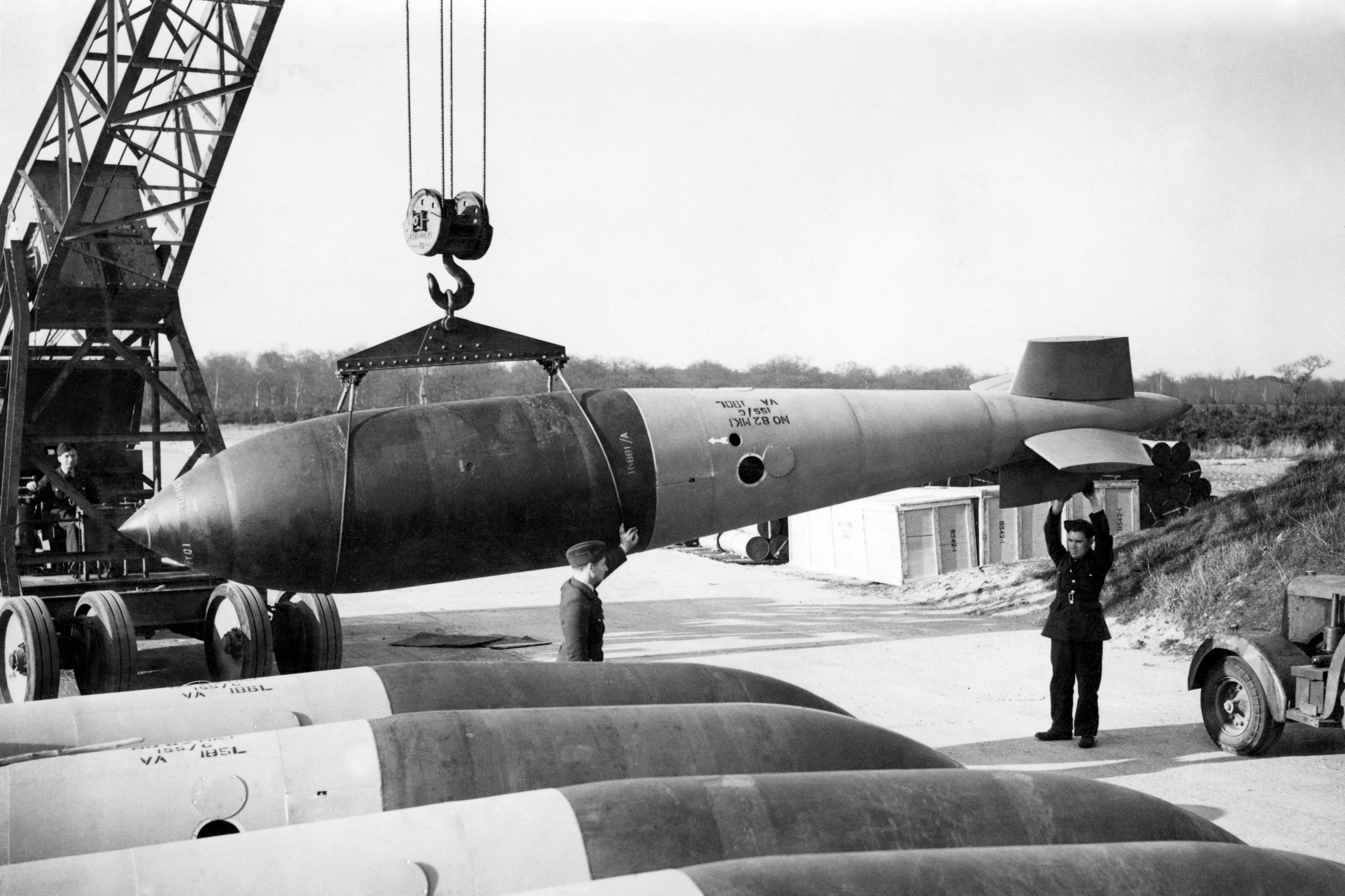
Meanwhile, the United States Army Air Forces licensed the 12,000-pound Tallboy in late 1944 as the T-10 (later standardized as the M121). Consequently, engineers modified Boeing B-29 Superfortress and Consolidated B-32 Dominator bomb bays to carry it against fortified Japanese cave defenses, although World War II ended before American T-10s saw combat. During the Korean War, however, the US Air Force fitted M121 Tallboy warheads with radio-command tail shrouds to create the ASM-A-1 Tarzon. Between December 1950 and March 1951, therefore, B-29s dropped thirty Tarzons to demolish six North Korean dams and bridges.
Remarkably, the World War II Tallboy warhead fought one final conflict twenty-five years after D-Day. During the Vietnam War, USAF engineers removed the tail cones from surplus M121 Tallboy warheads; instead, they mounted the 12,000-pound casings on cargo pallets and added 36-inch nose probes for Commando Vault missions. When dropped from C-130 transports—including at Hamburger Hill in May 1969—these warheads blasted instant helicopter landing zones out of triple-canopy jungle. Ultimately, every modern bunker buster, including the 30,000-pound GBU-57 Massive Ordnance Penetrator, descends directly from Barnes Wallis’s 1944 Tallboy.
Explore Connected Naval, Flak & Ordnance Dossiers in Our Archive
Furthermore, you can continue your investigation across our 4K colorized historical archive. Specifically, every dossier below connects directly to the naval battles, anti-aircraft defenses, and submarine campaigns shaped by the British Tallboy earthquake bomb.
German Battleship Bismarck — 4K Naval Dossier
First, examine the 12-inch belt armor architecture, Denmark Strait gunnery duel, and final Atlantic hunt of Tirpitz’s sister ship.
HMS Hood — Pride of the Royal Navy
Second, investigate the deck-armor vulnerabilities and catastrophic magazine detonation that drove Allied naval and aerial strike evolution.
German U-Boats of WWII — Submarine Warfare
Third, step inside the Type VII and Type XXI submarines sheltered beneath the reinforced concrete pens targeted by 617 Squadron’s Tallboys.
Bofors 40mm Anti-Aircraft Gun Technical Study
Moreover, analyze the rapid-fire automatic anti-aircraft cannon that forced precision bombers toward high-altitude SABS bombing profiles.
USS Iowa-Class Fast Battleships Archive
Similarly, compare Allied capital ship horizontal deck protection and heavy armor-piercing ordnance performance during World War II.
German M30 Drilling Triple-Barrel Survival Rifle
Finally, inspect the Sauer & Sohn combination shotgun-rifle issued to Luftwaffe aircrews operating over Europe and North Africa.
Primary Archival Resources & Declassified Bomber Command Records
Specifically, declassified British Air Ministry files and Imperial War Museum archives substantiate every specification, sortie date, and photograph in this dossier.
Official Air Ministry, National Archives & Museum Collections
First, this primary photographic archive houses Crown Copyright expired negatives CH 15363 (Woodhall Spa Tallboy loading), CH 15380 (617 Squadron release over Watten), and Saumur Rail Tunnel Reconnaissance.
02 — The National Archives (Kew, UK) AIR 14 & AIR 27 SeriesSecond, these files preserve declassified RAF Bomber Command Operational Record Books (Form 540) for 617 Squadron and 9 (IX) Squadron (1943–1945), including SABS bombing plots for Saumur, Wizernes, Kembs, and Tromsø.
03 — Royal Air Force Museum (Hendon & Cosford) PapersThird, researchers can consult original engineering blueprints, wind-tunnel spin-tail reports, and Barnes Wallis’s 1941 treatise A Note on a Method of Attacking the Axis Powers at the RAF Museum Research Archive.
04 — Australian War Memorial (AWM) & US National Archives (NARA)Additionally, these repositories provide public domain wartime photography of 9 Squadron Tallboy dumps at RAF Bardney and post-strike aerial damage assessments of the Fink II U-boat bunker.
05 — Barnes Wallis Foundation & Brooklands Museum ArchiveFurthermore, technical curators maintain historical engineering documentation on Barnes Wallis Munitions Design, Vickers-Armstrongs Sheffield alloy steel casting, and 22,000 lb Grand Slam production records.
06 — Published Historical Monographs & Ordnance StudiesFinally, key secondary studies include Paul Brickhill, The Dam Busters (1951); Patrick Bishop, Target Tirpitz (2012); John Sweetman, Tirpitz: Hunting the Beast (2004); Stephen Flower, The Dambusters (2013); and the Tallboy Ordnance Overview.