Inside Schwerer Gustav: The 1,350-Ton Railway Supergun That Fired Seven-Ton Shells
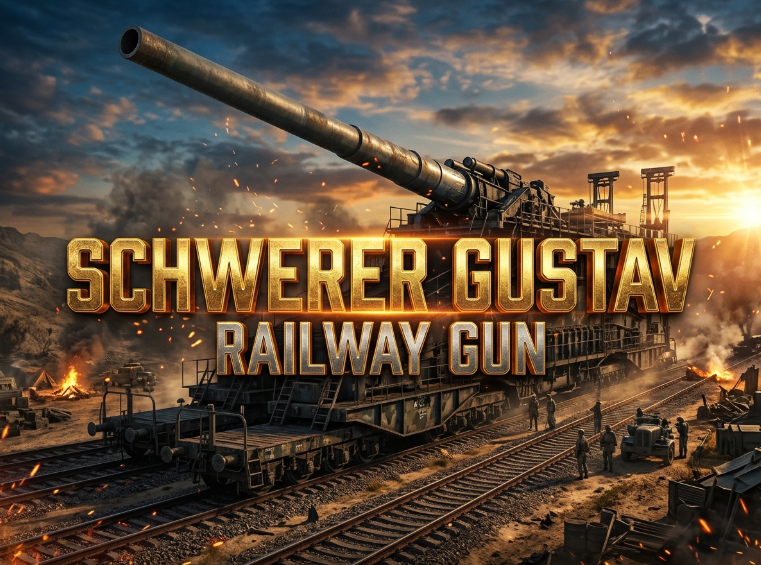
In March 1936, Adolf Hitler visited the Friedrich Krupp steelworks in Essen and demanded a weapon that defied conventional engineering. Specifically, he ordered an artillery piece capable of punching straight through the thickest steel turrets and subterranean concrete magazines of France’s Maginot Line. Consequently, Krupp chief ballistics engineer Professor Erich Müller designed the 80-cm-Kanone (E) Schwerer Gustav (“Heavy Gustav”) alongside its twin sister gun, Dora. Weighing 1,350 metric tons in firing order, this four-story steel leviathan remains the largest-caliber rifled weapon ever fired in human combat.
Thirty-One-Inch Caliber and Eighty-Wheel Dual-Track Engineering
Because no single railway track could bear 1,350 tons of dead weight, Krupp mounted the cannon atop a twin-girder bridge chassis carried by 80 wheels across two parallel railway tracks. Furthermore, its 106-foot (32.48-meter) rifled barrel hurled a 7.1-ton (15,650-pound) armor-piercing shell over 23 miles, or a 4.8-ton high-explosive projectile nearly 30 miles. Although France fell before the gun left the factory floor, Schwerer Gustav traveled east to the Crimea in spring 1942. There, during the Siege of Sevastopol, it unleashed 48 cataclysmic rounds that shattered hardened coastal forts and buried cliffside magazines.
80-cm-Kanone (E) Cutaway Elevation & Dual-Track Bogie Inspector
Restoring Krupp’s 80cm Railway Titan in True 4K 60fps Color
Original 1941 Rügenwalde proving-ground reels and June 1942 Sevastopol combat newsreels suffered from severe nitrate shrinkage, gate weave, and crushed shadow detail. Therefore, our restoration team rebuilt the surviving 35mm footage frame by frame in 4K resolution, combining motion-compensated 60fps stabilization with historically verified Wehrmacht ordnance color grading.
Authentic Dunkelgrau RAL 7021 & Brass Cartridge Color Calibration
First, our colorists referenced surviving 80cm ammunition wagons at the Lešany Military Technical Museum and 800mm brass cartridge cases in Dresden and London. Consequently, our grading pipeline restores the authentic Dunkelgrau (RAL 7021) dark slate-grey steel finish of the twin bridge girders, the burnished brass of the 1.3-meter obturator cases, and the Crimean limestone dust of Bakhchisaray.
Moreover, we reconstructed an authentic multi-channel ballistic soundscape that layers the hydraulic hiss of the loading rammer with the subsonic shockwave of 2,000 kilograms of smokeless propellant. Accordingly, you can inspect the high-resolution thumbnail captures in the plate comparator opposite or launch all five 4K colorized documentary reels below.

WW2 Visual Archive 4K Colorized Cinema Telemetry Deck (Click Any Preview Screen to Launch Player)
Schwerer Gustav — Railway Supergun 4K, 60fps, Colorized & Sound Design
Specifically, this primary 4K 60fps restoration captures the 106-foot barrel elevating to 48 degrees, the twin-track bridge girder recoil, and custom acoustic shockwave design.
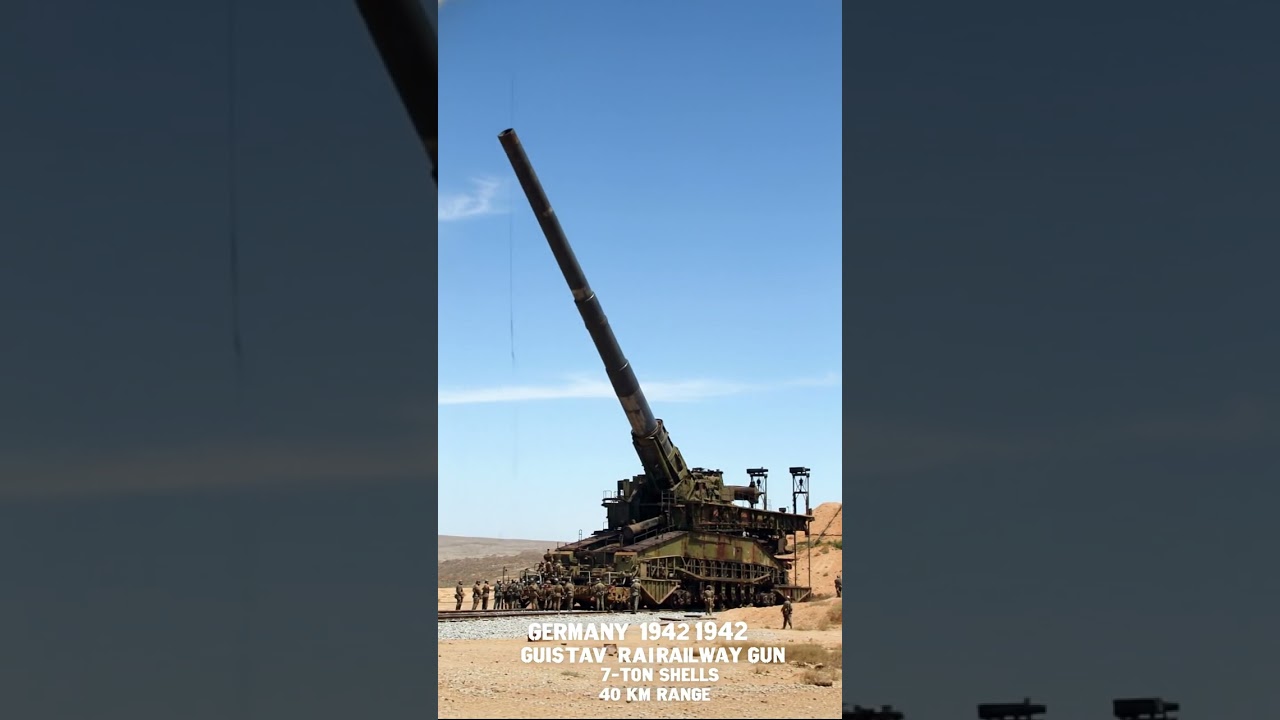
The German Gustav Gun — Heaviest Artillery Ever Built (WW2 Documentary)
Furthermore, this documentary study examines the four-story multi-deck walkways, the 80-wheel bogie distribution, and the hydraulic ramming of 7.1-ton concrete-piercing shells.

Germany’s WW2 Railway Supergun — Engineering Breakdown
Additionally, inspect the portal crane assembly and dual-track curved firing spur at Sevastopol.

The German Gustav Gun — Muzzle Blast & Recoil Telemetry
Likewise, witness the ignition of 2,000 kg of smokeless propellant and the 820 m/s muzzle flash.
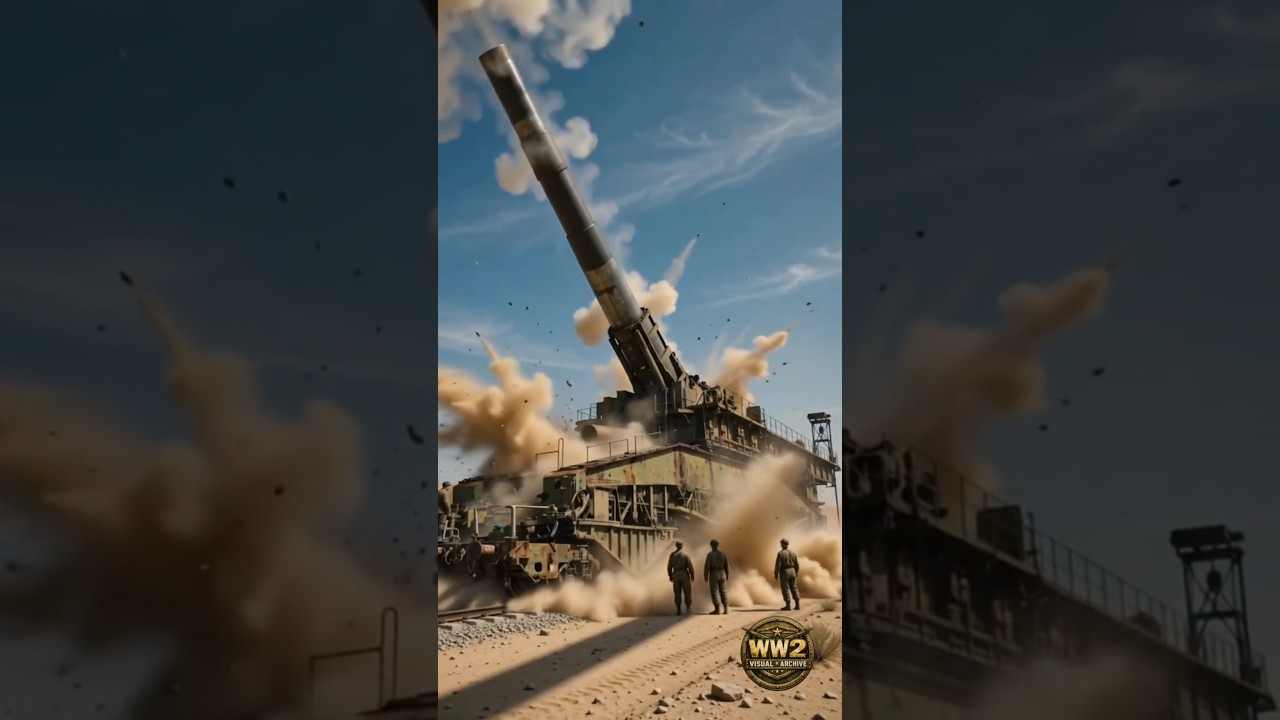
Largest Artillery Piece in Human History — Scale Study
Finally, compare human crew scale against the 11.6-meter-tall cradle and 800mm projectile hoist.
Why Hitler Ordered an 800mm Supergun to Smash the French Maginot Line
During the mid-1930s, German General Staff planners confronted a formidable strategic obstacle along their western frontier. Specifically, France had constructed the Maginot Line, a subterranean network of interlocking concrete ouvrages, retractable steel gun turrets, and deep ammunition magazines carved into solid rock. Because standard Wehrmacht field howitzers bounced harmlessly off three-meter ferro-concrete roofs, German commanders feared a costly stalemate if war broke out with France.
Hitler’s 1936 Essen Mandate and Professor Erich Müller’s Calculations
Consequently, during a documented visit to the Friedrich Krupp AG steelworks in Essen on 27 March 1936, Adolf Hitler personally demanded a super-heavy siege weapon capable of cracking any French frontier fortress from beyond counter-battery range. Immediately afterward, the German Army Weapons Office (Heereswaffenamt) issued a mathematical specification to Krupp’s artillery design bureau. Specifically, the new projectile had to perforate seven meters (23 feet) of reinforced concrete, one meter (39.4 inches) of solid Krupp armor steel plate, and up to thirty meters of packed earth.
To solve this ballistic equation, Krupp’s chief artillery designer, Professor Dr.-Ing. Erich Müller, evaluated hypothetical gun calibers of 70 cm, 80 cm, 85 cm, and 100 cm. After extensive ballistic modeling, Müller proved that an 80-centimeter (31.5-inch) rifled tube firing a 7.1-metric-ton chrome-nickel steel shell at 720 meters per second generated the exact kinetic energy required. Therefore, in early 1937, the High Command of the Army (OKH) formally commissioned Krupp to construct the first gun—and subsequently a second sister piece—for an estimated 7 to 10 million Reichsmarks per unit.
Bypassed by Blitzkrieg: When the Target Vanished Before Delivery
Forging, heat-treating, and lathing a 400-ton barrel and a 1,350-ton twin-railway mounting pushed even Krupp’s monumental Essen foundries to their physical limits. Although planners originally scheduled delivery for March 1940, metallurgical complexities delayed completion of the first gun tube until late 1940. Meanwhile, in May 1940, General Erich von Manstein’s Sichelschnitt offensive bypassed the main Maginot Line entirely by slicing through the Ardennes forest.
Within six weeks, France surrendered, and the primary strategic justification for the 80cm railway gun vanished overnight. Nevertheless, Adolf Hitler and Gustav Krupp refused to cancel the prestigious program. Instead, when test firing began at the Hillersleben and Rügenwalde (Darłowo) proving grounds in early 1941, German planners began searching for a new fortress worthy of their 1,350-ton giant—citing British Gibraltar, Leningrad, and the Soviet Black Sea citadel of Sevastopol.
Naming the Twin Giants: “Schwerer Gustav” and “Dora”
In official Wehrmacht ordnance tables, engineers designated the weapon the 80-cm-Kanone (Eisenbahn), or 80cm Gun (Railway). Following Krupp corporate tradition, Gustav Krupp von Bohlen und Halbach presented the first completed gun to the German Reich free of charge as a personal tribute; consequently, the company christened the first unit Schwerer Gustav (“Heavy Gustav”) in honor of the family patriarch. Meanwhile, artillerymen named the second identical 80cm gun—and frequently referred to the first gun in the field—as Dora, after the wife of chief designer Erich Müller.
Furthermore, Krupp initiated work on a third weapon, designated Langer Gustav (“Long Gustav”). Featuring an elongated 52-centimeter smoothbore barrel measuring 43 meters long, Langer Gustav was designed to fire sub-caliber rocket-assisted projectiles 190 kilometers across the English Channel into London; however, RAF bombing raids on Essen repeatedly crippled its forge shops before completion.

How Krupp Forged a 106-Foot Barrel and Seven-Ton Concrete-Piercing Shells
To grasp the sheer scale of Schwerer Gustav, historians often compare it against the mightiest naval battleships of World War II. For instance, the German battleship Bismarck and the British battlecruiser HMS Hood carried 38-centimeter (15-inch) main guns firing 800-kilogram shells. Even Imperial Japan’s super-battleship Yamato—armed with the largest naval artillery in history—mounted 46-centimeter (18.1-inch) guns firing 1,460-kilogram projectiles, while America’s USS Iowa-class battleships fired 1,225-kilogram armor-piercing rounds from 16-inch barrels. In stark contrast, Schwerer Gustav’s 800-millimeter bore launched a single concrete-piercing projectile weighing 7,100 kilograms—nearly five times heavier than a Yamato shell.
Two-Section Shrunk-Jacket Barrel Construction and Bore Erosion
Because no industrial lathe in 1938 could bore a continuous 32.48-meter (106.5-foot) steel cylinder in one piece, Krupp metallurgists cast and forged the barrel in two interlocking halves. Next, foundry workers heated a massive outer steel jacket until it expanded, slipped it over the rifled inner tube, and cooled the assembly so that thermal contraction locked the layers together under immense radial compression. Including the massive horizontal sliding-wedge breech block, the complete barrel assembly weighed 400 metric tons—equivalent to roughly 260 family automobiles suspended inside an elevating cradle.
Inside the 800mm bore, 96 deep rifling lands imparted gyroscopic spin to the outgoing shell. However, igniting up to 2,240 kilograms (nearly 2.5 tons) of diglycol smokeless propellant created blistering temperatures above 3,000°C and chamber pressures exceeding 4,000 atmospheres. Consequently, each shot scoured away millimeters of hardened chrome-nickel steel from the rifling origin. In combat at Sevastopol, gunners noticed measurable accuracy degradation after just 15 rounds, and the entire 400-ton tube had to return to Krupp’s Essen workshops for relining after firing only 48 combat shots (plus roughly 250 test and proof rounds).
Two Deadly Payloads: The 7.1-Ton Concrete-Piercer and 4.8-Ton High-Explosive Round
Furthermore, Krupp manufactured two distinct types of separate-loading cased ammunition for the 80cm railway gun. Each round required a colossal brass obturator cartridge case measuring 1.3 meters wide at the base, paired with silk increment propellant bags stored in climate-controlled railway cars so that powder temperature stayed constant at 15°C.
- First, the 80 cm Granate Be (Concrete-Piercing Shell): weighed 7,100 kg (15,650 lb) and stood 3.6 meters (11 ft 10 in) tall; forged from thick chrome-nickel alloy steel with a ballistic windshield cap and a 250 kg high-explosive base-fuzed burster charge, it left the muzzle at 720 m/s (1,610 mph) to strike targets up to 38 kilometers (23.6 miles) away.
- Second, the 80 cm Sprenggranate (High-Explosive Shell): weighed 4,800 kg (10,580 lb) and packed a massive 700 kg (1,540 lb) explosive payload; because of its lighter mass, it accelerated to 820 m/s (1,834 mph / Mach 2.4) and reached a maximum range of 47 to 48 kilometers (29.8 miles), gouging craters 10 meters wide and 10 meters deep.

Why Aiming Required Driving 1,350 Tons Along a Curved Railway Track
Unlike smaller railway guns that used a rotating turntable or sliding cross-beam for limited horizontal traverse, Schwerer Gustav possessed zero lateral traverse mechanism. Because no pivot bearing could withstand the 1,350-ton weight and violent recoil torque of an 800mm salvo, the barrel could only elevate vertically between 0° and +65° inside its twin-girder cradle.
Diesel-Electric Precision via Coupled D311 Locomotives
To aim the gun left or right, therefore, combat engineers laid a wide, gently curving double-track railway spur facing the target sector. Whenever ballistic computers called for an azimuth correction, two coupled Krupp-built Wehrmachtslokomotive D311 twin diesel-electric locomotives (delivering 1,880 horsepower total) slowly pushed or pulled the entire 1,350-ton gun along the curved rails to the exact millimeter mark before hydraulic rail-clamps locked the bogies down for firing.
80cm Shell, Propellant Charge & Fortress Penetration Lab
First, configure your 80cm projectile type, silk propellant charge increment, and historical fortress target below. Consequently, the Krupp ballistic computer calculates muzzle velocity, maximum range, impact kinetic energy, and underground concrete or rock perforation depth.
Computed 80cm Internal & Terminal Ballistic Telemetry
Why Firing One 80cm Railway Gun Required Five Trains and 4,000 Personnel
Popular military accounts frequently state that Schwerer Gustav required “4,000 men to fire,” whereas others cite a crew of 500 or 1,420. In reality, archival records from Schwere Artillerie-Abteilung (E) 672—commanded by Lieutenant Colonel Dr.-Ing. Robert Böhm—prove that both figures describe different rings of a temporary military city built around a single weapon. Crucially, Schwerer Gustav could not travel down normal railway tracks as an assembled gun; instead, engineers dismantled it into separate component loads transported across five dedicated railway trains totaling 43 to 106 wagons.
Four Weeks of Earthworks and Laying the Four-Track Firing Spur
Before the gun trains could even enter the Crimea in spring 1942, German railway pioneers had to convert Soviet broad-gauge lines to standard European gauge and reinforce every bridge along the route. Next, at a concealed valley site near Bakhchisaray—roughly 25 kilometers northeast of Sevastopol—1,000 engineers from Organisation Todt and 1,500 civilian and auxiliary laborers spent four full weeks excavating a massive curved railway cut through the limestone hills.
Specifically, workers laid a 2-kilometer approach spur leading into a 1,200-meter assembly yard equipped with four parallel railway tracks. While the inner two tracks carried the 80-wheel gun chassis along the curved firing arc, the outer two tracks supported two towering diesel-electric Ardelt portal gantry cranes (Brückenkräne), each capable of hoisting 110-ton loads.
The 56-Hour Assembly Sequence & 4,000-Man Security Umbrella
Once the four parallel tracks reached millimeter level tolerances, Lieutenant Colonel Böhm’s 500 direct gunners and 20 Krupp civilian technicians began the 56-hour mechanical assembly. First, the two portal cranes coupled the four 5-axle front bogies and four 5-axle rear bogies onto the inner tracks. Second, the cranes lowered the twin bridge girders, central cradle, and 400-ton barrel halves into place.
Meanwhile, because a four-story cannon sitting on open rails invited instant Soviet air attack, Adolf Hitler ordered permanent air defense protection. Consequently, the wider deployment ecosystem encompassed 1,420 battalion troops, two full Flak battalions armed with 88mm guns and rapid-fire 40mm anti-aircraft artillery, a 500-man chemical smoke-screen company, 300 military police guards with dog patrols, a field bakery, a meteorological balloon detachment, and a mobile Krupp machine shop—totaling between 4,000 and 5,000 personnel.

Forty-Eight Salvos at Sevastopol: Maxim Gorky, Fort Molotov, and the White Cliff
By May 1942, General Erich von Manstein’s German 11th Army had cornered the Soviet Separate Coastal Army inside the heavily fortified Black Sea naval base of Sevastopol. Ringed by twin-turreted 305mm armored coastal batteries, deep limestone cavern ammunition depots, and concrete land forts named Stalin, Molotov, Siberia, and Maxim Gorky, Sevastopol represented the exact type of hardened fortress that Krupp engineers built Schwerer Gustav to smash.
General Hansen’s Skepticism Versus Manstein’s 1,300-Gun Bombardment
Interestingly, not every German commander welcomed the arrival of the 80cm behemoth. General der Kavallerie Erik Oskar Hansen, commanding the LIV Army Corps at Sevastopol, objected that hauling Gustav’s five trains and 7-ton shells choked already strained Crimean rail lines, while dive-bombers and 60cm Karl-Gerät mortars could engage the same targets faster. Nevertheless, Manstein and artillery commander General Johannes Zuckertort integrated Schwerer Gustav as the centerpiece of Operation Störfang (“Sturgeon Catch”).
At exactly 05:35 on the morning of 5 June 1942, Schwerer Gustav fired its first combat shot in history from the Bakhchisaray spur. When the 2.2-ton propellant charge ignited, a blinding fireball and a 150-meter dust cloud erupted down the valley, while the sonic boom shattered windows kilometers away. Over the next twelve days—between 5 June and 17 June 1942—the massive gun fired 48 combat rounds across five distinct firing days before each reload cycle required 30 to 45 minutes of hydraulic hoisting, barrel elevation resets, and aerial spotting corrections from Focke-Wulf Fw 189 reconnaissance planes (whose Luftwaffe crews carried survival arms like the German M30 Drilling triple-barrel rifle).

Separating Fact from Myth at the Severnaya Bay “White Cliff” Magazine
The most famous moment of the bombardment occurred on 6 June 1942, when Schwerer Gustav fired nine 7.1-ton shells against the Soviet underground naval ammunition galleries carved into the chalk cliff face on the northern shore of Severnaya Bay—known to German observers as the White Cliff (Weiße Klippe). According to Field Marshal Manstein’s postwar memoirs, one 80cm shell burrowed through 90 feet (27 meters) of natural rock and detonated the main underground magazine, sending a 120-meter black smoke column skyward and capsizing a small harbor vessel with the shockwave.
Modern Archival Forensics on Dispersion and Hitler’s Complaint
However, modern military historians such as Robert Forczyk have cross-examined the LIV Corps war diaries to separate wartime myth from fact. First, later retellings falsely claimed the shell dove through 30 meters of bay water before piercing the seabed; in reality, the magazine sat inside the dry limestone cliff face beside the bay. Second, because 80cm dispersion frequently exceeded 300 meters, most rounds missed the narrow cliff galleries, and on 7 June 1942, Adolf Hitler actually messaged Manstein in annoyance to complain that Dora was wasting expensive concrete-piercing shells on cliffside rock tunnels instead of thick concrete casemates!
Declassified Sevastopol 48-Round Combat Firing Log (5–17 June 1942)
Click any of the eight documented firing sequences below to inspect the exact date, target complex, shell expenditure, range telemetry, and declassified German and Soviet damage assessments from the June 1942 Siege of Sevastopol.
Soviet Coastal Battery No. 10 & Northern Approach Bastions
At 05:35 on 5 June 1942, Lieutenant Colonel Robert Böhm ordered the first operational 80cm salvo in military history from the Bakhchisaray railway spur, targeting Soviet coastal defense positions 25 kilometers away.
What Happened to Sister Gun Dora and How Both Giants Met Their End in 1945
Following the fall of Sevastopol in July 1942, workers dismantled Schwerer Gustav and shipped its worn 400-ton barrel back to Krupp in Essen for relining. Equipped with a spare replacement barrel, the gun traveled north toward Leningrad, taking up a prepared forest spur near Taytsy (roughly 30 kilometers south of the city). However, Soviet forces launched Operation Iskra in early 1943 before the gun could open fire; consequently, German crews dismantled Schwerer Gustav once more and evacuated it to Germany.
Did Sister Gun “Dora” Ever Fire at Stalingrad?
Meanwhile, persistent postwar rumors claimed that the second 80cm railway gun—officially designated Dora and assigned to Schwere Artillerie-Abteilung (E) 672 / 833—deployed outside Stalingrad in August 1942. According to archival transport logs, Dora’s component trains did indeed travel toward the Stalingrad railhead in late summer 1942. However, before engineers could complete a curved firing spur, the Soviet Operation Uranus counteroffensive threatened to encircle the German 6th Army. Therefore, crews hastily withdrew Dora westward in September 1942 without firing a single combat round.
Colonel Porter’s Discovery in the Bavarian Pinewoods (April 1945)
By 1944, Allied air supremacy over Europe made operating a 1,350-ton railway gun completely impossible; after all, squadrons of Allied fighter-bombers or heavy Lancasters—which had already smashed German coastal batteries, Kriegsmarine U-boat bunkers, and V-weapon sites—would have spotted and destroyed the four-track spur within hours. Consequently, both 80cm guns retreated into deep forest sidings inside Germany.
On 14 April 1945, two days before US 1st Infantry Division troops arrived, German engineers dynamited Schwerer Gustav in the Auerswalde forest north of Chemnitz. Five days later, on 19 April 1945, crews blew up the second gun, Dora, on a woodland railway siding near Metzenhof and Grafenwöhr in northern Bavaria. When US Army Colonel Porter stumbled upon the wrecked 14-wagon train on 22 April 1945, he wrote in awe: “I saw a gun tube so huge that I stopped and gasped for breath.”
Surviving Relics: From Scrapped Barrels to Rebuilt Locomotives
After VE-Day, Soviet ordnance specialists hauled the shattered remains of Schwerer Gustav from Chemnitz to the Rzhevka artillery proving ground near Leningrad for metallurgical study before cutting the steel up for scrap around 1960. Simultaneously, US Army intelligence filmed and scrapped Dora’s demolished cradle in Bavaria during the late 1940s.
Ironically, the most useful survivors of the entire 80cm program proved to be its diesel-electric locomotives. After the war, the West German Federal Railway (Deutsche Bundesbahn) refurbished two of Krupp’s twin D311 locomotives as Class V 188, and they faithfully hauled freight trains across Germany until 1972. Today, only scattered 80cm shells, a 1.3-meter brass cartridge case in Dresden, and an armored ammunition wagon at Lešany remain on public view.

All Major WWII Super Guns Compared: Axis & Allied Siege Titans
Schwerer Gustav was the culmination of a global twentieth-century race to build ultra-heavy siege and coastal artillery. Before exploring the interactive comparator below, review how the four primary engineering schools of World War II super-artillery differed in doctrine, mobility, and survival.
Tracked Siege Mortars, Long-Range Rail Guns, and Multi-Chamber Superguns
While Schwerer Gustav sacrificed tactical mobility for sheer 800mm shell mass, Rheinmetall’s 60cm Karl-Gerät (Mörser Karl) mounted a stubby mortar tube on a self-propelled tracked chassis so that it could crawl into firing pits without a curved railway spur. Conversely, Krupp’s 28cm K5 (E) “Anzio Annie” and 21cm K12 (E) prioritized extreme barrel length and high velocity, allowing crews to shell Allied beachheads or the English coast from inside railway tunnels and roll back under cover before counter-battery planes arrived.
Meanwhile, the Allied powers and Imperial Japan took a pragmatic approach by adapting surplus naval battleship barrels onto railway mounts—such as Britain’s 18-inch (457mm) “Boche-Buster”, the Soviet 305mm TM-3-12, America’s 16-inch M1919, and Japan’s 240mm Type 90—while the US Army secretly built the 914mm (36-inch) “Little David” mortar, the only artillery piece in history with a wider bore than Schwerer Gustav.
Interactive WWII Super Guns Filter, Sort & Technical Inspector
80-cm-Kanone (E) “Schwerer Gustav” & “Dora”
Ordered by Adolf Hitler in 1936 to shatter the French Maginot Line, Krupp’s 80cm railway gun remains the heaviest mobile artillery piece ever constructed and the largest-caliber rifled weapon ever fired in combat.
Play “Operation Störfang 1942: 80cm Schwerer Gustav Siege Command”
Take command of Schwere Artillerie-Abteilung (E) 672 on the Bakhchisaray curved railway spur in June 1942. First, adjust your 106-foot barrel elevation angle and propellant charge bags to compensate for Crimean wind drift. Next, watch the ballistic computer arc and fire your 7.1-ton shell to penetrate four heavily fortified Soviet bastions before barrel wear degrades your rifling!
Live Bakhchisaray Ballistic Firing Range & Elevation Controls
Wonder of Artillery Technology or Monumental Waste of Wartime Steel?
After World War II, historians and surviving German commanders debated whether Schwerer Gustav justified its staggering industrial footprint. Writing in his 1955 memoir Lost Victories, Field Marshal Erich von Manstein offered the most balanced assessment of the 80cm railway gun. Specifically, he praised the cannon as “a wonder of artillery technology,” yet admitted in the very same paragraph that “taken as a whole, the effort undoubtedly did not stand in the right proportion to the effect.”
The Opportunity Cost: Five 38cm Railway Guns or Twenty U-Boats
From an industrial accounting perspective, British artillery historian Ian Hogg calculated that the high-grade alloy steel, precision lathe hours, and skilled Krupp labor consumed by the two 80cm guns could have produced at least five or six 38cm Siegfried railway guns—or dozens of standard 17cm and 21cm mobile field batteries that could have fought from 1940 through 1945. Similarly, 2,700 metric tons of prime Krupp steel could have built nearly forty Panther medium tanks or three ocean-going Type VII German U-boats.
Ultimately, Schwerer Gustav represented the twilight of railway siege artillery. Every core principle of the weapon—aiming along a curved track, multi-bogie weight distribution, and separate-loading siege shells—dated back to 1914. By 1944, a single four-engine heavy bomber carrying a 5.4-ton Tallboy or 10-ton Grand Slam earthquake bomb could fly 1,000 miles in four hours and deliver the exact same subterranean concrete-cracking shockwave without laying a single meter of railway track.
Explore Connected Battleships, Flak & German Ordnance Dossiers
Continue your exploration across our 4K colorized historical archive. Specifically, each interactive dossier below examines the capital warships, anti-aircraft defenses, and specialized German weapons directly connected to the era of the 80cm Schwerer Gustav supergun.
German Battleship Bismarck — 38cm Krupp Naval Artillery
First, inspect the 38cm SK C/34 Krupp main battery turrets and Wotan armor architecture of Germany’s most famous capital warship.
HMS Hood — Pride of the Royal Navy in 4K
Second, analyze the 15-inch naval gunnery duel in the Denmark Strait and the plunging-fire deck armor vulnerabilities of interwar capital ships.
Battleship Yamato — 4K Colorized Restoration
Third, compare Schwerer Gustav’s 800mm land artillery against Yamato’s 460mm (18.1-inch) Type 94 naval guns—the largest ever mounted afloat.
USS Iowa-Class Fast Battleships — 16-Inch Mark 7
Fourth, explore how American 16-inch/50 caliber naval guns and radar fire-control systems achieved super-heavy armor penetration at sea.
German U-Boats of WWII — Steel Allocation & Pens
Fifth, examine the Type VII and Type XXI submarine fleet that competed directly with Krupp’s super-heavy artillery for high-grade German steel.
Bofors 40mm Anti-Aircraft Gun Technical Dossier
Sixth, study the automatic anti-aircraft artillery systems deployed to shield stationary railway spurs and naval bases from low-level air attack.
German M30 Drilling Triple-Barrel Survival Rifle
Finally, inspect the precision Sauer & Sohn triple-barrel combination gun issued to Luftwaffe reconnaissance and bomber crews on the Eastern Front.
Primary Archival Resources & Declassified Ordnance Records
Primary German ordnance files, museum collections, and peer-reviewed artillery scholarship substantiate every specification, firing date, and historical photograph in this dossier.
Official Military Archives, Surviving Museum Artifacts & Reference Monographs
First, primary Wehrmacht war diaries for LIV Army Corps and Schwere Artillerie-Abteilung (E) 672 document the June 1942 Bakhchisaray deployment, alongside Krupp engineering records presented during the Nuremberg Krupp Trial and cataloged on Wikidata 80-cm-Kanone (E) Q27578.
02 — Imperial War Museum (London) & Bundeswehr Military History Museum (Dresden)Second, physical surviving 80cm artifacts include the 3.6-meter armor-piercing shell displayed in London (IWM 80cm Shell Exhibit) and the 1.3-meter brass obturator cartridge case and scale model preserved in Dresden (Dresden 80cm Cartridge Collection).
03 — Military Technical Museum Lešany (Czech Republic) & Darłowo RangeThird, researchers can inspect the surviving air-conditioned armored ammunition railway wagon of Schwerer Gustav at Lešany (Lešany Gustav Ammunition Wagon) as well as the concrete proof-firing emplacements at Rügenwalde-Bad (modern Bobolin/Darłowo, Poland).
04 — Wikimedia Commons Public Domain Photographic RepositoryFourth, public domain wartime photographs include Schwerer Gustav on Eastern Front Spur, Sevastopol High-Elevation Firing, Rügenwalde Acceptance Trials, and US Army 1945 Dora Wreckage Inspection.
05 — Standard Artillery & Siege HistoriographyFifth, authoritative technical studies include Gerhard Taube, Eisenbahngeschütz Dora: Das größte Geschütz aller Zeiten (Motorbuch Verlag); Ian V. Hogg, German Artillery of World War Two (Greenhill Books); and Marc Romanych & Martin Rupp, World War II German Super-Heavy Siege Guns (Osprey Publishing).
06 — Sevastopol Operational & Forensics ScholarshipFinally, modern archival reconstructions of the June 1942 bombardment include Robert Forczyk, Sevastopol 1942: Von Manstein’s Triumph (Osprey Campaign Series); Erich von Manstein, Verlorene Siege / Lost Victories (1955); and François de Lannoy, La Bataille de Sébastopol.