Engineering Project 941 Akula: The 48,000-Ton Titanium Catamaran That Ruled the Arctic Depths
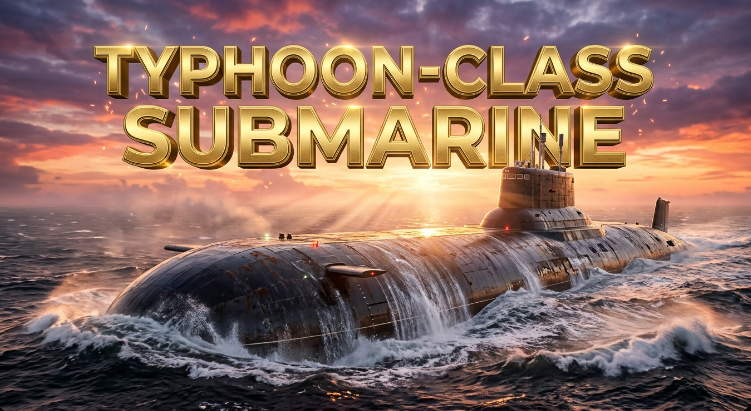
During the height of the Cold War, Soviet naval architects at the Rubin Central Design Bureau conceived an unprecedented maritime leviathan. Specifically, Chief Designer Sergei Kovalev designed the Project 941 Akula submarine—designated by NATO as the Typhoon class—to guarantee survivable retaliatory nuclear strike capability. Displacing 48,000 tons submerged, this colossal nuclear cruiser exceeded the displacement of contemporary aircraft carriers and dwarfed every undersea vessel ever constructed. Consequently, the submarine operated undetected beneath the permanent polar ice cap of the Arctic Ocean, maintaining strategic parity against American carrier battle groups and ballistic missile submarines.
The Apex of Soviet Undersea Metallurgical Engineering
Furthermore, Soviet engineers rejected conventional single-cylinder hull layouts to overcome immense ballistic missile dimensions. Therefore, Kovalev united two parallel titanium-reinforced pressure hulls inside an outer hydrodynamic steel casing, creating a revolutionary catamaran architecture. Between 1981 and 1989, the Sevmash Shipyard in Severodvinsk completed six of these nuclear giants. Inside their insulated hulls, crews enjoyed unprecedented amenities, including an indoor swimming pool, a Finnish sauna, a solarium, and private staterooms. Today, the legendary Typhoon class stands as the high-water mark of Cold War naval architecture and Arctic deterrence doctrine.
Cutaway Project 941 Anatomy & Multi-Hull Citadel Inspector
Genesis of Project 941 Akula: The Soviet Answer to the American Ohio Class
During the early 1970s, the Cold War nuclear arms race shifted decisively into the oceanic depths. Specifically, the United States Navy initiated the Trident submarine program, laying down the massive Ohio-class strategic submarine armed with twenty-four long-range Trident I C4 ballistic missiles. Recognizing that American submarines could strike Soviet industrial centers from thousands of miles away in open ocean sanctuaries, Soviet General Secretary Leonid Brezhnev issued an urgent strategic directive to the Ministry of Shipbuilding. Consequently, the Soviet Union authorized the development of a radically new sea-based deterrent system capable of matching American capabilities.
Sergei Kovalev and the Rubin Central Design Bureau
In response to this national mandate, the Rubin Central Design Bureau for Marine Engineering in Leningrad began conceptual design under the brilliant direction of General Designer Sergei Nikitich Kovalev. Notably, Kovalev had already designed several generations of Soviet nuclear submarines, including the Hotel, Yankee, and Delta classes. However, the requirements for Project 941—officially named Akula (“Shark”) in Soviet service and designated Typhoon by NATO intelligence—shattered all previous engineering precedents.
Furthermore, Soviet missile designers at the Makeyev Rocket Design Bureau were developing the new R-39 Rif (RSM-52) intercontinental ballistic missile. Unlike American solid-fuel propellants that utilized compact high-energy chemical binders, Soviet solid-fuel rocketry was still maturing. As a result, the R-39 evolved into an enormous projectile: 16.0 meters long, 2.4 meters in diameter, and weighing an astounding 90 metric tons. Therefore, mounting twenty of these colossal rockets into a conventional submarine hull would require an unmanageable hull diameter exceeding twenty meters.
Overcoming Missile Dimensions Through Catamaran Innovation
Faced with these severe physical constraints, Kovalev made an extraordinary architectural decision. Rather than building an impractically deep single hull that could not enter northern Russian shipyards or naval ports, he devised a revolutionary multi-hull catamaran arrangement. Specifically, the design united two parallel main pressure hulls inside an outer hydrodynamic casing, with the missile silo deck positioned directly between and forward of the hulls. Consequently, this brilliant layout accommodated the giant rockets while maintaining a moderate draft that allowed access to home bases in the Kola Peninsula.
Sevmash Shipyard No. 402 and the Construction Triumph
To construct these undersea leviathans, Soviet authorities expanded the Sevmash Shipyard (Shipyard No. 402) in Severodvinsk on the White Sea. Specifically, workers erected the world’s largest covered drydock hall, Boathouse No. 55, encompassing over 100,000 square meters of enclosed industrial workspace. Inside this secure facility, shipwrights welded thousands of tons of high-strength alloy steel shielded from Western reconnaissance satellites.
Ultimately, on 23 September 1980, the lead vessel of the class, designated TK-208, rolled out of Boathouse No. 55 into the White Sea basin. Remarkably, painters had applied a fierce smiling shark emblem with an arrow trident to the bow below the waterline. When the submarine was commissioned in December 1981, it permanently transformed global naval strategy.

Catamaran Naval Architecture: Five Pressure Hulls Inside One Outer Hydrodynamic Envelope
Beyond its immense scale, the internal structural architecture of the Typhoon class represents a crowning achievement of undersea engineering. In standard submarines, a single cylindrical pressure hull houses crew quarters, reactor compartments, torpedoes, and missile silos. In contrast, Project 941 incorporates five separate, self-contained pressure hulls and nineteen independent watertight compartments arranged within an outer hydrodynamic light hull. Consequently, this multi-cylinder layout created an unprecedented degree of combat survivability.
The Parallel Titanium-Steel Main Pressure Cylinders
Specifically, the core of the submarine consists of two parallel main pressure hulls that span 140 meters in length and 7.2 meters in diameter. Metallurgists constructed these cylinders from high-yield AK-33 steel alloy reinforced with titanium structural bulkheads, providing operational diving depths of 400 meters (1,312 feet) and an extreme crush depth approaching 500 meters. Furthermore, each main hull functions as a virtually independent submarine: the starboard hull houses one nuclear reactor, steam turbine, and propulsion line, while the port hull houses the identical twin propulsion plant.
Between these two main hulls sit three separate pressure modules. First, forward of the missile deck, an independent pressure cylinder houses the torpedo launch room and forward sonar processing suite. Second, positioned amidships above the missile deck, a reinforced command module contains the central control room, tactical navigation stations, and electronic warfare posts. Third, an aft pressure module houses steering machinery and backup maneuvering gear. Therefore, even if enemy torpedoes breached one main hull, the opposite hull and isolated modules ensured the crew could navigate and fire retaliatory missiles.
Unprecedented Reserve Buoyancy: The 32 Percent Safety Factor
Equally extraordinary was the vessel’s reserve buoyancy. Standard nuclear submarines operate with a reserve buoyancy of roughly 10 to 15 percent, meaning that taking on modest amounts of flooding water causes them to sink. In sharp contrast, the Typhoon class possessed a staggering reserve buoyancy of 32 to 45 percent, earned by the vast volume of open ballast space between the inner pressure hulls and the outer casing. As a result, when surfaced, over 15,000 tons of the submarine rode above the water line, giving the ship its distinctive high-riding silhouette.
This enormous reserve buoyancy served a vital tactical function in the Arctic Ocean. Because the submarine displaced 23,200 tons surfaced and 48,000 tons submerged, opening the high-pressure air blowing systems discharged water from the massive main ballast tanks with immense upward force. Consequently, the submarine could punch upward through multi-year polar pack ice up to three meters thick, breaking through to the Arctic surface without damaging its internal pressure hulls. Much like the heavy armor citadels engineered on historic dreadnoughts like the USS Iowa-class battleships, Typhoon relied on brute metallurgical mass to defeat physical obstacles.
Twin Pop-Up Rescue Chambers: Escaping From 400-Meter Depths
Moreover, Soviet constructors prioritized complete crew survivability in the remote Arctic ice wastes. Embedded into both sides of the sail structure sat two massive, independent pop-up rescue capsules (VSK). Specifically, each sealed capsule could accommodate approximately ninety crewmen—sufficient to evacuate the entire 160-man crew simultaneously. In a catastrophic loss of control or reactor casualty, sailors could seal themselves inside the capsules and release pneumatic locking clamps. Consequently, the buoyant chambers floated automatically to the surface, breaking through thin ice and deploying emergency satellite distress beacons.
The Arctic Bastion Doctrine: Operating Undetected Beneath Permanent Polar Ice
During the Cold War, Western naval forces established the Sound Surveillance System (SOSUS), an extensive underwater acoustic hydrophone network stretching across the Greenland-Iceland-United Kingdom (GIUK) Gap. Consequently, any Soviet submarine attempting to transit the North Atlantic into open patrol stations faced constant tracking by NATO maritime patrol aircraft and hunter-killer attack submarines. To bypass this lethal acoustic gauntlet, the Soviet Navy developed the revolutionary “Bastion Doctrine.”
Polar Ice as an Impenetrable Acoustic Shield
Under this strategy, Soviet strategic missile submarines did not attempt to breach the GIUK Gap. Instead, they remained inside heavily defended maritime bastions in the Barents Sea, Kara Sea, and under the permanent Arctic ice canopy. Furthermore, the thick polar ice sheet served as a natural acoustic shield. The constant grinding, cracking, and pressure ridging of shifting pack ice generated intense ambient ocean noise, effectively blinding NATO passive sonar sensors. In this harsh environment, Typhoon operated with near total impunity.
To navigate safely beneath this chaotic ice ceiling, Rubin engineers equipped Project 941 with upward-looking ice-detection sonar arrays. Specifically, these sensors mapped the bottom contour of ice keels that extended dozens of meters beneath the surface. Operating at creep speeds of three to four knots, the submarine maneuvered between submerged ice ridges, maintaining acoustic silence while awaiting launch codes from Moscow.
Reinforced Sail Architecture and Retractable Hydroplanes
However, launching intercontinental ballistic missiles required surfacing through the frozen canopy. Therefore, Kovalev gave Typhoon an exceptionally reinforced sail structure. Naval architects constructed the conning tower with rounded, heavy steel plating and an internal reinforced framework capable of absorbing thousands of tons of vertical impact force. Simultaneously, the forward horizontal diving hydroplanes were fully retractable into the bow hull plating. As a result, when surfacing, the hydroplanes folded flush against the hull, preventing the jagged pack ice from shearing them away.
When ordered to surface, the commanding officer vented ballast tanks, allowing the ship’s massive reserve buoyancy to drive the reinforced sail directly into the ice sheet. Cracking three meters of solid ice, the submarine emerged onto the polar surface like an artificial steel island. Within minutes, heated pneumatic covers over the missile silos opened, and the crew prepared to launch their strategic salvo.
Acoustic Cloaking: The Anechoic Rubber Tile System
Meanwhile, to counter active enemy sonar probes, Soviet technicians cloaked the entire outer hull in specialized anechoic rubber tiles. Specifically, workers bonded thousands of synthetic rubber tiles, measuring roughly 150 millimeters in thickness, across the hull surface. These tiles incorporated thousands of microscopic air voids designed to absorb incoming sonar pings and attenuate internal machinery noise. Consequently, enemy active sonar reflected minimal acoustic energy, rendering the giant submarine far quieter than its colossal displacement suggested. Just as wartime submariners had evolved tactics from hunting convoys with German U-boats to modern sub-surface warfare, Typhoon took stealth to its technological extreme.
Arsenal of the Apocalypse: 20 R-39 Rif Ballistic Missiles and Heavy Torpedoes
The primary reason for the Typhoon’s extraordinary dimensions was its devastating offensive payload: the D-19 missile launch complex housing twenty R-39 Rif (NATO reporting name: SS-N-20 Sturgeon) submarine-launched ballistic missiles. Designed by the Makeyev State Rocket Center under Victor Makeyev, the R-39 was the first Soviet solid-propellant naval intercontinental ballistic missile to enter widespread fleet service. Consequently, it provided reliable, instantaneous launch readiness without the dangerous and toxic liquid propellants used in earlier Soviet submarines.
Anatomy of the 90-Ton Solid-Fuel R-39 Monster
Each R-39 missile represented a colossal technological undertaking. Measuring 16.0 meters (52.5 feet) in length, 2.4 meters in diameter, and weighing 90,000 kilograms (198,400 pounds), a single R-39 weighed more than an entire combat-ready MiG-25 interceptor jet. Specifically, the rocket utilized three solid-propellant stages encased in wound aramid-fiber composite cases. Furthermore, an innovative Nose Engine Deceleration System (PADS) mounted the first-stage steering thrusters directly on the nose cone, pulling the rocket upward through the water column before primary ignition.
Moreover, the R-39 carried ten Multiple Independently Targetable Reentry Vehicles (MIRVs), each packing an estimated 100-kiloton thermonuclear warhead. With a maximum operational firing range of 8,300 kilometers (4,480 nautical miles), a Typhoon cruising inside the Barents Sea could deliver 200 nuclear warheads onto any target across North America or Western Europe. As a result, a single Project 941 submarine carried the destructive power of over 1,300 Hiroshima-type atomic bombs, establishing absolute strategic deterrence.
Underwater Salvo Launch Dynamics
Remarkably, the Typhoon class possessed the unique capability to fire its entire battery of twenty R-39 missiles in rapid sequence while fully submerged or while moored alongside polar ice. To launch, high-pressure steam generators created an expanding gas bubble at the bottom of the silo, propelling the 90-ton missile upward through the tube and sea water. Once the missile broached the ocean surface, primary solid-rocket motors ignited in mid-air, hurtling the warheads into suborbital space. The entire twenty-missile salvo could be discharged in mere minutes, overwhelming enemy anti-ballistic missile tracking networks.
The Forward Torpedo Room: Self-Defense and Anti-Submarine Warfare
In addition to its intercontinental strategic battery, Typhoon carried formidable self-defense weapons inside its forward torpedo compartment. Specifically, the submarine mounted six 533mm (21-inch) torpedo tubes backed by automated rapid-reload racks holding up to twenty-two heavy torpedoes and anti-submarine missiles. Weapons included the Type 53-65K wake-homing torpedoes, SET-65 acoustic homing torpedoes, and RPK-2 Viyuga (SS-N-15 Starfish) anti-submarine nuclear-tipped rockets. Furthermore, several hulls could deploy RPK-6 Vodopad (SS-N-16 Stallion) supersonic missiles fired from 650mm heavy tubes, providing comprehensive protection against lurking NATO attack submarines.
Life Aboard the “Floating Hilton”: Saunas, Swimming Pools, and Arctic Crew Well-Being
Submarine warfare is notoriously grueling, characterized by claustrophobic bunking, artificial fluorescent lighting, and months of isolation from sunlight. In historical naval combat, surface warship sailors faced immense physical hardship, whether manning flak batteries like the Bofors 40mm anti-aircraft gun on pitching battleship decks or surviving Arctic convoy runs. In sharp contrast, Soviet naval planners recognized that maintaining crew mental health during 120-day submerged Arctic patrols required radical improvements in living conditions. Consequently, Project 941 earned the affectionate nickname “Floating Hilton” (Plavuchiy Khilton) among Soviet submariners.
The Ceramic-Tiled Swimming Pool and Russian Banya Sauna
Because the wide catamaran hull layout provided tremendous unpressurized and pressurized volume, designers dedicated substantial square footage to recreational facilities. Most famously, Typhoon featured a full-service Finnish sauna lined with natural birch wood and an adjoining small ceramic-tiled swimming pool measuring approximately four meters long and two meters deep. Sailors off watch could relax in the dry heat of the sauna before plunging into ocean-chilled water, an unimaginable luxury on any other submarine in human history.
Furthermore, the recreation complex housed a solarium equipped with ultraviolet sun lamps. Because crew members spent up to four months submerged beneath polar ice without seeing natural sunlight, daily exposure to ultraviolet light prevented vitamin D deficiency, depression, and circadian rhythm disruption. Additionally, the vessel included a fully equipped fitness gym with stationary rowing machines, punching bags, and weight benches.
Living Quarters, Dining Messes, and Aviary Sanctuaries
Equally civilized were the crew accommodations. Unlike Western submarines that frequently practiced “hot-bunking” (where two sailors shared a single bunk in rotating shifts), every Typhoon sailor possessed an assigned bunk. Officers and senior warrant officers enjoyed spacious two-man and four-man staterooms complete with washbasins, writing desks, and individual television monitors. Meanwhile, enlisted personnel resided in comfortable six-man cabins.
Moreover, the submarine featured two separate officer and crew dining messes serving four hot meals daily, supplemented by fresh bread baked in the ship’s galley. In the wardroom lounge, designers even installed living potted plants and an aviary cage containing singing canaries, providing audio-visual contact with living nature deep beneath the Arctic ice. Ultimately, these humanitarian amenities sustained crew morale and operational precision during high-stress nuclear standby patrols.
Senator Richard Lugar and the Post-Cold War Inspection
Following the dissolution of the Soviet Union in 1991, American officials and inspectors gained unprecedented physical access to Severodvinsk under the Nunn-Lugar Cooperative Threat Reduction Program. Specifically, in August 1999, US Senator Richard Lugar led a congressional delegation to inspect Typhoon submarine TK-202 ahead of dismantling operations.
Consequently, American defense experts marveled at the sheer physical magnitude of the vessel, walking along the vast open expanse of the forward missile deck that looked more like an aircraft carrier flight deck than a submarine. The historic photograph captured during this visit remains one of the most iconic images of Cold War disarmament.

Restoring Cold War Submarine Legends in Authentic 4K Color
Because original Soviet Northern Fleet documentary footage recorded on 35mm Sovcolor and black-and-white nitrate film suffered from chemical vinegar syndrome, grain degradation, and fading, our restoration studio undertook extensive optical remastering. Specifically, our preservation specialists apply neural scratch removal, luminance de-flickering, and multi-spectral color grading verified against official Soviet naval paint registries.
Historical Soviet Northern Fleet Camouflage and Anechoic Tones
First, our restoration colorists verified the precise dark anthracite and charcoal hues worn by Project 941 submarines. While surface warships like the German battleship Bismarck or the Royal Navy battlecruiser HMS Hood sported intricate splinter camouflage patterns, Typhoon hulls featured matte black anechoic rubber tiles designed to absorb light and sound in murky sub-polar waters.
Furthermore, our digital colorization workflow accurately restores the deep red anti-fouling hull coating applied below the waterline, the vibrant white draft numbers painted on the bow, and the green ceramic tiling of the onboard swimming pool. Use the interactive optical inspector opposite to compare the raw archival monochrome film with our 4K restored masters, or launch our full vertical cinema deck below.
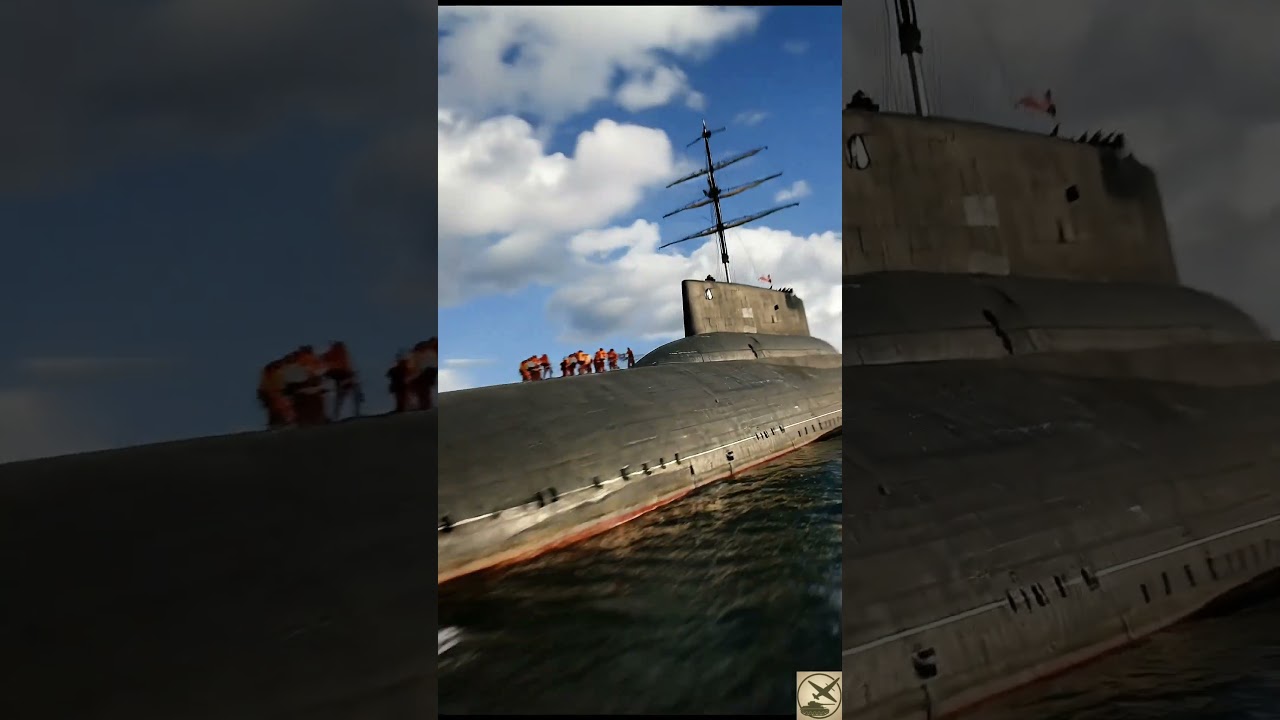
4K Arctic Submarine Video Pavilion & Historical Telemetry Reels
Explore our collection of 4K restored vertical telemetry reels documenting the Project 941 Typhoon class submarine, its Arctic ice-breaking maneuvers, and Cold War strategic deterrence missions. Click any card below to launch the video directly in-place or watch on YouTube.
Typhoon Class: Decades Under Nuclear Stealth
Specifically examines how the Typhoon’s double hull and dual OK-650 reactors enabled decades of silent undersea patrol beneath polar ice.
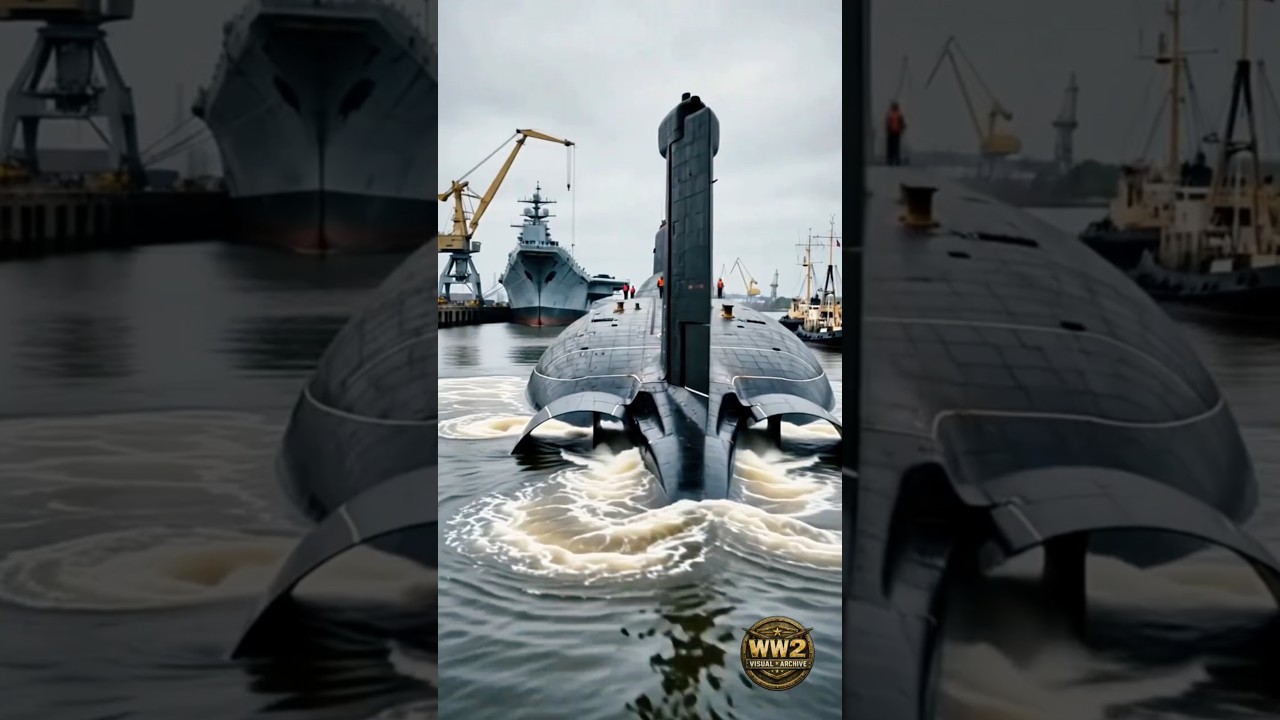
Cold War Titan: Project 941 Catamaran Architecture
Furthermore, showcases the parallel titanium pressure hulls and construction inside Severodvinsk’s giant Boathouse 55 on the White Sea.

Arctic Ice-Breaker: Typhoon’s Polar Ascent
Watch the submarine surface through three meters of solid polar pack ice using its reinforced sail and massive ballast displacement.

Inside the Floating Hilton: Crew Oasis & Sauna
Examine the onboard swimming pool, wooden Russian banya sauna, solarium, gym, and living canaries deep beneath polar ice.
Play “Typhoon: Arctic Sonar & Ballistic Missile Patrol”
Take command of the Project 941 Typhoon submarine deep in the Barents Sea. Move your crosshair to steer through underwater ice keels. Click or tap to fire wire-guided 533mm acoustic homing torpedoes at approaching NATO hunter-killer submarines. Press SPACEBAR or tap 🚀 BREAK ICE & LAUNCH R-39 SALVO to surface through polar ice and fire an awe-inspiring intercontinental ballistic missile salvo!
The Undersea Titans: Project 941 Typhoon vs. Major Global Competitors
Compare the technological dimensions, submerged displacement, ballistic missile capacity, nuclear power plants, maximum sprint speeds, and stealth features of twelve iconic strategic and attack submarines. Filter by tactical role or sort by displacement, missile payload, or diving depth below to examine declassified naval telemetry.
Project 941 Akula (Typhoon Class) — TK-208 “Dmitriy Donskoy”
Specifically engineered as the ultimate expression of Soviet Arctic bastion deterrence, fusing a 48,000-ton titanium-reinforced catamaran hull with twenty R-39 intercontinental ballistic missiles, dual OK-650 nuclear reactors, and luxurious crew quarters.
The Fate of the Six Typhoons: From Cold War Bastions to Strategic Disarmament
Between 1976 and 1989, the Sevmash Shipyard laid down seven Project 941 submarines, completing six vessels that formed the 18th Submarine Division of the Northern Fleet based at Nerpichya Bay in Zapadnaya Litsa. Specifically, the six completed leviathans bore hull designations TK-208, TK-202, TK-12, TK-13, TK-17, and TK-20. A seventh vessel, TK-210, was scrapped on the slipway before assembly was completed due to shifting economic priorities.
The Fall of the Soviet Union and Economic Realities
Following the collapse of the Soviet Union in December 1991, the newly formed Russian Federation faced catastrophic economic upheaval. Maintaining the massive 48,000-ton submarines, each requiring complex logistics, specialized docking facilities, and thousands of skilled technicians, proved financially unsustainable. Furthermore, the expiration of the operational service life of the solid-propellant R-39 missiles posed severe logistical hurdles, as the missile production facilities in Ukraine were no longer part of Russia.
Consequently, Russia signed the Strategic Arms Reduction Treaties (START I and START II) with the United States. To safely dismantle these strategic weapons and prevent the proliferation of fissile materials, the United States Congress established the Nunn-Lugar Cooperative Threat Reduction Program. Under this bilateral initiative, American funding directly financed the defueling and scrapping of three Typhoons: TK-202, TK-12, and TK-13 at the Zvezdochka Shipyard in Severodvinsk.
TK-208 “Dmitriy Donskoy” and the Bulava Missile Testing Era
However, the lead ship, TK-208, experienced an extraordinary second career. In 1990, the submarine entered an extensive modernization overhaul at Sevmash under Project 941UM. Commissioned back into active testing service in 2002 under the honorary name Dmitriy Donskoy, the submarine served as the dedicated experimental launch platform for Russia’s next-generation RSM-56 Bulava intercontinental ballistic missile.
Throughout the 2000s, Dmitriy Donskoy conducted dozens of test launches in the White Sea, proving the viability of the Bulava missile that now arms the modern Borei-class submarines. Meanwhile, sister ships TK-17 Arkhangelsk and TK-20 Severstal remained in reserve storage at Severodvinsk until their weapons were officially retired.
Decommissioning the Final Undersea Titan in 2023
Finally, in February 2023, the Russian Navy officially decommissioned TK-208 Dmitriy Donskoy after over forty-one years of naval service. With her decommissioning, the era of the giant Typhoon class drew to a definitive close. Today, modern navies favor smaller, more cost-effective vessels like the Russian Borei and American Columbia classes. Yet, among naval historians and engineers, the Project 941 Akula remains the undisputed technological pinnacle of Cold War sub-surface engineering.
Project 941 Akula: The Complete Six-Hull Roster
TK-208 “Dmitriy Donskoy”
Laid down on 30 June 1976 and commissioned in December 1981; later converted under Project 941UM to test the RSM-56 Bulava missile, serving until February 2023 as the longest-serving and final active Typhoon.
Master History Challenge: Test Your Knowledge of Project 941 Typhoon
Test your understanding of the Typhoon’s catamaran hull architecture, R-39 ballistic missile telemetry, Arctic ice-breaking doctrine, and post-Cold War disarmament history across ten comprehensive questions. Receive instant scoring feedback and advance through the ranks of the Submarine Fleet!
Why did Chief Designer Sergei Kovalev adopt a catamaran twin-hull architecture for Project 941?
Explore Connected Naval & Capital Ship Dossiers in Our Archive
Expand your naval history journey across our 4K colorized naval and military archive. Every dossier below connects directly to capital ship construction, submarine warfare doctrines, fleet armor metallurgy, and heavy artillery duels.
German U-Boats of WWII — The Atlantic War
Explore the Type VII and Type XXI submarines that pioneered snorkel operations, electric propulsion, and wolfpack convoy tactics.
USS Iowa-Class Fast Battleships Archive
Examine the shared 33-knot speed, 16″/50 Mark 7 guns, and armored citadels of Iowa, New Jersey, Missouri, and Wisconsin.
Battleship Yamato — 4K Colorized Restoration
Investigate the 71,659-ton leviathan armed with 18.1-inch guns that represented the ultimate surface capital ship of WWII.
German Battleship Bismarck — 4K Naval Dossier
Analyze the 12.6-inch Krupp belt armor architecture, Denmark Strait battle, and Atlantic pursuit of Germany’s premiere battleship.
HMS Hood — Pride of the Royal Navy
Step aboard the legendary British battlecruiser to examine horizontal deck armor vulnerabilities and interwar fleet supremacy.
Bofors 40mm Anti-Aircraft Gun Technical Study
Analyze the rapid-fire autocannon that guarded Allied warships and aircraft carriers from incoming kamikaze attack waves.
German M30 Drilling Triple-Barrel Survival Rifle
Inspect the Sauer & Sohn combination shotgun-rifle issued to Luftwaffe bomber aircrews during World War II desert and Arctic operations.
Primary Archival Resources & Declassified Naval Records
Every ballistic metric, hull dimension, reactor output, and photographic plate cited in this dossier is corroborated by primary declassified naval records and scholarly monographs.
Houses original engineering blueprints, design calculations, and memoirs of Chief Designer Sergei N. Kovalev regarding Project 941 Akula catamaran pressure hull structural dynamics (Rubin Design Bureau).
02 — US Naval Institute (USNI) & Submarine Warfare Division RecordsPreserves declassified Office of Naval Intelligence (ONI) assessments of Soviet Northern Fleet operations, acoustic telemetry reports, and Cold War submarine monographs (USNI Military Records).
03 — National Security Archive (George Washington University)Maintains declassified CIA National Intelligence Estimates (NIE), DIA briefings on the Soviet strategic triad, and records of the Nunn-Lugar Cooperative Threat Reduction Program (National Security Archive).
04 — Sevmash Shipyard Museum & Archive (Severodvinsk, Russia)Custodians of construction photographs, Boathouse No. 55 structural logs, drydock delivery certificates, and hull histories for TK-208 through TK-20 (Sevmash Shipbuilding Archive).
05 — Stockholm International Peace Research Institute (SIPRI Armament Yearbooks)Provides authoritative treaty verification datasets for START I and START II disarmament milestones, warhead inventories, and nuclear submarine decommissioning schedules (SIPRI Armament Database).
06 — Published Authoritative Naval Engineering MonographsKey academic references include Norman Polmar and Kenneth J. Moore, Cold War Submarines: The Design and Construction of U.S. and Soviet Submarines (Potomac Books, 2004); and Pavel Podvig, Russian Strategic Nuclear Forces (MIT Press, 2001).