Engineering “Mighty Mo”: The 45,000-Ton Fast Battleship That Closed World War II
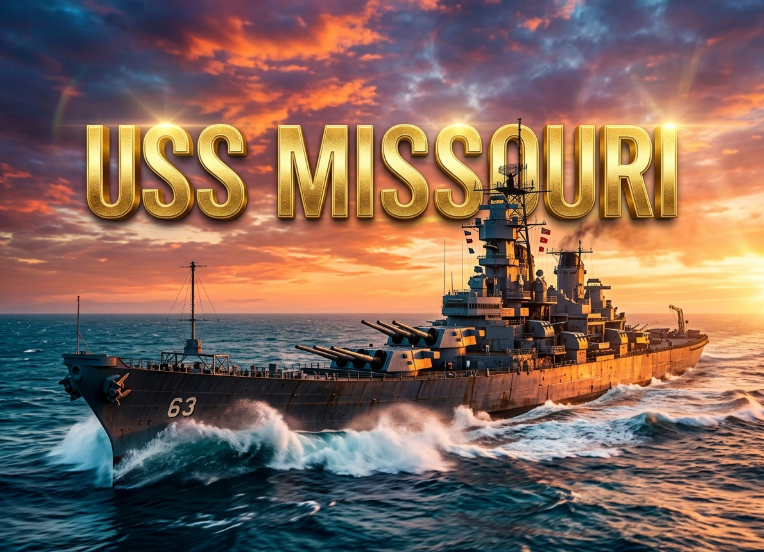
During early 1944, American naval architects at the New York Naval Shipyard completed the most advanced dreadnought in maritime history. Specifically, the USS Missouri (BB-63) fused 33-knot fleet speed with an armored citadel and nine radar-directed 16-inch guns. Consequently, the warship shielded fast carrier task forces across the western Pacific and withstood a direct kamikaze collision off Okinawa. Ultimately, on 2 September 1945, Missouri served as the floating stage where Japanese representatives signed the formal Instrument of Surrender in Tokyo Bay, thereby concluding the bloodiest conflict in human history.
Flagship of the Allied Pacific Fleet and Diplomatic Triumph
Furthermore, President Harry S. Truman selected Missouri because she bore the name of his home state and had been christened by his daughter Margaret. Therefore, Admiral William F. Halsey hoisted the four-star flag of the United States Third Fleet aboard her mainmast as Allied armadas anchored off Yokosuka. Between January 1945 and August 1945, Missouri spearheaded carrier raids against Tokyo, shelled industrial steelworks at Muroran, and sustained intense anti-aircraft defense operations. Today, the legendary dreadnought rests in Pearl Harbor as a living monument to naval engineering and international peace.
Cutaway USS Missouri Anatomy & Citadel Inspector
Engineering the Iowa-Class Fast Battleships: The Apex of Naval Architecture
During the late 1930s, escalating naval rearmament across the globe dissolved the restrictive Washington Naval Treaty limits. Consequently, the United States Navy invoked the “Escalator Clause” under the Second London Naval Treaty to expand battleship displacement from 35,000 tons to 45,000 tons standard. Furthermore, chief naval constructors prioritized unprecedented operational mobility. While earlier American dreadnoughts like the North Carolina and South Dakota classes maxed out at 27 to 28 knots, naval planners demanded 33 knots for the new Iowa class so that they could escort and protect fast fleet aircraft carriers against surface ambushes.
The Escalator Clause and Panama Canal Beam Constraints
Significantly, American naval designers faced a severe physical bottleneck known as the Panama Canal locks. Because every capital ship had to transit between the Atlantic and Pacific oceans rapidly, constructors strictly capped the maximum hull beam at 108 feet 2 inches (33.0 meters). Meanwhile, the canal lock chambers measured exactly 110 feet in clear width. Therefore, when Missouri passed through the locks, barely twelve inches of clearance separated her hull sides from the concrete walls.
To achieve 33 knots while honoring this narrow beam, engineers lengthened the waterline hull to an astonishing 887 feet 3 inches (270.4 meters). Consequently, the ship acquired a dramatic length-to-beam ratio of 8.2 to 1 and a bulbous bow that reduced hydrodynamic hull drag by seven percent. As a result, Missouri cut through open ocean swells with remarkable speed and stability.
General Electric Geared Turbines and 33-Knot Fleet Speed
Equally impressive was the engineering powerhouse churning inside her engineering spaces. Specifically, eight Babcock & Wilcox three-drum boilers supplied superheated steam at 600 pounds per square inch and 850 degrees Fahrenheit. Moreover, this steam drove four massive General Electric double-reduction geared steam turbines delivering 212,000 shaft horsepower. Consequently, the four bronze propellers—ranging up to 18.25 feet in diameter—drove the 57,500-ton battlewagon through sea trials at 33.0 knots, making the Iowa class the fastest battleships ever constructed.
Internal Armor Citadel, Decapping Plates, and Triple-Bottom Defense
Inside the hull, meanwhile, naval architects devised a sophisticated internal armor citadel. Rather than placing thick armor on the outer skin, constructors inclined a 12.1-inch (307 mm) Class A Krupp-cemented steel belt inward at a 19-degree angle. Furthermore, the outer hull plating featured a 1.5-inch special treatment steel (STS) decapping plate designed to break the hardened cap off enemy armor-piercing shells before they struck the primary belt.
Consequently, this inclined internal arrangement provided protection equivalent to 17.3 inches (439 mm) of vertical armor against plunging gunfire. Additionally, a triple-bottom hull structure with five internal longitudinal bulkheads absorbed torpedo shockwaves, safeguarding Missouri’s vital magazines and engine rooms.
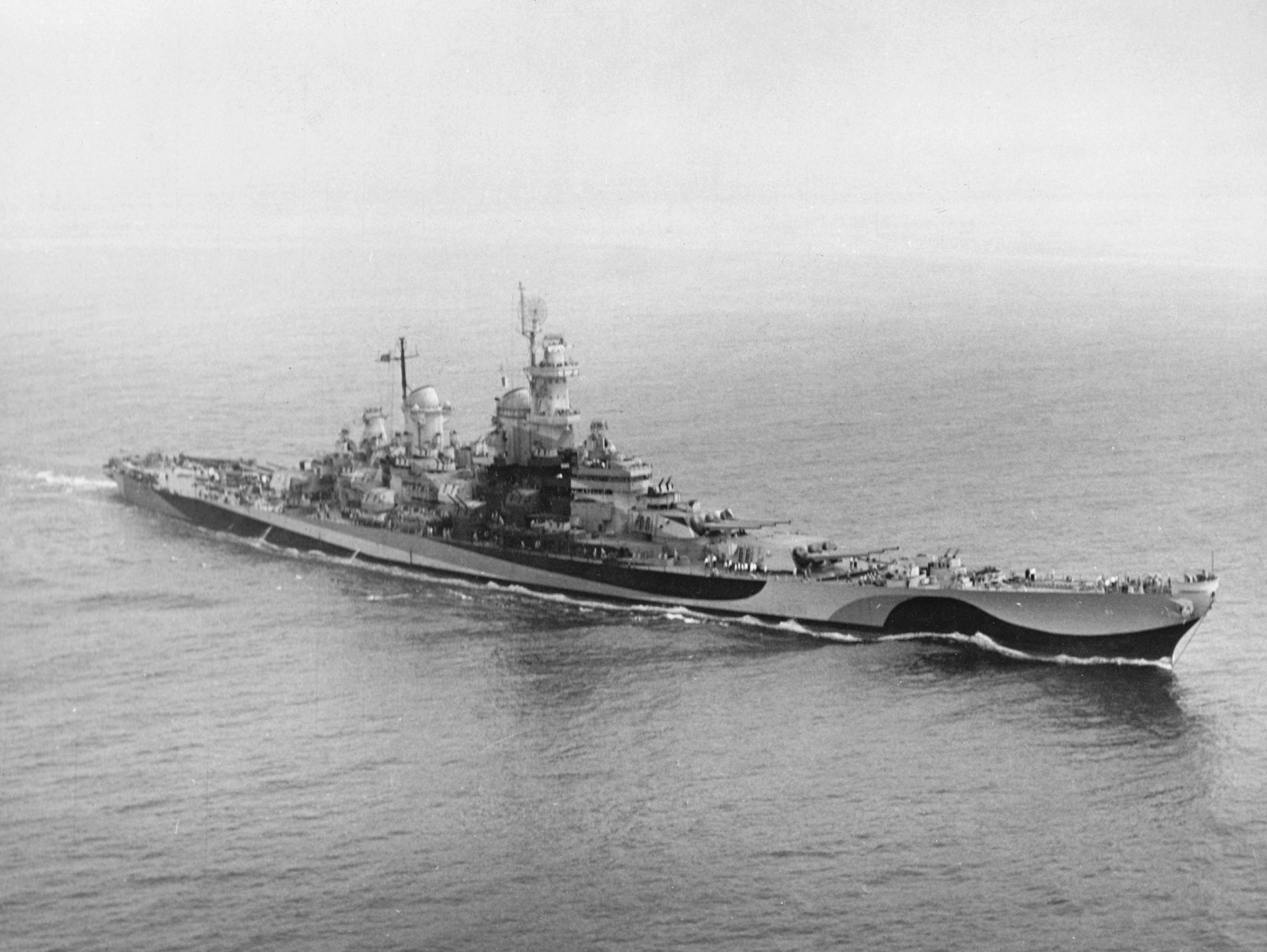
The 16″/50 Caliber Mark 7 Gun & Radar-Guided Fire Control
During combat operations, battleship firepower depended entirely on the synergy between gun mechanics and ballistic computation. Specifically, the Bureau of Ordnance armed Missouri with nine 16-inch/50 caliber Mark 7 naval guns. While earlier 16″/45 caliber rifles on the South Dakota class fired at 2,300 feet per second, the longer 50-caliber barrels extended the propellant combustion run by five feet. Consequently, this increased muzzle velocity to 2,500 feet per second and dramatically flattened the shell trajectory at medium combat ranges.
Anatomy of the 2,700-Pound Mark 8 Super-Heavy AP Shell
Moreover, American ballisticians rejected light high-velocity projectiles in favor of the devastating “Super-Heavy” 2,700-pound (1,225 kg) Mark 8 armor-piercing projectile. Because the projectile packed enormous sectional density, it retained kinetic energy through steep plunging angles at extreme ranges. When impacting at 35,000 yards, therefore, the shell struck downward at a 45-degree angle, punching cleanly through seven inches of horizontal armor deck steel.
To propel this 2,700-pound steel monolith, loaders packed six 110-pound silk powder bags containing smokeless diphenylamine-stabilized nitrocellulose propellant into the powder chamber. As a result, each full broadside fired 24,300 pounds of metal toward the enemy with pinpoint accuracy, dwarfing the broadside throw-weight of European contemporaries like the German battleship Bismarck.
The Ford Mark 8 Rangekeeper and Electromechanical Analog Computing
Equally revolutionary was the fire control suite concealed deep inside the armored plotting room beneath the waterline. There, operators ran the electromechanical Ford Mark 8 Rangekeeper. Specifically, this 3,000-pound analog computer used rotating differential gears, precision cams, and servomotors to calculate complex ballistic equations in real time. Technicians fed variables such as target bearing, enemy speed, own-ship roll and pitch, wind drift, barometric air pressure, and gun barrel powder temperature directly into the machine.
Consequently, the Mark 8 computer continuously computed the exact gun elevation and lead angle required to hit moving naval targets. Furthermore, electrical synchro transmissions linked the computer directly to hydraulic drives on each turret. Therefore, the massive 1,700-ton turrets automatically tracked the target in unison without manual pointer aiming.
Mark 38 Gun Director and Microwave Radar Gunnery at 38,000 Yards
Moreover, while Axis dreadnoughts like the colossal Japanese battleship Yamato relied primarily on optical stereoscopic rangefinders, Missouri integrated centimetric Mark 13 microwave radar atop her forward and aft Mark 38 directors. Operating at 3,000 megahertz, this radar tracked the splashes of falling shells at 38,000 yards in total night darkness, dense fog, or artificial smoke. Consequently, American fire control officers walked salvos onto target coordinates with devastating speed, rendering visual observation entirely obsolete.
Pacific Crucible: Iwo Jima, Okinawa, and the Kamikaze of 11 April 1945
Following shakedown cruises and transit through the Panama Canal, Missouri joined Vice Admiral Marc A. Mitscher’s Task Force 58 at Ulithi Atoll in January 1945. In February 1945, the battleship screened fleet aircraft carriers launching the first carrier strikes against Tokyo since the 1942 Doolittle Raid. Subsequently, the task force steamed south to Iwo Jima, where Missouri‘s 16-inch guns bombarded fortified Japanese coastal cave installations in direct support of the 4th and 5th Marine Divisions.
Screening Task Force 58 and Shore Bombardment at Iwo Jima
During the intense amphibious assaults on Iwo Jima, Missouri fired hundreds of 16-inch high-capacity explosive shells into Mount Suribachi’s subterranean concrete bunkers. Furthermore, her twenty 5-inch/38 caliber dual-purpose guns illuminated the night beaches with star shells to prevent Japanese counter-attacks. Throughout March 1945, Missouri provided round-the-clock flak cover for Task Group 58.4, throwing up a dense curtain of anti-aircraft fire from her twenty quad Bofors 40mm anti-aircraft mounts and forty-nine 20mm Oerlikon autocannons to down incoming Japanese dive-bombers.
The 11 April 1945 Kamikaze Attack: Setsuo Ishino’s A6M Zero
Subsequently, on 11 April 1945 off Okinawa, Missouri faced the most dangerous threat in naval warfare: the organized Special Attack suicide squadrons. At 14:43, a low-flying Mitsubishi A6M5 Zero piloted by 19-year-old Flight Petty Officer 2nd Class Setsuo Ishino emerged from low cloud cover. Although rapid-fire 40mm Bofors shells shredded the fighter’s port wing, the Zero retained momentum and slammed into Missouri‘s starboard quarter just below the main deck rail at Frame 169.
The violent impact tore the aircraft apart, scattering flaming aviation gasoline across the weather deck and catapult area. Furthermore, the 550-pound bomb carried by the plane miraculously failed to detonate, shearing away on contact and tumbling into the sea. Damage control teams led by Chief Boatswain’s Mates responded instantly, smothering the flames with chemical foam within ninety seconds. As a result, the ship sustained only cosmetic paint blistering and a minor dent in the side plating.
Captain William M. Callaghan’s Controversial Military Burial with Honors
Meanwhile, amid the wreckage on the deck, sailors discovered the partial remains of the Japanese pilot. Despite vehement objections from several wounded crewmen who demanded the corpse be thrown into the sea, Missouri‘s commanding officer, Captain William M. Callaghan, made an extraordinary command decision. Specifically, Callaghan declared that the enemy pilot had performed his duty with utmost bravery and deserved an honorable soldier’s burial.
Consequently, the ship’s medical corps and deckhands prepared the pilot’s body, while Navy seamstresses stitched a makeshift Japanese battle flag. On the morning of 12 April 1945, as the crew stood at attention and a marine bugler sounded Taps, six American pallbearers committed the fallen aviator to the deep with full military honors. Today, this act remains one of the most famous examples of naval chivalry in the Pacific War.
The Road to Tokyo Bay: Potsdam Declaration and Operation Downfall Canceled
By May 1945, Missouri had become the flagship of Admiral William F. Halsey’s formidable United States Third Fleet. In July, Halsey directed the fast battleships of Task Group 38.4 to execute heavy daylight coastal bombardments directly against the Japanese Home Islands. On 15 July 1945, Missouri spearheaded a devastating bombardment of the Nihon Steel Works and Wanishi iron foundries at Muroran, Hokkaido. Firing 860 tons of high-explosive ordnance, her 16-inch shells smashed industrial furnaces and crippled northern coal transportation networks.
Third Fleet Carrier Strikes on Honshu and Muroran Shore Bombardment
Two days later, Missouri teamed with British battleships HMS King George V and HMS Duke of York to shell industrial complexes at Hitachi, northeast of Tokyo. Meanwhile, carrier air wings from the fleet hammered Japanese airfields and naval anchorages at Kure. Consequently, by late July, the Imperial Japanese Navy ceased to exist as an effective fighting force, leaving Allied battleships free to operate within ten miles of the Japanese coast.
The Atomic Bombings, Soviet Invasion, and Emperor Hirohito’s Broadcast
Then, in early August 1945, strategic events accelerated with dramatic speed. Specifically, the United States dropped atomic bombs on Hiroshima on 6 August and Nagasaki on 9 August, while the Soviet Union launched a massive armored offensive across Manchuria. Recognizing that national annihilation was imminent, Emperor Hirohito intervened directly against military hardliners. On 15 August 1945, Hirohito’s recorded radio broadcast (the Gyokuon-hōsō) announced Japan’s acceptance of the Allied Potsdam Declaration terms, bringing combat hostilities to an end and canceling Operation Downfall.
Selecting Missouri: President Harry S. Truman’s Personal Connection
Shortly thereafter, debate arose over where to hold the formal surrender ceremony. While General Douglas MacArthur requested a ceremony on land, naval leaders strongly argued for a naval presentation on a capital ship. Ultimately, President Harry S. Truman settled the question by selecting the USS Missouri. Beyond honoring the home state of the Commander-in-Chief, Missouri symbolized the industrial might of American shipyards that had built the victorious Pacific armada from scratch.
Sunday, 2 September 1945: The Instrument of Surrender Ceremony in Tokyo Bay
On the humid, overcast morning of Sunday, 2 September 1945, Tokyo Bay presented an unforgettable spectacle of naval majesty. Over 250 Allied warships rode at anchor across the calm bay waters, their gray hulls stretching toward the horizon. At Position 35° 21′ North, 139° 40′ East, roughly four miles off Yokosuka, the USS Missouri swung gently with the tide. Sailors in immaculate summer white uniforms lined the rails, turrets, and superstructure platforms four levels high to witness the historic proceedings.
The Allied Fleet Gathers at Position 35° 21′ N, 139° 40′ E
At 08:05, Fleet Admiral Chester W. Nimitz boarded Missouri, breaking his five-star flag at the mainmast. Shortly thereafter, at 08:43, Supreme Commander for the Allied Powers General of the Army Douglas MacArthur arrived from the destroyer USS Buchanan. Notably, framed behind the ceremonial tables hung the historic 31-star American flag that Commodore Matthew C. Perry had flown in 1853 when his “Black Ships” first entered Tokyo Bay to open Japan to Western trade.
Arrival of Mamoru Shigemitsu and General Yoshijirō Umezu
At 08:56, the eleven-man Japanese delegation stepped aboard Missouri from the motor launch of USS Lansdowne. Heading the civilian mission was Foreign Minister Mamoru Shigemitsu, wearing formal morning dress, a silk top hat, and leaning heavily on a cane due to a prosthetic leg. Alongside him marched General Yoshijirō Umezu, Chief of the Imperial Japanese Army General Staff, clad in olive service uniform. Accompanied by three foreign ministry officials, three army officers, and three naval commanders, the delegation halted quietly before the green baize-covered surrender table on the veranda deck.
At exactly 09:02, General MacArthur stepped forward before a bank of microphones to deliver his opening address, declaring: “It is my earnest hope, and indeed the hope of all mankind, that from this solemn occasion a better world shall emerge out of the blood and carnage of the past.”

General Douglas MacArthur’s Historic Address and Five Parker Pens
At 09:04, Foreign Minister Shigemitsu signed the two copies of the Japanese Instrument of Surrender on behalf of the Emperor and Japanese Government. Subsequently, at 09:06, General Umezu signed for the Imperial General Headquarters. Next, General MacArthur sat at the table to sign as Supreme Commander for the Allied Powers. Dramatically, MacArthur invited two gaunt, recently liberated prisoner-of-war generals to stand behind him: American Lieutenant General Jonathan M. Wainwright (hero of Corregidor) and British Lieutenant General Sir Arthur E. Percival (commander at Singapore).
Specifically, MacArthur used five distinct fountain pens to write his signature. He handed the first pen to Wainwright, the second to Percival, sent the third to the US Military Academy at West Point, reserved the fourth for the National Archives, and gifted the fifth to his wife Jean. Following MacArthur, Fleet Admiral Nimitz signed for the United States, followed by representatives from China, the United Kingdom, the Soviet Union, Australia, Canada, France, the Netherlands, and New Zealand.

The 1,900-Plane Allied Aerial Armada Over Tokyo Bay
At 09:25, MacArthur stepped to the microphones and delivered the final sentence of the global conflict: “These proceedings are closed.” Immediately, as the Japanese delegation departed, the overcast sky broke and golden sunlight poured across Tokyo Bay. Simultaneously, a deafening thunder shook the fleet as 450 carrier fighters and dive-bombers from Task Force 38 swept low over the masts in massed formation.
Behind the naval aircraft followed hundreds of Boeing B-29 Superfortresses flying in majestic echelons from the Marianas. In total, over 1,900 Allied military aircraft filled the skies over Tokyo Bay in an awe-inspiring demonstration of aerial supremacy, officially cementing the final victory of World War II.
Restoring the Tokyo Bay Surrender in Authentic 4K Color
Because original September 1945 35mm and 16mm Kodachrome and black-and-white nitrate film suffered from chemical degradation, dust scratches, and color fading, our restoration laboratory systematically rebuilt these historical records. Specifically, technicians apply AI-assisted optical scratch removal, luminance de-flickering, and multi-spectral color grading verified against official US Navy Bureau of Ships camouflage specifications.
Historical US Navy Measure 22 Camouflage Standards
First, our colorists verified the exact paint scheme worn by Missouri on Surrender Day. During late 1944, shipyard workers applied Measure 22 graded camouflage: Navy Blue (5-N) along the lower hull up to the lowest point of the main deck, transitioning to Haze Gray (5-H) across all vertical superstructure surfaces, and Deck Blue (20-B) on all horizontal wood and steel decks.
Furthermore, our pipeline accurately restores the khaki and summer-white uniforms of the Allied delegates, the deep olive service dress of General Umezu, and the formal black morning coat of Foreign Minister Shigemitsu. By utilizing the interactive optical inspector opposite, you can compare raw monochrome negatives with our 4K restored masters, or launch our full vertical cinema deck below.

4K Fleet Video Pavilion & Historical Reels
Explore our exclusive collection of eleven 4K restored vertical telemetry reels and historical shorts documenting the USS Missouri, the Iowa-class fast battleships, and the Tokyo Bay surrender ceremony. Click any card below to launch the video directly in our high-end theater stage or watch directly on YouTube and Facebook.
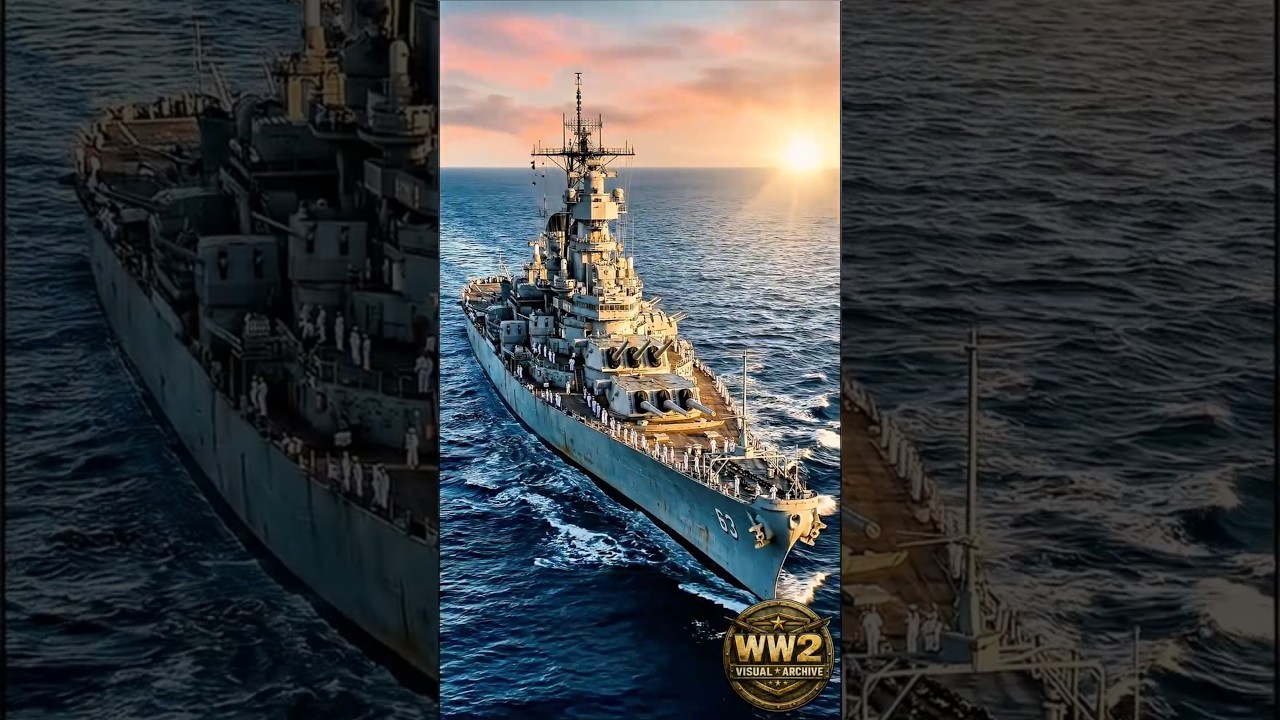
USS Missouri: Steel, Firepower & Naval Legend
Specifically examines Missouri‘s steel citadel, armor-piercing broadsides, and operational history in World War II combat.
USS Missouri: The Historic Day World War II Ended
Furthermore, showcases Japanese representatives signing the formal surrender aboard Missouri to conclude the global conflict.

Mighty Iowa-Class Quartet Sailing in 4K
Moreover, presents all four completed Iowa-class dreadnoughts—Iowa, New Jersey, Missouri, and Wisconsin—assembled in breathtaking 4K clarity.

Honoring the Exact Spot of Japan’s Surrender
Additionally, visualizes the commemorative bronze plaque embedded into the teak deck where the surrender instruments were signed.

USS Missouri Maneuvering at Norfolk Naval Base
Here, high-altitude cameras capture tugboats guiding Missouri‘s 887-foot hull into Norfolk berths ahead of Korean War service.

Iowa Class: Built for Speed & Hard-Hitting Power
Consequently highlights the 33-knot design doctrine, high length-to-beam ratio, and heavy armor belts of the four sisters.
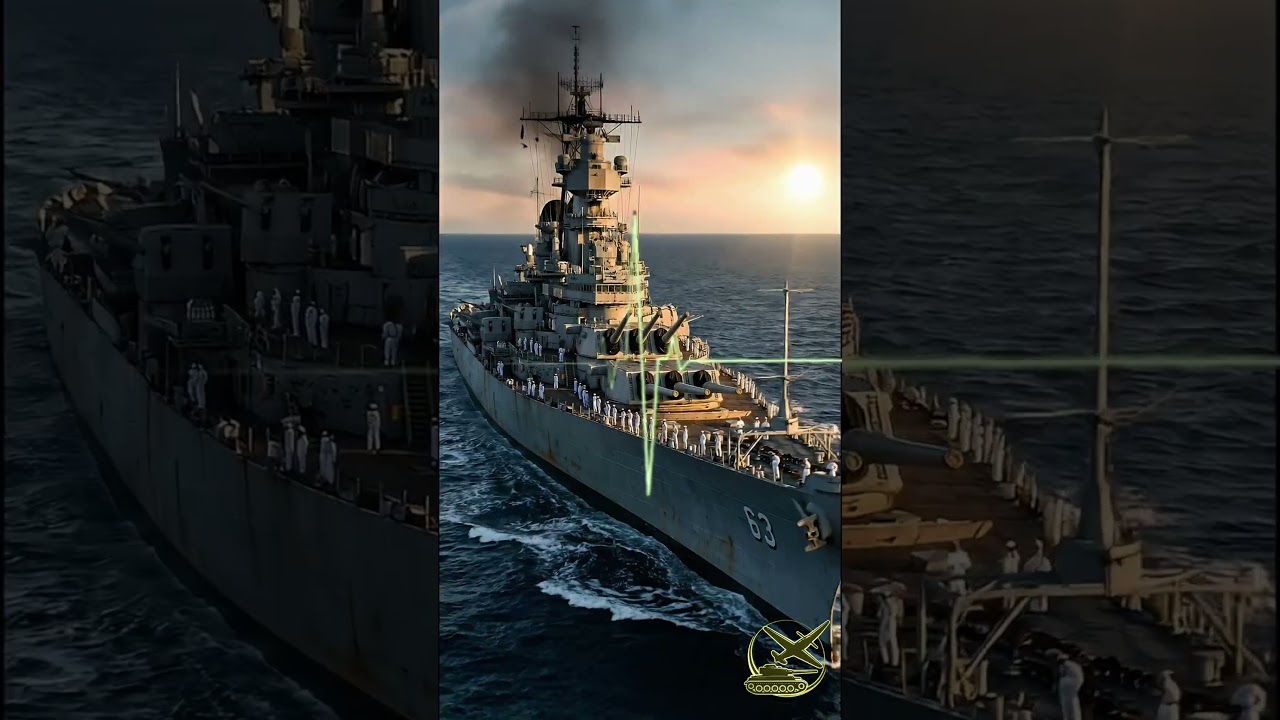
USS Missouri: The Last Commissioned US Battleship
Notably marks Missouri‘s commissioning in June 1944 as the final battleship ever completed for the United States Navy.
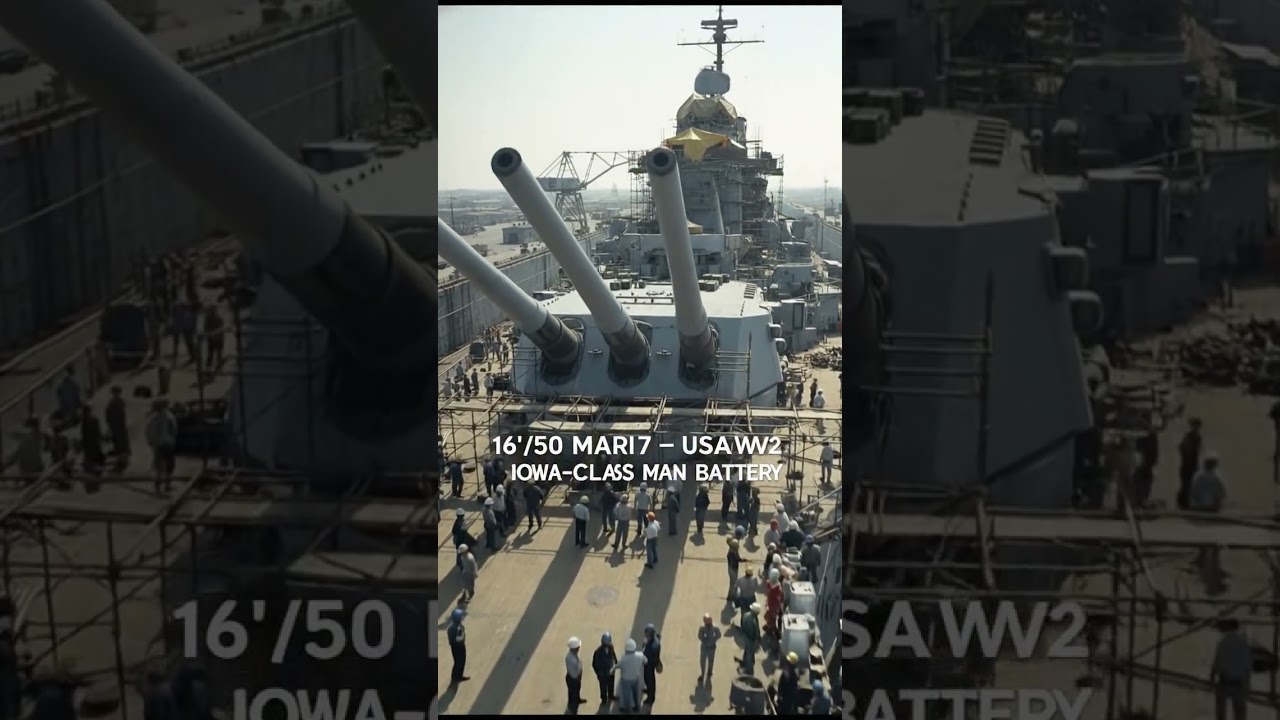
16″/50 Mark 7: America’s Most Powerful Artillery
Specifically details the 66-foot rifled barrels, shell handling elevators, and 2,700-pound super-heavy AP shells.

USS Missouri: Stage of the Final Surrender
Finally, recaps the 23-minute signing ceremony and Allied flyover that brought peace to the Pacific Basin.
USS Missouri Historical Colorization Reel I
Features our social media edition showing the deck preparations and arrival of General MacArthur on the veranda deck.
USS Missouri Historical Colorization Reel II
Visualizes the dramatic 1,900-plane flyover and departure of the Japanese delegates across Tokyo Bay.
Play “Mighty Mo: Pacific Flak & 16-Inch Gunnery Command”
Take direct command of the guns of USS Missouri (BB-63). Aim your crosshair across the sky to stream rapid-fire 40mm Bofors flak against incoming Japanese kamikaze strike aircraft. Press SPACEBAR or tap 💥 FIRE 16-INCH SALVO to unleash a devastating broadside that shakes the screen and clears target sectors!
Mark 38 Fire Control Director & Flak Defense Viewport
The Titans of Steel: USS Missouri vs. World War II Dreadnoughts
Compare the technological specifications, armor citadels, main artillery, top speeds, and operational fates of twelve iconic World War II capital ships. Filter by tactical classification or sort by displacement, gun caliber, speed, or belt thickness below to inspect declassified naval telemetry.
Interactive Capital Ship Selector & Comparative Filter Matrix
USS Missouri (BB-63) — “Mighty Mo”
Specifically engineered as the ultimate expression of American fast battleship doctrine, fusing 33.0 knots speed with an internal 12.1-inch inclined armor belt, nine radar-directed 16″/50 cal Mark 7 guns, and advanced analog computing.
The Tokyo Bay Surrender Protocol: Minute-by-Minute Chronicle
Trace the exact sequence of historical events that transpired on Missouri‘s veranda deck between 08:00 and 09:30 Tokyo Time on 2 September 1945. Select any chronological timestamp below to examine the declassified diplomatic protocol, signatory biographical profiles, and official remarks.
Select a Surrender Milestone Timestamp (08:00 – 09:30 Tokyo Time)
Admiral Sir Bruce Fraser Boards from HMS Duke of York
British Admiral Sir Bruce Fraser, Commander-in-Chief of the British Pacific Fleet, arrives alongside USS Missouri from his flagship HMS Duke of York to lead the Commonwealth delegation.
Master History Challenge: Test Your Knowledge of USS Missouri
Test your understanding of USS Missouri‘s design specifications, the 11 April 1945 kamikaze strike, the Tokyo Bay surrender protocol, and the Allied signatories across ten comprehensive historical questions. Receive instant scoring feedback and advance through official US Navy ranks!
Why was USS Missouri selected over USS Iowa or USS South Dakota for the formal surrender ceremony?
Post-War Service: Korea, 1980s Modernization, Desert Storm, and Pearl Harbor
Following the Japanese surrender, Missouri‘s combat career was far from over. In 1950, when North Korean forces invaded South Korea, Missouri became the first American battleship to reach the war zone. During the pivotal Inchon Amphibious Landing in September 1950, her 16-inch guns pulverized North Korean coastal batteries at Samchok, diverting enemy reserves and securing the landing beaches for General MacArthur’s X Corps.
The Korean War: Inchon Invasion and Hungnam Shore Bombardment
Furthermore, in December 1950, when Chinese forces encircled American forces at the Chosin Reservoir, Missouri stood offshore at Hungnam. Firing thousands of 16-inch high-capacity and 5-inch shells day and night, the battleship formed an impenetrable ring of artillery fire around the perimeter, successfully safeguarding the evacuation of over 100,000 Allied troops and 98,000 North Korean refugees. Although briefly decommissioned in 1955, the dreadnought remained preserved in reserve fleet storage.
1980s 600-Ship Navy Modernization: Tomahawk and Harpoon Missiles
Subsequently, in 1984, President Ronald Reagan and Navy Secretary John Lehman ordered the modernization of the four Iowa-class battleships as part of the 600-Ship Navy program. Technicians at Long Beach Naval Shipyard stripped Missouri of her obsolete 20mm and 40mm anti-aircraft guns. Instead, they installed thirty-two BGM-109 Tomahawk land-attack cruise missiles in eight armored box launchers, sixteen RGM-84 Harpoon anti-ship missiles, four 20mm Phalanx Close-In Weapon Systems (CIWS), and modern digital satellite navigation suites.
Operation Desert Storm (1991): The Final Combat Salvoes of a Battleship
In January 1991, Missouri deployed to the Persian Gulf for Operation Desert Storm. On the opening night of the air war, 17 January 1991, she fired twenty-eight Tomahawk cruise missiles into Iraqi command headquarters in Baghdad. Over the following weeks, Missouri fired 783 16-inch shells (over one million pounds of ordnance) against Iraqi artillery bunkers along the Kuwaiti coast, executing the final combat broadsides ever fired by a battleship in world history. Just as Allied naval strategy had evolved from hunting German U-boats and dealing with Luftwaffe aircrews armed with survival weapons like the German M30 Drilling rifle, Missouri demonstrated that heavy naval guns remained unmatched in raw demolition power.
Resting in Honor at Pearl Harbor: Facing the USS Arizona Memorial
Finally, on 31 March 1992, Missouri was decommissioned for the final time. Today, the legendary dreadnought rests at Pier Foxtrot 5 on Battleship Row in Pearl Harbor, Hawaii, as the centerpiece of the Battleship Missouri Memorial. Poignantly, her massive bow points directly toward the submerged hull of the sunken battleship USS Arizona (BB-39). Together, the two ships bookend America’s involvement in World War II: Arizona marks the tragic beginning on 7 December 1941, while Missouri marks the triumphant surrender that brought eternal peace.
Explore Connected Naval & Capital Ship Dossiers in Our Archive
Expand your historical exploration across our 4K colorized naval and military archive. Every dossier below connects directly to the battleship gunnery duels, carrier warfare, anti-aircraft weaponry, and fleet armor doctrines of the Second World War.
USS Iowa-Class Fast Battleships Archive
Examine the shared 33-knot design lineage, 16″/50 Mark 7 guns, and service records of Iowa, New Jersey, Missouri, and Wisconsin.
Battleship Yamato — 4K Colorized Restoration
Investigate the 71,659-ton leviathan armed with 18.1-inch main guns that symbolized Imperial Japan’s capital ship doctrine.
German Battleship Bismarck — 4K Naval Dossier
Analyze the 12.6-inch Krupp belt armor architecture, Denmark Strait duel, and Atlantic pursuit of Germany’s premiere battleship.
HMS Hood — Pride of the Royal Navy
Step aboard the legendary British battlecruiser to examine horizontal deck armor vulnerabilities and interwar fleet supremacy.
German U-Boats of WWII — The Atlantic War
Explore the Type VII and Type XXI submarines that tested Allied anti-submarine escorts and convoy defense networks.
Bofors 40mm Anti-Aircraft Gun Technical Study
Analyze the rapid-fire quad autocannon that armed USS Missouri with eighty barrels of devastating anti-kamikaze defense.
German M30 Drilling Triple-Barrel Survival Rifle
Inspect the Sauer & Sohn combination shotgun-rifle issued to Luftwaffe bomber aircrews during World War II.
Primary Archival Resources & Declassified Naval Records
Every ballistic metric, armor thickness, operational date, and photographic plate in this dossier is corroborated by primary documents preserved in the National Archives and naval museum archives.
Official Naval History, Government Archives & Museum Collections
Houses Record Group 38 (Chief of Naval Operations War Diaries), Record Group 19 (Bureau of Ships Hull Design Blueprints for BB-61 through BB-66), and official 80-G series photographic negatives of the 2 September 1945 surrender ceremony (NARA Archives).
02 — Naval History and Heritage Command (NHHC, Washington Navy Yard)Maintains official Action Reports for USS Missouri (BB-63), including the 11 April 1945 Kamikaze Damage Report, Third Fleet War Diary (July–August 1945), and the declassified Japanese Instrument of Surrender Historical Collection.
03 — Battleship Missouri Memorial Archives (Pearl Harbor, Hawaii)Preserves physical ship blueprints, oral histories from crew members present on Surrender Day, the original bronze surrender deck plaque documentation, and curatorial research papers (USS Missouri Memorial Association).
04 — The General Douglas MacArthur Memorial & Archives (Norfolk, Virginia)Custodians of MacArthur’s personal papers, ceremonial drafts of his 2 September 1945 radio broadcast, photographs of the surrender table, and one of the five historic Parker fountain pens used to sign the surrender (MacArthur Memorial).
05 — United States Strategic Bombing Survey (USSBS Pacific Reports)Provides official post-war damage evaluations of naval gunfire against the Japanese mainland, including Missouri‘s 16-inch bombardments of the Nihon Steel Works at Muroran and Hitachi industrial facilities (NARA USSBS Records).
06 — Published Authoritative Naval Monographs & Technical StudiesKey scholarly references include Norman Friedman, U.S. Battleships: An Illustrated Design History (Naval Institute Press, 1985); Paul Stillwell, Battleship Missouri: An Illustrated History (1996); and Samuel Eliot Morison, Victory in the Pacific 1945 (Little, Brown, 1960).