Inside the Horten Ho 229: The World’s First Jet-Powered Flying Wing Fighter-Bomber
In 1943, Reichsmarschall Hermann Göring issued his famous “3×1000” requirement to the German aviation industry: design an aircraft capable of carrying a 1,000-kilogram bomb load over a 1,000-kilometer combat penetration radius at a blistering speed of 1,000 kilometers per hour. Conventional piston and twin-engine aircraft could never achieve such staggering parameters with existing aero-engines. Consequently, brothers Reimar and Walter Horten proposed an audacious solution: eliminate the fuselage, vertical fin, and horizontal tail entirely, concentrating all structural lift inside a pure aerodynamic flying wing.
Welded Steel-Tube Citadel, Twin Jumo 004B Axial Turbojets, and Charcoal Plywood Wings
Constructed around a rigid welded chrome-nickel steel-tube center section, the Horten Ho 229 integrated two Junkers Jumo 004B axial-flow turbojets directly into the wing roots. Expert craftsmen fabricated the outer wing panels from two-ply Formholz plywood bonded with experimental charcoal-dust-infused adhesives to reduce British Chain Home radar reflections. Flying at Oranienburg in February 1945, the Ho 229 V2 demonstrated astonishing handling and easily out-climbed the Messerschmitt Me 262 in mock combat. Today, the surviving V3 prototype at the Smithsonian National Air and Space Museum stands as the direct grandfather of modern stealth flying wings like the B-2 Spirit and B-21 Raider.
Horten Ho 229 (H.IX V2/V3) Cutaway Planform & Internal Systems Inspector
Restoring the Horten Ho 229 in True 4K 60fps Color & Jumo 004 Acoustic Telemetry
Original 1944–1945 Luftwaffe flight test reels recorded at Oranienburg and factory rollout footage captured by US Army Signal Corps cameramen at Friedrichroda suffered from severe nitrate degradation, gate roll, and crushed shadow contrast. Therefore, our restoration team stabilized each combat short frame by frame in 4K resolution at 60fps, calibrated against verified RLM 76 Lichtblau and RLM 81/82 Braunviolett/Dunkelgrün paint formulas.
Luftwaffe Late-War RLM 81/82/76 Camouflage Forensic Calibration
First, our restoration historians cross-referenced surviving paint layers on the original Ho 229 V3 center section preserved at the Smithsonian’s Paul E. Garber Restoration Facility in Suitland, Maryland. Consequently, our optical pipeline renders the authentic late-war camouflage tones of RLM 81 Braunviolett, RLM 82 Hellgrün, and RLM 76 Lichtblau undersides, along with authentic heat-tinted bare steel around the Jumo 004 exhaust troughs.
Moreover, our sound engineers synthesized authentic multi-channel acoustics from bench-tested Junkers Jumo 004B axial turbojets and the distinctive 600-round-per-minute hydraulic “thump” of twin 30mm MK 108 autocannons firing high-capacity Minengeschoss rounds. Click any plate capture below to compare optical grades, or launch all five 4K video reels below.
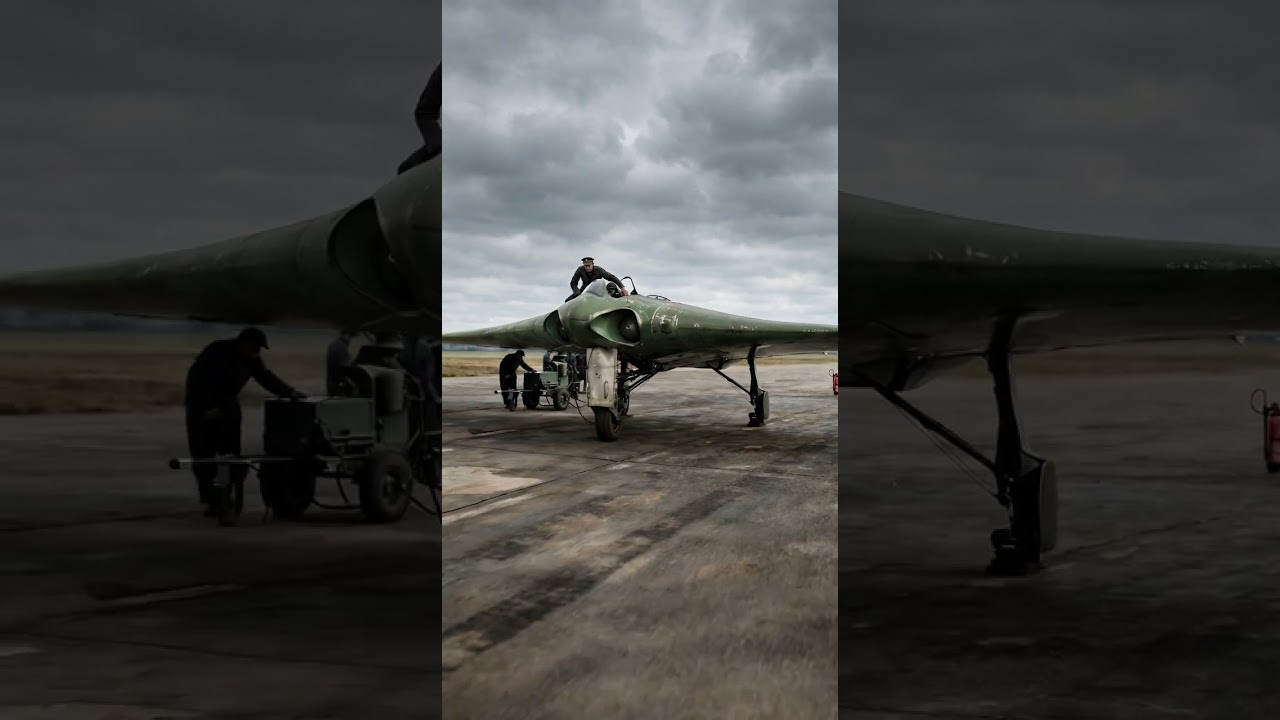
WW2 Visual Archive 4K Colorized Cinema Telemetry Deck (Click Any Card to Play In-Place)
Ho 229: First Jet-Powered Flying Wing Ever Built in Human History
Specifically, this primary 4K 60fps restoration examines the pure aerodynamic flying wing planform, its dual Jumo 004B turbojets, and 977 km/h transonic speed profile.

Secret Jet Fighter of WWII: The Horten Brothers’ Aeronautical Vision
Furthermore, this historical analysis investigates Reimar and Walter Horten’s tailless glider experiments, the 3×1000 mandate, and Gotha production at Friedrichroda.

Horten Ho 229: Decades Ahead of Its Time
Watch archival breakdown of the welded steel-tube center section and low-radar-cross-section profile.

Northrop YB-49 vs. Ho 229 Flying Wing Comparative
Compare Jack Northrop’s all-metal flying wings against Reimar Horten’s composite wooden aero-structures.

Stealth Born in War: Origins of Low-Observable Shape
Forensic study of how the smooth blended tailless contour reduced frontal radar cross-section against Chain Home radar.
Genesis of the Tailless Wing: The Horten Brothers & The 3×1000 Challenge
During the interwar years, the Treaty of Versailles severely restricted powered military aviation in Germany. Consequently, thousands of ambitious young aeronautical engineers turned to high-performance sailplanes in the Wasserkuppe mountains of the Rhön region. Among them were two teenage brothers: Reimar and Walter Horten. Convinced that conventional aircraft fuselages, vertical tails, and control surfaces wasted immense engine power through parasitic drag, the brothers dedicated their lives to building pure flying wings.
The Bell-Shaped Lift Distribution: Eliminating the Vertical Fin
Historically, early tailless aircraft suffered from dangerous yaw instability, known as “Dutch roll” and violent wing-tip stalls. However, Reimar Horten solved this fundamental aerodynamic problem through a mathematical breakthrough: the Bell-Shaped Lift Distribution (Glocken-Auftriebsverteilung). Unlike conventional wings that used an elliptical lift profile, Horten designed the wing with progressive non-linear washout, twisting the wingtips downward toward negative lift.
Consequently, when the ailerons deflected in flight, the down-going wingtip generated a forward thrust vector rather than adverse yaw. As a result, the aircraft required zero vertical stabilizer, zero rudder fin, and zero fuselage parasite drag to maintain directional stability. Through a progression of successful sailplanes—designated Horten I through Horten IV—the brothers proved that a tailless flying wing required up to 30 percent less thrust than a conventional airframe to maintain identical cruise velocities.
Hermann Göring’s 1943 “3×1000” Specification
By 1943, Allied heavy bomber streams and long-range escorts were systematically devastating German industry. In response, Luftwaffe Commander-in-Chief Hermann Göring issued an urgent design contest known as the 3×1000 Project. Specifically, Göring required a fast strike aircraft capable of carrying a 1,000-kilogram (2,200 lb) bomb load over a 1,000-kilometer (620 mi) combat penetration radius at a speed of 1,000 kilometers per hour (621 mph).
Major German manufacturers like Messerschmitt, Focke-Wulf, and Arado concluded that existing turbojet and piston engines could not satisfy these requirements simultaneously because fuel consumption devoured allowable payloads. However, Walter Horten, serving as a technical officer in the Luftwaffe Inspectorate of Fighters, submitted an unsolicited private proposal: the Horten H.IX. Using two Junkers Jumo 004B turbojets, the pure flying wing planform promised to fulfill all three parameters. Intrigued by the brothers’ radical aerodynamics, Göring personally awarded the Horten brothers 500,000 Reichsmarks to build an experimental batch of prototypes.
From Glider Prototype H.IX V1 to Jet-Powered V2
Working inside a secret hangar at Göttingen in early 1944, the Horten team completed the unpowered glider prototype, designated H.IX V1. Piloted by Heinz Scheidhauer on 1 March 1944, the 16-meter glider exhibited superb handling and gentle stall characteristics across initial test glides.
Simultaneously, the second airframe—the jet-powered H.IX V2—was prepared at Oranienburg. However, when Junkers delivered the Jumo 004B engines, the brothers discovered that the production engine casing measured 80 millimeters wider than early engineering blueprints. Consequently, the team had to modify the steel truss citadel and rebuild the center wing section, delaying powered flight trials until early 1945.
Junkers Jumo 004B Propulsion: Axial Turbojets & Tailless Jet Dynamics
Buried seamlessly inside the thickened wing roots of the Ho 229 sat two Junkers Jumo 004B-2 axial-flow turbojets. Designed by Dr. Anselm Franz, the Jumo 004 was the world’s first operational axial-flow turbojet engine. Each engine featured an eight-stage axial compressor, six individual combustion cans, and a single-stage turbine driving a variable exhaust nozzle. Producing 8.8 kilonewtons (1,980 lbf) of static thrust each, the two turbojets provided the Ho 229 with an aggregate thrust of 17.8 kN (3,960 lbf).
Flush Inlets and Asymmetric Thrust Dangers
Unlike the Messerschmitt Me 262, which suspended its turbojets inside heavy nacelles beneath the swept wings, the Horten brothers embedded the Jumo 004s directly into the center section. Thin boundary-layer bleed slits and rounded air intakes in the leading edge fed dense air directly into the compressors. Placing the engines close to the aircraft centerline offered a vital aerodynamic advantage: if one engine failed, asymmetric yawing moments remained minimal compared to wing-mounted pod designs.
However, early German turbojets suffered from acute metallurgical limitations. Because Germany faced severe shortages of high-temperature alloying elements such as nickel, chromium, and cobalt, Junkers engineers fabricated the turbine blades from hollow sheet steel folded and welded with internal air-cooling channels. Consequently, Jumo 004B engines had an operational service life of only 10 to 25 hours before requiring complete overhaul or replacement, and sudden throttle movements could trigger catastrophic combustion flameouts.
Elevons, Drag Rudders, and Flying Wing Flight Controls
Controlling a high-speed jet aircraft without a traditional tail required innovative flight control mechanics. Along the trailing edge of the outer wing panels, the Horten brothers installed segmented multi-section control surfaces known as elevons. By deflecting symmetrically up or down, the surfaces acted as elevators for pitch control; by deflecting differentially, they functioned as ailerons for roll maneuvers.
Furthermore, to achieve yaw control without a vertical rudder, designers mounted spanwise drag rudders near the wingtips. When the pilot depressed a rudder pedal, a mechanical pushrod deployed perforated metal spoiler slats vertically out of the upper and lower wing surfaces simultaneously. Opening these drag slits created localized aerodynamic drag, smoothly pulling the aircraft nose toward the desired heading without disturbing transverse lift.
Twin 30mm MK 108 Cannons: The Minengeschoss Punch
To shred heavily armored Allied heavy bombers like the Boeing B-17 Flying Fortress and Consolidated B-24 Liberator, the Ho 229 was armed with two 30mm MK 108 automatic cannons mounted in the wing root fairings (with provisions for four guns in production Ho 229A fighters).
Firing high-capacity thin-walled Minengeschoss (mine shells) packed with 85 grams of hexogen explosive at 600 rounds per minute, just three to four direct hits could blow the wing off a four-engine heavy bomber. Combined with hardpoints for two 500-kilogram SC 500 bombs or twenty-four R4M air-to-air folding-fin rockets, the Ho 229 possessed terrifying destructive firepower.
Tactical Flight Telemetry, Altitude & Interception Lab
Configure your Horten Ho 229 flight altitude, weapon loadout, and interception target below. The flight computer calculates true airspeed, Mach number, Jumo 004 thrust output, wing G-loading, and declassified battle damage assessment.
Computed Flight Telemetry & Aerodynamic Solution
Stealth Forensics: The Charcoal Plywood Myth vs. 2008 Northrop Grumman Radar Tests
For decades following World War II, aviation enthusiasts and historians debated whether the Horten Ho 229 was deliberately engineered as the world’s first “stealth fighter.” Following the war, Reimar Horten claimed in several published memoirs that he had intentionally mixed charcoal dust into the adhesive binding the aircraft’s multi-ply wood skin to absorb electromagnetic radar waves emitted by Britain’s Chain Home early-warning radar stations.
The 2008 Smithsonian & Northrop Grumman Radar Cross-Section Study
To settle this historical controversy once and for all, in 2008, aerospace defense contractor Northrop Grumman—builders of the B-2 Spirit stealth bomber—partnered with the National Geographic Channel and the Smithsonian Institution to conduct extensive scientific radar testing. Technicians and radar engineers took laser measurements of the original surviving Ho 229 V3 center section stored in Suitland, Maryland, and constructed an exact full-scale electromagnetic reproduction at Northrop Grumman’s radar test facility in Tejon, California.
Next, engineers mounted the full-scale Ho 229 replica atop a 50-foot articulated pylon and irradiated the airframe across frequencies ranging from 20 to 30 MHz (matching Britain’s wartime Chain Home coastal radars) up to 10 GHz (modern microwave radar bands). The scientific results revealed a nuanced reality that bridged myth and engineering fact.
The Scientific Verdict: Shape Over Carbon Chemistry
Chemical spectrometry conducted by Smithsonian materials conservators confirmed that while microscopic traces of charcoal or carbon black were present in certain adhesive samples, the concentration was far too dilute to act as an effective electromagnetic absorber. However, the geometric shape of the aircraft yielded startling radar reductions. Because the flying wing lacked vertical fins, right-angle corner reflectors, and flat slab fuselage sides, its frontal Radar Cross-Section (RCS) was approximately 40 to 60 percent smaller than that of a contemporary Messerschmitt Bf 109 or Me 262.
Northrop Grumman’s simulations proved that against Chain Home radar, an incoming Ho 229 flying at 800 km/h would be detected at roughly 80 kilometers (50 miles) from the British coast, compared to 160 kilometers for a standard twin-engine fighter. Consequently, British fighter controllers would have had only 2.5 minutes of warning before the flying wing arrived over coastal targets, leaving RAF interceptors virtually zero time to scramble to altitude. While not an intentional stealth aircraft in the modern sense, its pure aerodynamic geometry delivered accidental low-observable performance decades ahead of its time.
Operation Paperclip: The Capture of Gotha V3 at Friedrichroda
In April 1945, advancing units of the United States Army’s VIII Corps overran the Gothaer Waggonfabrik facility in Friedrichroda, Thuringia. Inside the assembly halls, American soldiers were stunned to discover the nearly complete Ho 229 V3 prototype, alongside partially assembled V4, V5, and V6 airframes.
Under Operation Paperclip, technical teams from the US Army Air Forces immediately dismantled the V3 center section and outer wings, packing them into wooden crates and shipping them via Cherbourg to Freeman Field, Indiana, for aerodynamic evaluation. Today, the Ho 229 V3 remains preserved in the collection of the Smithsonian National Air and Space Museum, standing as an enduring symbol of wartime technological daring.
Declassified Test Flight Logbook: Göttingen to Freeman Field
Click any of the eight documented historical milestones below to inspect the date, location, airframe telemetry, pilot, and declassified technical outcomes from original German flight records and Allied intelligence reports.
H.IX V1 Glider Prototype Maiden Flight at Göttingen
Piloted by experienced sailplane expert Heinz Scheidhauer, the 16-meter unpowered H.IX V1 was towed aloft by a Heinkel He 111, proving the stability of the bell-shaped lift distribution.
Global WWII & Early Cold War Jet & Flying Wing Comparative Matrix
Compare the Horten Ho 229 V3 directly against its chief wartime and early postwar jet contemporaries: Germany’s Messerschmitt Me 262, Britain’s Gloster Meteor and Vampire, America’s P-80 Shooting Star, and Jack Northrop’s pioneering YB-35 flying wing.
Horten Ho 229 V3 (Gotha Go 229)
The world’s first jet-powered flying wing: pure aerodynamic planform, welded steel citadel, twin Jumo 004B axial turbojets, twin 30mm MK 108 cannons, and low-observable composite wood wings.
Play “Ho 229: Reich Defense — High-Altitude Intercept”
Take the controls of the Horten Ho 229 flying wing over Germany in spring 1945. Throttle up your twin Jumo 004B turbojets, intercept incoming USAAF B-17 bomber boxes, fire devastating 30mm MK 108 Minengeschoss autocannons, and launch 24-rocket R4M salvos while out-turning escorting P-51 Mustangs!
Horten Flying Wing Tactical Qualification Quiz
Test your knowledge on the Horten Ho 229’s tailless aerodynamics, Göring’s 3×1000 project, Jumo 004 engines, 2008 radar testing, and postwar preservation.
Explore Connected Capital Warships, Superguns & Advanced Weapons
Discover our comprehensive interactive archives covering capital warships, super-heavy siege artillery, seismic earthquake ordnance, and naval anti-aircraft weapons.
Schwerer Gustav 80cm Railway Gun
The largest rifled artillery weapon ever built: 1,350-ton siege titan that fired 7-ton shells at the Siege of Sevastopol in 1942.
German Battleship Bismarck
Detailed operational breakdown of the legendary 50,000-ton dreadnought, her Rheinübung sortie, and torpedo steering damage.
HMS Hood Battlecruiser
Comprehensive architectural study of the Mighty Hood, Denmark Strait engagement, and catastrophic magazine explosion.
Battleship Yamato 4K Restoration
4K multi-spectral restoration of the world’s largest 72,800-ton battleship, featuring 46cm main batteries and Operation Ten-Go.
USS Iowa-Class Fast Battleships
Engineering analysis of the 33-knot Iowa class, 16-inch Mark 7 guns, advanced radar fire control, and Pacific carrier escorts.
German U-Boats of WWII
Technical dossier covering Type VII and Type IX submarine fleets, Atlantic wolfpack doctrine, and acoustic homing torpedoes.
Bofors 40mm Anti-Aircraft Gun
The gold-standard naval AA weapon: detailed breakdown of the 40mm single and quad mounts that protected Allied fleets and PT boats.
German 15mm Drilling Triple MG
Technical analysis of the high-rate triple 15mm MG 151/15 mount deployed on German light surface vessels and armored halftracks.
USS Missouri (BB-63) Battleship
The historical legacy of Mighty Mo: Tokyo Bay surrender ceremonies, Pacific shore bombardments, and armor defense systems.
Tallboy 12,000 lb Seismic Bomb
Barnes Wallis’ revolutionary deep-penetration seismic bomb that capsized the German battleship Tirpitz in Norwegian fjords.
Japanese Imperial Naval AA Guns
Comprehensive dossier on the 25mm Type 96 autocannon, doctrine limitations, vibration issues, and late-war fleet defense.
German Flak Artillery Systems
From 2cm Flak 38 to 12.8cm Flakzwilling and Berlin Flaktürme: complete technical telemetry and radar fire-control analysis.
IJN I-400 Submarine Aircraft Carrier
The giant Sen-Toku submarines carrying three folding-wing M6A1 Seiran attack floatplanes engineered to strike the Panama Canal.
Primary Archival Resources & Declassified Aeronautical Records
Every technical dimension, engine telemetry parameter, and flight test record cited within this dossier has been verified against declassified wartime documentation.
Aeronautics Division Archives (Washington, DC): Technical restoration reports, laser scans, and physical preservation logs for the Horten Ho 229 V3 (Accession No. A19600329000).
02 — Bundesarchiv-Militärarchiv (Freiburg, Germany)Record Group RL 3 (Reichsluftfahrtministerium): Sonderkommando 9 Oranienburg flight test logs, Walter Horten technical memorandums, and Gothaer Waggonfabrik production contracts.
03 — National Archives and Records Administration (NARA)Record Group 243 (United States Strategic Bombing Survey): German Jet and Rocket Aircraft Development; Record Group 342 (Air Force Technical Intelligence): Freeman Field Ho 229 Evaluation.
04 — Northrop Grumman 2008 Radar Cross-Section Test FilesTejon Radar Range electromagnetic testing data, full-scale Ho 229 replica radar backscatter measurements (20 MHz to 10 GHz), and British Chain Home radar simulation records.
05 — Standard Aviation Historiography & MonographsDavid Myhra, The Horten Ho 9/Ho 229: Technical History (Schiffer Publishing); Reimar Horten and Peter F. Selinger, Nurflügel: Die Geschichte der Horten-Flugzeuge 1933–1960; Andrei Shepelev, Horten Ho 229: Spirit of Thuringia.
06 — Luftwaffe Turbojet Engine Engineering RecordsJunkers Motorenbau GmbH: Betriebsanleitung für das Strahltriebwerk Jumo 004 B-1/B-2; Antony L. Kay, German Jet Engine and Gas Turbine Development 1930–1945 (Airlife Publishing).